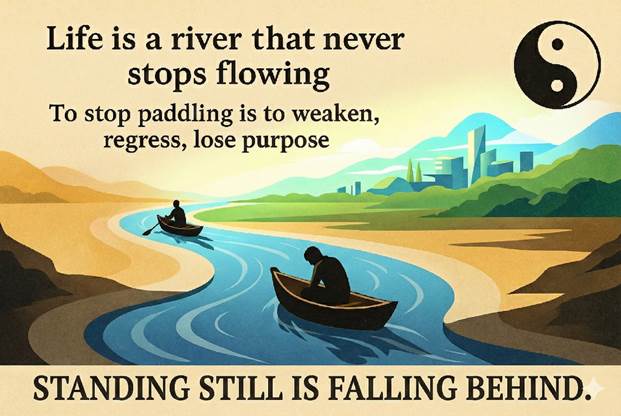
The universe is a system of ceaseless motion cosmically, biologically, psychologically, and spiritually. Nothing in existence remains static. Galaxies rotate, atoms vibrate, seasons cycle, and human bodies grow, age, and decay. To remain unchanged in such a dynamic reality is not neutrality; it is regression. This essay explores the philosophical, scientific, and spiritual foundations of this principle, arguing that choosing stagnation puts one “behind” in a world that continually evolves. Growth physically, mentally, and spiritually, is not merely beneficial but essential for aligning with the fundamental nature of existence.

The Physical Universe: Motion as a Cosmic Law
Physics confirms that stillness is an illusion. The Earth rotates on its axis at approximately 1,670 km/h (1,037 mph) and orbits the sun at nearly 107,000 km/h (66,000 mph) (Urrutia & Howell, 2025). At a deeper level, quantum mechanics reveals that particles fluctuate constantly, never truly at rest (Griffiths & Schroeter, 2018). This means that even if a person attempts to “remain still,” they exist within an environment of perpetual motion.
In Hermetic philosophy, this is reflected in the Principle of Vibration: “nothing rests; everything moves; everything vibrates” (Three Initiates, 1908/2011). Thus, when human beings choose personal stagnation, they fall out of harmony with the energetic structure of the cosmos.
Biological Reality: Stagnation Equals Decline
Human biology mirrors this universal motion. Muscles atrophy without movement. Neural pathways prune without stimulation. The body is a dynamic biochemical ecosystem in which regular movement, challenge, and adaptation maintain vitality.
Research shows that physical inactivity accelerates aging, metabolic dysregulation, and cognitive decline (Booth et al., 2017). Neuroplasticity, the brain’s ability to change, depends on continual stimulation and learning (Pascual-Leone et al., 2015). Even at the cellular level, life is characterized by turnover, repair, and transformation.
Therefore, biological systems demonstrate clearly:
If we stop engaging in life, the body does not preserve itself, it deteriorates.
Psychological Growth: The Mind Evolves or Contracts
Psychologically, stagnation leads to rigidity, fear, and diminished adaptability. Cognitive schemas or mental frameworks that guide perception, require updating as conditions change. When they are not renewed, individuals fall into outdated patterns, biases, and maladaptive behaviors (Beck, 2011).
From a developmental standpoint, humans require novelty, challenge, and reflection to maintain mental flexibility and emotional resilience (Kashdan & Rottenberg, 2010). Choosing not to grow mentally or emotionally allows entropy, or disorder and rigidity, to dominate the psyche.
In this sense, stagnation is not benign; it is an inward collapse.
Spiritual Traditions: Transformation as a Sacred Imperative
Every major spiritual and philosophical system promotes growth as a requirement for alignment with higher principles.
- Taoism emphasizes flow, transformation, and the dangers of stagnation (Laozi, trans. 2008).
- Buddhism teaches impermanence (anicca), asserting that clinging to static states causes suffering (Rahula, 1974).
- Christianity encourages believers to “be transformed by the renewing of your mind” (Romans 12:2, New International Version).
- Hermeticism describes spiritual ascent as a continual refinement from lower to higher states of being (Evola, 1995).
The classical frameworks of jing → qi → shen, along with more modern constructs of somatic calibration, iterative self-cultivation, and transmutation, reflect this same upward arc:
A human being must refine the physical, mental, and spiritual dimensions to evolve.
Dynamic Stillness vs. Passive Inertia
It is important to clarify that spiritual stillness does not contradict growth. Meditation, breathwork, and contemplative practices produce dynamic stillness: an inner clarity within movement, not an absence of movement. This stillness is alignment, not stagnation.
Passive inertia, however, is avoidance, denial, and resistance. One clarifies; the other decays.
To remain unchanged in a universe defined by motion is to drift backward. The cosmos evolves, the body transforms, and consciousness expands when nurtured. Stagnation is not a neutral state but a misalignment with the fabric of existence. Growth in the physical, mental, and spiritual, is the only path that harmonizes the human being with the ever-unfolding nature of reality. To live fully is to evolve continuously.
References:
Beck, J. S., PhD. (2011). Cognitive Behavior therapy. In Aaron T. Beck, Cognitive Behavior therapy (2nd ed.). THE GUILFORD PRESS. https://img3.reoveme.com/m/be38edbbfc79330a.pdf
Booth, F. W., Roberts, C. K., & Laye, M. J. (2017). Lack of exercise is a major cause of chronic diseases. Comprehensive Physiology, 2(2), 1143–1211. https://doi.org/10.1002/cphy.c110025
Griffiths, D. J., & Schroeter, D. F. (2018). Introduction to Quantum Mechanics. In Reed College, Reed College (Third edition). Cambridge University Press. https://api.pageplace.de/preview/DT0400.9781108103145_A45553844/preview-9781108103145_A45553844.pdf
Kashdan, T. B., & Rottenberg, J. (2010). Psychological flexibility as a fundamental component of health. Clinical Psychology Review, 30(7), 865–878. https://doi.org/10.1016/j.cpr.2010.03.001
Evola, J. (1995). The Hermetic tradition: Symbols and teachings. Inner Traditions.
Laozi. (2008). Tao Te Ching (D. C. Lau, Trans.). Penguin Classics. (Original work published ca. 4th century BCE)
Pascual-Leone, A., Amedi, A., Fregni, F., & Merabet, L. B. (2015). The plastic human brain cortex. Annual Review of Neuroscience, 28, 377–401. https://doi.org/10.1146/annurev.neuro.27.070203.144216
Rahula, W. (1974). What the Buddha taught. Grove Press. https://archive.org/details/whatbuddhataught00walp
Three Initiates. (2011). The Kybalion. Penguin. (Original work published 1908)
Urrutia, D. E., & Howell, E. (2025, February 27). How fast is Earth moving? Space. https://www.space.com/33527-how-fast-is-earth-moving.html