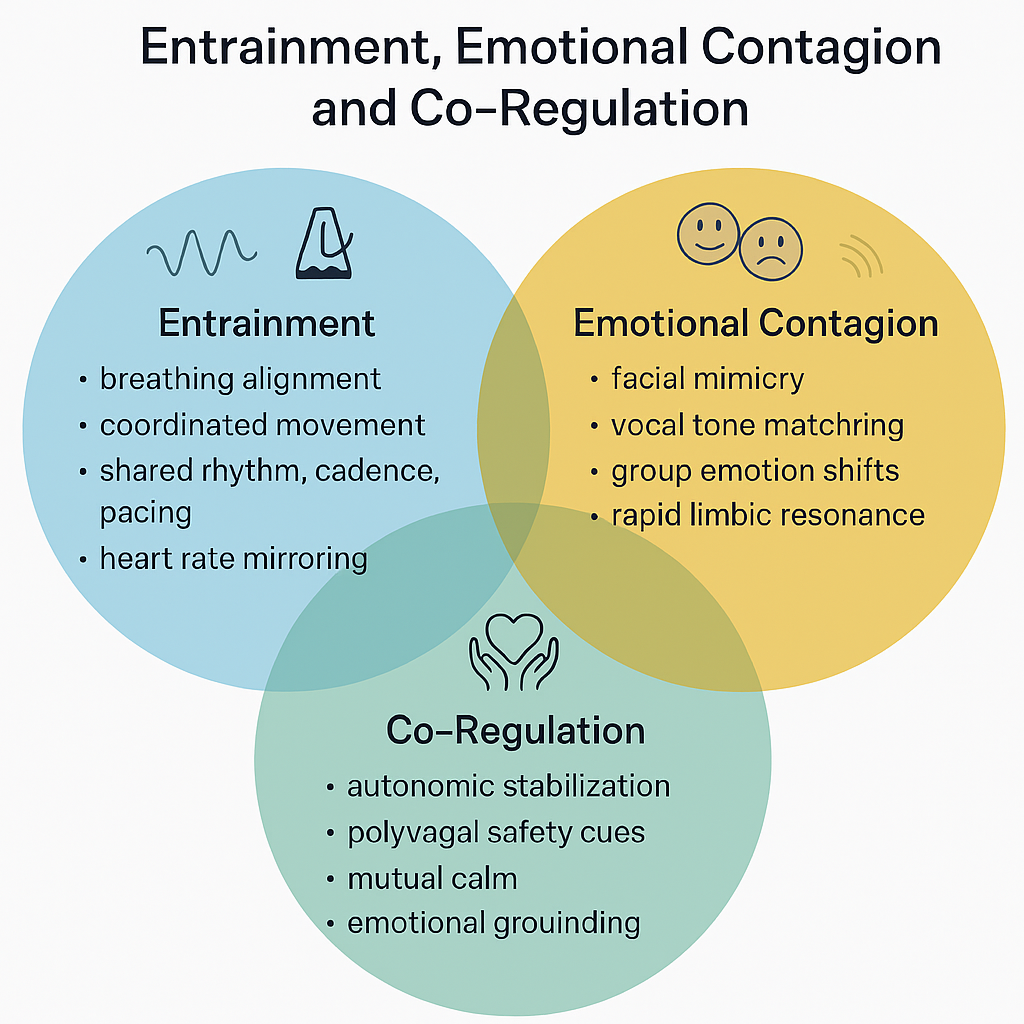
Entrainment, Emotional Contagion, and Co-Regulation
Human beings are inherently social organisms whose internal states are shaped by the people and environments around them. Modern affective neuroscience, psychology, and physiology increasingly show that when individuals share a space, their emotional expressions, nervous system activity, behavioral rhythms, and even biological oscillations begin to align. This subtle but powerful process has been described through three interconnected mechanisms: entrainment, emotional contagion, and co-regulation. Together, these processes help explain why the emotional “tone” of a room shifts when a certain person enters, how stress can spread through groups, and why calm individuals can stabilize others.
1. Entrainment: Synchronizing Rhythms and Biological Oscillations
Entrainment refers to the process by which two or more independent rhythmic systems become synchronized through interaction. Originally a physics term (Huygens’ discovery that pendulum clocks synchronize when placed near each other), entrainment is now recognized as a central phenomenon in human physiology and social behavior.
1.1 Physiological Entrainment
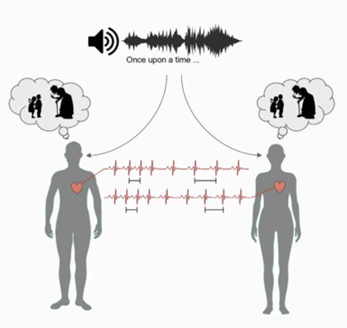
Human biological systems such as heart rate, breathing, neural oscillations, and circadian rhythms, are sensitive to the rhythms of others. When people interact, especially face-to-face, their internal states often fall into alignment. This synchronization can occur through respiration, posture, vocal patterns, or subtle movement cues.
Research shows that:
- Breathing rhythms spontaneously synchronize during shared tasks, cooperative work, or group chanting and singing (Vickhoff et al., 2013).
- Heart rate variability (HRV) and autonomic activity entrain between individuals during emotionally meaningful or coordinated interactions (Palumbo et al., 2017).
- Brainwave patterns can synchronize between people who are making eye contact, cooperating, or experiencing shared emotions (Dumas et al., 2010).
This form of entrainment provides a nonverbal channel of communication that shapes how individuals relate and how groups function.
1.2 Social and Behavioral Entrainment
Humans also entrain on behavioral levels. Vocal tone, speech pace, posture, and gestures subtly influence and mirror each other in dyadic interactions. This is often unconscious and facilitates social bonding.
Bernieri and Rosenthal (1991) found that the degree of interpersonal coordination, sometimes called “interactional synchrony,” is strongly associated with perceptions of empathy, rapport, and cooperation.
2. Emotional Contagion: The Spread of Affect Through Social Networks
While entrainment focuses on rhythmic alignment, emotional contagion describes the spread of emotional states from one person to another. It occurs rapidly, automatically, and often outside conscious awareness.
Emotional contagion works through two primary mechanisms:
2.1 Mimicry and Feedback Loops
Humans instinctively mimic facial expressions, vocal patterns, and body language. This mimicry activates mirror-neuron and limbic circuits that generate similar feelings in the observer. Hatfield, Cacioppo, and Rapson (1994) demonstrated that people unconsciously imitate emotional expressions within milliseconds, leading their own physiological state to shift toward the emotion they are observing.
This means:
- An anxious person can elevate others’ heart rates and muscle tension.
- A relaxed or smiling person can reduce group stress levels.
- A hostile or negative presence may shift the emotional climate of an entire room.
2.2 Group-Level Emotional Transmission
Emotional contagion also spreads through groups. Barsade (2002) showed that a single individual’s positive or negative mood significantly influences group cooperation, conflict, decision-making, and performance. This group-level emotional transmission occurs even when people believe they are not being influenced.
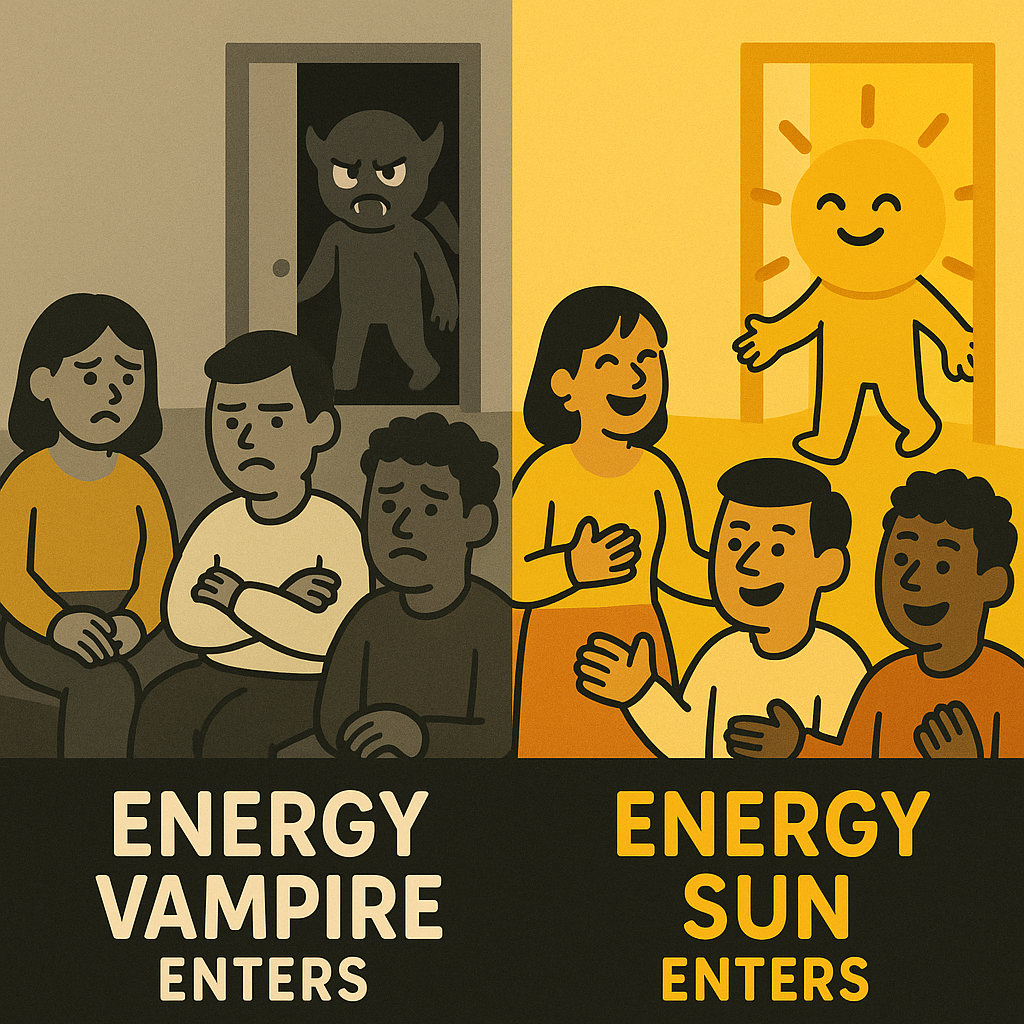
In organizational settings, research shows that leaders’ emotional expressions strongly predict team emotions, stress levels, and motivation (Sy, Côté, & Saavedra, 2005). This explains why “energy vampires” (chronically negative individuals) can drain a room, while “positive energizers” can elevate it.
3. Co-Regulation: Interpersonal Stabilization of the Nervous System
Co-regulation is a concept rooted in attachment theory and polyvagal theory. It refers to the process by which two people regulate each other’s emotional and physiological states through relational cues such as tone of voice, eye contact, posture, and presence.
3.1 The Polyvagal Basis of Co-Regulation
Stephen Porges’ polyvagal theory emphasizes that the human autonomic nervous system evolved to require social safety signals for stable functioning. According to Porges (2011), the vagus nerve and the social engagement system continuously scan the environment for threat or safety. The presence of a calm, attuned individual can activate safety pathways, lowering sympathetic arousal.
Co-regulation occurs when:
- A calm person helps another down-regulate stress.
- A dysregulated individual triggers sympathetic activation in others.
- A pair or group maintains collective stability through mutual attunement.
Parents and infants co-regulate naturally, but adults also rely on interpersonal cues to stabilize their internal states.
3.2 Co-Regulation in Adult Relationships and Groups
Siegel (2012) describes co-regulation as a cornerstone of interpersonal neurobiology: humans maintain their emotional equilibrium largely through connection with others. In group settings, such as workplaces, classrooms, or family systems, members’ nervous systems are constantly responding to each other’s cues.
Co-regulation is especially strong under conditions of:
- Shared attention
- Physical proximity
- Eye contact
- Rhythmic interaction (e.g., conversation, movement, music)
- Emotional vulnerability or resonance
This explains why certain people feel grounding and others feel destabilizing.
4. How These Processes Interact in Real-World Settings
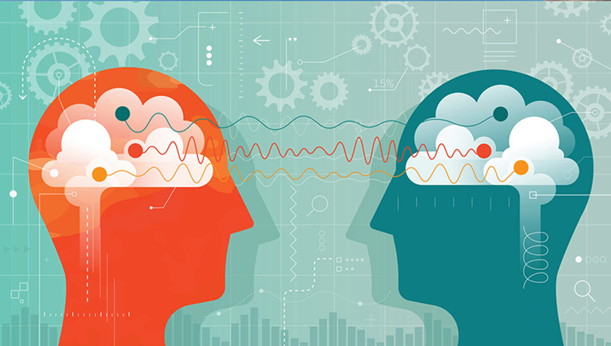
Although entrainment, emotional contagion, and co-regulation are often studied separately, in real life they operate simultaneously. When individuals enter a shared environment:
- Rhythmic patterns align (entrainment).
- Emotional expressions spread (emotional contagion).
- Autonomic states mutually regulate (co-regulation).
4.1 The Emotional Climate of a Room
Consider a meeting where one person enters feeling stressed:
- Their breathing rate and vocal tension increase.
- Others begin matching these cues (entrainment).
- Within minutes, anxiety spreads (emotional contagion).
- The group’s autonomic tone shifts toward sympathetic activation (co-regulation).
By contrast, the presence of a grounded, calm individual can entrain the group toward slower breathing and more regulated states, spreading emotional stability.
4.2 Health and Well-Being Implications
Positive co-regulation has been shown to:
- Improve stress recovery (Messina et al., 2021)
- Increase prosocial behavior.
- Enhance learning environments.
- Strengthen group cohesion and interpersonal trust.
Negative emotional contagion, conversely, is associated with:
- Increased cortisol
- Impaired cognitive performance
- Defensive communication
- Reduced social safety
Thus, the emotional composition of a room has measurable physiological consequences.
5. Implications for Leadership, Teaching, Therapy, and Everyday Life
These processes are essential to fields such as psychotherapy, education, leadership, and martial arts instruction, areas highly relevant to my own professional work.
Entrainment, Emotional Contagion and Co-regulation
| Concept | Definition | Primary Mechanisms | Physiological Effects | Social/Behavioral Outcomes |
| Entrainment | Synchronization of rhythms between people (breath, movement, heart rate, neural oscillations). | Breath alignment, shared pace, vocal rhythm, movement synchrony. | HRV alignment, respiratory matching, neural rhythm coupling. | Greater rapport, cooperation, cohesion, reduced tension. |
| Emotional Contagion | Automatic spread of emotion from one individual to another. | Facial mimicry, limbic resonance, tone matching, mirror neurons. | Shifts in cortisol, arousal, autonomic activation matching observed emotion. | Group mood shifts, leader influence effects, emotional climate changes. |
| Co-Regulation | Mutual stabilization of nervous systems through safety cues from others. | Eye contact, prosody, posture, attunement, presence. | Down-regulated sympathetic activity, increased vagal tone, calm restorative states. | Trust, emotional safety, improved learning and communication, conflict reduction. |
| Where They Overlap | All three shape interpersonal physiology and emotion. | Rhythmic, emotional, and autonomic alignment interact. | Shared arousal states; collective regulation. | A stable or unstable “room-wide” emotional atmosphere. |
5.1 Leaders and Teachers
Leaders who maintain emotional regulation can set the tone for entire groups. Research in organizational behavior demonstrates that emotionally positive leaders measurably improve team performance and resilience through emotional contagion and co-regulation (Barsade & Gibson, 2007).
5.2 Therapists and Healers
Therapists use vocal tone, body language, and attuned presence to co-regulate clients’ nervous systems. Safety cues support trauma recovery by enabling the client to access regulated autonomic states (Schore, 2021).
5.3 Everyday Relationships
Couples, friends, and families are constantly co-regulating. A dysregulated household breeds chronic stress, whereas emotionally stable members can serve as regulatory anchors for others.
Humans are wired for connection, and our nervous systems continuously respond to the rhythms, emotions, and physiological states of those around us. Entrainment allows biological rhythms to synchronize. Emotional contagion transmits affective states through mimicry and neural resonance. Co-regulation provides interpersonal stability that supports health and emotional well-being.
Understanding these processes helps explain why some individuals elevate a room while others destabilize it, why certain relationships feel grounding, and how human beings are always shaping one another even in silence. In recognizing this dynamic, people can deliberately cultivate a presence that promotes harmony, safety, and collective well-being.
References:
Barsade, S. G. (2002). The ripple effect: Emotional contagion and its influence on group behavior. Administrative Science Quarterly, 47(4), 644–675. https://doi.org/10.2307/3094912
Barsade, S. G., & Gibson, D. E. (2007). Why does affect matter in organizations? Academy of Management Perspectives, 21(1), 36–59. https://doi.org/10.5465/amp.2007.24286163
Bernieri, F. J., & Rosenthal, R. (1991). Interpersonal coordination: Behavior matching and interactional synchrony. In R. S. Feldman & B. Rimé (Eds.), Fundamentals of nonverbal behavior (pp. 401–432). Cambridge University Press.
Dumas, G., Nadel, J., Soussignan, R., Martinerie, J., & Garnero, L. (2010). Inter-brain synchronization during social interaction. PLoS ONE, 5(8), e12166. https://doi.org/10.1371/journal.pone.0012166
Hatfield, E., Cacioppo, J. T., & Rapson, R. L. (1994). Emotional contagion. Cambridge University Press.
Messina, I., Calvo, V., Mastria, S., & Harvey, A. (2021). Interpersonal emotion regulation: A review of foundational frameworks and research directions. Frontiers in Psychology, 12, 636919. https://doi.org/10.3389/fpsyg.2021.636919
Palumbo, R. V., et al. (2017). Interpersonal autonomic physiology: A systematic review of the literature. Personality and Social Psychology Review, 21(2), 99–141. https://doi.org/10.1177/1088868316628405
Porges, S. W. (2011). The polyvagal theory: Neurophysiological foundations of emotions, attachment, communication, and self-regulation. W. W. Norton.
Schore, A. N. (2021). Right brain psychotherapy. W. W. Norton.
Siegel, D. J. (2012). The developing mind: How relationships and the brain interact to shape who we are (2nd ed.). Guilford Press.
Sy, T., Côté, S., & Saavedra, R. (2005). The contagious leader: Impact of the leader’s mood on the mood of group members. Journal of Applied Psychology, 90(2), 295–305. https://doi.org/10.1037/0021-9010.90.2.295
Vickhoff, B., et al. (2013). Music structure determines heart rate variability of singers. Frontiers in Psychology, 4, 334. https://doi.org/10.3389/fpsyg.2013.00334