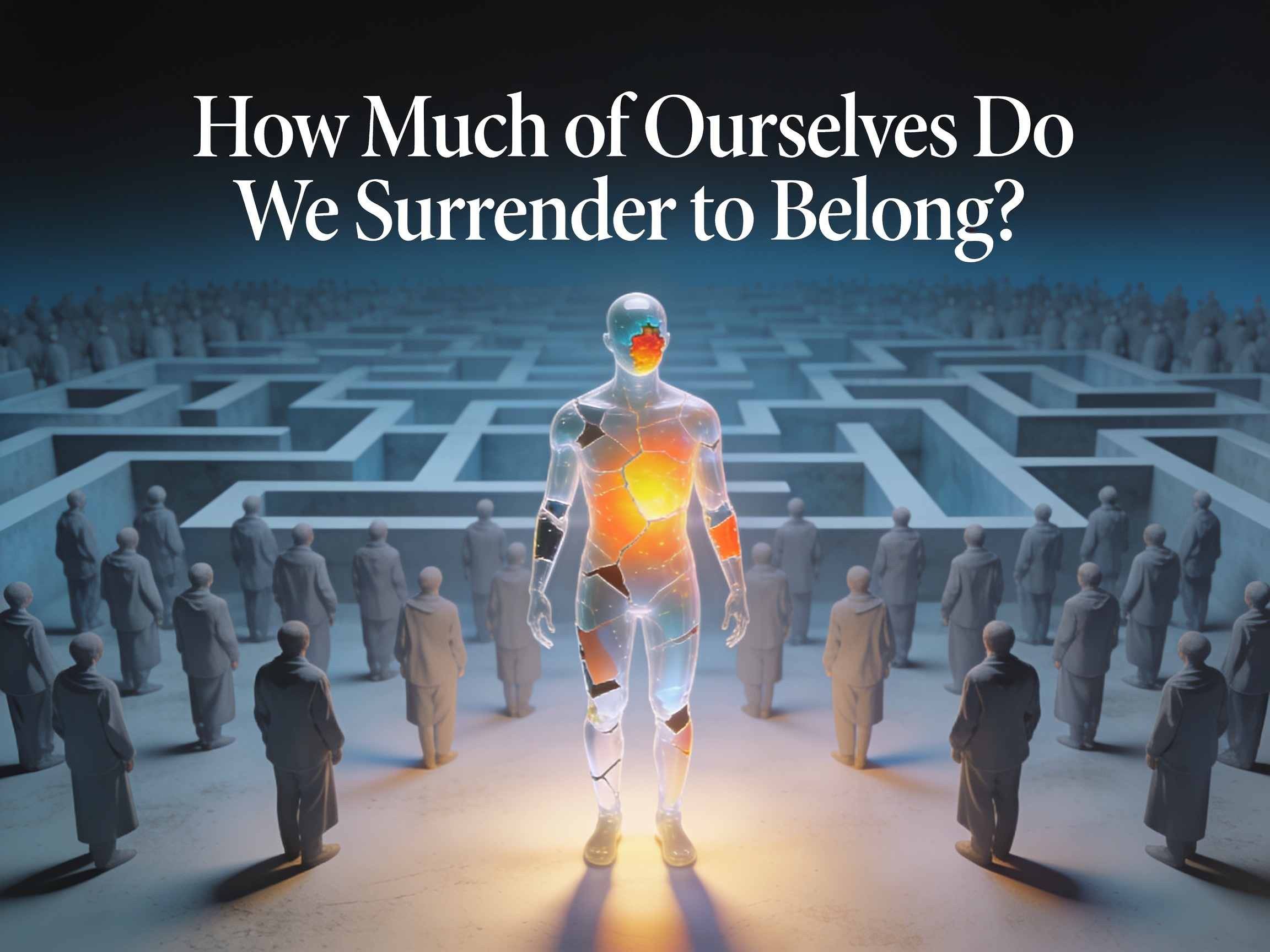
How Much of Ourselves Do We Surrender to Belong?

What is the Point? We are all going to die anyway.

Over the years, some of the wiser mentors I have known have shared a simple idea with me that has remained in the back of my mind: we should strive to earn the life we live.

I do not interpret this as meaning that we somehow have to earn the right to exist, nor do I believe our worth should be measured by how much money we make, how productive we are, or how many accomplishments we can accumulate. I understand it more as an invitation to participate fully in the life we have been given. If we are fortunate enough to wake up to another day, perhaps there is something to be said for trying to make reasonable use of it.

Hopefully, over the course of a lifetime, we can build a life containing some combination of love, meaning, purpose, contribution, friendship, family, learning, service, and perhaps even a little wisdom. We certainly will not succeed every day. There will be periods when simply getting through a difficult time is accomplishment enough. There will also be days when we need to rest, step away, or allow someone else to help us. But when viewed across the longer arc of a life, I think there is something worthwhile about trying to leave the world, or at least our small corner of it, a little better because we were here.

What Is the Point?

Every so often, I encounter someone who expresses a very different perspective. They may say something along the lines of, “What is the point? We are all going to die anyway.” Technically, they are correct.

Every person reading these words will eventually die. So will I. Every generation before us has faced the same reality, and every generation after us will face it as well. No amount of exercise, money, medicine, education, spiritual practice, healthy eating, positive thinking, or modern technology has changed that basic fact. But to me, that is exactly the point.

If our time were unlimited, there might be much less urgency to do anything meaningful with it. We could always begin tomorrow. The book could be written someday. The old friend could be called eventually. We could apologize later, tell someone we love them another time, take better care of ourselves next year, or finally begin sharing what we have learned when the timing seems more convenient.

The problem is that we do not actually know how many tomorrows we will have.

None of us knows when our last breath will occur. I do not see that realization as necessarily depressing or morbid. In fact, I think it can be quite motivating. The awareness that our time is limited can help us separate what is important from what merely consumes our attention. Research in psychology has long suggested that awareness of mortality can influence how people think about meaning, identity, relationships, and values (Greenberg et al., 1986). Other research has found that having a sense of purpose is associated with important aspects of psychological and physical well-being across adulthood (Hill & Turiano, 2014).

The objective, then, is not to become preoccupied with death. It is to become more engaged with life.

What If All of This Actually Matters?

None of us possesses absolute certainty about the ultimate meaning of existence. Philosophers, scientists, theologians, mystics, and ordinary people have debated these questions for thousands of years. We continue to wonder why we are here, whether life has some larger purpose, what happens when consciousness ends, and whether meaning is something we discover or something we create for ourselves. I certainly do not claim to know the answers to those questions.

Somewhere along the way, however, I arrived at a practical conclusion that works for me. Why not err on the positive side? What if all of “this” actually matters?

Perhaps the encouragement we give another person matters. Maybe teaching someone an exercise that improves their balance or mobility can have a positive effect. Showing someone how to slow their breathing when they are overwhelmed may help that person considerably. Sharing an experience that prevents someone else from repeating one of our mistakes may matter considerably more than we realize at the time.

A conversation might change someone’s perspective. An article might reach someone we will never meet. A book could sit on a shelf for years before eventually being opened by the person who needs what is written inside it. A video that receives relatively little attention today might someday help someone halfway around the world.

We may never know. That does not mean it did not matter.

Purpose Does Not Have to Be Grand

I think one mistake we sometimes make is assuming that purpose has to involve something enormous. The phrase “life purpose” can conjure images of changing the world, becoming famous, creating a movement, building an empire, or somehow being remembered generations after we die. Most meaningful lives probably do not look anything like that.

Purpose is often remarkably ordinary. It can be found in raising children, caring for an aging parent, teaching a class, helping a neighbor, creating something useful, sharing knowledge, volunteering in the community, mentoring someone younger, or simply being available when another human being needs someone to listen to.

Psychiatrist Viktor Frankl wrote extensively about the human search for meaning, particularly through his experiences of extraordinary suffering. His work emphasized that meaning can be found through what we create and contribute, through what we experience and whom we love, and through the attitudes we adopt toward circumstances that cannot be changed (Frankl, 2006).

I have always appreciated that perspective because it places meaning within reach of ordinary people living ordinary lives. We do not necessarily have to save humanity to live meaningfully. Sometimes we simply help the people who happen to be within our reach.

Expanding the Circle

As I have gotten older, this idea has increasingly influenced how I choose to spend my time. It manifests itself in my desire to reach more people, teach more classes, offer more perspectives, and share more of what I have learned and experienced. It is also one of the reasons I continue writing articles and books and creating videos for people whom I may never have an opportunity to meet personally.

This is not because I believe I possess all the answers. Quite the opposite. The longer I live and continue learning, the more aware I become of how much there still is to understand.

But I have accumulated experiences. I have made mistakes, changed my mind, been taught by many people, watched ideas come and go, and seen things that I once believed to be true turn out to be incomplete, exaggerated, misunderstood, or simply incorrect. At the same time, I have watched seemingly simple lessons become much more meaningful as I grew older and finally accumulated enough life experience to understand them differently. At some point I began asking myself, why keep all of that to myself?

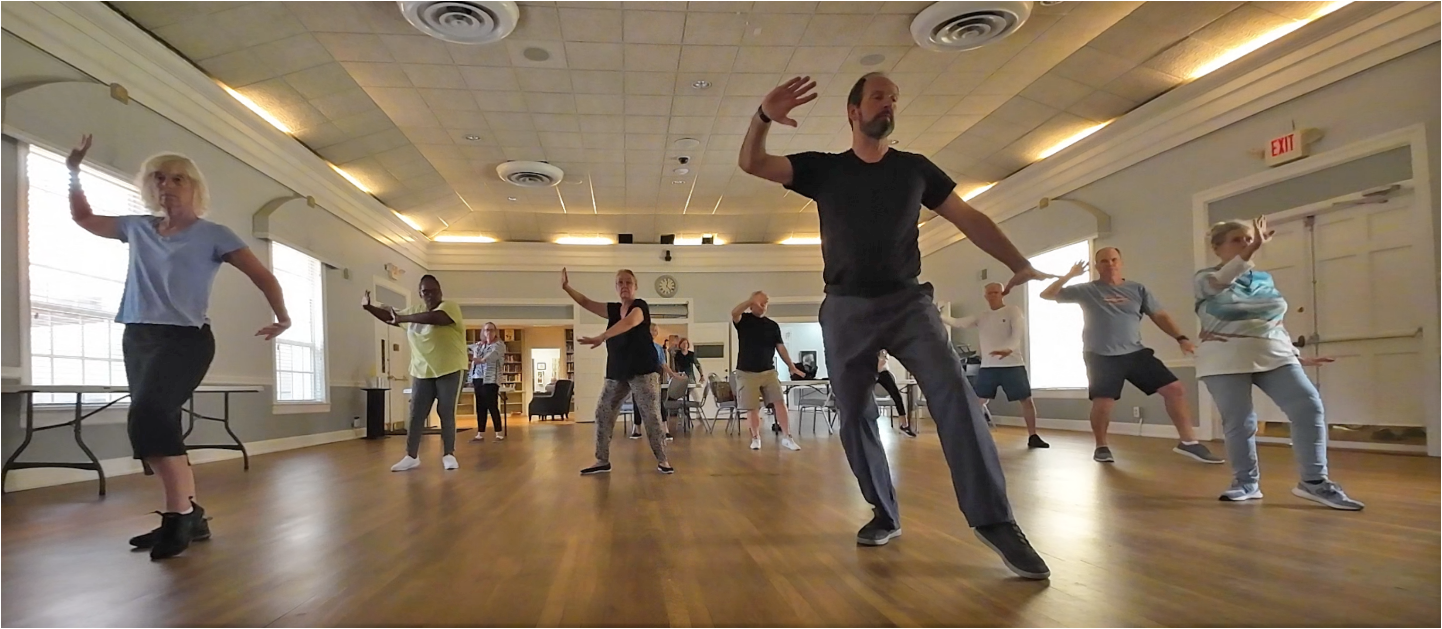
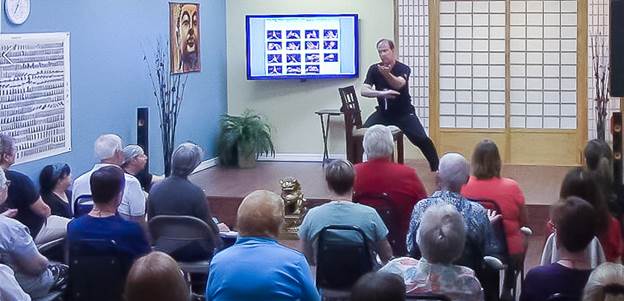
Teaching in person has always been meaningful to me because there is an immediate human connection. You can see whether someone understands what you are explaining. You can modify what you are doing, answer questions, demonstrate an exercise differently, laugh together, and watch people gradually improve. But there are obvious limitations. Any one of us can only teach so many classes, be in one room at a time, and personally interact with a limited number of people during the course of a day. Writing and modern technology extend that circle considerably.

An article can travel somewhere I cannot. A book can continue communicating an idea when I am somewhere else doing something entirely different. A video can demonstrate an exercise to someone who may never attend one of my classes. Something created today might remain available years from now.

The internet certainly has its problems, particularly in today’s cultural climate. We are surrounded by enormous amounts of information, misinformation, advertising, anger, entertainment, distraction, and increasingly shorter attention spans. Yet the same technology that spreads nonsense can also spread education, encouragement, experience, and useful ideas. The tool itself is not necessarily the problem. Much depends upon what we choose to do with it.

The Ripple Effect We Rarely See

One of the interesting things about teaching, helping, mentoring, parenting, writing, or simply interacting with other people is that we rarely get to see the full effect of what we do.

A teacher may say something that a student remembers twenty years later. A parent may offer advice that a child dismisses at twenty but suddenly understands at forty-five. Someone might read an article, think about one paragraph for several days, and quietly make a change in their life. A person might learn an exercise in a class and later teach it to a spouse, friend, child, or grandchild. The original teacher may never know any of this occurred.

This is worth remembering because we increasingly live in a world where influence is measured through visible numbers. We count attendance, sales, views, likes, subscribers, comments, followers, income, and recognition. Those measurements have their place, but they cannot possibly measure every form of human influence.

Research on generativity, a concept strongly associated with Erik Erikson’s theory of adult development, describes the human desire to contribute to and guide future generations. Generativity can take many forms, including parenting, mentoring, teaching, leadership, creativity, and community involvement (McAdams & de St. Aubin, 1992).

I find that concept increasingly meaningful as the years pass. At some point, the question can gradually shift from “What can I accumulate?” toward “What can I contribute?” That is a very different way of looking at one’s remaining time.

Earning the Day

Perhaps the idea of “earning the life we live” sounds too ambitious when considered across an entire lifetime. I sometimes find it more useful to reduce the scale and simply think about earning the day.

That does not require accomplishing something extraordinary every twenty-four hours. It might simply mean learning something, helping someone, taking reasonable care of ourselves, appreciating the people around us, creating something rather than merely consuming, or contributing in some small way to the lives of the people we encounter.

Obviously, every day will not look like this. There are days for rest and recovery. There are days when our own problems require most of our attention. There are times when we need other people far more than they need us. This is part of being human. But there is an important difference between allowing ourselves to rest and deciding that nothing matters because everything eventually ends.

A beautiful meal, a great conversation, a vacation, a class, a sunset, childhood and careers end. Relationships eventually end, whether through circumstances, separation, or death. Human life itself eventually ends. Something does not become meaningless simply because it is temporary. In fact, I would argue that its temporary nature may be exactly what gives it value.

If we had an unlimited number of sunsets, years with the people we love, opportunities to repair relationships, time to learn, and unlimited opportunities to say what needs to be said, perhaps we would appreciate these things far less.

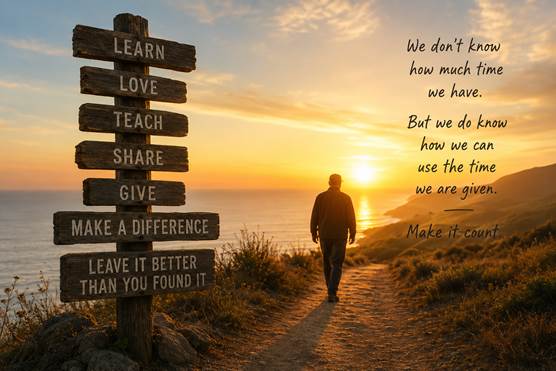
Scarcity creates value in many areas of life. Time may be the greatest example of all.

Until the Last Breath

None of us knows how much time remains. Hopefully, there are many years ahead, but there are no guarantees. That reality encourages me to continue doing what I can while I can.

There are still classes I would like to teach, ideas I want to explore, articles I want to write, books I hope to complete, videos I would like to create, people I have yet to meet, and perspectives that I will probably continue changing as I learn more. There are also lessons accumulated over a lifetime that might be useful to someone else, even if I never know who that person is.

Will all of it matter? I cannot prove that it will. But neither can anyone prove that it will not.

Given those two possibilities, I choose to err on the positive side. I would rather live as though kindness, teaching, learning, sharing experiences, taking care of ourselves, helping other people, and loving people matters.

I would rather believe that something we create today might continue helping someone after we are no longer here to explain why we created it. Someday, like everyone else who has walked this earth, I will take my last breath. Between this breath and that final one lies whatever amount of life remains. I would prefer to use as much of it as reasonably possible.

Perhaps I will never know how far the ripples will travel. Perhaps none of us does. But I think there is something worthwhile about continuing to throw a few stones into the water. And perhaps that is part of what it means to earn the life we live.

References

Frankl, V. E. (2006). Man’s search for meaning. Beacon Press. (Original work published 1946)

Greenberg, J., Pyszczynski, T., & Solomon, S. (1986). The causes and consequences of a need for self-esteem: A terror management theory. In R. F. Baumeister (Ed.), Public self and private self (pp. 189–212). Springer.

Hill, P. L., & Turiano, N. A. (2014). Purpose in life as a predictor of mortality across adulthood. Psychological Science, 25(7), 1482–1486.

McAdams, D. P., & de St. Aubin, E. (1992). A theory of generativity and its assessment through self-report, behavioral acts, and narrative themes in autobiography. Journal of Personality and Social Psychology, 62(6), 1003–1015.

Teukgi  –  Finding Your Specialty in the Martial Arts

Over many years of martial arts training, we encounter words and concepts that sometimes remain with us long after we have forgotten exactly where we first heard them. Some are philosophical ideas, while others are practical terms used by instructors to describe what they were seeing in our training. One such term that I remember hearing sounded something like “tiki.” It was used to describe a practitioner’s specialty, forte, or the particular skill that person had become especially good at.

After looking more closely at the Korean language, I believe the term was most likely teukgi, written in Korean as 특기 and with the Chinese characters 特技. The Korean Basic Dictionary translates teukgi as “specialty” or “one’s skill,” referring to a special skill or talent that distinguishes someone from others (National Institute of Korean Language, n.d.). The word combines teuk (特), meaning special or distinctive, with gi (技), referring to skill, technique, or ability. Although teukgi is not exclusively a martial arts term, I find the concept particularly useful when considering how martial artists develop over many years of practice.

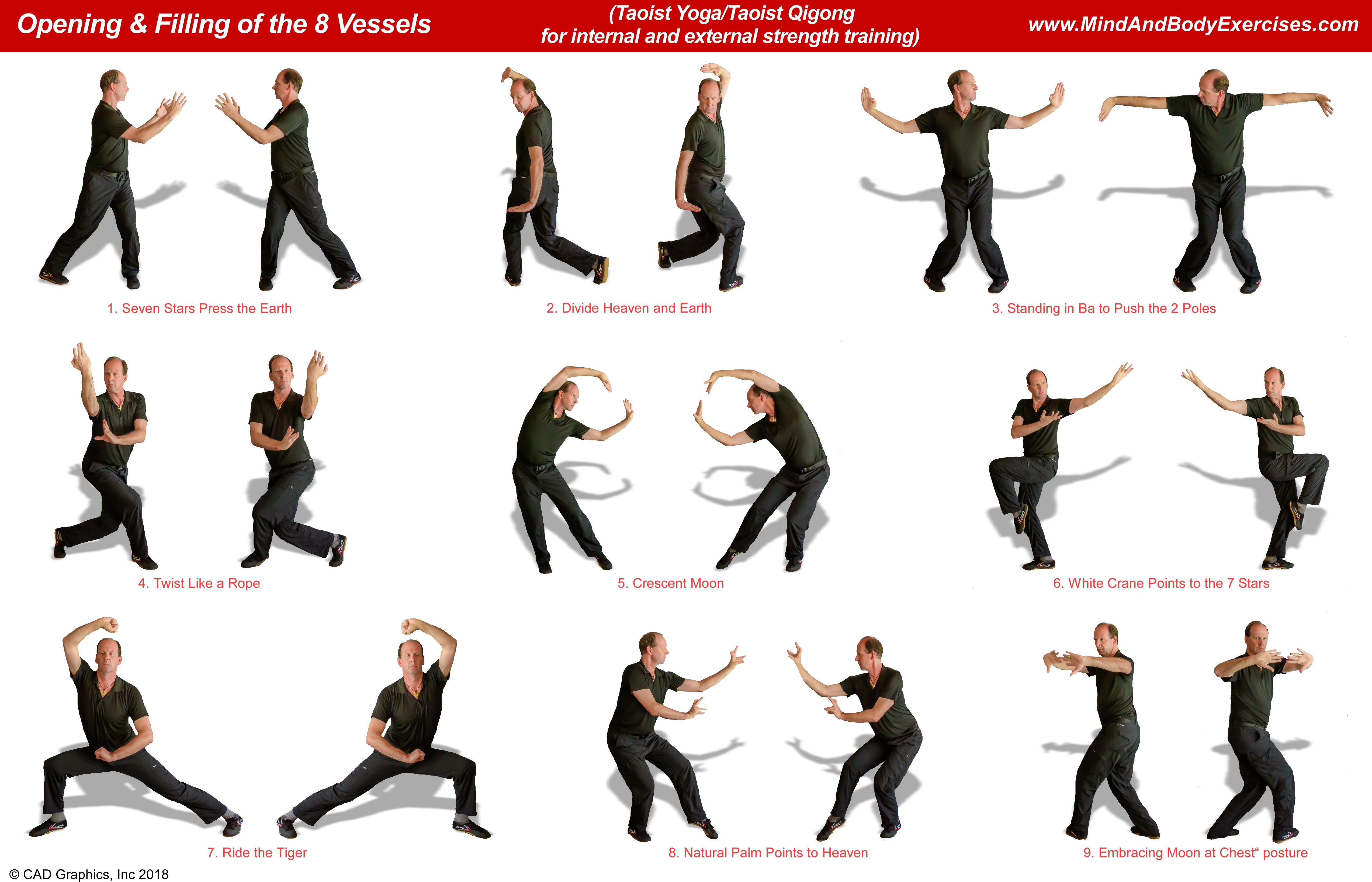
Most martial artists begin their training by accumulating information. We learn stances, punches, kicks, blocks, throws, joint locks, forms, breathing methods, conditioning exercises, and various methods of self-defense. Depending upon the system, we might also learn weapons, meditation, internal exercises, or other traditional practices. This accumulation is necessary because we first need exposure to different methods before discovering which ones suit us particularly well. The mistake is assuming that continued accumulation always represents continued advancement.

There can be a tendency in martial arts to measure progress by how many techniques, forms, weapons, or systems someone knows. Yet there is an important difference between being familiar with a technique and developing the ability to perform it effectively. I can show someone the mechanics of a particular kick in a relatively short period of time. They may understand where to place the supporting foot, how to rotate the hip, how to maintain balance, and where the intended target might be. They now understand the technique, but that does not necessarily mean they have developed the skill.

After hundreds or thousands of repetitions, something begins to change. The movement becomes smoother, unnecessary tension diminishes, balance improves, and timing becomes more natural. The practitioner no longer has to consciously think about every component of the movement. What began as something they were trying to remember gradually becomes something their body has learned through experience. This is where teukgi begins to make sense in a martial arts setting. A specialty is not necessarily the technique we know the most about or the one that looks the most impressive. It may simply be something we have practiced so consistently and understood so thoroughly that it has become particularly reliable.

We Are Not All Built the Same

One of the lessons that becomes increasingly apparent after decades of training is that people are different. We have different body structures, flexibility, strength, speed, personalities, injuries, experiences, and ways of processing information. It would therefore be unrealistic to expect every practitioner to develop exactly the same abilities to exactly the same degree.

A tall practitioner with long legs may naturally gravitate toward certain kicking techniques, while a shorter or heavier practitioner may become particularly effective at close-range techniques, throwing, or controlling another person’s center of gravity. Someone with exceptional coordination may become skilled with weapons, while another person may develop an unusual sensitivity for timing, distance, or redirecting force. Even students who begin in the same school, practice the same curriculum, and learn from the same instructor will eventually develop somewhat differently.

In the early stages of training, imitation is necessary. We watch the teacher’s posture, movement, timing, and technique and attempt to reproduce what we see. Those fundamentals provide a common foundation, but advanced practitioners should not necessarily become identical copies of their instructors. Eventually, martial arts becomes personal. A good instructor recognizes this and helps students develop their natural strengths while continuing to address their weaknesses. One student may demonstrate exceptional footwork, another may generate considerable power at close range, and someone else may have an intuitive understanding of throwing, locking, or controlling techniques.

This is also why I do not believe a teukgi should be chosen too quickly. A beginning student may say that kicking is their specialty simply because they enjoy kicking. Enjoyment certainly matters, but a genuine specialty usually reveals itself through experience. Sometimes our instructors may recognize it before we do. With enough time and repetition, certain methods simply begin to fit the practitioner better than others.

Breadth Versus Depth

There is nothing wrong with learning new material. Curiosity is one of the things that can keep martial arts interesting throughout a lifetime, and exposure to different instructors and systems can broaden our understanding. The problem arises when searching for something new begins replacing the deeper practice of what we already know.

Modern martial artists have access to an extraordinary amount of information. Seminars, instructional videos, online courses, books, social media, and teachers from around the world are available in ways that would have been unimaginable when many of us began training. This can be tremendously valuable, but it can also create the impression that the next piece of information is always the one we are missing. There is always another form to learn, another seminar to attend, another weapon to study, another instructor to follow, or another supposedly advanced technique waiting around the corner.

Some practitioners can spend years moving from one source of information to another without spending enough time with what they have already learned to become truly proficient. At some point, it becomes useful to ask whether we are simply learning more or actually becoming better. Perhaps instead of continually asking, “What else can I learn?” we occasionally need to ask, “What have I already learned that deserves another thousand repetitions?”

This does not mean closing ourselves off from new knowledge. Breadth and depth can coexist. The experienced practitioner can remain curious while recognizing that genuine skill usually requires staying with something long enough to move beyond the initial excitement of learning it. Repetition eventually begins revealing details that were invisible when the technique was new.

When a Specialty Becomes a Personal Method

As a practitioner becomes more experienced, teukgi may evolve beyond one particular technique. Someone may initially think of their specialty as a certain kick, throw, strike, or weapon. Over time, however, the deeper specialty may turn out to be something more fundamental. A practitioner who has developed exceptional footwork may begin using that ability throughout almost everything they do. Someone whose strength is sensitivity may become particularly skilled at feeling and redirecting force. Another practitioner may develop an unusual ability to control distance, while someone else becomes especially good at generating power through relatively small movements.

At that point, the specialty is no longer simply “my best kick” or “my favorite throw.” It begins influencing the person’s entire approach to martial arts. This may help explain why highly experienced martial artists often appear to do less rather than more. Their movements can become simpler because they have discovered what works particularly well for them. They no longer need to demonstrate everything they know or search through a mental catalog of techniques. A smaller number of principles and methods have been practiced deeply enough to become dependable.

There is a certain economy in that kind of skill. A less experienced practitioner may know numerous possible responses to a situation and hesitate while deciding which one to use. The experienced practitioner may rely upon only a few preferred responses, but those responses have been practiced so thoroughly that they emerge naturally. Rather than representing a limitation, this kind of simplicity can represent refinement.

Teukgi Over a Lifetime

Another aspect of teukgi that interests me is that our specialty does not necessarily remain the same throughout our lives. What works exceptionally well for us at twenty-five may not be what we rely upon at sixty-five. Age, injuries, experience, and changes in our priorities inevitably influence how we train. A younger practitioner may develop a reputation for explosive kicking or athletic movement, while years later that same individual may become particularly skilled at timing, positioning, or controlling distance. Someone who once relied heavily upon muscular strength may eventually discover that structure, relaxation, leverage, and sensitivity can accomplish many of the same tasks with considerably less effort.

This should not automatically be viewed as losing ability. In many cases, it represents a deeper understanding of what is actually necessary. Perhaps this is one of the advantages of viewing martial arts as a lifelong practice rather than something limited to our physical prime. Our bodies change, but our experience continues accumulating. We may lose some attributes while developing others. Speed may diminish somewhat while timing improves. Explosive strength may decrease while efficiency increases. Our teukgi can mature along with us.

The Korean word teukgi may simply mean a special skill, specialty, or particular talent in ordinary conversation, but within martial arts I believe it provides a useful way of thinking about long-term development. We begin by learning broadly because we need a foundation. Over time, experience begins showing us which methods fit our bodies, personalities, and circumstances particularly well. Through repetition, some of those methods become increasingly natural and reliable.

We should certainly continue learning. Curiosity keeps the mind open and prevents training from becoming stagnant. But there is also a time to stop collecting long enough to cultivate what we already possess. Martial arts development is not measured solely by the amount of information we accumulate. At some point, depth matters as much as breadth, and perhaps even more.

After many years of practice, the question may no longer be, “How many techniques do I know?” Instead, we might ask, “What can I actually do well, and what have I practiced deeply enough that it has truly become part of me?” Somewhere within the answer to those questions, we may discover our own teukgi.

References

National Institute of Korean Language. (n.d.). 특기 (特技). Korean Basic Dictionary. https://krdict.korean.go.kr/eng/dicSearch/SearchView?ParaWordNo=82981&nation=eng

Moments of Enlightenment – When the Light Comes On

The word enlightenment carries a great deal of weight. For some people, it brings to mind Buddhist monks meditating for decades in monasteries, spiritual masters living apart from society, or philosophers and sages who have somehow reached a level of understanding beyond that of the average person. In our modern culture, however, the word is also used much more casually. Someone may describe becoming enlightened after discovering a new philosophy, surviving a difficult period of life, traveling to another culture, studying under a particular teacher, or suddenly seeing something from an entirely different perspective.

The problem is that enlightenment is not something that can easily be measured or verified. There is no blood test for enlightenment. There is no brain scan that can definitively determine that someone has crossed a particular threshold. There is no universally recognized certificate stating that a person has successfully completed the requirements and is now officially enlightened. Perhaps that is part of the problem with the way we sometimes think about it.

Over many years, I have been around individuals who appeared to possess considerably more wisdom, awareness, patience, or insight than others. Some were teachers. Some were martial artists. Some were involved in Eastern philosophy or contemplative practices. Others were simply people who had accumulated a great deal of life experience and, more importantly, had apparently learned something from those experiences. Interestingly, some of the wisest people I have encountered were also among the least likely to describe themselves as enlightened.

What several of these people shared with me over the years was a somewhat different way of looking at enlightenment. Rather than viewing it as a permanent destination that someone eventually reaches, they viewed enlightenment as something that can occur temporarily and repeatedly throughout one’s lifetime. I have come to appreciate this perspective more and more as I have grown older.

We often speak about enlightenment as though it were a place. Someone searches for enlightenment, reaches enlightenment, or becomes enlightened. The language itself suggests a destination. Once the traveler arrives, presumably the journey is complete. But human beings do not seem to function that way.

We can be remarkably insightful about one aspect of our lives and surprisingly unaware about another. We can understand something clearly today and become confused about it tomorrow. We can give excellent advice to someone else while failing to recognize the exact same problem occurring within ourselves. We can spend decades studying a subject and then suddenly realize that something we had believed for years was incomplete or perhaps even incorrect.

Perhaps enlightenment, then, is better understood not entirely as something we are, but as something we occasionally experience.

Psychologists have studied what are sometimes called insight experiences, those sudden moments when a previously confusing problem or situation becomes understandable. The familiar “Aha!” experience can involve a rapid restructuring of how we perceive something, producing the feeling that an answer has suddenly become obvious even though it had been hidden only moments before (Kounios & Beeman, 2014).

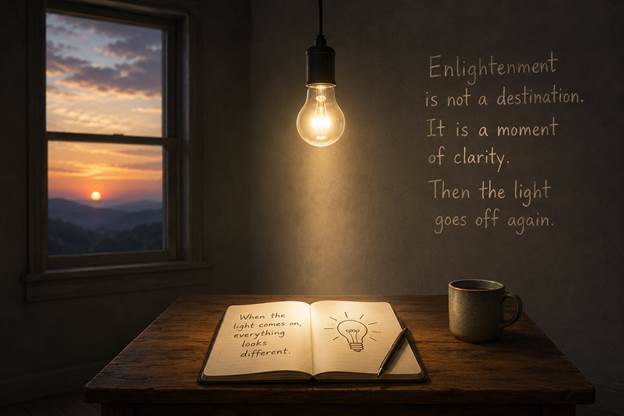
Most of us have experienced something similar, and I prefer the simple analogy of walking into a dark room and turning on a light. Before turning on the light, everything in the room was already there. The doors, windows, tables, chairs, and other objects existed whether we could see them or not. Turning on the light did not create anything. It simply allowed us to perceive what had previously been hidden by darkness.

Sometimes understanding works much the same way. Suddenly we see something that we did not see before. We might wonder how we could have missed something that now seems so obvious. The information may have been available to us for years, but for whatever reason we were not yet capable of seeing it from that particular perspective. We often call these “lightbulb moments.” Perhaps, at least temporarily, we might also call them moments of enlightenment.

There is another part of this analogy that I find equally important. The light does not necessarily stay on. Someone can have a profound realization during meditation, while practicing tai chi or qigong, walking through nature, recovering from an illness, traveling, losing someone they love, becoming a parent or grandparent, reading a book, talking with a friend, or simply sitting quietly and thinking. For a moment, something becomes remarkably clear. Then everyday life returns.

The bills still need to be paid. Someone cuts us off in traffic. Our body hurts. We become impatient with another person. We worry about tomorrow. Someone challenges one of our beliefs and we immediately become defensive. The supposedly enlightened human being suddenly looks remarkably human again. This does not necessarily invalidate the earlier experience. It may simply demonstrate that insight and wisdom are not always permanent states.

Even contemplative traditions that place great importance on awakening frequently emphasize continued practice rather than treating insight as permission to stop learning. Buddhist traditions themselves contain numerous interpretations of awakening and enlightenment, and they do not all describe the process in precisely the same way (Gethin, 1998). This alone should make us somewhat cautious about declaring exactly what enlightenment must look like.

Perhaps there is another possibility worth considering. As people become more curious, observant, reflective, and willing to question their own assumptions, these moments may begin occurring more frequently. Experience itself does not automatically produce wisdom. Someone can repeat the same mistake for forty years and simply become very experienced at making the same mistake. Reflection matters.

Psychological research distinguishes between merely accumulating experiences and developing wisdom through the way those experiences are interpreted. Wisdom has been associated with qualities such as reflection, compassion, emotional regulation, tolerance for uncertainty, and the ability to recognize multiple perspectives (Ardelt, 2003; Grossmann et al., 2020). Knowledge tells us things. Experience exposes us to things. Reflection helps us understand what those things might mean. Wisdom may gradually emerge from the interaction of all three.

This may explain why certain experiences that seemed insignificant when we were younger suddenly make sense decades later. The information did not necessarily change. We changed. Sometimes I think wisdom involves repeatedly walking through the same room and discovering another light switch.

There is also an interesting paradox that comes with all of this. The moment someone announces that they have become enlightened, I tend to become somewhat cautious. Claims of extraordinary wisdom or spiritual attainment can create authority. If other people accept that an individual possesses knowledge, awareness, or consciousness beyond their own, questioning that person can become increasingly difficult. This can be particularly relevant within spiritual communities, martial arts organizations, wellness movements, philosophical schools, and other groups built around respected or charismatic teachers.

A teacher may indeed possess extraordinary knowledge in certain areas. That does not mean that person possesses extraordinary knowledge in every area. Expertise is not omniscience. Wisdom is not infallibility. And enlightenment, however we choose to define it, should probably not provide immunity from reasonable questions.

There is even a psychological problem that can occur when we begin believing that we have finally figured everything out. Human beings remain vulnerable to confirmation bias, overconfidence, motivated reasoning, and numerous other cognitive tendencies that influence how we interpret information (Kahneman, 2011). Years of study do not necessarily make these tendencies disappear.

Ironically, believing ourselves to be permanently enlightened could become another obstacle preventing us from seeing what remains hidden. Perhaps one characteristic of wisdom is recognizing just how much remains unknown. This brings me back to another question that has always interested me. Who gets to decide what qualifies as enlightenment?

One person’s profound spiritual revelation may seem perfectly ordinary to someone else. A person may experience an overwhelming realization that everything in nature is interconnected. A biologist or ecologist might respond that ecosystems have demonstrated interdependence all along. Someone may suddenly realize that possessions do not create lasting happiness, while a philosopher may have reached that conclusion decades earlier. Someone else may discover through meditation that thoughts arise and disappear without necessarily requiring action, while a psychologist familiar with mindfulness may consider this a well-established observation. Does the fact that someone else already understands something make another person’s realization less meaningful? I do not think so.

Understanding is personal. Knowing something intellectually and realizing it through experience are not necessarily the same thing. We can tell someone for years that life is temporary. They understand the words. They may even agree with them. Then someone close to them dies, they survive a serious accident, their children grow up and leave home, they retire from a lifelong career, or they suddenly recognize their own aging in the mirror. The words have not changed. Their understanding has. The light came on.

This is perhaps why one person’s nirvana may be another person’s typical Tuesday afternoon. What is profound to one person may seem obvious to another because we are all arriving at these realizations from different starting points. We carry different experiences, different beliefs, different educations, different cultures, different hardships, and different levels of awareness. Perhaps we also make enlightenment unnecessarily exotic.

Maybe enlightenment does not always require mountaintops, monasteries, gurus, secret teachings, or decades of esoteric study. Perhaps some of our most meaningful moments of enlightenment occur while washing dishes, teaching a class, walking through the woods, talking with our children, practicing a familiar exercise, sitting beside someone who is dying, traveling through an unfamiliar country, or simply recognizing that something we believed for many years was incorrect. That last example may be particularly important. There is a certain freedom in being able to say, “I was wrong.”

That simple statement may represent a greater degree of awareness than defending an old belief simply because we have invested years of our lives in it. Real learning frequently requires revising our existing understanding rather than merely adding more information to what we already believe. Sometimes growth occurs because we discover something new. At other times, growth occurs because we finally become willing to let go of something old. Both can turn on another light.

After decades of studying martial arts, Eastern philosophy, mind-body practices, holistic health, psychology, and simply observing people, I have become increasingly comfortable with the possibility that enlightenment may not be an all-or-nothing condition. Perhaps we do not become enlightened once and remain that way forever. Perhaps we become enlightened for a few seconds. Maybe for several minutes. Occasionally perhaps for an afternoon, or during some particularly meaningful period of our lives. Then we return to being ordinary human beings again, carrying our habits, emotions, assumptions, strengths, weaknesses, and unfinished business along with us. Over time, however, perhaps the lights begin coming on more frequently.

Through practice, reflection, curiosity, humility, experience, and a willingness to reconsider what we think we already know, we may begin noticing things that were previously hidden from us. The room becomes brighter. Then we discover another room. And perhaps another after that. Eventually we may realize that there was never going to be a final room where all of the answers were waiting for us.

I find something encouraging about this way of looking at enlightenment. It makes enlightenment less of a trophy reserved for a select few and more of an ongoing human possibility. We do not need to prove that we have reached some ultimate state of consciousness. We do not need to convince others that we possess secret knowledge. We simply need to remain receptive enough to recognize those moments when something becomes clearer than it was before. Maybe that is enough.

The universe, nature, society, relationships, our bodies, and our own minds seem to provide endless opportunities for observation, learning, questioning, and reconsideration. Some of those opportunities are dramatic. Most are probably quite ordinary. Many may pass directly in front of us without our ever recognizing them.

The challenge may simply be remaining open enough to notice when another light comes on. And perhaps there is a final paradox in all of this. The more lights we turn on, the more clearly we may see just how much remains in the dark.

References

Ardelt, M. (2003). Empirical assessment of a three-dimensional wisdom scale. Research on Aging, 25(3), 275–324. https://doi.org/10.1177/0164027503025003004

Gethin, R. (1998). The foundations of Buddhism. Oxford University Press.

Grossmann, I., Weststrate, N. M., Ardelt, M., Brienza, J. P., Dong, M., Ferrari, M., Fournier, M. A., Hu, C. S., Nusbaum, H. C., & Vervaeke, J. (2020). The science of wisdom in a polarized world: Knowns and unknowns. Psychological Inquiry, 31(2), 103–133. https://doi.org/10.1080/1047840X.2020.1750917

Kahneman, D. (2011). Thinking, fast and slow. Farrar, Straus and Giroux.

Kounios, J., & Beeman, M. (2014). The cognitive neuroscience of insight. Annual Review of Psychology, 65, 71–93. https://doi.org/10.1146/annurev-psych-010213-115154