The word enlightenment carries a great deal of weight. For some people, it brings to mind Buddhist monks meditating for decades in monasteries, spiritual masters living apart from society, or philosophers and sages who have somehow reached a level of understanding beyond that of the average person. In our modern culture, however, the word is also used much more casually. Someone may describe becoming enlightened after discovering a new philosophy, surviving a difficult period of life, traveling to another culture, studying under a particular teacher, or suddenly seeing something from an entirely different perspective.
The problem is that enlightenment is not something that can easily be measured or verified. There is no blood test for enlightenment. There is no brain scan that can definitively determine that someone has crossed a particular threshold. There is no universally recognized certificate stating that a person has successfully completed the requirements and is now officially enlightened. Perhaps that is part of the problem with the way we sometimes think about it.
Over many years, I have been around individuals who appeared to possess considerably more wisdom, awareness, patience, or insight than others. Some were teachers. Some were martial artists. Some were involved in Eastern philosophy or contemplative practices. Others were simply people who had accumulated a great deal of life experience and, more importantly, had apparently learned something from those experiences. Interestingly, some of the wisest people I have encountered were also among the least likely to describe themselves as enlightened.
What several of these people shared with me over the years was a somewhat different way of looking at enlightenment. Rather than viewing it as a permanent destination that someone eventually reaches, they viewed enlightenment as something that can occur temporarily and repeatedly throughout one’s lifetime. I have come to appreciate this perspective more and more as I have grown older.
We often speak about enlightenment as though it were a place. Someone searches for enlightenment, reaches enlightenment, or becomes enlightened. The language itself suggests a destination. Once the traveler arrives, presumably the journey is complete. But human beings do not seem to function that way.
We can be remarkably insightful about one aspect of our lives and surprisingly unaware about another. We can understand something clearly today and become confused about it tomorrow. We can give excellent advice to someone else while failing to recognize the exact same problem occurring within ourselves. We can spend decades studying a subject and then suddenly realize that something we had believed for years was incomplete or perhaps even incorrect.
Perhaps enlightenment, then, is better understood not entirely as something we are, but as something we occasionally experience.
Psychologists have studied what are sometimes called insight experiences, those sudden moments when a previously confusing problem or situation becomes understandable. The familiar “Aha!” experience can involve a rapid restructuring of how we perceive something, producing the feeling that an answer has suddenly become obvious even though it had been hidden only moments before (Kounios & Beeman, 2014).
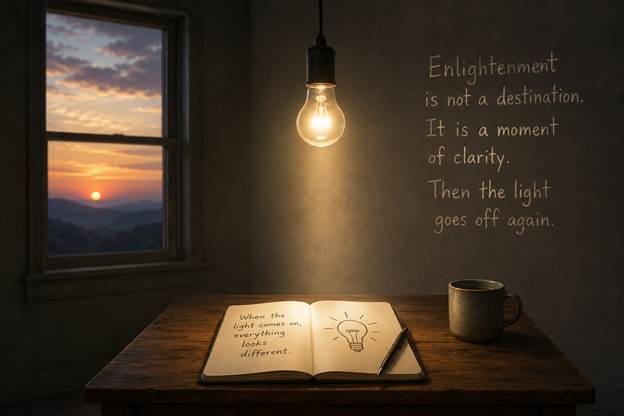
Most of us have experienced something similar, and I prefer the simple analogy of walking into a dark room and turning on a light. Before turning on the light, everything in the room was already there. The doors, windows, tables, chairs, and other objects existed whether we could see them or not. Turning on the light did not create anything. It simply allowed us to perceive what had previously been hidden by darkness.
Sometimes understanding works much the same way. Suddenly we see something that we did not see before. We might wonder how we could have missed something that now seems so obvious. The information may have been available to us for years, but for whatever reason we were not yet capable of seeing it from that particular perspective. We often call these “lightbulb moments.” Perhaps, at least temporarily, we might also call them moments of enlightenment.
There is another part of this analogy that I find equally important. The light does not necessarily stay on. Someone can have a profound realization during meditation, while practicing tai chi or qigong, walking through nature, recovering from an illness, traveling, losing someone they love, becoming a parent or grandparent, reading a book, talking with a friend, or simply sitting quietly and thinking. For a moment, something becomes remarkably clear. Then everyday life returns.
The bills still need to be paid. Someone cuts us off in traffic. Our body hurts. We become impatient with another person. We worry about tomorrow. Someone challenges one of our beliefs and we immediately become defensive. The supposedly enlightened human being suddenly looks remarkably human again. This does not necessarily invalidate the earlier experience. It may simply demonstrate that insight and wisdom are not always permanent states.
Even contemplative traditions that place great importance on awakening frequently emphasize continued practice rather than treating insight as permission to stop learning. Buddhist traditions themselves contain numerous interpretations of awakening and enlightenment, and they do not all describe the process in precisely the same way (Gethin, 1998). This alone should make us somewhat cautious about declaring exactly what enlightenment must look like.
Perhaps there is another possibility worth considering. As people become more curious, observant, reflective, and willing to question their own assumptions, these moments may begin occurring more frequently. Experience itself does not automatically produce wisdom. Someone can repeat the same mistake for forty years and simply become very experienced at making the same mistake. Reflection matters.
Psychological research distinguishes between merely accumulating experiences and developing wisdom through the way those experiences are interpreted. Wisdom has been associated with qualities such as reflection, compassion, emotional regulation, tolerance for uncertainty, and the ability to recognize multiple perspectives (Ardelt, 2003; Grossmann et al., 2020). Knowledge tells us things. Experience exposes us to things. Reflection helps us understand what those things might mean. Wisdom may gradually emerge from the interaction of all three.
This may explain why certain experiences that seemed insignificant when we were younger suddenly make sense decades later. The information did not necessarily change. We changed. Sometimes I think wisdom involves repeatedly walking through the same room and discovering another light switch.
There is also an interesting paradox that comes with all of this. The moment someone announces that they have become enlightened, I tend to become somewhat cautious. Claims of extraordinary wisdom or spiritual attainment can create authority. If other people accept that an individual possesses knowledge, awareness, or consciousness beyond their own, questioning that person can become increasingly difficult. This can be particularly relevant within spiritual communities, martial arts organizations, wellness movements, philosophical schools, and other groups built around respected or charismatic teachers.
A teacher may indeed possess extraordinary knowledge in certain areas. That does not mean that person possesses extraordinary knowledge in every area. Expertise is not omniscience. Wisdom is not infallibility. And enlightenment, however we choose to define it, should probably not provide immunity from reasonable questions.
There is even a psychological problem that can occur when we begin believing that we have finally figured everything out. Human beings remain vulnerable to confirmation bias, overconfidence, motivated reasoning, and numerous other cognitive tendencies that influence how we interpret information (Kahneman, 2011). Years of study do not necessarily make these tendencies disappear.
Ironically, believing ourselves to be permanently enlightened could become another obstacle preventing us from seeing what remains hidden. Perhaps one characteristic of wisdom is recognizing just how much remains unknown. This brings me back to another question that has always interested me. Who gets to decide what qualifies as enlightenment?
One person’s profound spiritual revelation may seem perfectly ordinary to someone else. A person may experience an overwhelming realization that everything in nature is interconnected. A biologist or ecologist might respond that ecosystems have demonstrated interdependence all along. Someone may suddenly realize that possessions do not create lasting happiness, while a philosopher may have reached that conclusion decades earlier. Someone else may discover through meditation that thoughts arise and disappear without necessarily requiring action, while a psychologist familiar with mindfulness may consider this a well-established observation. Does the fact that someone else already understands something make another person’s realization less meaningful? I do not think so.
Understanding is personal. Knowing something intellectually and realizing it through experience are not necessarily the same thing. We can tell someone for years that life is temporary. They understand the words. They may even agree with them. Then someone close to them dies, they survive a serious accident, their children grow up and leave home, they retire from a lifelong career, or they suddenly recognize their own aging in the mirror. The words have not changed. Their understanding has. The light came on.
This is perhaps why one person’s nirvana may be another person’s typical Tuesday afternoon. What is profound to one person may seem obvious to another because we are all arriving at these realizations from different starting points. We carry different experiences, different beliefs, different educations, different cultures, different hardships, and different levels of awareness. Perhaps we also make enlightenment unnecessarily exotic.
Maybe enlightenment does not always require mountaintops, monasteries, gurus, secret teachings, or decades of esoteric study. Perhaps some of our most meaningful moments of enlightenment occur while washing dishes, teaching a class, walking through the woods, talking with our children, practicing a familiar exercise, sitting beside someone who is dying, traveling through an unfamiliar country, or simply recognizing that something we believed for many years was incorrect. That last example may be particularly important. There is a certain freedom in being able to say, “I was wrong.”
That simple statement may represent a greater degree of awareness than defending an old belief simply because we have invested years of our lives in it. Real learning frequently requires revising our existing understanding rather than merely adding more information to what we already believe. Sometimes growth occurs because we discover something new. At other times, growth occurs because we finally become willing to let go of something old. Both can turn on another light.
After decades of studying martial arts, Eastern philosophy, mind-body practices, holistic health, psychology, and simply observing people, I have become increasingly comfortable with the possibility that enlightenment may not be an all-or-nothing condition. Perhaps we do not become enlightened once and remain that way forever. Perhaps we become enlightened for a few seconds. Maybe for several minutes. Occasionally perhaps for an afternoon, or during some particularly meaningful period of our lives. Then we return to being ordinary human beings again, carrying our habits, emotions, assumptions, strengths, weaknesses, and unfinished business along with us. Over time, however, perhaps the lights begin coming on more frequently.
Through practice, reflection, curiosity, humility, experience, and a willingness to reconsider what we think we already know, we may begin noticing things that were previously hidden from us. The room becomes brighter. Then we discover another room. And perhaps another after that. Eventually we may realize that there was never going to be a final room where all of the answers were waiting for us.
I find something encouraging about this way of looking at enlightenment. It makes enlightenment less of a trophy reserved for a select few and more of an ongoing human possibility. We do not need to prove that we have reached some ultimate state of consciousness. We do not need to convince others that we possess secret knowledge. We simply need to remain receptive enough to recognize those moments when something becomes clearer than it was before. Maybe that is enough.
The universe, nature, society, relationships, our bodies, and our own minds seem to provide endless opportunities for observation, learning, questioning, and reconsideration. Some of those opportunities are dramatic. Most are probably quite ordinary. Many may pass directly in front of us without our ever recognizing them.
The challenge may simply be remaining open enough to notice when another light comes on. And perhaps there is a final paradox in all of this. The more lights we turn on, the more clearly we may see just how much remains in the dark.
References
Ardelt, M. (2003). Empirical assessment of a three-dimensional wisdom scale. Research on Aging, 25(3), 275–324. https://doi.org/10.1177/0164027503025003004
Gethin, R. (1998). The foundations of Buddhism. Oxford University Press.
Grossmann, I., Weststrate, N. M., Ardelt, M., Brienza, J. P., Dong, M., Ferrari, M., Fournier, M. A., Hu, C. S., Nusbaum, H. C., & Vervaeke, J. (2020). The science of wisdom in a polarized world: Knowns and unknowns. Psychological Inquiry, 31(2), 103–133. https://doi.org/10.1080/1047840X.2020.1750917
Kahneman, D. (2011). Thinking, fast and slow. Farrar, Straus and Giroux.
Kounios, J., & Beeman, M. (2014). The cognitive neuroscience of insight. Annual Review of Psychology, 65, 71–93. https://doi.org/10.1146/annurev-psych-010213-115154