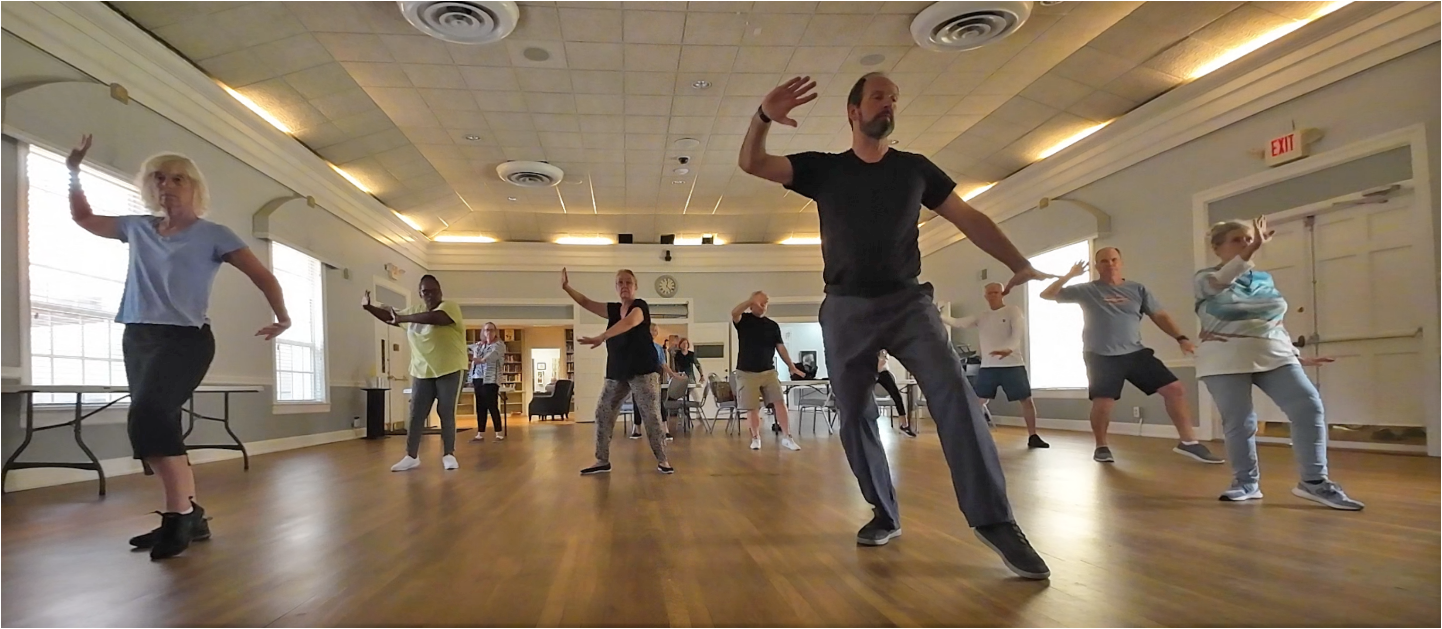
Over the years, some of the wiser mentors I have known have shared a simple idea with me that has remained in the back of my mind: we should strive to earn the life we live.
I do not interpret this as meaning that we somehow have to earn the right to exist, nor do I believe our worth should be measured by how much money we make, how productive we are, or how many accomplishments we can accumulate. I understand it more as an invitation to participate fully in the life we have been given. If we are fortunate enough to wake up to another day, perhaps there is something to be said for trying to make reasonable use of it.
Hopefully, over the course of a lifetime, we can build a life containing some combination of love, meaning, purpose, contribution, friendship, family, learning, service, and perhaps even a little wisdom. We certainly will not succeed every day. There will be periods when simply getting through a difficult time is accomplishment enough. There will also be days when we need to rest, step away, or allow someone else to help us. But when viewed across the longer arc of a life, I think there is something worthwhile about trying to leave the world, or at least our small corner of it, a little better because we were here.
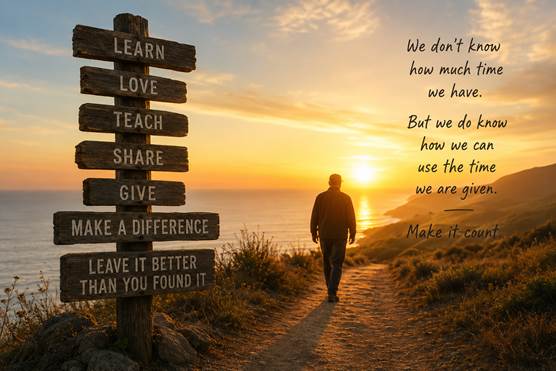
What Is the Point?
Every so often, I encounter someone who expresses a very different perspective. They may say something along the lines of, “What is the point? We are all going to die anyway.” Technically, they are correct.
Every person reading these words will eventually die. So will I. Every generation before us has faced the same reality, and every generation after us will face it as well. No amount of exercise, money, medicine, education, spiritual practice, healthy eating, positive thinking, or modern technology has changed that basic fact. But to me, that is exactly the point.
If our time were unlimited, there might be much less urgency to do anything meaningful with it. We could always begin tomorrow. The book could be written someday. The old friend could be called eventually. We could apologize later, tell someone we love them another time, take better care of ourselves next year, or finally begin sharing what we have learned when the timing seems more convenient.
The problem is that we do not actually know how many tomorrows we will have.
None of us knows when our last breath will occur. I do not see that realization as necessarily depressing or morbid. In fact, I think it can be quite motivating. The awareness that our time is limited can help us separate what is important from what merely consumes our attention. Research in psychology has long suggested that awareness of mortality can influence how people think about meaning, identity, relationships, and values (Greenberg et al., 1986). Other research has found that having a sense of purpose is associated with important aspects of psychological and physical well-being across adulthood (Hill & Turiano, 2014).
The objective, then, is not to become preoccupied with death. It is to become more engaged with life.
What If All of This Actually Matters?
None of us possesses absolute certainty about the ultimate meaning of existence. Philosophers, scientists, theologians, mystics, and ordinary people have debated these questions for thousands of years. We continue to wonder why we are here, whether life has some larger purpose, what happens when consciousness ends, and whether meaning is something we discover or something we create for ourselves. I certainly do not claim to know the answers to those questions.
Somewhere along the way, however, I arrived at a practical conclusion that works for me. Why not err on the positive side? What if all of “this” actually matters?
Perhaps the encouragement we give another person matters. Maybe teaching someone an exercise that improves their balance or mobility can have a positive effect. Showing someone how to slow their breathing when they are overwhelmed may help that person considerably. Sharing an experience that prevents someone else from repeating one of our mistakes may matter considerably more than we realize at the time.
A conversation might change someone’s perspective. An article might reach someone we will never meet. A book could sit on a shelf for years before eventually being opened by the person who needs what is written inside it. A video that receives relatively little attention today might someday help someone halfway around the world.
We may never know. That does not mean it did not matter.
Purpose Does Not Have to Be Grand
I think one mistake we sometimes make is assuming that purpose has to involve something enormous. The phrase “life purpose” can conjure images of changing the world, becoming famous, creating a movement, building an empire, or somehow being remembered generations after we die. Most meaningful lives probably do not look anything like that.
Purpose is often remarkably ordinary. It can be found in raising children, caring for an aging parent, teaching a class, helping a neighbor, creating something useful, sharing knowledge, volunteering in the community, mentoring someone younger, or simply being available when another human being needs someone to listen to.
Psychiatrist Viktor Frankl wrote extensively about the human search for meaning, particularly through his experiences of extraordinary suffering. His work emphasized that meaning can be found through what we create and contribute, through what we experience and whom we love, and through the attitudes we adopt toward circumstances that cannot be changed (Frankl, 2006).
I have always appreciated that perspective because it places meaning within reach of ordinary people living ordinary lives. We do not necessarily have to save humanity to live meaningfully. Sometimes we simply help the people who happen to be within our reach.
Expanding the Circle
As I have gotten older, this idea has increasingly influenced how I choose to spend my time. It manifests itself in my desire to reach more people, teach more classes, offer more perspectives, and share more of what I have learned and experienced. It is also one of the reasons I continue writing articles and books and creating videos for people whom I may never have an opportunity to meet personally.
This is not because I believe I possess all the answers. Quite the opposite. The longer I live and continue learning, the more aware I become of how much there still is to understand.
But I have accumulated experiences. I have made mistakes, changed my mind, been taught by many people, watched ideas come and go, and seen things that I once believed to be true turn out to be incomplete, exaggerated, misunderstood, or simply incorrect. At the same time, I have watched seemingly simple lessons become much more meaningful as I grew older and finally accumulated enough life experience to understand them differently. At some point I began asking myself, why keep all of that to myself?
Teaching in person has always been meaningful to me because there is an immediate human connection. You can see whether someone understands what you are explaining. You can modify what you are doing, answer questions, demonstrate an exercise differently, laugh together, and watch people gradually improve. But there are obvious limitations. Any one of us can only teach so many classes, be in one room at a time, and personally interact with a limited number of people during the course of a day. Writing and modern technology extend that circle considerably.
An article can travel somewhere I cannot. A book can continue communicating an idea when I am somewhere else doing something entirely different. A video can demonstrate an exercise to someone who may never attend one of my classes. Something created today might remain available years from now.
The internet certainly has its problems, particularly in today’s cultural climate. We are surrounded by enormous amounts of information, misinformation, advertising, anger, entertainment, distraction, and increasingly shorter attention spans. Yet the same technology that spreads nonsense can also spread education, encouragement, experience, and useful ideas. The tool itself is not necessarily the problem. Much depends upon what we choose to do with it.
The Ripple Effect We Rarely See
One of the interesting things about teaching, helping, mentoring, parenting, writing, or simply interacting with other people is that we rarely get to see the full effect of what we do.
A teacher may say something that a student remembers twenty years later. A parent may offer advice that a child dismisses at twenty but suddenly understands at forty-five. Someone might read an article, think about one paragraph for several days, and quietly make a change in their life. A person might learn an exercise in a class and later teach it to a spouse, friend, child, or grandchild. The original teacher may never know any of this occurred.
This is worth remembering because we increasingly live in a world where influence is measured through visible numbers. We count attendance, sales, views, likes, subscribers, comments, followers, income, and recognition. Those measurements have their place, but they cannot possibly measure every form of human influence.
Research on generativity, a concept strongly associated with Erik Erikson’s theory of adult development, describes the human desire to contribute to and guide future generations. Generativity can take many forms, including parenting, mentoring, teaching, leadership, creativity, and community involvement (McAdams & de St. Aubin, 1992).
I find that concept increasingly meaningful as the years pass. At some point, the question can gradually shift from “What can I accumulate?” toward “What can I contribute?” That is a very different way of looking at one’s remaining time.
Earning the Day
Perhaps the idea of “earning the life we live” sounds too ambitious when considered across an entire lifetime. I sometimes find it more useful to reduce the scale and simply think about earning the day.
That does not require accomplishing something extraordinary every twenty-four hours. It might simply mean learning something, helping someone, taking reasonable care of ourselves, appreciating the people around us, creating something rather than merely consuming, or contributing in some small way to the lives of the people we encounter.
Obviously, every day will not look like this. There are days for rest and recovery. There are days when our own problems require most of our attention. There are times when we need other people far more than they need us. This is part of being human. But there is an important difference between allowing ourselves to rest and deciding that nothing matters because everything eventually ends.
A beautiful meal, a great conversation, a vacation, a class, a sunset, childhood and careers end. Relationships eventually end, whether through circumstances, separation, or death. Human life itself eventually ends. Something does not become meaningless simply because it is temporary. In fact, I would argue that its temporary nature may be exactly what gives it value.
If we had an unlimited number of sunsets, years with the people we love, opportunities to repair relationships, time to learn, and unlimited opportunities to say what needs to be said, perhaps we would appreciate these things far less.
Scarcity creates value in many areas of life. Time may be the greatest example of all.
Until the Last Breath
None of us knows how much time remains. Hopefully, there are many years ahead, but there are no guarantees. That reality encourages me to continue doing what I can while I can.
There are still classes I would like to teach, ideas I want to explore, articles I want to write, books I hope to complete, videos I would like to create, people I have yet to meet, and perspectives that I will probably continue changing as I learn more. There are also lessons accumulated over a lifetime that might be useful to someone else, even if I never know who that person is.
Will all of it matter? I cannot prove that it will. But neither can anyone prove that it will not.
Given those two possibilities, I choose to err on the positive side. I would rather live as though kindness, teaching, learning, sharing experiences, taking care of ourselves, helping other people, and loving people matters.
I would rather believe that something we create today might continue helping someone after we are no longer here to explain why we created it. Someday, like everyone else who has walked this earth, I will take my last breath. Between this breath and that final one lies whatever amount of life remains. I would prefer to use as much of it as reasonably possible.
Perhaps I will never know how far the ripples will travel. Perhaps none of us does. But I think there is something worthwhile about continuing to throw a few stones into the water. And perhaps that is part of what it means to earn the life we live.
References
Frankl, V. E. (2006). Man’s search for meaning. Beacon Press. (Original work published 1946)
Greenberg, J., Pyszczynski, T., & Solomon, S. (1986). The causes and consequences of a need for self-esteem: A terror management theory. In R. F. Baumeister (Ed.), Public self and private self (pp. 189–212). Springer.
Hill, P. L., & Turiano, N. A. (2014). Purpose in life as a predictor of mortality across adulthood. Psychological Science, 25(7), 1482–1486.
McAdams, D. P., & de St. Aubin, E. (1992). A theory of generativity and its assessment through self-report, behavioral acts, and narrative themes in autobiography. Journal of Personality and Social Psychology, 62(6), 1003–1015.