
Reality, Consciousness, and the Possibility That This Life Is Only One Part of a Much Larger Existence
Most of us wake up every morning without giving much thought to what is real. We open our eyes, recognize the room around us, get out of bed, and continue with our lives. There are people we love, responsibilities waiting for us, bills to pay, meals to prepare, places to go, and bodies that need our attention. This is the world we know, and naturally, we call it reality.
But what if it is only our present reality?
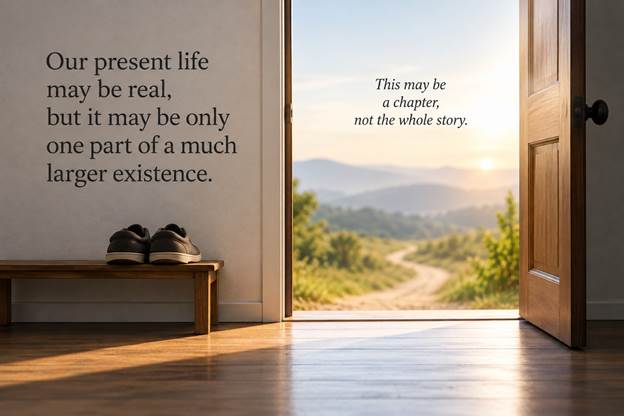
That question does not require us to reject science, deny the physical world, or believe in anything supernatural. It simply asks us to consider a possibility that human beings have wondered about for thousands of years: What if the reality we experience through our bodies and senses is only one part of something much larger?
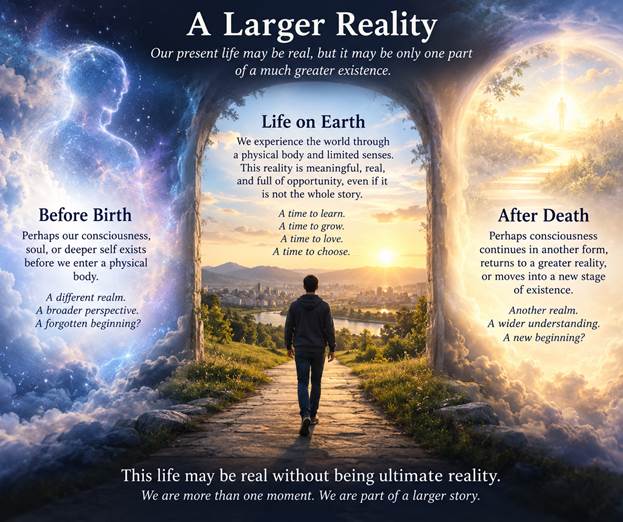
Perhaps birth and death are not necessarily the beginning and ending of existence. Maybe they are simply the beginning and ending of this particular experience. We do not know. But perhaps not knowing is exactly what makes the question worth considering.
We Experience Only Part of the World
One reason to remain open-minded about reality is that we already know our senses are limited. Our eyes see only a small portion of the light that exists around us. Our ears detect only certain frequencies of sound. Other animals can smell, hear, see, or sense things that we cannot. A dog’s experience of the world is heavily influenced by smell. A bird may navigate through abilities that humans barely notice. Other creatures perceive forms of light or vibration that are completely invisible to us. None of this means that our world is false. It simply means that we experience the world through the equipment we have been given.
The philosopher Immanuel Kant explored a similar idea. In simple terms, he suggested that there may be a difference between reality itself and reality as human beings are capable of experiencing it. We cannot step outside our human senses and human minds to see existence from a completely independent point of view (Guyer & Horstmann, 2026).
That leaves us with an interesting possibility. What we experience may be completely real while still being incomplete. Think of a fish living its entire life underwater. Water is not simply something surrounding the fish; it is part of the conditions through which the fish experiences existence. A bird experiences space differently because flight is part of its world. A dog experiences a landscape of smells that we can barely imagine.
Perhaps human beings are no different. We experience reality through a human body and a human brain. Naturally, we tend to assume that what we can see, hear, touch, measure, and remember represents everything that exists. But what if it doesn’t?
Plato’s Cave
More than two thousand years ago, Plato explored a similar question through his famous Allegory of the Cave. He imagined people who had spent their entire lives inside a cave, able to see only shadows appearing on a wall. Because the shadows were all they had ever known, they naturally believed the shadows were reality. They were not foolish. They were simply working with the information available to them. That may be the most important part of the story. Their mistake was not believing that the shadows existed. Their mistake was believing that the shadows were all that existed.
Plato believed there was a deeper reality beyond ordinary appearances and also explored the possibility that the soul existed beyond the physical body (Silverman, 2014). We do not have to accept all of Plato’s conclusions to appreciate the question he left us. Could we also be looking at only part of the picture?
We experience matter, space, time, birth, aging, and death. From where we stand, these things seem absolute. But if some greater level of existence were beyond the abilities of our senses, how would we know? Perhaps we wouldn’t.
The Wave and the Ocean
Indian philosophy offers another useful way of thinking about this.
The Sanskrit word māyā is often translated as “illusion,” but that can create the wrong impression. It can sound as though Hindu philosophy is saying that nothing around us is real. A better way to understand the idea is that things may not be exactly what they appear to be. In Advaita Vedānta, for example, the deepest self, called ātman, is understood as being connected with, and ultimately not separate from, the deeper reality called Brahman (Dalal, 2021).
The ocean provides a simple way of imagining this. Watch a wave rise from the water. For a few moments, it appears to be a separate thing. We can point at it. We can photograph it. We can watch it travel toward shore. Then it disappears back into the ocean. Was the wave real? Of course. But was it ever truly separate from the ocean?
Perhaps human life can be considered in a similar way. We emerge into the world as individuals. We develop names, personalities, careers, relationships, beliefs, possessions, memories, fears, and hopes. Eventually the body returns to the same physical world from which it came.
The question raised by some Indian traditions is whether we have become so focused on being the wave that we have forgotten the possibility of the ocean.
Buddhism Offers Another Possibility
Buddhism complicates the picture because it generally does not teach that there is a permanent individual soul that remains unchanged forever. The Buddhist idea of anattā, or “not-self,” asks us to question how permanent the person we call “me” actually is (Siderits, 2011).
Consider how much you have already changed during your lifetime. Your body, thoughts and your beliefs may have changed. Your relationships, priorities, fears, interests, and understanding of yourself may all be different from what they were decades ago. Yet somehow there is a sense of continuity.
Buddhism developed teachings about karma, rebirth, and liberation without necessarily requiring an eternal, unchanging personality to travel from one life to another. What continues might be more like a process than a permanent individual object.
That opens another possibility. Maybe the choices are not limited to “I remain exactly myself forever” or “nothing continues after death.” There may be possibilities we simply do not understand.
What If Life Is Something Like a Dream?
Daoist philosophy gives us one of the simplest and most memorable examples. The ancient Chinese philosopher Zhuangzi told a story about dreaming that he was a butterfly. In the dream, being a butterfly seemed completely natural. After waking, however, he wondered whether he was Zhuangzi who had dreamed of being a butterfly, or somehow a butterfly dreaming that he was Zhuangzi. The story was not meant simply as a joke or puzzle. It raises a fascinating question about how we decide which experience is ultimately real (Hansen, 2024).
Most of us have experienced very convincing dreams. While dreaming, we usually do not stop and say, “None of this is real.” We accept it. We may talk with people who died years ago. We may find ourselves in places that could not possibly exist. We may feel fear, sadness, happiness, love, or grief. During the dream, those emotions can seem completely genuine. Then we wake up. Only afterward do we recognize that what seemed completely real existed within a different state of consciousness. That leads to an unusual but fascinating question: What would it mean to awaken from this life?
Perhaps death is simply the end of consciousness. That possibility must remain on the table. But if consciousness somehow exists beyond the physical body, death might look completely different from the other side. What we call dying might be experienced as something more like waking up. Again, we do not know. But our inability to see beyond our present condition does not necessarily mean there is nothing beyond it.
What Were We Before We Were Born?
People frequently ask, “What happens after we die?” We ask much less often, “What were we before we were born?”
Plato believed the soul existed before physical birth and suggested that some forms of learning might actually involve remembering truths the soul already knew (Silverman, 2014). Centuries later, Plotinus developed related ideas about the soul becoming absorbed in physical existence and forgetting its deeper origin (Moore, n.d.).
Whether we accept those ideas or not, they raise an interesting problem. We usually assume that because we cannot remember anything before birth, there must have been nothing before birth. But memory is not the same thing as existence.
Most adults remember almost nothing from their first year of life. That does not mean they did not exist during that year. We spend roughly a third of our lives sleeping and often remember little or nothing about much of that time. Lack of memory does not prove that something did or did not happen. It simply means we do not remember it.
Other Religious Traditions
Christianity, Judaism, and Islam approach these questions differently from Hinduism and Buddhism. They generally preserve the idea of an individual person who continues in some way beyond physical death and emphasize a continued relationship with God.
Christianity, in particular, has traditionally placed considerable importance on resurrection rather than simply describing death as a soul permanently escaping the body. Exactly what personal survival means has been debated by theologians and philosophers for centuries (Meister, 2023).
The traditions disagree considerably about the details. Some speak of heaven. Others describe reincarnation or rebirth. Some describe liberation from the cycle of physical existence. Others speak of returning to a divine source. Yet beneath many of these differences is a remarkably persistent idea: This physical life may not be the whole story.
Maybe “Illusion” Is the Wrong Word
This may be one of the most important distinctions in the entire discussion. Even if there is a greater reality beyond this physical life, that does not necessarily mean this life is fake or meaningless. Perhaps “illusion” is simply the wrong word. Childhood is not an illusion because adulthood comes afterward. A classroom is not unreal because the student eventually graduates. A chapter of a book is not false simply because there are chapters before and after it.
Perhaps our physical lives are something similar. This experience may be real without being all of reality. Our bodies still matter. Pain, love and relationships matter. Our choices affect other people. What we learn and what we teach are all important to us. And if this life is temporary, perhaps that gives these things even greater value.
Living as Though This Matters
There can be a problem with believing that the physical world is somehow less than ultimate reality. Taken too far, that idea might encourage someone to think, “If none of this is permanent, why should anything matter?” I would suggest almost the opposite. If this life is one stage within a much larger existence, then perhaps what happens here matters enormously.
Maybe there are things that can only be experienced through physical life. We experience limitations because we have bodies. We experience uncertainty because we cannot see the future. We experience relationships because we appear to be separate individuals. We experience aging, loss, desire, responsibility, pleasure, pain, and choice. Most importantly, we are required to make decisions without knowing everything. Perhaps that is part of the experience.
A sunset does not become meaningless because it lasts only a few minutes. In many ways, its temporary nature makes us appreciate it more. Time with an aging parent becomes precious because we know there will not be an unlimited number of conversations. Our bodies deserve care partly because they will not remain young and strong forever. Relationships deserve attention because circumstances change. Temporary does not mean meaningless. Sometimes temporary is exactly what creates meaning.
The Value of Not Knowing
Science has not established that an individual soul existed before birth or survives bodily death. Religious traditions and philosophical systems offer possibilities, teachings, arguments, and personal experiences, but these are not the same thing as scientific proof. Perhaps it is important to admit that.
We use words such as consciousness, life, death, mind, spirit, and reality so frequently that we can begin to think we understand exactly what they mean. But do we?
We know that we are here and conscious. We know that, for some period of time, we experience existence through a human body. We know that the body eventually dies. Beyond that point, our certainty begins to fade.
Perhaps this life is the only reality we will ever experience. Maybe consciousness is entirely produced by the brain and ends when the brain stops functioning. But perhaps not. Or maybe what we call birth was not our absolute beginning, and what we call death will not be our absolute end. Maybe they are simply boundaries between different kinds of experience. While we are alive, however, we cannot step outside this existence and look back at it from somewhere else. We are inside the experience.
Like Plato’s prisoners looking at shadows, Zhuangzi dreaming of the butterfly, or a wave temporarily rising from the ocean, we can only see reality from where we presently stand. Perhaps someday there will be nothing more to discover.
Or perhaps someday we will awaken and recognize that what we confidently called “the real world” was real after all, but it was only one remarkable part of something much greater.
References
Dalal, N. (2021). Śaṅkara. In E. N. Zalta (Ed.), The Stanford encyclopedia of philosophy. Stanford University.
Guyer, P., & Horstmann, R.-P. (2026). Idealism. In E. N. Zalta & U. Nodelman (Eds.), The Stanford encyclopedia of philosophy. Stanford University.
Hansen, C. (2024). Zhuangzi. In E. N. Zalta & U. Nodelman (Eds.), The Stanford encyclopedia of philosophy. Stanford University.
Meister, C. (2023). Afterlife. In E. N. Zalta & U. Nodelman (Eds.), The Stanford encyclopedia of philosophy. Stanford University.
Moore, E. (n.d.). Plotinus. Internet Encyclopedia of Philosophy.
Siderits, M. (2011). Mind in Indian Buddhist philosophy. In E. N. Zalta (Ed.), The Stanford encyclopedia of philosophy. Stanford University.
Silverman, A. (2014). Plato’s middle period metaphysics and epistemology. In E. N. Zalta (Ed.), The Stanford encyclopedia of philosophy. Stanford University.


