
There are times when I think about everything I have taught, written, studied, practiced, and shared over the years and wonder where any of it ultimately goes. A class ends and everyone goes home. A book is purchased and disappears onto someone’s shelf. An article is posted and eventually moves farther down the page. A video may be watched by someone whose name I will never know. A conversation ends, and two people go their separate ways.
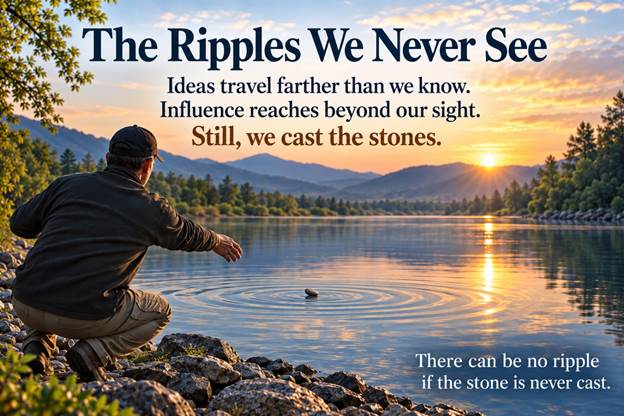
I have gradually come to think of these experiences as something like standing beside a river with a stone in my hand. I throw the stone into the water and watch it strike the surface. There is a splash, followed by ripples spreading outward. Then the stone sinks and disappears. I cannot see where it finally settles, nor can I follow the ripples very far. I simply know that something has been set in motion.
Perhaps sharing knowledge works much the same way.
Becoming a Conduit
After decades of studying martial arts, holistic health, philosophy, psychology, spirituality, human behavior, and the many ways people search for meaning, I have become increasingly aware of how little any one person can actually know. The more we learn, the more we encounter questions for which we do not have complete answers.
For that reason, I increasingly think of myself as a conduit rather than an authority. Knowledge passes through us. Some of it comes from formal education, while much of it comes from teachers, mentors, books, traditions, science, personal experience, mistakes, relationships, hardships, and simple observation.
We rarely create knowledge entirely by ourselves. We encounter ideas, examine them, compare them with our experiences, and decide whether they still have value. Some remain with us for decades. Others are eventually discarded. Occasionally, something we once accepted as true proves incomplete or incorrect, and intellectual honesty requires us to change our position.
This is one of the reasons I believe knowledge should be shared rather than guarded. Human beings have always learned from one another. Long before universities, websites, podcasts, and videos existed, someone discovered something useful and showed someone else. That person remembered it, adapted it, and perhaps passed it along again. In that sense, we are temporary caretakers of what we have learned.
Influence We May Never Witness
One of the difficulties with teaching or writing is that we naturally notice the visible results. We know how many people attended a class, purchased a book, watched a video, or responded to an article. Those measurements can tell us something, but they cannot tell us everything. What happens afterward is much harder to see.
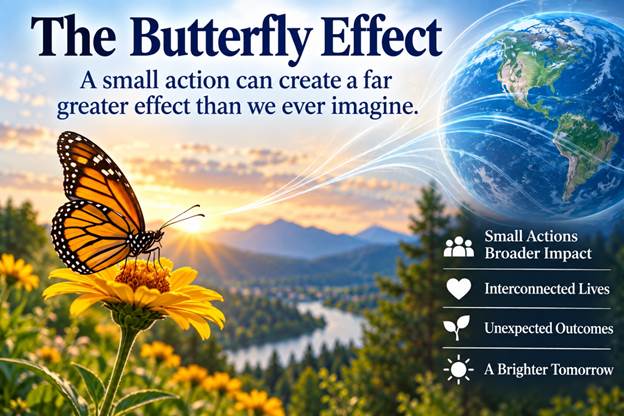
A person might learn a breathing technique in a class and later show it to a spouse who is struggling with stress. Someone might read a paragraph about self-responsibility and begin reconsidering the way they approach their health. A student may remember something a teacher said many years earlier and suddenly understand it differently because life has finally provided the experience necessary to make sense of it.
Research into social networks has shown that ideas and behaviors can move through relationships in complicated ways. Researchers continue to debate how far particular effects spread and how much can truly be attributed to social influence, but there is little question that human beings continually affect one another through relationships, behavior, communication, and example (Christakis & Fowler, 2013).
I have experienced this from the receiving side myself. There are things teachers told me decades ago that did not seem especially important at the time. Years later, a particular phrase or lesson suddenly carried much greater meaning. The teacher could not have known when, or even whether, that understanding would arrive. The same is probably true of things I have shared with others.
Teaching Without Owning the Outcome
Recognizing this also requires humility. If I share something with another person, I cannot control what that person does with it. I can explain an exercise, but I cannot make someone practice it. I can discuss movement, breathing, nutrition, stress management, philosophy, or self-awareness, but another person must decide whether any of that belongs in their life.
This is closely related to the distinction I have often made between healing and fixing. A good teacher, coach, practitioner, or healer can provide knowledge, tools, encouragement, and perspective, but meaningful change eventually requires participation from the person receiving them.
Psychologist Albert Bandura described human agency as our capacity to influence our own actions and circumstances rather than simply being passive recipients of outside forces (Bandura, 2001). That idea resonates strongly with my own approach to teaching. The goal should not be to make another person permanently dependent upon the teacher. Ideally, what has been taught eventually becomes something the student can understand, question, adapt, and use independently. At some point, the information no longer belongs to the person who offered it.
Purpose Beyond Recognition
Modern culture makes it easy to confuse visibility with impact. We count followers, views, subscribers, sales, downloads, attendance, and engagement. These measurements have practical value, particularly when we are trying to determine whether people are being reached, but numbers cannot fully measure what happens inside another human being.
A video watched by thousands may quickly be forgotten, while a quiet conversation with one person may influence a decision that changes the direction of a life. The person who initiated that conversation may never know what happened afterward. This is where purpose begins to separate from recognition.
Viktor Frankl wrote extensively about the human search for meaning and suggested that meaning can be found through what we contribute, what we experience, and how we respond to circumstances that cannot be changed (Frankl, 2006). Purpose does not necessarily require an audience to confirm that something mattered.
For me, teaching and writing have increasingly become expressions of that understanding. There are only so many classes I can teach and people I can meet personally. Writing, books, recorded lessons, and videos allow ideas to continue traveling beyond those limitations. Someone I will never meet may encounter something years from now that happens to be useful at precisely the right moment. That possibility is enough reason to continue.
Carrying Knowledge Forward
There is also another side to this process. Before we ever began sharing what we knew, other people were sharing with us.
Teachers, parents, friends, authors, philosophers, scientists, martial artists, health practitioners, and ordinary people describing their experiences have all contributed to the way we understand the world. Some lived centuries before us, yet their ideas still reached our lives.
Much of what I have learned through martial arts, tai chi, qigong, philosophy, and holistic approaches to health existed long before I encountered it. My responsibility is not necessarily to preserve everything exactly as I received it. Experience has taught me that traditions should be examined rather than blindly repeated. Some ideas withstand scrutiny, while others require clarification, modernization, or correction.
Being a conduit does not mean being a passive pipe. We can question what passes through us, compare old ideas with new evidence, admit when our understanding changes, and separate useful principles from unnecessary mythology. We can then communicate what remains valuable in language that another person might understand.
Someone else may eventually take one of those ideas and carry it farther than we ever could.
The Ripples We Never See
Perhaps this is one of the quieter meanings of legacy.
Legacy does not have to mean that our names are remembered generations from now. It may simply mean that something we contributed became part of someone else’s life. An idea influenced the way another person thought. A practice became part of someone’s routine. A kindness affected how that person later treated someone else. A question caused someone to reconsider an assumption. Eventually, the original source may even be forgotten. I find something reassuring in that.
At this stage of my life, I am increasingly comfortable knowing that I will never be able to measure the reach of everything I have taught or written. I intend to continue studying, questioning, teaching, writing, and sharing what seems worthwhile, not because every effort will produce a visible result, but because someone somewhere may be looking for an idea, a practice, a different perspective, or simply a little direction. Perhaps something I share will reach that person. Perhaps it will not. There is no way to know. But there can be no ripple if the stone is never cast.
References
Bandura, A. (2001). Social cognitive theory: An agentic perspective. Annual Review of Psychology, 52, 1–26. https://doi.org/10.1146/annurev.psych.52.1.1
Christakis, N. A., & Fowler, J. H. (2013). Social contagion theory: Examining dynamic social networks and human behavior. Statistics in Medicine, 32(4), 556–577. https://doi.org/10.1002/sim.5408
Frankl, V. E. (2006). Man’s search for meaning. Beacon Press. (Original work published 1946)


