
“It has always been now, it has always been you, you have always been here, the eternal consciousness momentarily residing in form.”
The Strange Reality of the Present Moment
At first, this statement may sound mysterious or overly spiritual. But there is a fairly simple idea behind it. No matter where we have been in life, how old we were, or what was happening around us, we have always experienced life in the present moment.
Think about your childhood. At the time, it was not the past. It was now. Think about something you were worried about ten years ago. At the time, the future had not yet happened. You were experiencing another now. Even when tomorrow arrives, we will not experience it as “the future.” We will experience it as the present.
In that sense, it really has always been now.
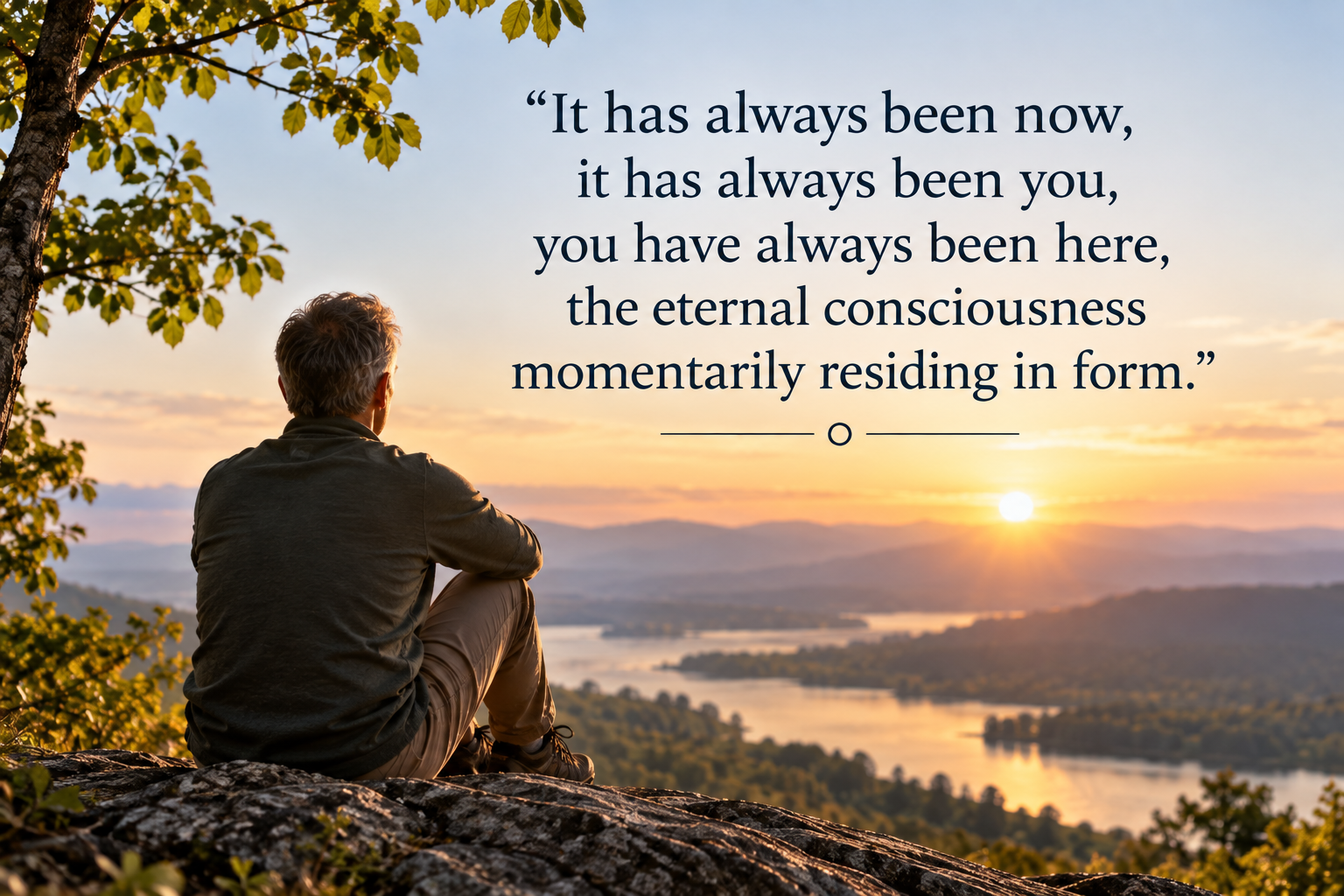
Our lives obviously unfold through time. We are born, grow older, accumulate experiences, and eventually die. Calendars and clocks are useful and necessary ways of organizing this movement. Yet our actual experience of being alive happens only in the present. The past survives largely through memory, while the future exists through anticipation, imagination, planning, and expectation. The only place where we actually experience anything is here.
This simple observation has been explored in many different ways by philosophers, spiritual traditions, scientists, and contemplative teachers. Eckhart Tolle (1999), for example, made the experience of the present moment central to The Power of Now. Buddhist and Taoist traditions have approached similar questions for centuries, although through very different philosophical frameworks.
Perhaps we do not need to understand all of those traditions to appreciate the basic point. Life is always happening now.
The Past and Future Still Matter
Recognizing the importance of the present does not mean pretending that the past and future are meaningless. Our memories help shape who we are. We learn from experience, carry relationships with us, and sometimes live with the consequences of decisions made decades earlier. Likewise, thinking about the future allows us to make plans, protect ourselves, set goals, and prepare for what may come.
The problem begins when our attention becomes so dominated by yesterday or tomorrow that we barely experience today.
Most people know what this feels like. We replay a conversation from last week, worry about something that might happen next month, regret a decision from years ago, or imagine a future problem that may never occur. Meanwhile, the body is sitting in a chair, walking through a park, eating dinner, exercising, or talking with someone we care about. The mind can travel backward and forward. The body cannot.
This is one reason practices such as meditation, Tai Chi, qigong, breathing exercises, and simple mindful movement can be useful. They bring attention back to what is actually happening. The breath, balance and body movements are happening now. The feeling of the ground beneath our feet is happening now.
For a few moments, we stop living almost entirely inside the story of our lives and return to the experience of actually living them.
What Do We Mean by “You”?
The second part of the statement, “it has always been you,” raises another interesting question: What exactly do we mean by you?
At first the answer seems obvious. I am the person with my name, body, history, personality, relationships, and my memories. All of that is certainly part of who I am.
But consider how much of that has changed.
The body you had at five years old is not the body you have today. Your beliefs have probably changed. Your knowledge has changed. Your relationships, interests, fears, abilities, and priorities may have changed dramatically. You may look at photographs from decades ago and barely recognize the person staring back at you.
And yet there is still a sense that it was you.
Something seems to connect the child, the teenager, the young adult, the middle-aged person, and the older person. We can call it identity, awareness, consciousness, or simply the continuing experience of being ourselves.
Eastern philosophical traditions have spent considerable time exploring this distinction between the changing person and the awareness experiencing those changes. Advaita Vedānta, for example, distinguishes between our temporary personal identity and a deeper level of awareness (Deutsch, 1980). Zen approaches the question differently, but it too asks us to look beyond the stories and labels we normally use to define ourselves (Suzuki, 1956).
We do not have to accept any particular spiritual explanation to find the question worthwhile. If almost everything about us changes during a lifetime, what is it that allows us to continue saying, “That was me”?
Consciousness Residing in Form
This brings us to perhaps the most challenging part of the original statement: “eternal consciousness momentarily residing in form.”
Here we move beyond what can be easily demonstrated and into philosophy, spirituality, and personal belief.
We know that human consciousness, as we ordinarily experience it, is deeply connected to the living brain and body. What science has not established is that an individual consciousness existed before the body or continues independently after death. Religious and philosophical traditions have offered many different answers to that question.
But suppose, simply as a philosophical possibility, that the body is not the whole story. Many traditions have suggested that what we call the self may be a temporary expression of something larger. Hindu traditions have explored the relationship between Atman and Brahman. Taoism describes individual forms emerging from and returning to the Tao. Christian mystical traditions have spoken about a deeper spiritual reality within ordinary human existence. These traditions differ greatly, and we should not pretend they are all saying exactly the same thing. Yet they share an interest in a similar question: Is the person we see in the mirror the entirety of what we are?
There may be no way to answer that question with certainty during our lifetime. But contemplating it can change the way we look at life.

We Are Temporary, Whatever Else May Be True
There is one part of this discussion that does not require a spiritual belief: our present physical form is temporary.
Every human body has a beginning and an end. The material that makes up our bodies existed before we did and will continue to exist after we are gone. The elements within us came from processes reaching far back into the history of the universe. As physicist Brian Greene (2004) discusses in his exploration of matter, space, and time, we are physically part of a universe that existed billions of years before our individual lives began. That alone is remarkable.
For a relatively brief period, these materials come together as us. We breathe, move and think. We love people. We become frightened. We learn and teach things. We create memories and influence other people. Also, we make mistakes. Eventually the particular arrangement we call our body changes and returns to the larger physical world. Whether consciousness continues beyond that point is a different question.
Religion may answer yes. Materialism generally answers no. Various philosophical traditions offer possibilities somewhere between those positions. Perhaps intellectual humility requires admitting that we simply do not know with certainty. But uncertainty does not make the question meaningless.
What If This Life Is One Expression of Something Larger?
If consciousness is somehow larger than our individual physical existence, then life might be understood as a temporary opportunity for consciousness to experience the world through a particular person. For these years, it sees through these eyes. It experiences the world through this body. It encounters these people, these challenges, these joys, these losses, and these opportunities. Then the form changes.
This possibility helps explain the phrase “momentarily residing in form.” Momentarily does not necessarily mean briefly in human terms. Someone may live ninety or one hundred years. But compared with the age of the universe, even a long human life is extraordinarily short.
We arrive, experience our portion of existence, and leave. What existed before and what follows afterward remain among humanity’s oldest questions.
Returning to the Present
This is where an abstract philosophical idea can become surprisingly practical. If the present moment is the only place where life is actually experienced, then learning to inhabit it more fully becomes important regardless of what we believe about consciousness, reincarnation, heaven, the soul, or death.
Meditation can bring us back to the breath. Tai Chi can bring us back to posture, balance, and movement. Qigong can bring attention to sensation and breathing. Walking can reconnect us with our surroundings. A conversation can become an opportunity to actually listen rather than prepare our next response.
None of this requires withdrawing from ordinary life. In fact, it may allow us to participate in ordinary life more completely. Presence does not mean abandoning goals or refusing to think about tomorrow. It means recognizing when tomorrow has taken over today. Likewise, it does not mean forgetting the past. It means remembering that we cannot return there. We can learn from yesterday and prepare for tomorrow while still living today.
The Eternal Now
Perhaps that is the most accessible way to understand the original statement. It has always been now.
Every moment you have ever experienced was experienced as the present. It has always been you.
Although your body, beliefs, circumstances, and personality have changed, there has remained a continuing experience of being the person living through those changes. You have always been here. Wherever your life has taken you, experience itself has always occurred from the immediate position of here and now.
And finally: Eternal consciousness momentarily residing in form.
That final idea remains a possibility rather than something we can prove. Perhaps consciousness is produced entirely by the body and ends when the body dies. Perhaps consciousness is somehow more fundamental, and the individual body provides it with a temporary form. Humanity has wrestled with these possibilities for thousands of years, and the question remains open. Maybe we do not need to solve it in order to gain something from considering it.
We are here and conscious now. We have this particular body, this particular life, these particular relationships, and whatever amount of time remains to us. If something greater exists beyond this physical life, we will eventually discover it. If it does not, then the time we have becomes even more precious. Either way, perhaps the wisest response is remarkably similar: be here for the life that is happening now.
References
Deutsch, E. (1980). Advaita Vedānta: A philosophical reconstruction. University of Hawaii Press.
Garfield, J. L. (1995). The fundamental wisdom of the Middle Way: Nāgārjuna’s Mūlamadhyamakakārikā. Oxford University Press. https://doi.org/10.1093/oso/9780195103175.001.0001
Greene, B. (2004). The fabric of the cosmos: Space, time, and the texture of reality. Alfred A. Knopf.
Suzuki, D. T. (1956). Zen Buddhism: Selected writings. Doubleday.
Tolle, E. (1999). The power of now: A guide to spiritual enlightenment. New World Library.


