
There is an ancient Greek story about a man condemned to push an enormous stone up a mountain. Each time he nears the summit, the stone rolls back down, forcing him to return to the bottom and begin again. His name was Sisyphus, and his punishment has become one of the most enduring metaphors for the repetitive struggles of human life.
In Greek mythology, Sisyphus was the king of Ephyra, the city later known as Corinth. He was remembered as exceptionally clever, but also deceitful and willing to challenge the authority of the gods. Different versions of the myth describe his offenses somewhat differently, but he was particularly known for attempting to outwit death itself. Eventually, the gods condemned him to an eternal punishment in the underworld. He would roll a massive stone toward the top of a hill, only to have it tumble back down before the task could ever be completed. He would then descend the mountain, return to his stone, and begin again.
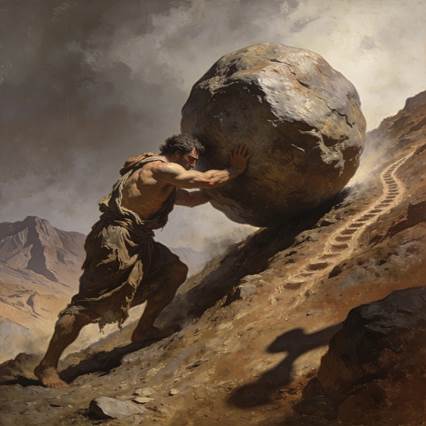
At first glance, this seems like little more than a story about punishment. The cruelty is not simply that Sisyphus must perform hard physical labor. Human beings have always worked hard. The real punishment is that his labor appears to accomplish nothing. There is no completed building, harvested crop, finished journey, or lasting achievement waiting for him at the end. Whatever progress he makes is eventually erased.
That may be precisely why the story has survived for thousands of years. Beneath the mythology is a surprisingly familiar question: What is the value of effort when so much of what we accomplish eventually disappears anyway?
We All Push Stones
When viewed from a broader perspective, much of ordinary life has a Sisyphus-like quality. We clean the house knowing it will become dirty again. We maintain our bodies knowing they will continue to age. We exercise knowing that physical conditioning disappears if we stop training. We solve one problem only to eventually encounter another.
Anyone who has practiced martial arts, tai chi, qigong, yoga, meditation, or physical conditioning for many years understands this principle particularly well. There is rarely a point when we can declare ourselves permanently finished. Flexibility and strength must be maintained. Balance must be practiced. Forms are repeated thousands of times, yet each repetition provides another opportunity to refine movement, breathing, awareness, and understanding.
The beginner sometimes imagines that mastery means eventually arriving at a place where practice is no longer necessary. Experience usually teaches the opposite. The more we understand, the more clearly we recognize that practice itself is part of the path.
This is one place where the story of Sisyphus intersects with Taoist and Buddhist perspectives. Impermanence reminds us that nothing remains fixed forever. Our health, possessions, relationships, accomplishments, circumstances, and ultimately our bodies are temporary. Recognizing this does not necessarily make them meaningless. In many ways, their temporary nature contributes to their value.
A sunset would not become more beautiful if it lasted forever.
Camus and the Modern Sisyphus
The ancient story received an entirely new interpretation through the French writer and philosopher Albert Camus. In his 1942 essay The Myth of Sisyphus, Camus used the story to explore what he called the absurd, the conflict between the human desire for meaning, order, and explanation and a universe that does not necessarily provide them (Camus, 1955).
Camus was interested in what happens when human beings confront the possibility that life may not contain some predetermined cosmic purpose. If the universe does not provide us with an obvious explanation for why we are here, why continue struggling?
His answer was defiant. Sisyphus knows that the stone will roll back down the mountain. He has no illusion about his circumstances. Yet he returns to it anyway. He cannot control the mountain, the stone, or the punishment imposed upon him, but his awareness of his situation changes his relationship with it. Camus ultimately concludes that the struggle itself can become sufficient and famously asks us to imagine Sisyphus happy (Camus, 1955).
There are interesting parallels here with Viktor Frankl’s writings about meaning, although Frankl and Camus approached the subject from very different philosophical directions. Frankl argued that human beings retain some capacity to determine how they respond to circumstances, including circumstances they did not choose. His concept of logotherapy emphasized the human search for meaning and the possibility of finding purpose even in the presence of unavoidable suffering (Frankl, 2006).
Neither perspective requires us to pretend that hardship is pleasant. Instead, both raise an important possibility: circumstances may limit our choices without completely determining our response.

The Stone as a Teacher
This is where Sisyphus can also be considered through the concept of the Warrior, Scholar, and Sage.
The Warrior pushes the stone, developing discipline, persistence, courage, and the willingness to continue when circumstances become difficult.
The Scholar eventually asks why the stone is being pushed. Effort without reflection can become mindless repetition. Discipline alone is not wisdom. The Scholar examines the task, questions assumptions, studies alternatives, and considers whether the mountain being climbed is even worth climbing.
The Sage may eventually recognize something deeper. Perhaps the value was never entirely located at the top of the mountain. Part of the value may exist in who we become along the way.
This relates to Albert Bandura’s concept of self-efficacy, the belief that we possess some capacity to influence circumstances through our own actions (Bandura, 1997). Self-efficacy does not require believing that we can control everything. We obviously cannot. Rather, experiences of meeting challenges, developing skills, adapting, and overcoming obstacles can strengthen our confidence in our ability to deal with what comes next.
The stone therefore becomes more than an obstacle. It becomes feedback. Sometimes we push and become stronger. Sometimes we push incorrectly and become injured. Sometimes we discover a better path. Occasionally, we realize we have been pushing someone else’s stone. Wisdom develops partly through learning the difference.
Struggle and Post-Traumatic Growth
Sisyphus also provides an interesting metaphor for post-traumatic growth. Tedeschi and Calhoun (2004) describe post-traumatic growth as positive psychological change that can sometimes emerge through the struggle with highly challenging circumstances. Such growth may involve a greater appreciation of life, stronger relationships, recognition of personal strength, changing priorities, or deeper existential reflection.
The important distinction is that adversity itself is not necessarily beneficial. Trauma does not automatically make someone stronger or wiser. Illness, injury, betrayal, and loss can simply hurt. Growth, when it occurs, develops through the process of confronting, interpreting, adapting to, and sometimes rebuilding after difficult experiences (Calhoun & Tedeschi, 2004).
There is an interesting parallel with physical training. Resistance can stimulate adaptation, but only when the challenge can be absorbed and integrated. Muscles require resistance to become stronger, bones respond to appropriate loading, balance improves when it is challenged, and skills develop through repeated encounters with difficulty. Too little challenge produces little adaptation, while excessive challenge can produce injury.
Life does not follow these physiological principles perfectly, of course, but the comparison is useful. Challenge provides an opportunity for adaptation, not a guarantee of it.
The Mountain Never Really Ends
As I grow older, the story of Sisyphus seems less like a strange Greek punishment and more like an exaggerated version of ordinary human existence. Much of what we spend our lives building and maintaining will eventually change or disappear. That reality can lead someone to ask, “What is the point?”
Perhaps the better question is whether permanence is really necessary for something to have value.
A meal is not meaningless because we will become hungry again. Exercise is not pointless because the body requires continued movement. Teaching a class is not wasted because the students eventually go home. Writing a book is not meaningless because its author will someday no longer be here.
Something happened during the process. Knowledge was shared. A skill developed. A relationship formed. Someone may have been helped. An experience became part of another person’s life.
This perspective has become increasingly important to me because the passing of time becomes much more tangible as we grow older. There are only so many mountains we can climb, books we can write, classes we can teach, people we can help, places we can visit, and conversations we can have. That realization does not have to be depressing. It can help clarify where our time and energy are best invested.
This is also where I would modify the lesson sometimes drawn from Sisyphus. Persistence by itself is not necessarily wisdom. “Never give up” sounds inspiring, but there are circumstances when letting go may be the healthier and wiser choice. Some battles consume far more life than they deserve. Some goals were inherited from other people. Some beliefs have outlived their usefulness. Some burdens were never ours to carry in the first place.
Sisyphus could not choose his stone. We often can.
Perhaps this is one of the more useful lessons hidden within the old myth. We cannot eliminate struggle from life, nor can we make everything we accomplish permanent. What we can sometimes determine is where we place our effort, what we are willing to carry, and what deserves the limited currency of our remaining time.
The goal may never have been to reach some final mountaintop where all struggle ends. Such a place probably does not exist. There will always be change, uncertainty, work, loss, discovery, and another challenge somewhere ahead.
The deeper question is not whether the stone will eventually roll back down.
It is whether the stone was worth pushing in the first place.
References
Bandura, A. (1997). Self-efficacy: The exercise of control. W. H. Freeman.
Calhoun, L. G., & Tedeschi, R. G. (2004). The foundations of posttraumatic growth: New considerations. Psychological Inquiry, 15(1), 93–102. https://doi.org/10.1207/S15327965PLI1501_03
Camus, A. (1955). The myth of Sisyphus and other essays (J. O’Brien, Trans.). Alfred A. Knopf. (Original work published 1942)
Frankl, V. E. (2006). Man’s search for meaning. Beacon Press. (Original work published 1946)
Tedeschi, R. G., & Calhoun, L. G. (2004). Posttraumatic growth: Conceptual foundations and empirical evidence. Psychological Inquiry, 15(1), 1–18. https://doi.org/10.1207/S15327965PLI1501_01


