The Three Marks of Existence: Ancient Wisdom for the Human Journey

Over many years of studying holistic health, martial arts, Eastern philosophy, psychology, and the different ways human beings attempt to understand themselves, I have encountered teachings that initially seem complicated but become surprisingly practical when applied to everyday life. The Buddhist teaching known as the Three Marks of Existence is one of them.

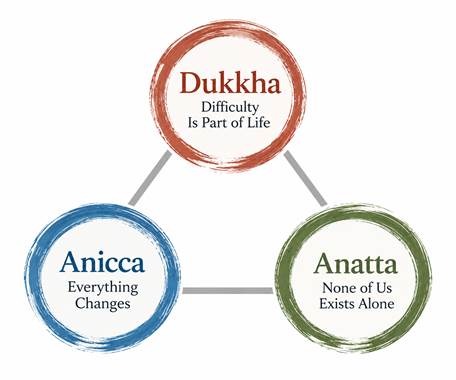
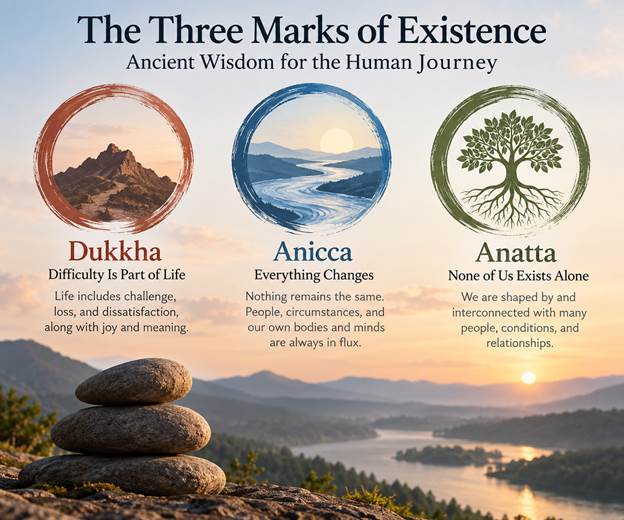
The Three Marks are traditionally described as dukkha, anicca, and anatta. We do not need to become Buddhist scholars to appreciate what they are pointing toward. At their most practical level, they describe three realities most of us eventually discover for ourselves: life includes difficulty, everything changes, and none of us exists entirely on our own.

Knowing these things intellectually is different from accepting them as part of life. Much of our frustration may come not from being unaware of these realities, but from expecting life to operate differently.
Dukkha: Difficulty Is Part of Life

The first Mark, dukkha, is frequently translated as “suffering,” although that can make the concept sound more pessimistic than necessary. Dukkha can also refer to dissatisfaction, discomfort, stress, frustration, loss, or the feeling that life is not unfolding as we would like.

This does not mean life is nothing but suffering. There can be tremendous joy through family, friendship, love, accomplishment, discovery, community, and purpose. Dukkha simply reminds us that none of these completely protects us from difficulty.

People we love change or leave us. Bodies that once seemed nearly indestructible begin requiring greater attention. Careers end, children grow up, relationships change, plans fail, and injuries happen. Even during good periods, we cannot guarantee that circumstances will remain as they are.

Recognizing this does not have to make us pessimistic. Instead of immediately asking, “Why is this happening to me?” we might ask, “How can I work with what is happening?”

Martial arts training provides a useful example. We do not assume every movement will be comfortable or every technique will work perfectly the first time. Resistance is part of training. Losing our balance teaches us something about balance. Fatigue teaches us about efficiency. Difficulty can reveal weaknesses that might otherwise remain hidden. Life often teaches in much the same way.

This does not mean suffering should be glorified or unnecessary hardship tolerated. Self-care means participating in our own well-being and improving what we reasonably can. Yet even with excellent habits and preparation, we cannot eliminate every hardship.

Perhaps the goal is not to construct a life in which nothing difficult happens, but to develop enough physical, emotional, social, and spiritual resilience that difficulty does not destroy our sense of direction. Dukkha can also encourage compassion by reminding us that regardless of health, wealth, status, or accomplishment, everyone carries something.

Anicca: Everything Changes

The second Mark is anicca, usually translated as impermanence. Evidence of impermanence surrounds us. Seasons change. Children become adults. Relationships develop and sometimes end. Our bodies move through different stages of life. Even while sitting still, our hearts beat, blood circulates, thoughts appear and disappear, and emotions shift.

This has interesting parallels with the Taoist understanding of yin and yang. Day becomes night. Summer moves toward autumn. Activity requires rest. Strength changes with age. The world is less like a photograph and more like a river. The difficulty is that human beings often want to freeze the river.

When something feels good, we want it to remain. When something is unpleasant, we want it gone immediately. We may cling to youth, status, possessions, relationships, identities, careers, or beliefs because they provide familiarity and security. Anicca reminds us that permanence was never part of the arrangement.

Yet this can also be reassuring. Difficult periods are subject to change. Pain, grief, fear, and circumstances change. We may not know how quickly or what they will become, but experience continues to move.

Anyone who has practiced tai chi, qigong, meditation, or breathwork has experienced this on a smaller scale. The mind wanders and returns. Tension appears and releases. Breathing changes. Balance continually shifts beneath our feet. What appears stationary is actually an ongoing process of adjustment.

Aging can be viewed similarly. We sometimes treat aging as though something has gone wrong because we cannot do everything exactly as we did decades earlier. Yet change is not a malfunction of life. Change is life.

A person who once relied upon speed may develop timing. Someone who depended upon strength may discover efficiency. External exercise may gradually become balanced with internal practice, mobility, recovery, and greater awareness. What first appears to be loss can sometimes become refinement.

Impermanence also gives value to the present. Time with family matters because it is finite. Health deserves attention because it cannot be taken for granted. Recognizing impermanence does not make life less meaningful. It can make us appreciate what is here, while it is here.

Anatta: None of Us Exists Alone

The third Mark, anatta, is commonly translated as “no-self” or “not-self,” and may be the most easily misunderstood. A practical way of approaching anatta is to question the idea that each of us exists as a completely independent, permanent, isolated self. Consider how many things have contributed to who you are today: family, teachers, friends, adversaries, mentors, communities, education, successes, failures, relationships, occupations, cultural traditions, and chance encounters.

Our physical existence is equally dependent upon conditions outside ourselves. We rely upon air, water, food, sunlight, ecosystems, communities, and countless people we will never meet. When examined closely, the idea of being entirely “self-made” becomes difficult to defend. This does not eliminate personal responsibility. In many ways, it increases it.

Because we are interconnected, our actions rarely affect only ourselves. How we care for our health influences those around us. How we speak contributes to the emotional environment of our families and communities. What teachers share with students may eventually reach people they will never meet.

I have come to appreciate this through teaching. An idea shared with one student may eventually help that person improve their health, assist a spouse, teach a child, or someday teach others. Knowledge moves through human relationships much like ripples across water.

Anatta can also loosen rigid ideas about identity. We sometimes say, “This is just who I am,” as though our personalities, beliefs, and habits were permanently fixed. Yet experience, reflection, relationships, and changing circumstances continually influence us. We do not have to remain psychologically identical to the person we were twenty or forty years ago.
Bringing the Three Marks Into Everyday Life

Considered together, the Three Marks provide a practical framework for navigating the human journey. Difficulty is unavoidable, circumstances continually change, and we experience both within an enormous network of relationships and conditions.

These ideas fit naturally into a holistic understanding of health because human wellness has never been merely physical. Physical health affects emotional well-being. Emotions influence relationships. Relationships affect stress, stress affects physiology, and our environment influences behavior. Everything overlaps.

One lesson I have learned through decades of mind-body practice is that awareness creates a little space between what happens and how we respond. Tai chi teaches us that we do not always need to meet force with greater force. Qigong encourages awareness of changes within ourselves. Meditation teaches us to observe thoughts without automatically following them. Good martial arts training teaches adaptability rather than insisting that one predetermined response must work under every circumstance.

Acceptance should not be confused with surrender. Recognizing reality simply gives us a more accurate starting point from which to act. If it is raining, accepting that it is raining does not mean we have to enjoy being wet. It means arguing with the sky accomplishes very little. Once we recognize conditions as they are, we can decide what to do next.

Perhaps the deeper lesson of the Three Marks is learning to care about life without demanding that life remain exactly as we would like it to be. We can work toward health while understanding that our bodies will change. We can build relationships while recognizing that relationships evolve. We can develop our individual abilities while remembering how much of who we are came through other people. We can make plans while remaining capable of adjusting them when circumstances change.

The Three Marks of Existence do not offer an escape from being human. They offer a way of understanding what being human involves. Life includes difficulty. Life is continually changing. And none of us travels through it entirely alone.

Understanding these realities may not eliminate the challenges before us, but it may help us meet them with greater awareness, adaptability, compassion, gratitude, and perspective as we continue navigating the human journey.

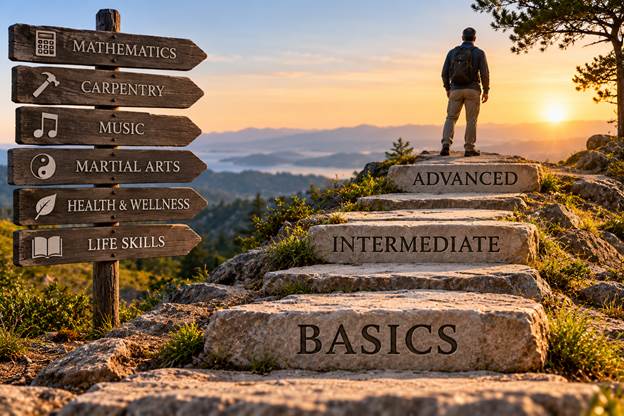
There Is No Advanced Without the Basics

Over many years of teaching martial arts, Tai Chi, Qigong, wellness practices, and other mind-body disciplines, I have occasionally heard people describe something as being โ€œadvancedโ€ while seemingly dismissing the basics that should support it. I have always found this somewhat contradictory. How can something truly be advanced if there is little understanding of the fundamentals upon which it is supposedly built?

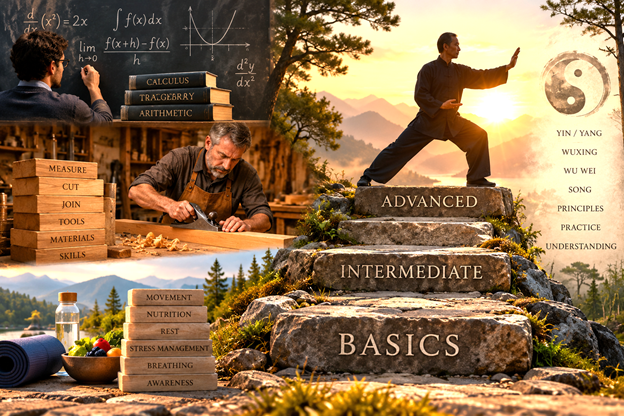
To me, advanced practice does not mean that we have moved beyond the basics and no longer need them. It means that we have developed a deeper understanding of those basics and have learned how to apply, combine, refine, and sometimes adapt them. Before we can meaningfully go beyond the fundamentals, we first need to have something to go beyond.

This seems obvious when we look at almost any established discipline. A mathematician cannot realistically teach calculus without first understanding arithmetic, algebra, and the mathematical principles upon which calculus depends. A master carpenter cannot produce consistently high-level craftsmanship without knowing how to measure accurately, cut properly, understand the characteristics of wood, join materials, and use basic woodworking tools. A concert pianist may perform extraordinarily complex compositions, but that ability still rests upon such fundamentals as scales, timing, rhythm, fingering, and countless hours of basic practice.

The advanced expression may look dramatically different from the fundamentals that preceded it, but those fundamentals are still there. This is particularly apparent in martial arts. A beginner learns where to put the feet, how to position the hands, how to maintain balance, how to shift weight, and how to coordinate the body. These things may seem elementary, especially after years of training, but they never actually stop being important. Balance does not suddenly become irrelevant because someone earns a black belt. Body mechanics do not disappear because someone has practiced for twenty years. Timing, distance, posture, breathing, relaxation, awareness, and coordination remain present in virtually everything that follows. What changes is the practitionerโ€™s relationship with those fundamentals.

I believe the same standard should apply when we use terms such as โ€œadvanced Tai Chi.โ€ It is difficult for me to understand how someone can meaningfully teach advanced Tai Chi while possessing little understanding of the principles that historically and philosophically inform the art. Yin and Yang, for example, is not merely a symbol placed on a Tai Chi school logo. The continual relationship between substantial and insubstantial, opening and closing, rising and sinking, advancing and retreating, tension and relaxation is woven throughout the practice.

Likewise, concepts such as Wuxing, the Five Phases; wu wei, commonly understood as non-forcing or action that accords with circumstances; and song, the cultivated release of unnecessary muscular tension without collapsing the bodyโ€™s structure, provide additional ways of understanding how Tai Chi is practiced and experienced. Different schools and lineages may emphasize these concepts differently, and not every practitioner interprets them in precisely the same manner. Yet claiming increasingly advanced practice while having little familiarity with the foundational ideas, mechanics, and theory of the art seems difficult to reconcile.

When I teach Tai Chi, a beginner may initially be concerned with remembering which foot moves next or where the hands are supposed to go. With experience, those same movements begin to reveal additional layers. The practitioner becomes more aware of weight distribution, alignment, relaxation, coordinated movement, breathing, intention, and sensitivity. Eventually, movements that once required considerable conscious thought become increasingly natural. Interestingly, the outward movement may not have changed very much at all. What has changed is the understanding taking place within it.

This is why an experienced practitioner and a beginner can perform what appears to be the same movement while experiencing it at entirely different levels. Advanced practice is often not about collecting more movements. Sometimes it is about discovering more within the movements we already know.

The same principle extends into health and wellness. Before pursuing complicated training programs, specialized exercises, supplements, recovery technologies, or the latest wellness trend, it makes sense to consider whether the fundamentals are reasonably well established. Regular movement, appropriate nutrition, adequate sleep, stress management, breathing, recovery, and awareness of what our bodies are telling us may sound basic precisely because they are basic. That does not make them unimportant. Quite the opposite. Their importance is why they became fundamentals in the first place.

There is certainly nothing wrong with exploring more sophisticated approaches. I have spent much of my own life studying different systems, methods, traditions, and ideas. But complexity should not be mistaken for advancement. Something does not become more valuable simply because it sounds technical, mysterious, specialized, or difficult. Sometimes the most advanced thing we can do is return to something remarkably simple and understand it better.

I see the same process in education and personal development. We first acquire information and skills. Then we begin to recognize relationships among them. Eventually, we may become capable of questioning, adapting, or even departing from what we originally learned. But there is an important difference between intentionally modifying a principle because we understand it and ignoring a principle because we never learned it.

The carpenter may eventually work almost instinctively, but years of basic woodworking skills made that instinct possible. The mathematician may look at a complicated equation and recognize relationships that a student cannot yet see, but that understanding was built upon simpler mathematics. The experienced Tai Chi practitioner may demonstrate a movement that appears effortless and remarkably simple, but what we see externally may be supported by decades of accumulated understanding. That is very different from simply skipping the foundation.

I also recognize that development does not always follow a perfectly organized progression labeled beginner, intermediate, and advanced. Some traditions introduce sophisticated concepts early. Others repeatedly return to the same material while gradually revealing greater depth. In those systems, the distinction between levels may not always be obvious. The absence of an explicitly labeled intermediate stage does not necessarily mean that intermediate development has been bypassed. What matters is whether a genuine foundation exists.

After more than four decades of martial arts practice, I find it interesting that many of the things I continue to examine are things I encountered near the beginning. Posture, balance, breathing, relaxation, awareness, movement, intention, Yin and Yang, and the relationship between effort and non-forcing have not become less important with experience. If anything, they have become more interesting because I can now recognize layers within them that I could not have appreciated when I first encountered them.

Perhaps that is one of the signs of genuine advancement. Instead of constantly searching for something more complicated, we begin to recognize how much depth was hidden inside the fundamentals all along.

This applies equally well to wellness and life. We can spend enormous amounts of time searching for advanced answers while overlooking basic behaviors and principles that influence us every day. Sometimes progress comes from adding something new. At other times it comes from returning to what we already know and practicing it with greater attention, consistency, and understanding. The basics are not merely the things we learn before becoming advanced.

The basics are the things upon which advanced understanding continues to stand.

Tai Chi Chโ€™uan: From Martial Art to Lifelong Practice

Today, many people encounter Tai Chi in a community center, senior program, health club, hospital wellness program, local park or even in martial arts schools. They see people moving slowly and deliberately, shifting their weight from one leg to another while coordinating the movements of the arms and body. From this perspective, Tai Chi may appear to be a gentle form of exercise, moving meditation, or relaxation practice.

All of those descriptions contain some truth. But they describe what Tai Chi has become for millions of people rather than fully explaining what it originally was.

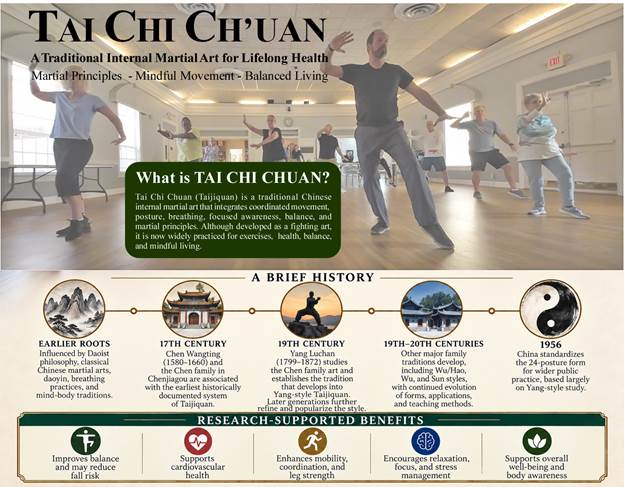
Tai Chi Chโ€™uan, or Taijiquan, is a traditional Chinese martial art.

That distinction is important.

The word quan (ๆ‹ณ) refers to the fist or a system of boxing. Remove that character and Taiji (ๅคชๆฅต) refers more broadly to the philosophical concept of the โ€œSupreme Ultimate,โ€ commonly represented through the familiar yin-yang symbol. Taijiquan therefore represents something more specific: a martial discipline influenced by Chinese concepts of balance, change, complementary forces, body mechanics, awareness, and the cultivation of coordinated movement.

A Martial Art That Learned to Serve Other Purposes

The history of Tai Chi is sometimes presented as though one person invented the entire system at a particular moment. The reality is more complicated.

Chinese martial arts, Daoist philosophy, daoyin exercises, breathing practices, traditional health methods, and theories concerning yin and yang existed long before the recognizable family systems of Taijiquan emerged. Legendary accounts sometimes attribute the creation of Tai Chi to the Daoist figure Zhang Sanfeng, but historians generally treat those stories differently from the more documentable history associated with the Chen family.

By the 17th century, Chen Wangting (1580โ€“1660) and the Chen family of Chenjiagou were developing martial practices that are associated with the earliest historically documented system leading to modern Taijiquan. During the 19th century, Yang Luchan (1799โ€“1872) studied the Chen family art and established the tradition that eventually became Yang-style Taijiquan. Later generations continued to modify and develop the art, while other important family traditions emerged, including Wu/Hao, Wu, and Sun styles.

The Tai Chi practiced today is therefore not one unchanged exercise that has been handed down intact for hundreds of years. It represents generations of development, interpretation, refinement, and adaptation.

One particularly important change occurred in 1956, when Chinese sports authorities developed the standardized 24-posture simplified form. Drawing primarily from Yang-style Tai Chi, the sequence provided a shorter and more accessible way for large numbers of people to learn and practice the art. That development helped Tai Chi move even further beyond the martial arts community.

Why Do We Move So Slowly?

One of the most recognizable characteristics of modern Tai Chi is its slow movement. Yet slowness should not be confused with the purpose of the original martial art.

Moving slowly provides an opportunity to examine posture, alignment, balance, weight transfer, coordination, breathing, muscular tension, and awareness. A movement performed quickly can conceal poor mechanics. Slow it down and suddenly every unnecessary movement becomes much easier to recognize.

Traditional Taijiquan also contains martial applications, partner training, pushing hands, changes of speed, methods of generating power, and, within some traditions, weapons training. The slow forms familiar to the general public represent an important training method, but not the entirety of the art.

This is one reason I prefer to describe Tai Chi as a martial art that can also function as a lifelong health practice, rather than simply calling it a relaxation exercise.

From Fighting Art to Health Practice

Perhaps one of the most interesting things about Tai Chi is that many of the qualities useful for martial training are also valuable for maintaining physical function. A martial artist needs balance. So does an older adult trying to reduce the likelihood of falling. A martial artist needs coordinated movement and controlled weight transfer. Those same abilities help us walk, turn, climb stairs, recover from a stumble, and remain physically independent. A martial artist benefits from relaxed attention rather than unnecessary muscular tension. That same quality can make Tai Chi useful as a method of mindful movement and stress management.

Research has increasingly examined these applications. Systematic reviews and clinical studies have found evidence that Tai Chi can improve balance and physical function and may help reduce fall risk, particularly among older adults. Other research has explored possible benefits involving mobility, strength, cardiovascular function, psychological well-being, and quality of life (Huang et al., 2017; Li et al., 2024; Wayne & Kaptchuk, 2008).

This does not mean that Tai Chi is a cure-all, nor should every traditional claim automatically be converted into a medical claim. Its value does not require exaggeration. A practice that encourages people to move regularly while developing balance, coordination, awareness, controlled breathing, and attention already offers a great deal.

Preserving the Roots While Allowing the Art to Grow

I have practiced and taught Tai Chi and related mind-body disciplines for many years. I believe there is value in understanding where these practices came from, even when we use them for different purposes today.

Someone does not have to become a fighter to benefit from Tai Chi. A person may practice primarily for balance, mobility, stress reduction, social interaction, personal development, or simply because moving feels good. There is nothing inherently wrong with allowing an old practice to serve new purposes. But we should also be careful not to rewrite its history.

Tai Chi did not begin as an exercise program for older adults. It was not originally created as moving meditation, physical therapy, or stress management. These are modern applications of a much broader traditional martial discipline. Perhaps that adaptability is part of what has allowed Tai Chi to survive.

An art that once trained people to respond to physical conflict can now help someone maintain balance at age seventy and older. Principles originally concerned with stability, sensitivity, structure, timing, and efficient movement can help someone become more aware of how they stand, walk, breathe, and interact with their surroundings.

The martial purpose may no longer be the primary interest of many practitioners, but the principles remain within the movements. Understanding those roots does not diminish modern Tai Chi. It gives the practice greater depth.

Tai Chi Chโ€™uan has traveled an extraordinary distance, from traditional Chinese martial culture to parks, hospitals, wellness centers, senior programs, and community classrooms around the world. Along the way, its purpose has expanded. What began primarily as a martial discipline has become something that can accompany us throughout much of life: a practice of movement, balance, awareness, adaptation, and continued learning.

References

Huang, Z.-G., Feng, Y.-H., Li, Y.-H., & Lv, C.-S. (2017). Systematic review and meta-analysis: Tai Chi for preventing falls in older adults. BMJ Open, 7(2), e013661. https://doi.org/10.1136/bmjopen-2016-013661

Li L, Guo S, Ding B and Zhang J (2024) Effectiveness of Tai Chi exercise on balance, falls, and motor function in older adults: a meta-analysis. Front. Med. 11:1486746. doi: 10.3389/fmed.2024.1486746

lWayne, P. M., & Kaptchuk, T. J. (2008). Challenges inherent to t’ai chi research: part I–t’ai chi as a complex multicomponent intervention. Journal of alternative and complementary medicine (New York, N.Y.), 14(1), 95โ€“102. https://doi.org/10.1089/acm.2007.7170a

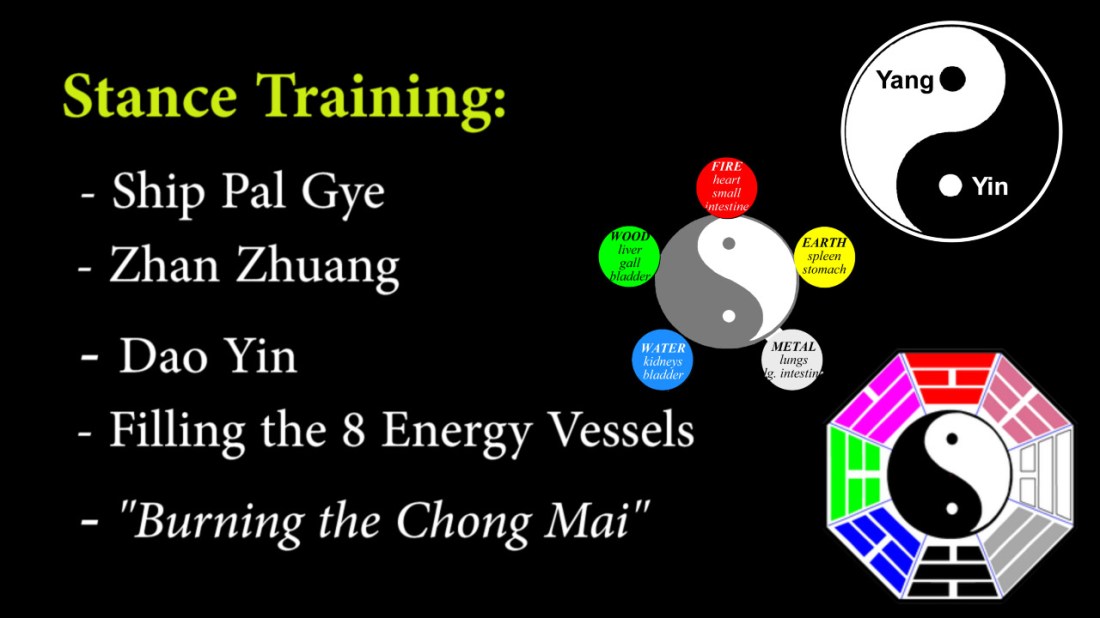
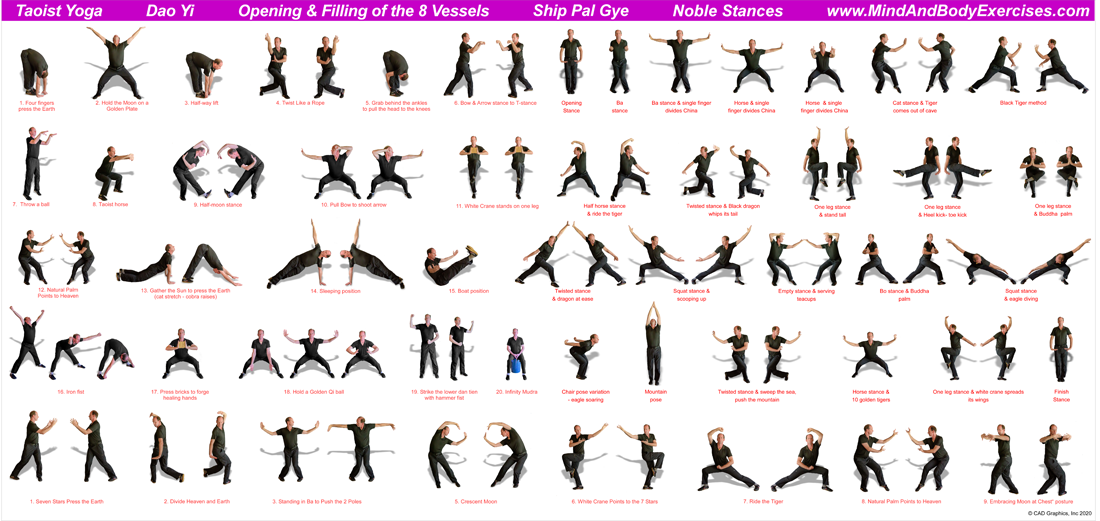
๐‘ท๐’‚๐’ ๐‘ฎ๐’š๐’† 6 (18 ๐‘ธ๐’Š ๐‘ฌ๐’™๐’†๐’“๐’„๐’Š๐’”๐’†๐’”), ๐’๐’‰๐’‚๐’ ๐’๐’‰๐’–๐’‚๐’๐’ˆ (๐‘บ๐’•๐’‚๐’๐’…๐’Š๐’๐’ˆ ๐‘ธ๐’Š๐’ˆ๐’๐’๐’ˆ), & ๐‘ซ๐’‚๐’ ๐’€๐’Š๐’ (๐‘ฎ๐’–๐’Š๐’…๐’Š๐’๐’ˆ ๐‘ธ๐’Š ๐’˜๐’‰๐’Š๐’๐’† ๐’”๐’•๐’“๐’†๐’•๐’„๐’‰๐’Š๐’๐’ˆ)

Stance training is a foundational practice in traditional martial arts and mind-body cultivation, developing physical strength, structural alignment, balance, endurance, concentration, and nervous system resilience. Drawing upon Ship Pal Gye (18 Qi Exercises), Zhan Zhuang (standing Pole Qigong), and Dao Yin (Guiding Qi while stretching) , these exercises integrate intentional posture, controlled breathing, and focused awareness. By progressively increasing the duration and intensity of standing postures, we introduce manageable physical and psychological challenges that encourage adaptation. Rather than reacting to muscular fatigue and discomfort with unnecessary tension, we learn to regulate our breathing, maintain composure, and remain mentally focused. Over time, this deliberate conditioning can improve postural stability, muscular endurance, body awareness, and our ability to manage stress without becoming overwhelmed.

This video also explores traditional Chinese energetic cultivation through the Eight Extraordinary Vessels, including a practice is referred to as “Burning the Chong Mai,” or expansion of the Thrusting Vessel. Within traditional Chinese medicine, these practices are associated with cultivating and regulating Qi throughout the body. From a physiological perspective, progressive stance training challenges the neuromuscular system while providing opportunities to practice autonomic regulation, attentional control, and relaxation under physical demand. The objective is not simply to stand still or tolerate discomfort, but to gradually strengthen our capacity to remain physically stable, mentally focused, and emotionally composed. Through consistent practice, we cultivate greater self-regulation, resilience, and confidence in our ability to respond effectively to life’s challenges