
Over many years of teaching martial arts, Tai Chi, Qigong, wellness practices, and other mind-body disciplines, I have occasionally heard people describe something as being “advanced” while seemingly dismissing the basics that should support it. I have always found this somewhat contradictory. How can something truly be advanced if there is little understanding of the fundamentals upon which it is supposedly built?
To me, advanced practice does not mean that we have moved beyond the basics and no longer need them. It means that we have developed a deeper understanding of those basics and have learned how to apply, combine, refine, and sometimes adapt them. Before we can meaningfully go beyond the fundamentals, we first need to have something to go beyond.

This seems obvious when we look at almost any established discipline. A mathematician cannot realistically teach calculus without first understanding arithmetic, algebra, and the mathematical principles upon which calculus depends. A master carpenter cannot produce consistently high-level craftsmanship without knowing how to measure accurately, cut properly, understand the characteristics of wood, join materials, and use basic woodworking tools. A concert pianist may perform extraordinarily complex compositions, but that ability still rests upon such fundamentals as scales, timing, rhythm, fingering, and countless hours of basic practice.
The advanced expression may look dramatically different from the fundamentals that preceded it, but those fundamentals are still there. This is particularly apparent in martial arts. A beginner learns where to put the feet, how to position the hands, how to maintain balance, how to shift weight, and how to coordinate the body. These things may seem elementary, especially after years of training, but they never actually stop being important. Balance does not suddenly become irrelevant because someone earns a black belt. Body mechanics do not disappear because someone has practiced for twenty years. Timing, distance, posture, breathing, relaxation, awareness, and coordination remain present in virtually everything that follows. What changes is the practitioner’s relationship with those fundamentals.
I believe the same standard should apply when we use terms such as “advanced Tai Chi.” It is difficult for me to understand how someone can meaningfully teach advanced Tai Chi while possessing little understanding of the principles that historically and philosophically inform the art. Yin and Yang, for example, is not merely a symbol placed on a Tai Chi school logo. The continual relationship between substantial and insubstantial, opening and closing, rising and sinking, advancing and retreating, tension and relaxation is woven throughout the practice.
Likewise, concepts such as Wuxing, the Five Phases; wu wei, commonly understood as non-forcing or action that accords with circumstances; and song, the cultivated release of unnecessary muscular tension without collapsing the body’s structure, provide additional ways of understanding how Tai Chi is practiced and experienced. Different schools and lineages may emphasize these concepts differently, and not every practitioner interprets them in precisely the same manner. Yet claiming increasingly advanced practice while having little familiarity with the foundational ideas, mechanics, and theory of the art seems difficult to reconcile.
When I teach Tai Chi, a beginner may initially be concerned with remembering which foot moves next or where the hands are supposed to go. With experience, those same movements begin to reveal additional layers. The practitioner becomes more aware of weight distribution, alignment, relaxation, coordinated movement, breathing, intention, and sensitivity. Eventually, movements that once required considerable conscious thought become increasingly natural. Interestingly, the outward movement may not have changed very much at all. What has changed is the understanding taking place within it.
This is why an experienced practitioner and a beginner can perform what appears to be the same movement while experiencing it at entirely different levels. Advanced practice is often not about collecting more movements. Sometimes it is about discovering more within the movements we already know.
The same principle extends into health and wellness. Before pursuing complicated training programs, specialized exercises, supplements, recovery technologies, or the latest wellness trend, it makes sense to consider whether the fundamentals are reasonably well established. Regular movement, appropriate nutrition, adequate sleep, stress management, breathing, recovery, and awareness of what our bodies are telling us may sound basic precisely because they are basic. That does not make them unimportant. Quite the opposite. Their importance is why they became fundamentals in the first place.
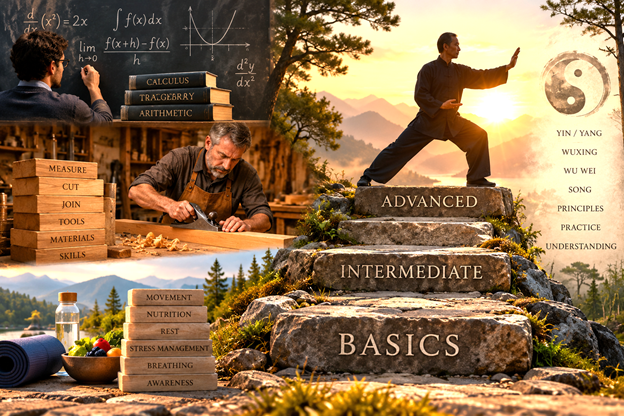
There is certainly nothing wrong with exploring more sophisticated approaches. I have spent much of my own life studying different systems, methods, traditions, and ideas. But complexity should not be mistaken for advancement. Something does not become more valuable simply because it sounds technical, mysterious, specialized, or difficult. Sometimes the most advanced thing we can do is return to something remarkably simple and understand it better.
I see the same process in education and personal development. We first acquire information and skills. Then we begin to recognize relationships among them. Eventually, we may become capable of questioning, adapting, or even departing from what we originally learned. But there is an important difference between intentionally modifying a principle because we understand it and ignoring a principle because we never learned it.
The carpenter may eventually work almost instinctively, but years of basic woodworking skills made that instinct possible. The mathematician may look at a complicated equation and recognize relationships that a student cannot yet see, but that understanding was built upon simpler mathematics. The experienced Tai Chi practitioner may demonstrate a movement that appears effortless and remarkably simple, but what we see externally may be supported by decades of accumulated understanding. That is very different from simply skipping the foundation.
I also recognize that development does not always follow a perfectly organized progression labeled beginner, intermediate, and advanced. Some traditions introduce sophisticated concepts early. Others repeatedly return to the same material while gradually revealing greater depth. In those systems, the distinction between levels may not always be obvious. The absence of an explicitly labeled intermediate stage does not necessarily mean that intermediate development has been bypassed. What matters is whether a genuine foundation exists.
After more than four decades of martial arts practice, I find it interesting that many of the things I continue to examine are things I encountered near the beginning. Posture, balance, breathing, relaxation, awareness, movement, intention, Yin and Yang, and the relationship between effort and non-forcing have not become less important with experience. If anything, they have become more interesting because I can now recognize layers within them that I could not have appreciated when I first encountered them.
Perhaps that is one of the signs of genuine advancement. Instead of constantly searching for something more complicated, we begin to recognize how much depth was hidden inside the fundamentals all along.
This applies equally well to wellness and life. We can spend enormous amounts of time searching for advanced answers while overlooking basic behaviors and principles that influence us every day. Sometimes progress comes from adding something new. At other times it comes from returning to what we already know and practicing it with greater attention, consistency, and understanding. The basics are not merely the things we learn before becoming advanced.
The basics are the things upon which advanced understanding continues to stand.


