
Today, many people encounter Tai Chi in a community center, senior program, health club, hospital wellness program, local park or even in martial arts schools. They see people moving slowly and deliberately, shifting their weight from one leg to another while coordinating the movements of the arms and body. From this perspective, Tai Chi may appear to be a gentle form of exercise, moving meditation, or relaxation practice.
All of those descriptions contain some truth. But they describe what Tai Chi has become for millions of people rather than fully explaining what it originally was.
Tai Chi Ch’uan, or Taijiquan, is a traditional Chinese martial art.
That distinction is important.
The word quan (拳) refers to the fist or a system of boxing. Remove that character and Taiji (太極) refers more broadly to the philosophical concept of the “Supreme Ultimate,” commonly represented through the familiar yin-yang symbol. Taijiquan therefore represents something more specific: a martial discipline influenced by Chinese concepts of balance, change, complementary forces, body mechanics, awareness, and the cultivation of coordinated movement.
A Martial Art That Learned to Serve Other Purposes
The history of Tai Chi is sometimes presented as though one person invented the entire system at a particular moment. The reality is more complicated.
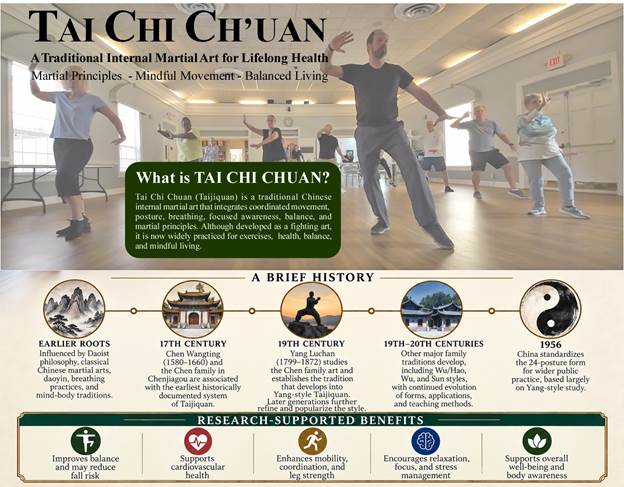
Chinese martial arts, Daoist philosophy, daoyin exercises, breathing practices, traditional health methods, and theories concerning yin and yang existed long before the recognizable family systems of Taijiquan emerged. Legendary accounts sometimes attribute the creation of Tai Chi to the Daoist figure Zhang Sanfeng, but historians generally treat those stories differently from the more documentable history associated with the Chen family.
By the 17th century, Chen Wangting (1580–1660) and the Chen family of Chenjiagou were developing martial practices that are associated with the earliest historically documented system leading to modern Taijiquan. During the 19th century, Yang Luchan (1799–1872) studied the Chen family art and established the tradition that eventually became Yang-style Taijiquan. Later generations continued to modify and develop the art, while other important family traditions emerged, including Wu/Hao, Wu, and Sun styles.
The Tai Chi practiced today is therefore not one unchanged exercise that has been handed down intact for hundreds of years. It represents generations of development, interpretation, refinement, and adaptation.
One particularly important change occurred in 1956, when Chinese sports authorities developed the standardized 24-posture simplified form. Drawing primarily from Yang-style Tai Chi, the sequence provided a shorter and more accessible way for large numbers of people to learn and practice the art. That development helped Tai Chi move even further beyond the martial arts community.
Why Do We Move So Slowly?
One of the most recognizable characteristics of modern Tai Chi is its slow movement. Yet slowness should not be confused with the purpose of the original martial art.
Moving slowly provides an opportunity to examine posture, alignment, balance, weight transfer, coordination, breathing, muscular tension, and awareness. A movement performed quickly can conceal poor mechanics. Slow it down and suddenly every unnecessary movement becomes much easier to recognize.
Traditional Taijiquan also contains martial applications, partner training, pushing hands, changes of speed, methods of generating power, and, within some traditions, weapons training. The slow forms familiar to the general public represent an important training method, but not the entirety of the art.
This is one reason I prefer to describe Tai Chi as a martial art that can also function as a lifelong health practice, rather than simply calling it a relaxation exercise.
From Fighting Art to Health Practice
Perhaps one of the most interesting things about Tai Chi is that many of the qualities useful for martial training are also valuable for maintaining physical function. A martial artist needs balance. So does an older adult trying to reduce the likelihood of falling. A martial artist needs coordinated movement and controlled weight transfer. Those same abilities help us walk, turn, climb stairs, recover from a stumble, and remain physically independent. A martial artist benefits from relaxed attention rather than unnecessary muscular tension. That same quality can make Tai Chi useful as a method of mindful movement and stress management.
Research has increasingly examined these applications. Systematic reviews and clinical studies have found evidence that Tai Chi can improve balance and physical function and may help reduce fall risk, particularly among older adults. Other research has explored possible benefits involving mobility, strength, cardiovascular function, psychological well-being, and quality of life (Huang et al., 2017; Li et al., 2024; Wayne & Kaptchuk, 2008).
This does not mean that Tai Chi is a cure-all, nor should every traditional claim automatically be converted into a medical claim. Its value does not require exaggeration. A practice that encourages people to move regularly while developing balance, coordination, awareness, controlled breathing, and attention already offers a great deal.
Preserving the Roots While Allowing the Art to Grow
I have practiced and taught Tai Chi and related mind-body disciplines for many years. I believe there is value in understanding where these practices came from, even when we use them for different purposes today.
Someone does not have to become a fighter to benefit from Tai Chi. A person may practice primarily for balance, mobility, stress reduction, social interaction, personal development, or simply because moving feels good. There is nothing inherently wrong with allowing an old practice to serve new purposes. But we should also be careful not to rewrite its history.
Tai Chi did not begin as an exercise program for older adults. It was not originally created as moving meditation, physical therapy, or stress management. These are modern applications of a much broader traditional martial discipline. Perhaps that adaptability is part of what has allowed Tai Chi to survive.
An art that once trained people to respond to physical conflict can now help someone maintain balance at age seventy and older. Principles originally concerned with stability, sensitivity, structure, timing, and efficient movement can help someone become more aware of how they stand, walk, breathe, and interact with their surroundings.
The martial purpose may no longer be the primary interest of many practitioners, but the principles remain within the movements. Understanding those roots does not diminish modern Tai Chi. It gives the practice greater depth.
Tai Chi Ch’uan has traveled an extraordinary distance, from traditional Chinese martial culture to parks, hospitals, wellness centers, senior programs, and community classrooms around the world. Along the way, its purpose has expanded. What began primarily as a martial discipline has become something that can accompany us throughout much of life: a practice of movement, balance, awareness, adaptation, and continued learning.
References
Huang, Z.-G., Feng, Y.-H., Li, Y.-H., & Lv, C.-S. (2017). Systematic review and meta-analysis: Tai Chi for preventing falls in older adults. BMJ Open, 7(2), e013661. https://doi.org/10.1136/bmjopen-2016-013661
Li L, Guo S, Ding B and Zhang J (2024) Effectiveness of Tai Chi exercise on balance, falls, and motor function in older adults: a meta-analysis. Front. Med. 11:1486746. doi: 10.3389/fmed.2024.1486746
lWayne, P. M., & Kaptchuk, T. J. (2008). Challenges inherent to t’ai chi research: part I–t’ai chi as a complex multicomponent intervention. Journal of alternative and complementary medicine (New York, N.Y.), 14(1), 95–102. https://doi.org/10.1089/acm.2007.7170a


