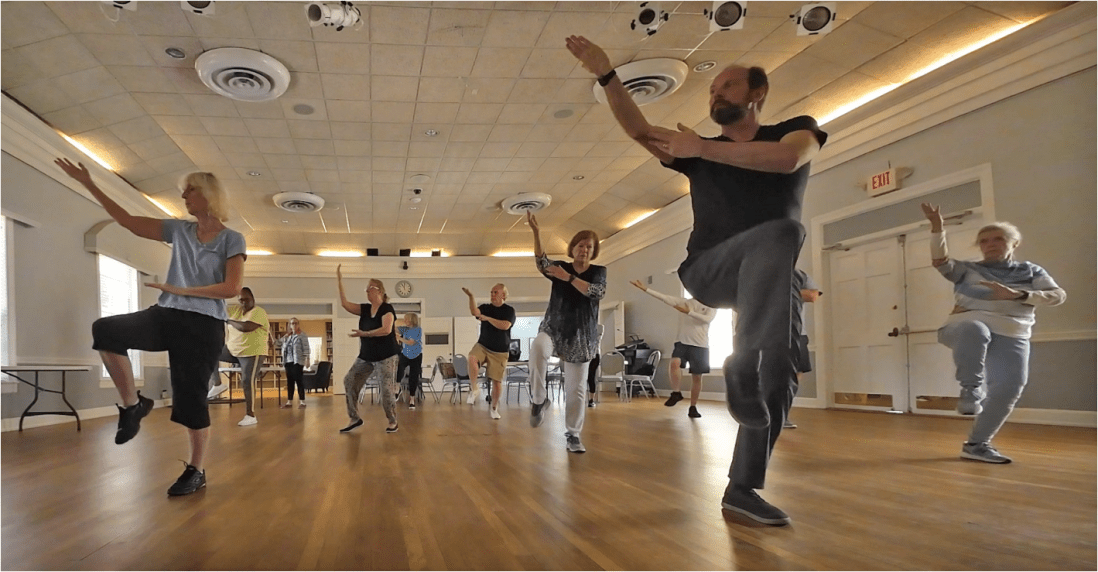
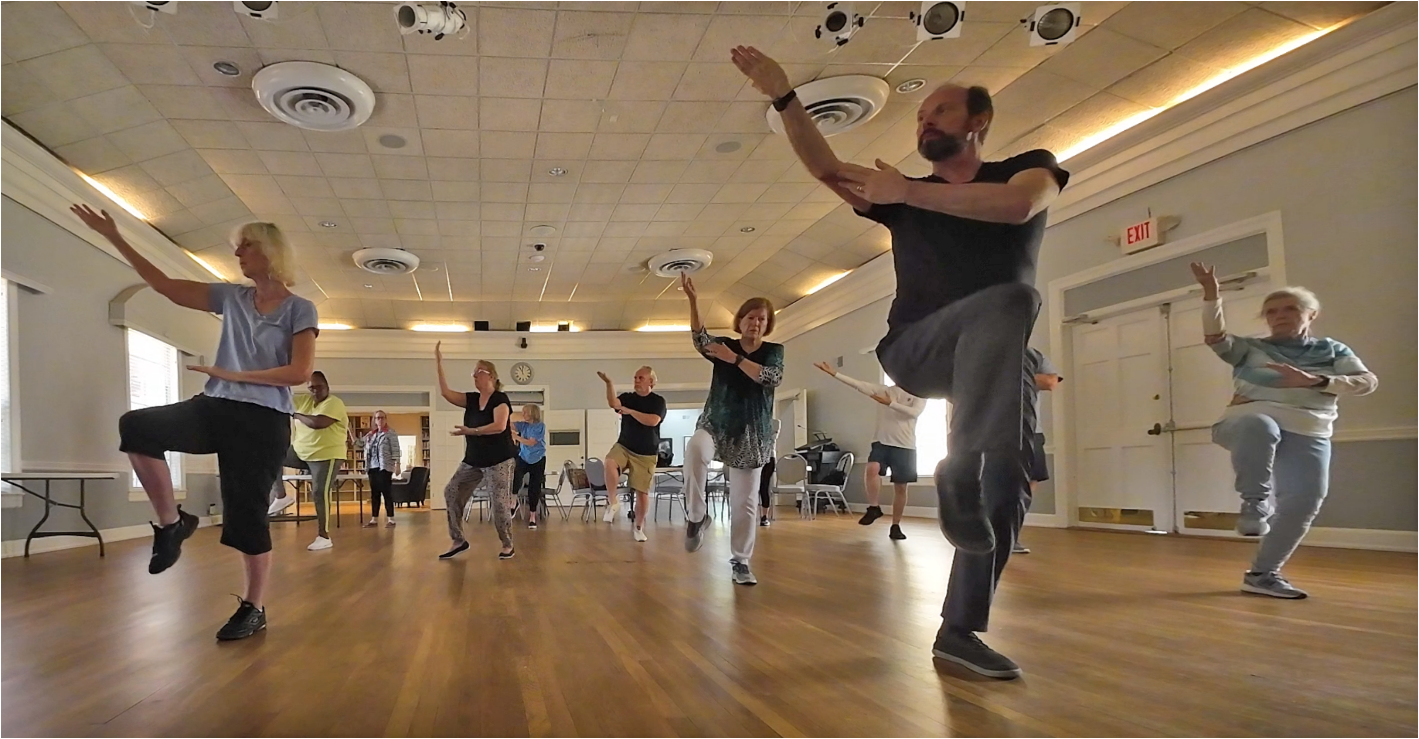
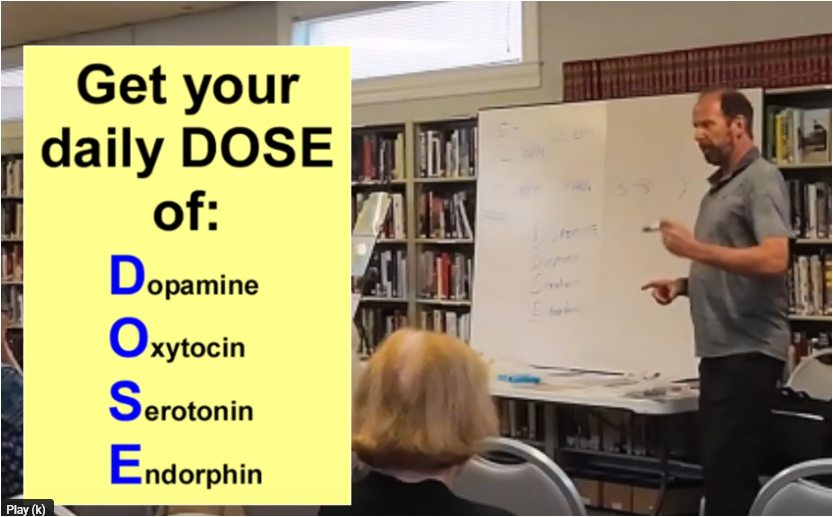
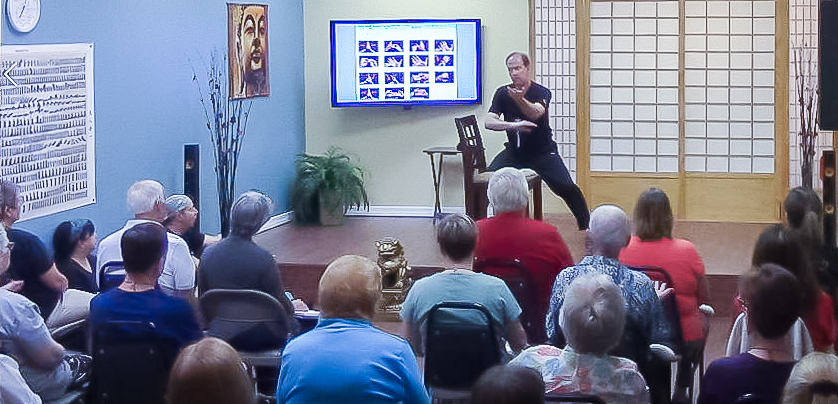
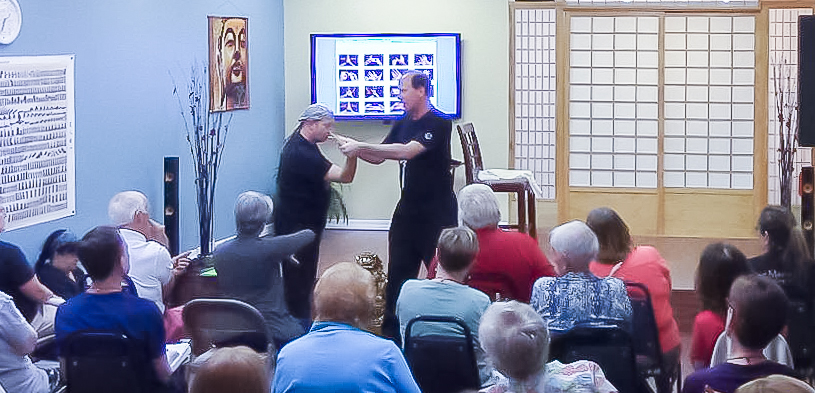
Last week I led a discussion on improving balance (mental, physical, and spiritual awareness) at the University Club of Winter Park, I would gladly speak again at other locations if anyone cares to reach out to me. Below is a brief summary of the topics that were discussed.
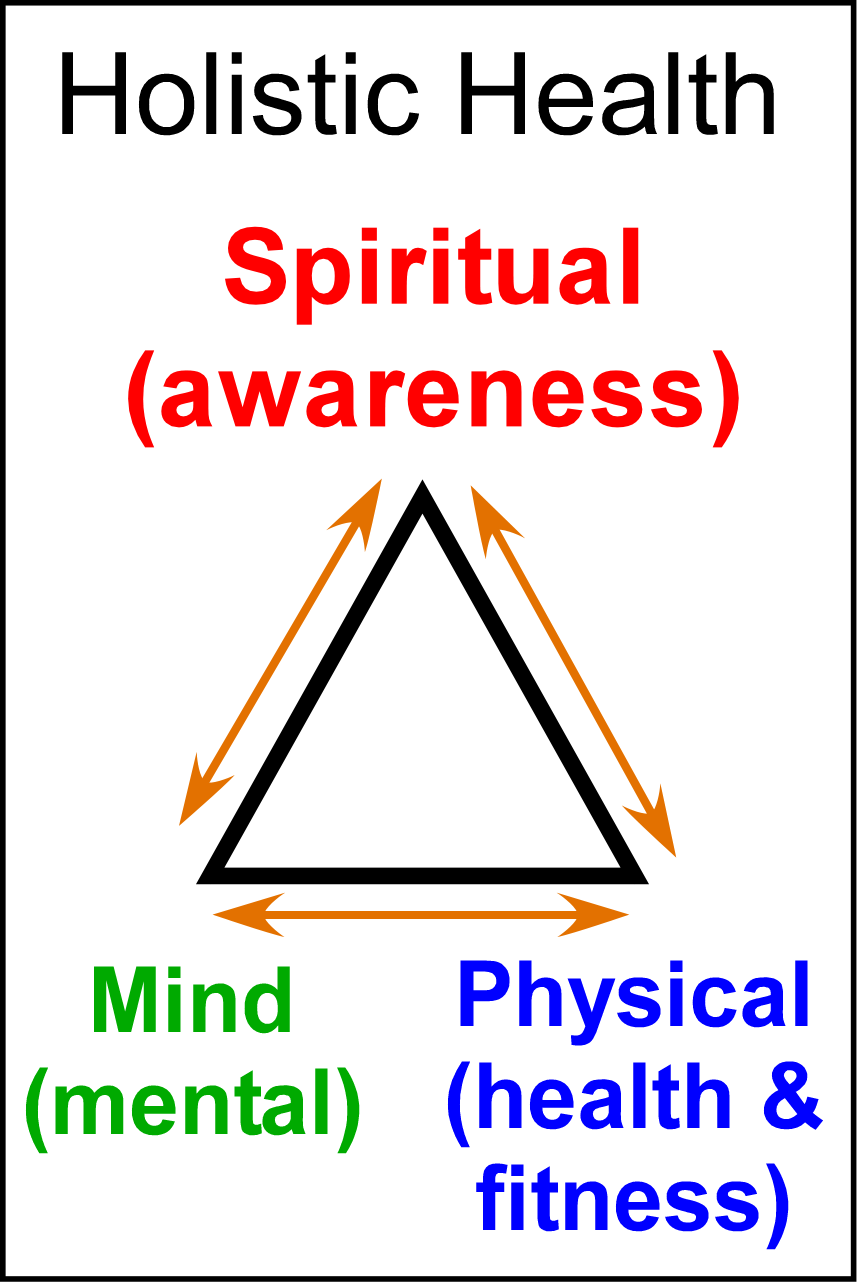
This video was a discussion about holistic health, which is a way of looking at the whole person, including the physical, mental, and spiritual aspects. Harmony is achieved when the physical, mental, and spiritual aspects are in balance. These components are all deeply interconnected. If you are physically balanced, you are more likely to feel mentally balanced. If you are mentally balanced, you are more likely to be able to connect with your spirituality.
The following main components of balance:
Physical balance: This refers to the ability to maintain your equilibrium. It is important for many activities, such as walking, running, and playing sports.
Mental balance: This refers to the ability to manage your thoughts and emotions. It is important for your overall well-being and for your ability to cope with stress.
Spiritual balance: This refers to your sense of connection to something larger than yourself. It can be a connection to nature, to other people, or to a higher power.
I offered some tips on how to improve balance. These tips include:
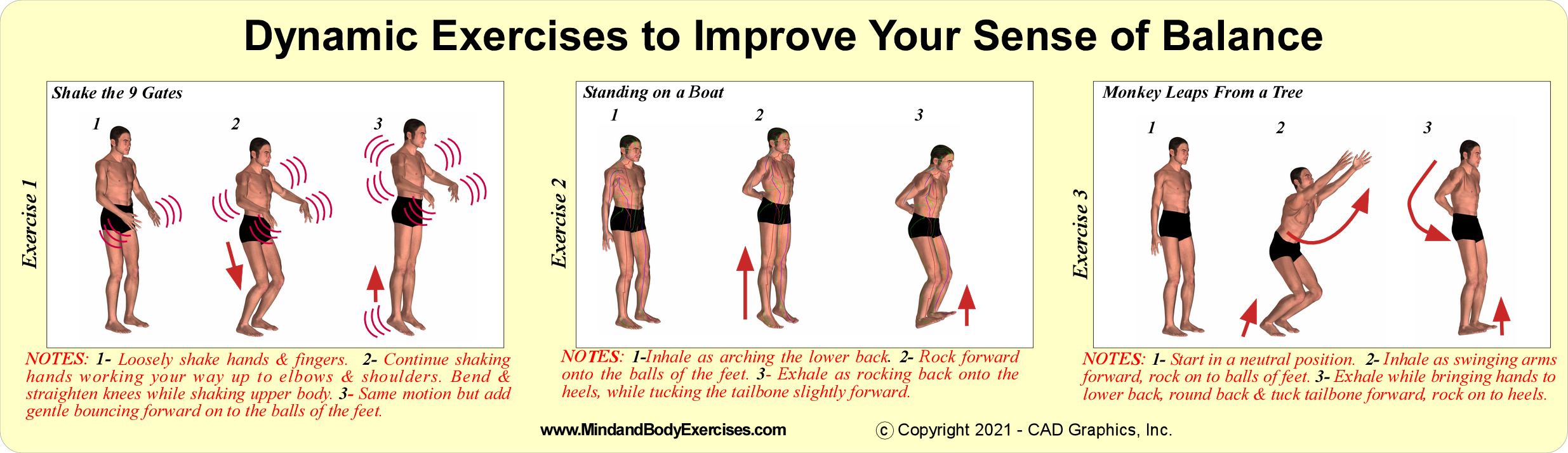
Doing balance exercises regularly. There are many different balance exercises that you can do, such as practicing tai chi, qigong, yoga, pilates, standing on one leg, or even walking on uneven surfaces.
Practicing mindfulness. Mindfulness is the practice of paying attention to the present moment without judgment. It can help you to reduce stress and improve your mental balance.
____________
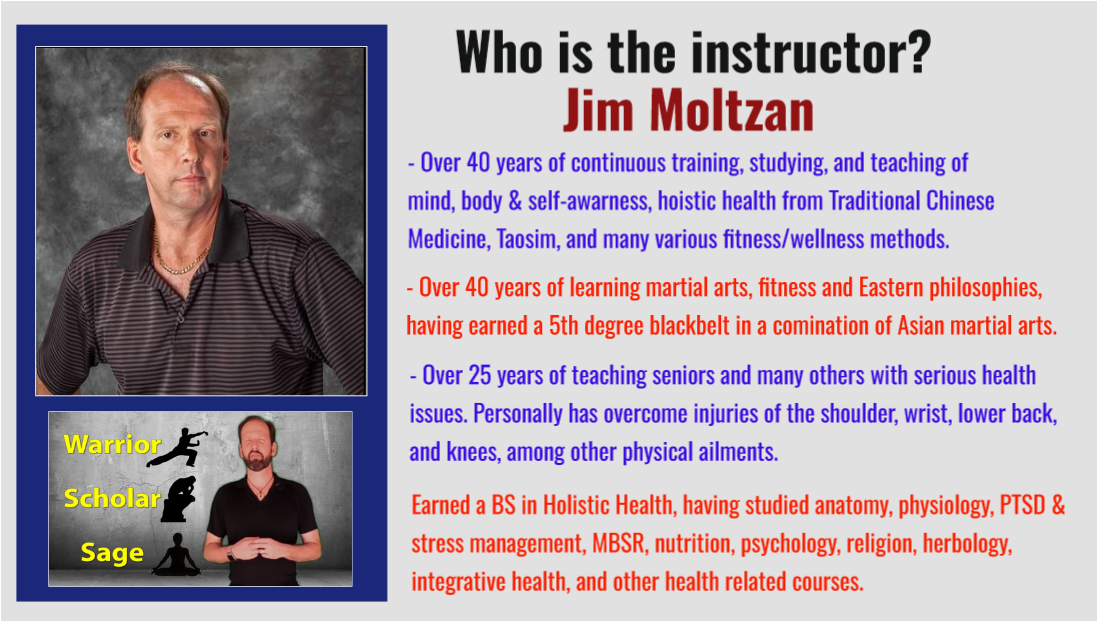
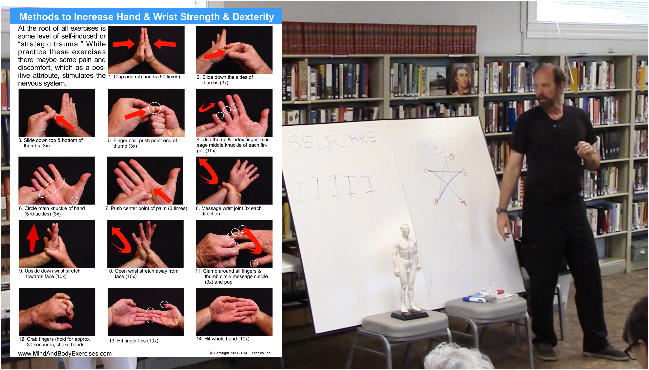
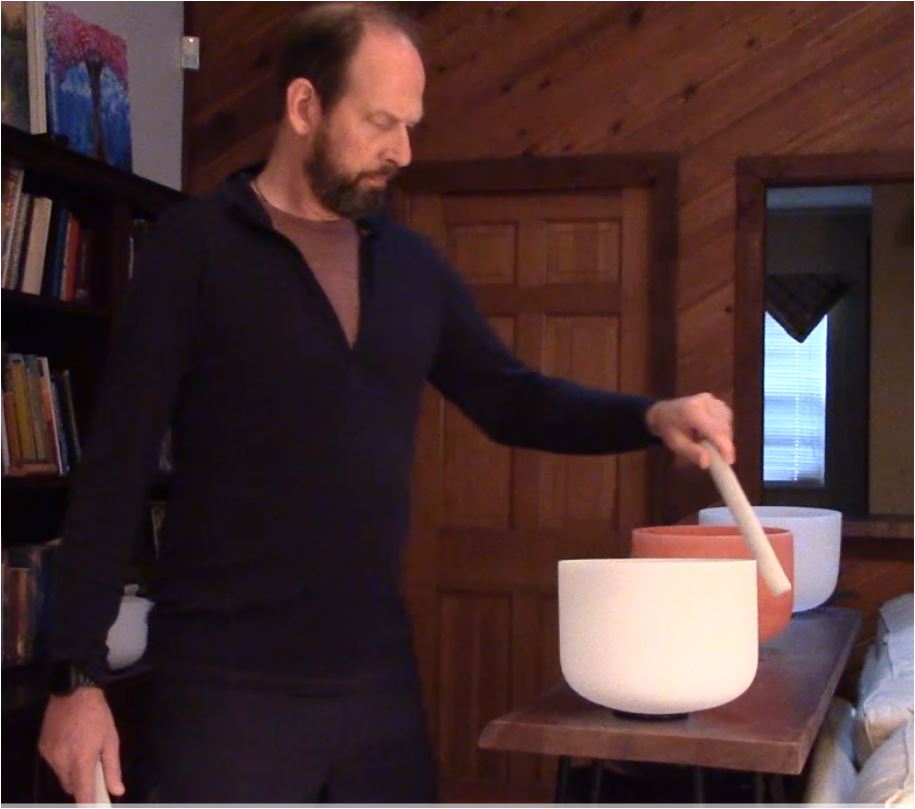
I teach and offer lectures about holistic health, physical fitness, stress management, human behavior, meditation, phytotherapy (herbs), music for healing, self-massage (acupressure), Daoyin (yoga), qigong, tai chi, and baguazhang.
Please contact me if you, your business, organization, or group, might be interested in hosting me to speak on a wide spectrum of topics relative to better health, fitness, and well-being.
I look forward to further sharing more of my message by partnering with hospitals, wellness centers, VA centers, schools on all levels, businesses, and individuals who see the value in building a stronger nation through building a healthier population.
I also have hundreds of FREE education video classes, lectures, and seminars available on my YouTube channel at:
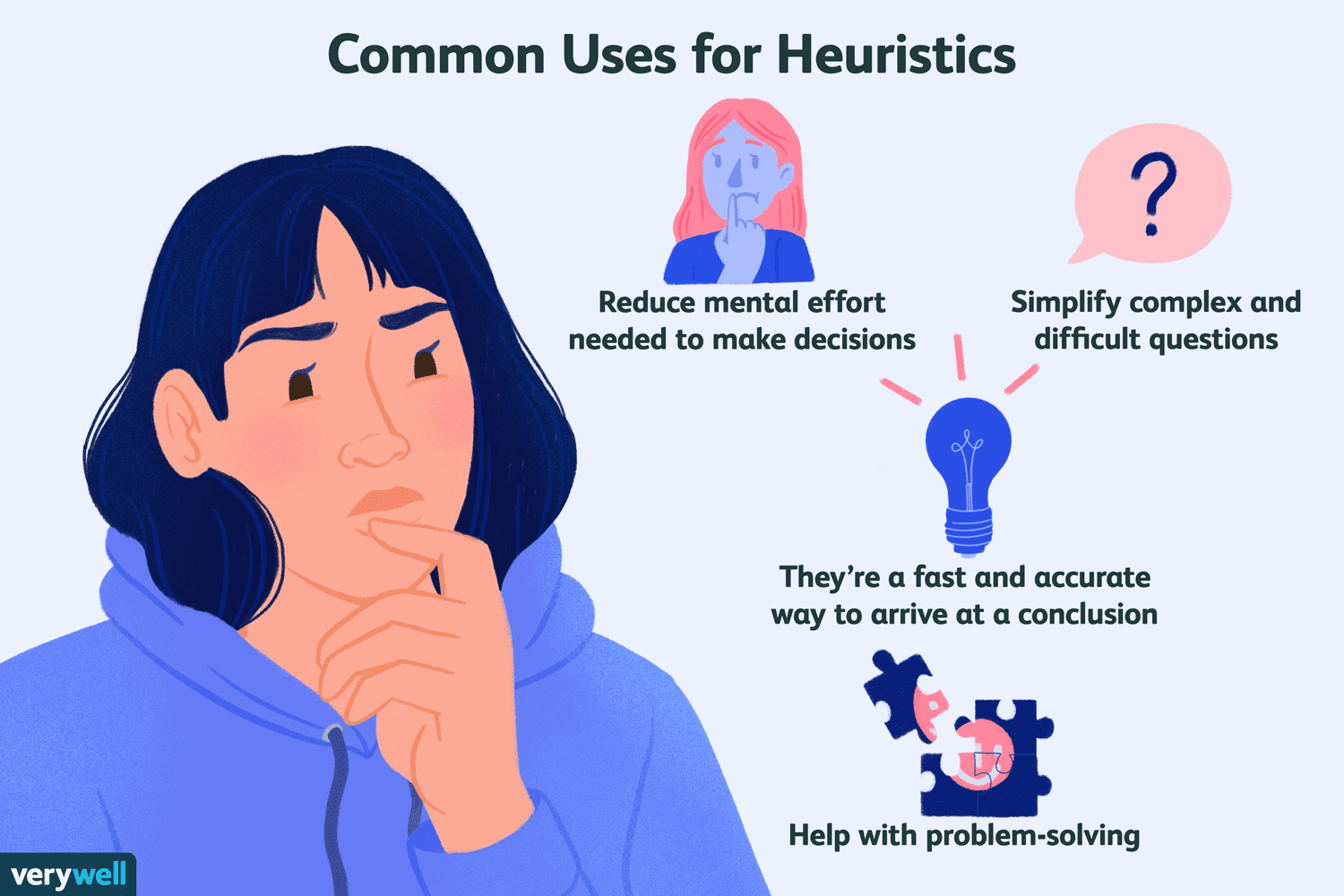
Have you ever made an important choice based on a gut feeling, only to later realize that it wasn’t as logical as you previously thought? Chances are, the availability heuristic played a role.
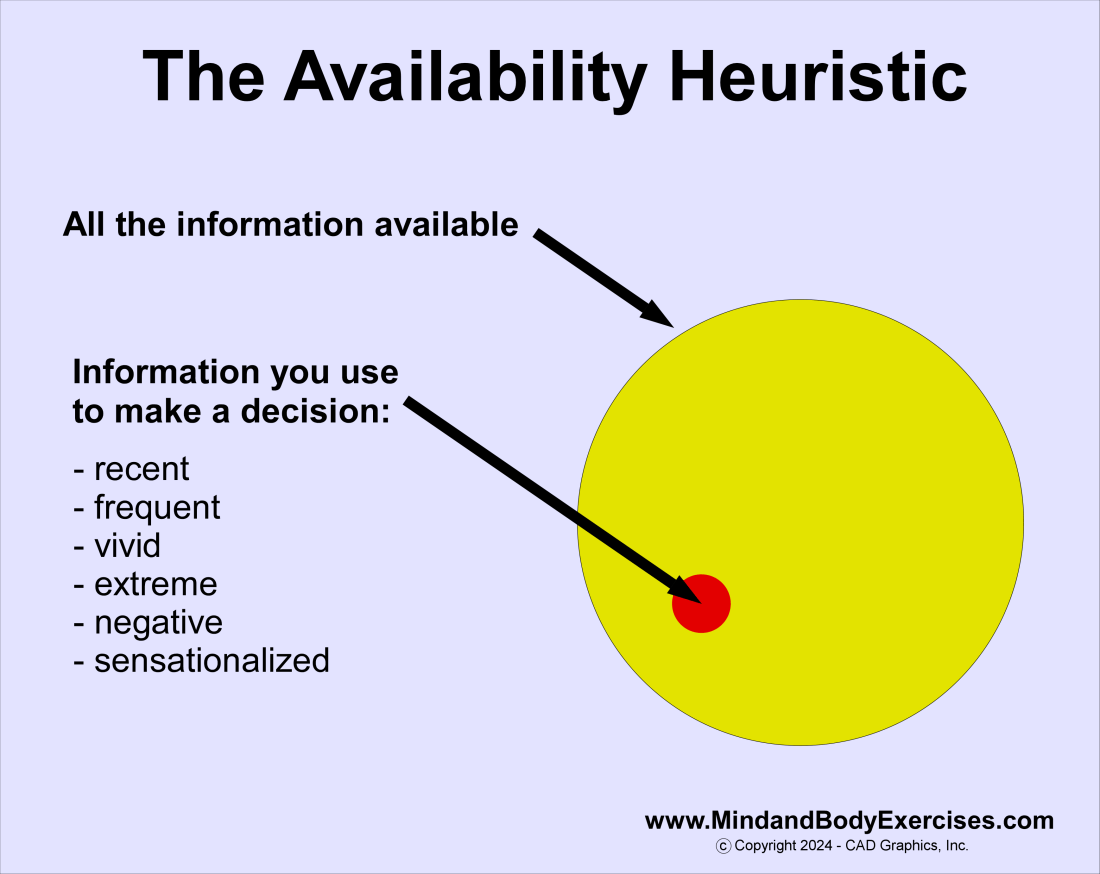
In today’s fast-paced world, information is just a click away, allowing our brains to take shortcuts to make sense of the overwhelming amount of data we encounter. One such psychological shortcut is the availability heuristic or availability bias, a cognitive bias that influences how we perceive and judge the world around us. These terms have gained some awareness in recent times. Availability heuristic is a cognitive bias or mental shortcut that entails making judgments about the likelihood of events based on how readily and easily examples come to mind. People have a propensity to rely on information that is readily available in their memory and may make uninformed decisions based on their immediate environment, rather than taking into account more logical, comprehensive, or statistically accurate data. Examples of this abound in today’s highly polarized facets of society such as politics, economics, science, healthcare, and others where the internet, social media, and word of mouth play major roles in shaping individuals’ reality.
A common example of the availability heuristic is the fear of commercial flying despite its statistical safety record. Due to the intense media coverage of plane crashes, these rare events are more readily recalled, leading to an exaggerated perception of the risks associated with flying. In contrast, the routine nature of safe flights doesn’t leave a strong impression, even though driving a car is statistically far more dangerous.
The availability heuristic may include some of the following memory and recall biases:
Ease of Recall: If something is easily brought to mind, it may be perceived as more likely or significant. People often judge the probability of events based on how easily they can recall examples.
Media Influence: Events that draw more media coverage or are more sensationalized are more likely to be at the forefront of people’s minds, leading to an overestimation of the likelihood of such events occurring.
Personal Experience: People may draw from their own personal experiences or the experiences of others they know when determining probabilities, even when these experiences are not necessarily representative of the overall statistical likelihood.
Familiarity – Favoring options that are well-known or have been encountered frequently.
Fluency – Judging something as more likely or better because it is easier to process or understand.
Recognition – Preferring options that are familiar or well-known over those that are unknown.
Other types of availability heuristic would be:
Decision-making strategies:
Satisficing – Choosing an option that meets the minimum criteria, rather than seeking the best possible solution.
Elimination by Aspects – Sequentially eliminating options by focusing on one attribute at a time until only one remains. Also known as the process of elimination.
Tallying – Summing up positive aspects for each option and choosing the one with the highest total.
Take the Best – Making decisions by focusing on the most important attributes, such as size, cost, value, etc.
Naive Diversification – Spreading choices across a variety of options without a deeper thought process.
Influence of emotions and perceptions:
Affect – Making decisions based on emotions and feelings rather than objective analysis.
Social Proof – Assuming that the actions and behaviors of others reflect the correct behavior in a given situation.
Effort – Estimating the value of something based on the amount of effort required to obtain it.
Similarity – Assessing outcomes based on how similar an option is to a known category or case.
Probability and risk perception bias:
Neglect of Base Rates: The availability heuristic can lead people to disregard base rates or broader statistical information when making decisions and judgments. Instead, they may focus on memorable instances.
Scarcity – thinking something is more valuable when it is less available or limited in quantity.
Representativeness – Judging the likelihood of something based on how closely it resembles a typical case.
Anchoring and Adjustment – Relying mostly on the first piece of information (anchor) and making adjustments based on it.
Cognitive shortcuts and simplifications:
Contagion – Believing that physical objects can transfer properties through physical contact or association.
Hiatus – Assuming that a long pause in a particular pattern makes it less likely to continue.
Simulation – Predicting outcomes based on how easily one can imagine or simulate them in their mind.
Gaze – Using the direction of one’s gaze to make decisions or influence actions.
In a world where we’re constantly exposed to sensory information, it’s important to recognize when the availability heuristic might be impacting our decisions. By being aware of these biases, we can attempt to make more informed choices, relying not just on what comes to mind first but on a broader, more accurate set of data.
I teach and offer lectures about holistic health, physical fitness, stress management, human behavior, meditation, phytotherapy (herbs), music for healing, self-massage (acupressure), Daoyin (yoga), qigong, tai chi, and baguazhang.
Please contact me if you, your business, organization, or group, might be interested in hosting me to speak on a wide spectrum of topics relative to better health, fitness, and well-being.
I look forward to further sharing more of my message by partnering with hospitals, wellness centers, VA centers, schools on all levels, businesses, and individuals who see the value in building a stronger nation through building a healthier population.
I also have hundreds of FREE education video classes, lectures, and seminars available on my YouTube channel at:
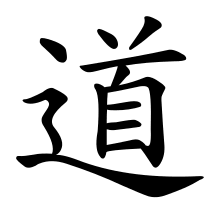
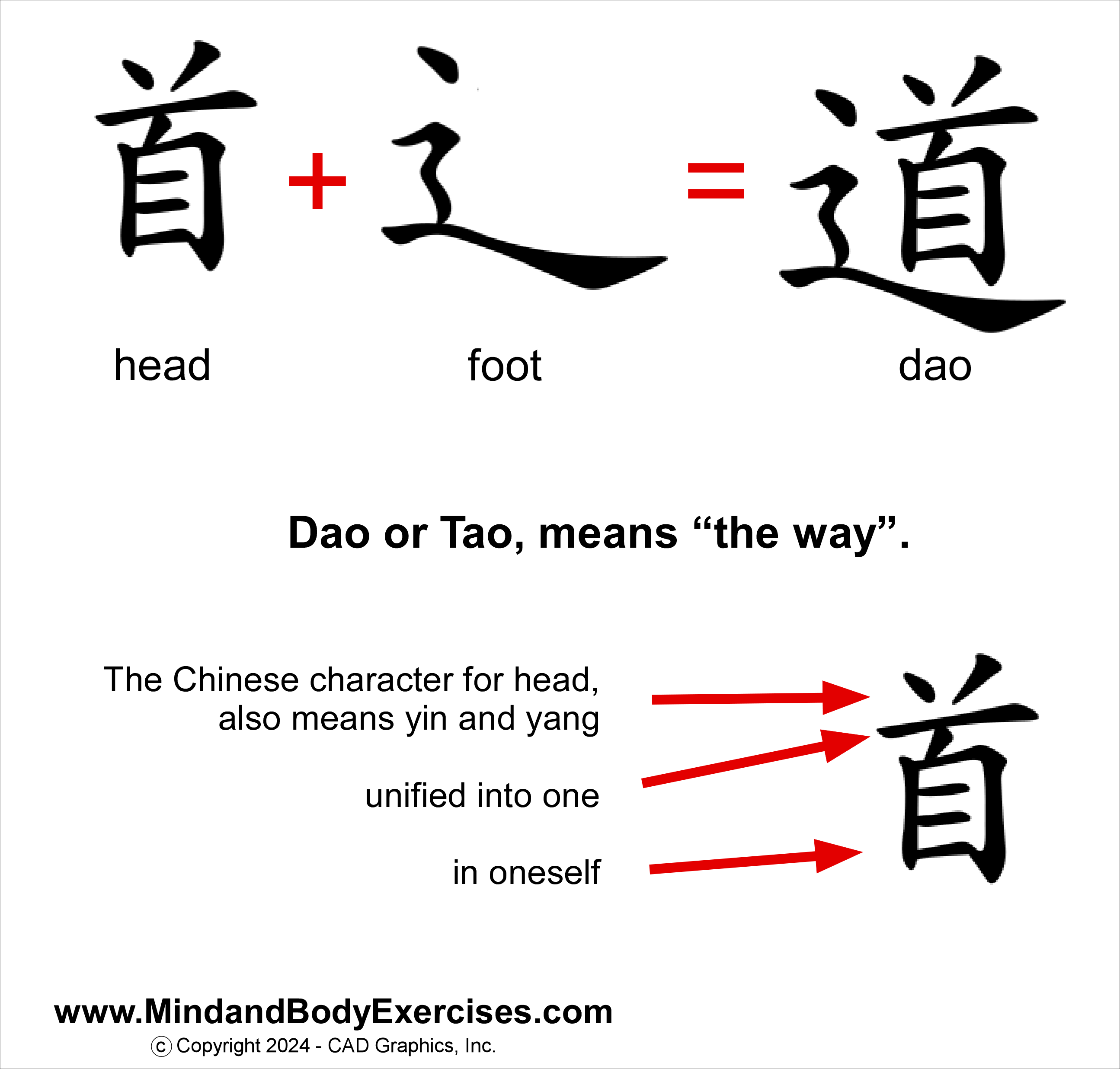
Taoism or Daoism is based upon the concept of the Tao (or Dao) and its literal meaning of the path, or way. The Tao is the main principle of Taoism, where the Tao is seen as the natural order of the universe. This understanding of the universe and all-encompassing things within whether alive or inanimate, cannot be defined in mere words, but rather become known through actual living experience in everyday beings (Smith, 2009). The Taoist individual becomes more reliant upon their own intuition in order to understand the potential for their own individual wisdom. The universe came into being with us together; with us, all things are one. The Tao is simply inconceivable, and therefore it is useless to say another word about it. Intuitively, we know there is a dimension of ourselves and of nature that eludes us because it is too close, too general, and too all-embracing to be singled out as a particular object. This dimension is the ground of all the astonishing forms and experiences of which we are aware. Because we are aware, it cannot be unconscious, although we are not conscious of it as an external thing. We can give it a name but cannot make any definitive statement about it. The only way of apprehending it is by watching the process and patterns of nature and by the meditative discipline of allowing our minds to become quiet, to have a vivid awareness of “what is” without verbal comment.
Visual representation of the Chinese character for “the Tao”
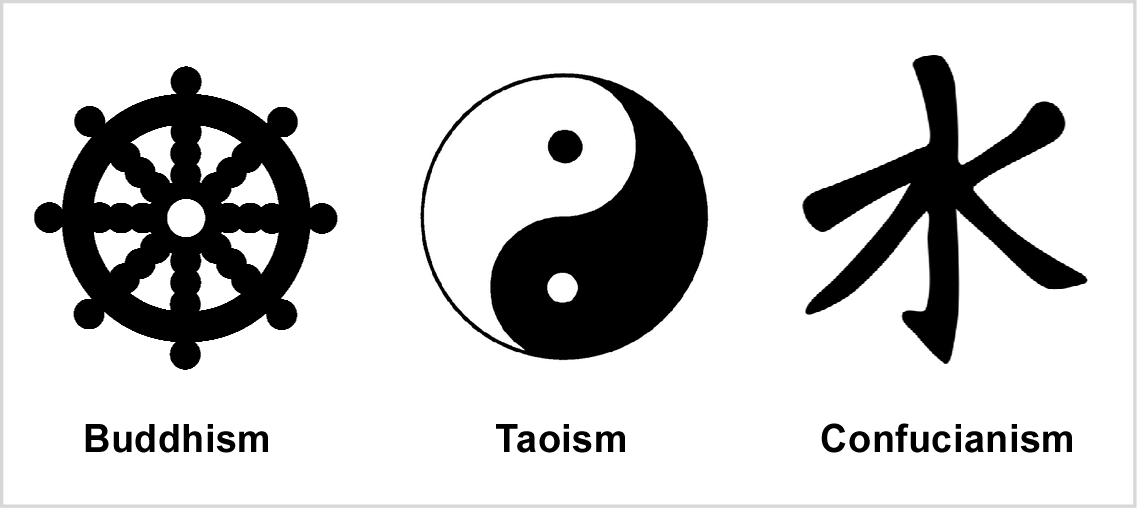
Chinese culture and its views on religion have evolved over many centuries with Confucianism, Taoism, and Buddhism being considered the “three pillars” of ancient Chinese society (National Geographic Society, 2022). Consequently, most Chinese people have practiced Confucianism in their ethics and public life, Taoism in their private life and hygiene, and Buddhism at the time of death, along with shamanistic folk religion also added in along the way. “Every Chinese wears a Confucian hat, Taoist robes, and Buddhist sandals” (Smith, 2009).
There are 3 main types of Taoism. The first type is referred to as philosophical Taoism, where it is essentially a frame of mind, where the goal is to conserve one’s te or power, by expending it efficiently. This type of Taoism holds the main concept of wu wei, meaning “inaction” but in Taoism means pure effectiveness. Wu wei is an action in which the individual strives to minimize conflict in relationships and be in harmony with nature (Smith, 2009). This concept more simply stated would be to learn to “go with the flow”. Attempting to exist in opposition to the Tao, one will eventually be consumed by it. Striving to live in harmony with the Tao or more specifically wu wei, will benefit from this relationship. Living more in harmony with the Tao can be often seen as being more out in the world and nature to experience its gifts while living a life interacting with nature as well as with others.
A second type of Taoism is “vitalizing” where practitioners strive to maximize their life force, also called qi or chi. These adepts worked with their minds, matter, and physical movement, to increase their life force (Smith, 2009). Some may find this branch of Taoism as more unusual or unfamiliar as Huston Smith called it a “vitality cult” (Smith, 2009). Most belief systems and/or religions are based upon the unknown, mysteries, and unconfirmed facts. To the uninformed, what is considered one person’s religion may very well be another person’s cult.
A third type of Taoism was influenced by Buddhism, being that of Religious Taoism. Here the actions of psychics, free-lance soothsayers, shamans, and faith healers who may have come by their powers naturally, religious Taoism institutionalized these activities (Smith, 2009). Religious Taoism appears as a crude superstition to the uneducated. At the time of Smith’s observation, science knew little of what energy is, how it proceeds, or the means by which it can be utilized (Smith, 2009). However, currently, we do know about faith healing engaging energies, including faith in oneself. Placebos are now known and proven to have various healing effects mentally, physically, and/or spiritually.
I have had much firsthand experience with all 3 of these types of Taoism along with Buddhism and Confucianism, as a philosophical lifestyle, as my martial arts and qigong lineages are deeply rooted within these belief systems. I did not priorly nor formally study any of these philosophies but rather lived with them in my life. I see the concepts and principles found within these philosophies as being highly relevant to my everyday routine. I was raised within the Christian Church and more specifically the Lutheran and Disciples of Christ branches. Taoism does not oppose nor contradict these Christian faiths but rather supports morals and ethics found in many other religions.
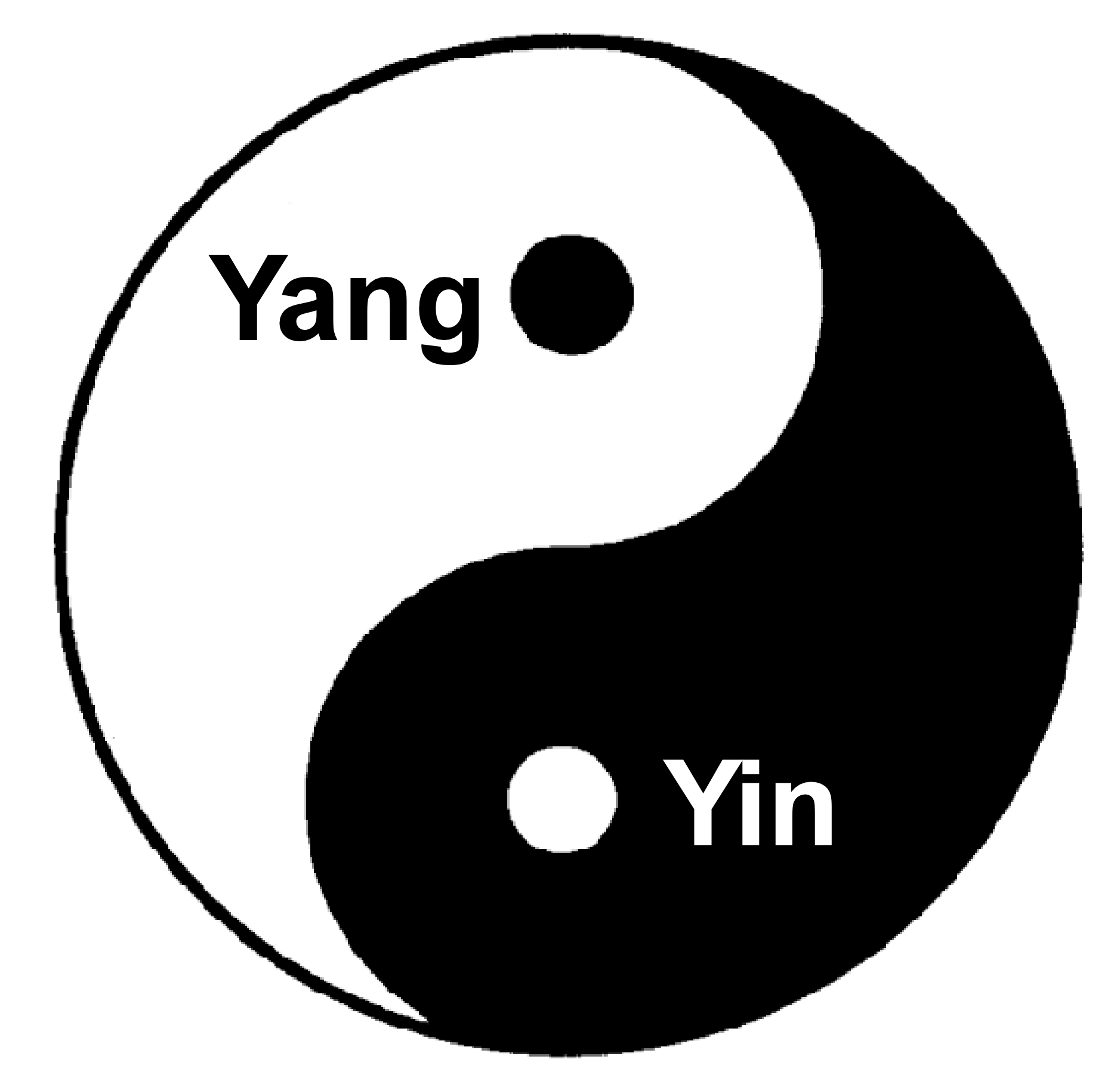
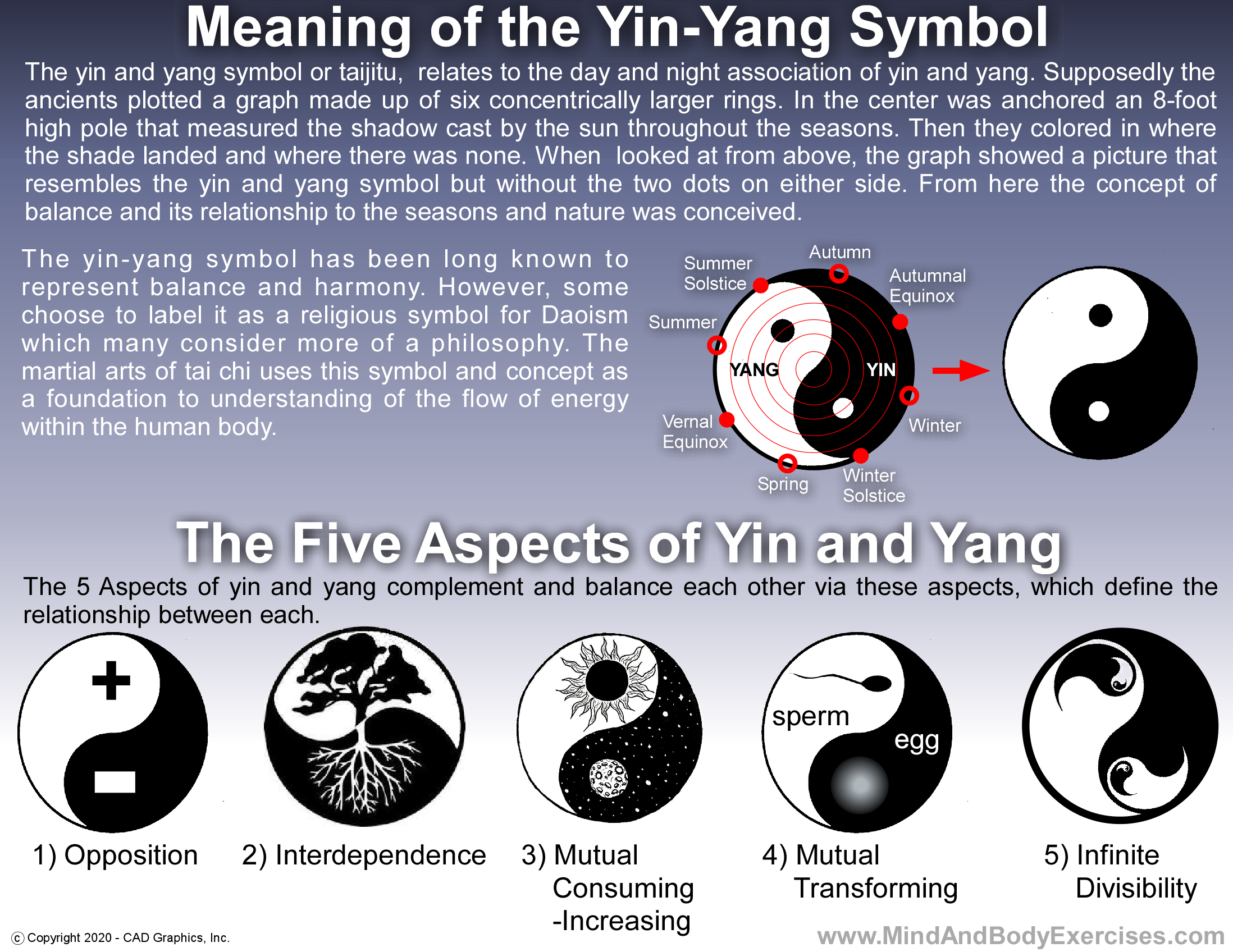
The Taoist concept of yin and yang, where harmony and balance coexist, contrast and relativity are seen in all things in life and nature. Yin and yang ultimately affect all aspects of life in health, relationships, business, and even other religions in various other aspects. Yin and yang are much more than simply the contrast between dark and light. The symbol for this concept depicts cause and effect, ebb and flow, and other manifestations of harmony, and is known as the Tajitu. The symbol actually has more components beyond just the 2 fish-shaped halves. The complete circle itself consists of the two halves, plus the small dots of contrast found in each half, and lastly, the line that divides the two halves. These dots remind us that nothing is truly black or white, or absolute. The fine line resting between the two opposing halves may be viewed as the gray area that we sometimes find ourselves navigating when striving to balance our decisions. Decisions between what we perceive as true, right, or correct for whatever situation and circumstances relate to any particular time and place. What is seen as correct yesterday may not be so today; appropriate for one, may not be for another. These components collectively represent the ever-changing relationship of all of these various pieces and parts that make up the whole.
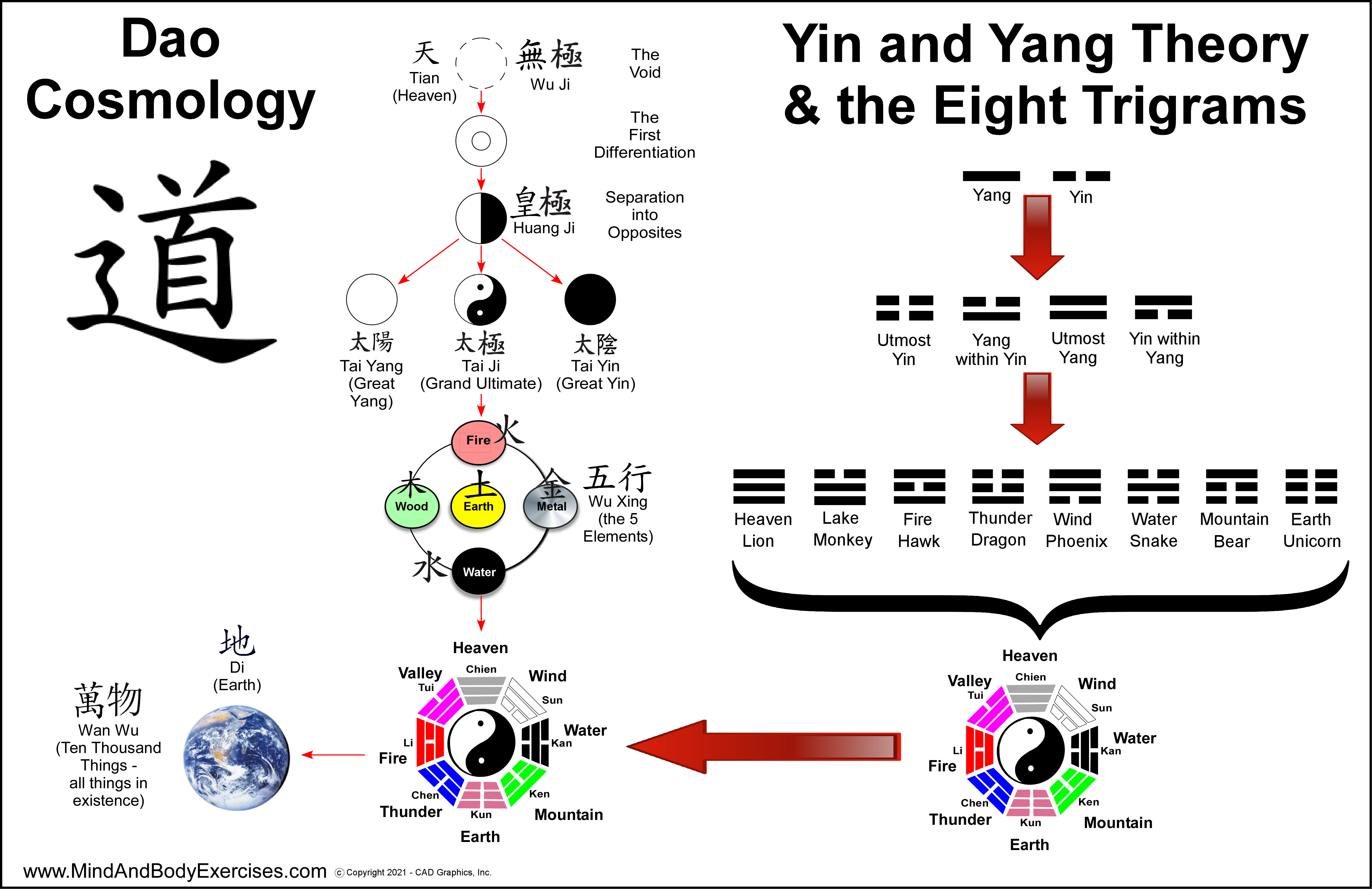
Taoism does explain the creation of the Universe and what exists within it. The Tao transformed from the nothingness or Wuji, to yin and yang, then further into the 5 Elements or Wuxing, then to the 8 trigrams or Bagua, and eventually into the Ten Thousand Things. Some people may see these concepts as religious, while others may interpret as philosophy and maybe even others will see these ideas as a science of the universe.
The I Ching, a Taoist philosophical text written by Fu Xi around 1300 BCE, addresses 64 phases in that we go through in the process of becoming a human being (Hon, 2019). Through these phases, one can evolve from basically being unconscious to hopefully conscious, from an inferior to a superior human being. It actually takes considerable effort and time to become what we consider human. We are born basically like any other animal and more specifically a mammal, but with the potential abilities to learn to communicate and reason.
Hexagrams of the I Ching
There is a fundamental belief within Taoism, that we are not born with the wisdom of being “correct” but rather we are born and begin to be “true” in our perceptions, words, and actions. For example, a child cries because they are hungry, expressing their true feelings of hunger pangs in their stomach. Later in life, that same child will learn that the correct way to express oneself may be to ask for food verbally. We are usually not born as balanced or enlightened human beings. Humans are not intrinsically born as what we often label as “good”. Our nature is seemingly good as an innocent little human being but basically, we are born as an animal with no inherent skill to survive physically or socially. Unguided children will not feed, clothe or potty-train themselves. If you look at any young child not nurtured, guided, or refined by a parent or mentor of that child, that child will instinctively do whatever they please until met with resistance. The child is not inherently “bad” but rather has instinctive behavior, similar to that of a little animal not knowing of boundaries or refinement. If the parent doesn’t accept this duty of actual parenting, the child may eventually grow into an adult who spends their whole life behaving like an animal. If the parent does not take the time to give their child life direction by teaching with words and actions rooted in principle and love, that child will become a human being in physical form, while remaining an animal in their consciousness and relative actions.
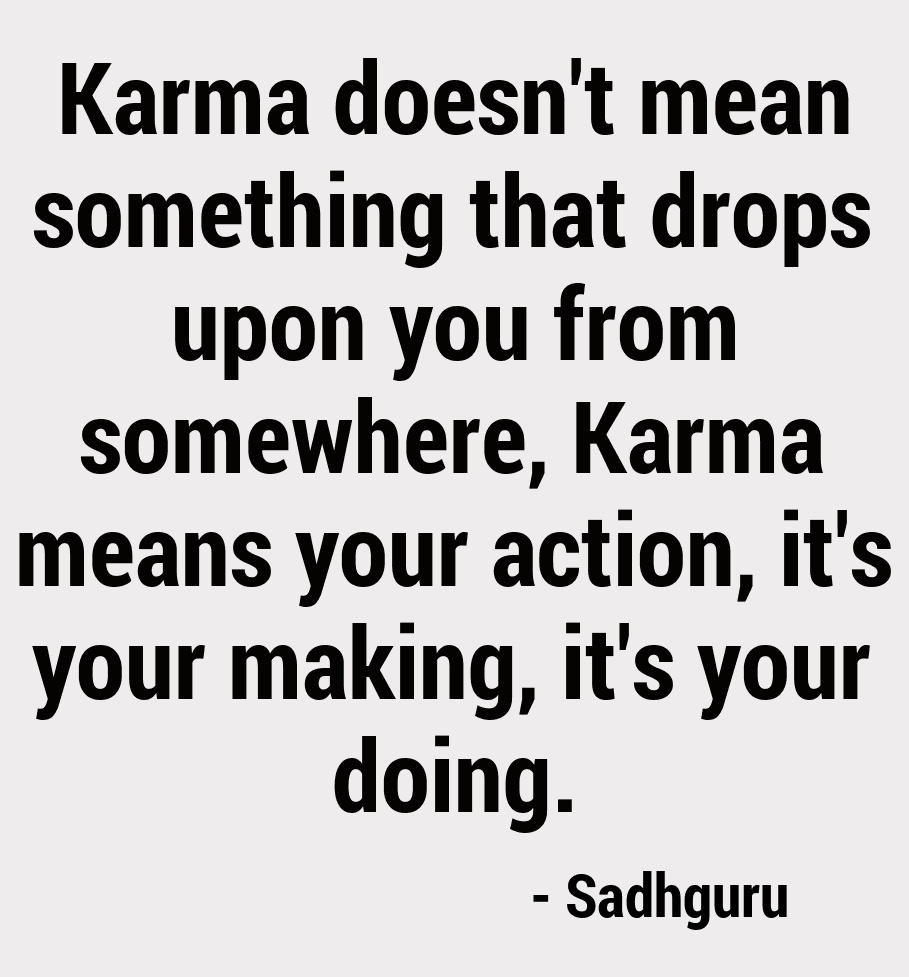
Some belief systems or philosophic schools of thought believe that we have to earn our human potential beyond that of being an animal. We are born into a particular set of circumstances or actions of cause and effect, known as karma, in Hinduism, Buddhism, and Taoism. Even before we arrive in the physical form of a zygote, embryo, or fetus, there is a belief structure that we already made an agreement based upon our karma, of what kind of resources one will come into this world with and relative life from these resources. These may include time and place of birth, physical or mental traits, ethnicity, status, and other cultural variables. Hopefully, the individual earned good karma in their past life because that affects where and to who they are born into.
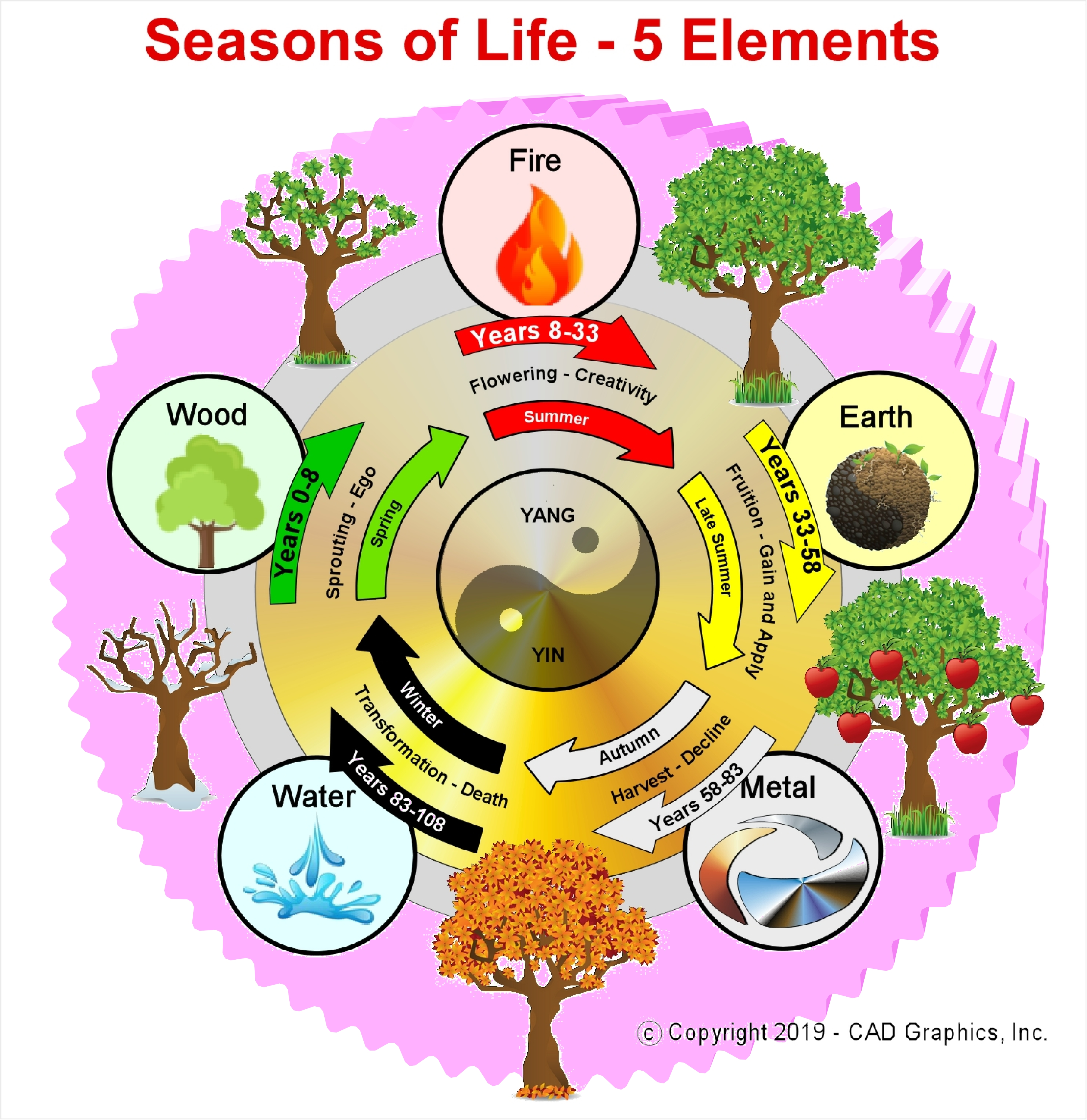
The first phase of life is childhood from birth to age 8, which is considered as Spring and is highly relative to one’s past karma. The individual child has very little control over their own current karma at this age, relying almost entirely upon where they were born and who their parents are. The order of the next phases of life would be Summer (ages 8-33), Late Summer (ages 33-58), Fall (ages 58-83), and Winter (ages 83-108). These phases of the year correspond accordingly with the 5 Element Theory or Wuxing (Wuxing, Internet Encyclopedia of Philosophy, n.d.), and the mental and physical changes we experience throughout our whole cycle of one lifetime.
After the initial spring phase of childhood and into young adulthood or summer, the individual begins to work on choosing whether or not they are going to go through life in a state of unconscious suffering or go through life evolving as a conscious human being. Life is a challenge or struggle, and we all experience this struggle differently. The struggle never ends as we strive to become more human until we can no longer. Similar to standing upright on two feet, we always have a struggle to work and exert effort to stay standing. As soon as we stop working on standing, we fall. Consequently, there is this constant struggle to become more human or to use other labels such as self-realization or self-mastery. Realization in this context may be defined as having an advanced understanding of the interrelationship of their mind, body, and consciousness. Self-cultivation is another appropriate term, as we ourselves are actually the garden that needs constant tending. Some among us may have started on this path decades long ago, trying to navigate within this lifestyle and path of self-cultivation. Some are considered spiritual teachers or leaders. They are not done yet, as we are never truly done as far as this physical life is concerned. If life is a constant struggle, the concept we have to accept is that no one is entitled to anything. If we truly want to change our reality, we need to realize that no one is going to change it for us. Not our friends, family, boss, government, or anyone other than ourselves. The universe and nature offer no entitlements that are going to change our individual reality. It starts with us taking ownership and responsibility to change our own set of circumstances and actions (karma) whether good or bad. If we look at our situations or circumstances as being someone else’s fault or responsibility, we have lost control over our own life and our own potential outcomes. Ultimately, we may realize that we allow others the power to manage our lives until we choose to change this reality, as we alone choose to make ourselves good or make ourselves bad.
The concept of freewill
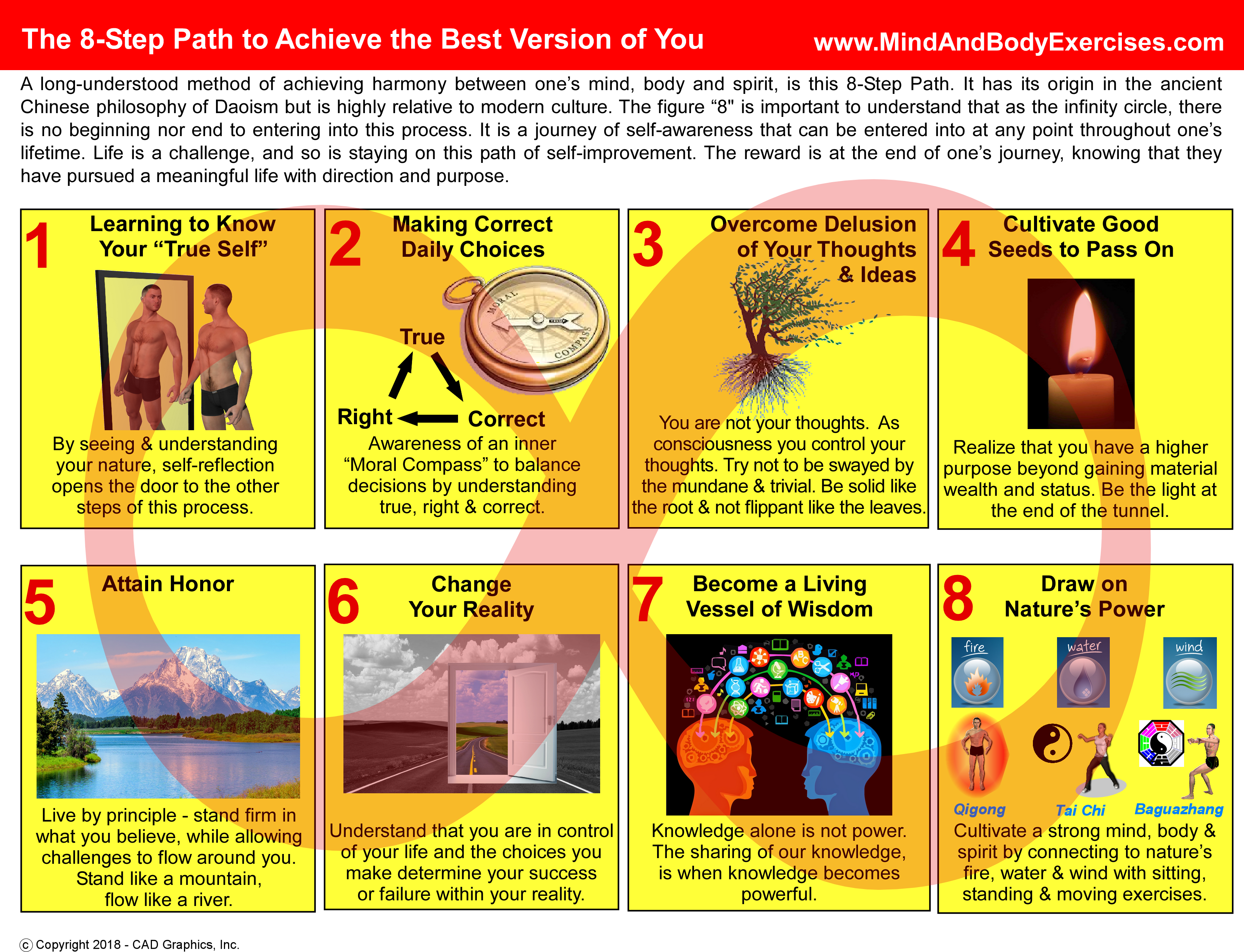
We have no true freedom if we are subject to the will of others. Self-cultivation is about taking total ownership of our own life and its direction. We have this choice every minute of every day, until death. Ancient and time-proven safe and effective methods of mind and body practices rooted in Buddhism and Taoism, such as yoga, tai chi, qigong, and other methods, offer ways to build character, strength, and self-discipline. Within some belief systems, these practices can affect one’s karma. By regular and consistent execution in maintaining a particular posture or stance, despite the physical discomfort in doing so, the individual develops the fundamentals of self-discipline. These practices offer a very deliberate equation or recipe, to achieve self-cultivation. Self-cultivation cannot be achieved by luck or chance. Similar to traveling to a specific destination, one cannot easily reach their target by chance, without a map or sense of direction. Religions of Hinduism offer the Yamas and Niyamas whereas Christianity holds the 10 Commandments as guidance or maps of direction. Buddhism has the philosophy of the Eightfold Path and Islam has their 5 Pillars. The philosophy of Taoism has a similar guide in its own Eight-step Path.
This Eight-step Path of Taoism is where I will focus some attention. This path of processes is a map or recipe of insights that may lead to experiences in varying levels of evolution of our own consciousness. This recipe is rooted in the understanding that our life is basically a continuous yearly journey around the sun where we all go through the yearly cycles of the climatic seasons. The climate appears very random to us as children, where we see sun and rain for a while and then a time later of wind and snow. Until we are taught that there is a deliberate repeating cycle, this change in our surroundings, environment and relative weather patterns seems to be so random. When the child knowingly experiences a second or third year of the season changes, the climate becomes less confusing and actually more predictable. Similarly, the steps or cycles of the Eight-step Path may appear at first to be somewhat random but are quite deliberate.
The first step may be the most difficult, which is to truly see oneself in the highest expression of their humanness. The Sanskrit word of namaste, meaning of “may the divine in me see the divine in you”. The challenge here is that in most cases, the individual cannot see the divine in others because they cannot see it first in themselves. This highly important component is in the reflection of actually looking inside of yourself. Often this step is most uncomfortable, where the individual is venturing outside of their comfort zone in order to go through the humility of seeing themselves in a less-than-perfect perspective. This is where methods of sitting, standing, and moving practices within yoga, qigong, tai chi, and others can offer these self-awareness reflections, in addition to their mere basic physical benefits of Westernized glorified stretching and breathing exercises. Beyond just exercising the body, these somewhat gentle methods can require the practitioner to become aware of their various aspects of weaknesses in their postural alignments, coordination, balance, and other facets of their self-awareness like breath and heart rate. Observing and becoming aware of our physical body is the gateway into becoming more aware of our complex thoughts and emotions. We are not our thoughts, but rather the observer and master of them. Within the Tao Te Ching we find the wisdom text relating to reflection in (Novak, 1994):
“Knowing others is intelligence,
knowing yourself is true wisdom.
Mastering others is strength,
mastering yourself is true power.
If you realize that you have enough,
you are truly rich…”
We can seek to find the root causes of the turbidity and chaos in our society today, where most people do not aspire to see their true selves and the chaos coming from within. This can be evident in our lack of taking ownership and accountability for any of our own behaviors. Self-reflection is a very important component of any belief system or spiritual cultivation. It is called reflection because in ancient times, mirrors did not exist. One would actually have to look at water in order to see their own image or a reflection thereof. If the water was moving or turbid it would not be possible to see one’s reflection. Similarly, if one’s thoughts and relative lifestyle are turbid, it is very difficult for one to self-reflect. Your mind is that water and so you never really get a chance to see your true nature because it’s not very tranquil enough and never clear enough to reveal even just a fleeting glimpse of our true nature. This is an important component of spirituality, self-improvement, self-awareness, or whatever one chooses to call this concept. This nature of our higher nature isn’t just your nature. It is my nature. It is his and her nature. It is all of our nature. It is all the same nature being that we are all basically connected. The divine in me sees the divine in all. We all have one little particle of that highest nature and when it is momentarily separated, we suffer the illusion of individuality for only a moment.
Strive to see your true nature
I do not see Taoism, Confucianism, or Buddhism as religions, but rather as life philosophies in that they hold principles that can easily be seen and/or incorporated into other spiritual belief systems. What I find most appealing about Taoism is that I don’t find it to be a religion by definition, but rather a philosophy of how to navigate the human condition. I have found that Taoism at its core seeks to focus on holistic, universal, and peaceful principles of living in harmony with nature and the natural order of all within it, whether alive or inanimate.
Wuxing (Wu-hsing) | Internet Encyclopedia of Philosophy. (n.d.). Internet Encyclopedia of Philosophy. Retrieved August 9, 2022, from https://iep.utm.edu/wuxing/
I teach and offer lectures about holistic health, physical fitness, stress management, human behavior, meditation, phytotherapy (herbs), music for healing, self-massage (acupressure), Daoyin (yoga), qigong, tai chi, and baguazhang.
Please contact me if you, your business, organization, or group, might be interested in hosting me to speak on a wide spectrum of topics relative to better health, fitness, and well-being.
I look forward to further sharing more of my message by partnering with hospitals, wellness centers, VA centers, schools on all levels, businesses, and individuals who see the value in building a stronger nation through building a healthier population.
I also have hundreds of FREE education video classes, lectures, and seminars available on my YouTube channel at:
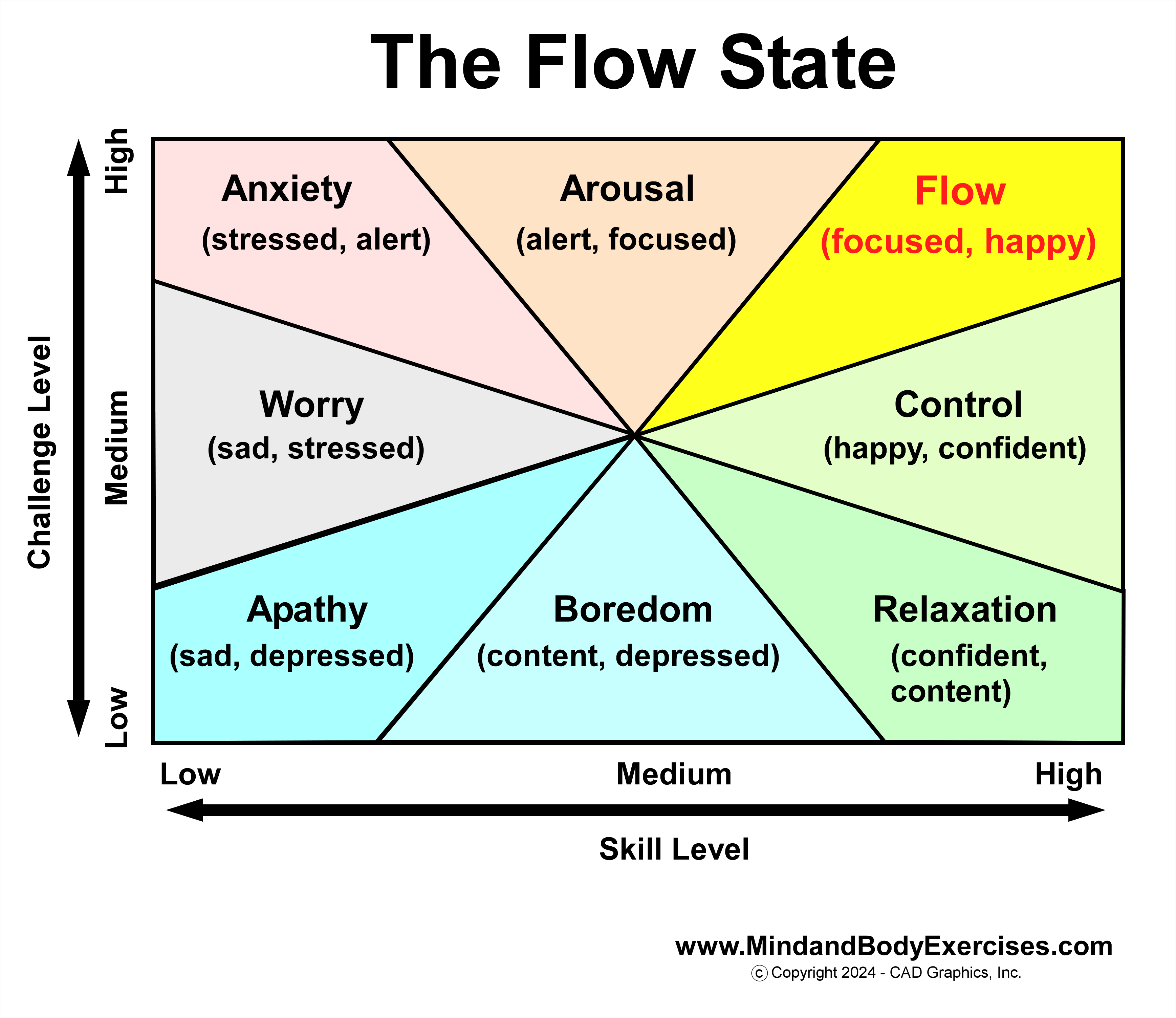
The “flow state” also known as being “in the zone,” refers to a focused mental state in which an individual is fully immersed in an activity, perhaps feeling energized, with effortless action, while also enjoying the process. This term was introduced by psychologist Mihaly Csikszentmihalyi in the 1970s. This flow is often described as a state of “optimal experience,” where individuals are so involved in what they are doing that they may lose track of time and may even become oblivious about their surroundings.
I have come to experience this myself through martial arts training with weapons practice where one strives to harmonize the movement of the sword with the mind and body engagement. See my broadsword demonstration. https://youtu.be/d_KmKHFbCt8?si=GMYvzTs9IpmmUN63&t=491
I have seen others achieve the flow state through rowing or crew. In rowing this flow state is referred to as “perfect swing” or just swing. Swing only happens when all eight rowers are rowing in such perfect unison that no single action by anyone is out of sync with those of all the others. Only then will the boat continue to move, unchecked, fluidly and gracefully between the pulls of the oars.
Characteristics of the flow state may include:
Intense Concentration: People in a state of flow are deeply focused on the task in the present moment. They experience a sense of clarity and concentration, with a heightened focus on the present moment.
Loss of Self-consciousness: People in flow often report a decreased awareness of themselves. They are not too concerned with how they are perceived by others or with thoughts of failure and success.
Timelessness: Flow activities can create a sense of time distortion. Some people may feel that time is passing quickly or, conversely, that they’ve been experiencing an activity for a much longer period than actually has transpired.
Intrinsic Motivation: Flow is often linked with intrinsically rewarding activities. The satisfaction and enjoyment come from the activity itself rather than external recognition or rewards.
Clear Goals: Activities that produce flow typically have concise and achievable goals. Individuals understand what needs to be done, and feedback is immediate.
A Balance of Skill and Challenge: Flow manifests when the level of challenge in an activity is highly compatible with an individual’s skill level. If the activity is too easy, it may lead to boredom. If the activity is too difficult, it can result in anxiety or insecurity.
Some common examples of activities that may manifest into a flow state include certain sports, playing musical instruments, writing/journaling, painting, martial arts, target shooting, or other artistic endeavors, or any other task that requires some skill, ability, and concentration. Achieving a flow state can have many positive effects on overall physical health, mental well-being, creativity, and even performance. Many pursue flow-inducing activities to further enhance their experiences and productivity.
There are several benefits to experiencing a flow state. These may include:
Increased productivity and creativity
Reduced stress and anxiety
Improved mood and well-being
Greater sense of self-efficacy
How can one achieve a flow state? There is no one-size-fits-all answer. If someone can find activities that they enjoy and that challenge them just enough, they’ll be more likely to experience a flow state. And once they do, they will better understand why it’s such a sought-after experience. However, there are several things someone can do to increase their chances of experiencing it. These may include:
Choose a challenging but achievable task.
Set clear goals for yourself.
Remove distractions.
Get into a relaxed but focused state of mind.
Be fully present in the moment.
Some additional tips for achieving a flow state:
Find a passion. What activities do you get lost in? What makes you lose track of the world around you? Once you know what your passions are, you can begin to focus on activities that are related to them.
Set smaller, more achievable goals. When you’re starting out, it’s imperative to set goals that are challenging enough but not too difficult. If you set goals that are too out of reach, you’re more likely to get discouraged and give up.
Break down bigger tasks into smaller ones. This will make challenges seem less daunting and more manageable.
Get rid of external and internal distractions. When you’re trying to achieve a flow state, it’s important to reduce as many distractions as possible. Turn off the phone, close the email app, and seek a quiet place to perform your tasks.
Be present in the moment. Put your mind where you are at. Don’t dwell on the past or worry about the future. Try to focus on the task at hand and enjoy the experience.
I teach and offer lectures about holistic health, physical fitness, stress management, human behavior, meditation, phytotherapy (herbs), music for healing, self-massage (acupressure), Daoyin (yoga), qigong, tai chi, and baguazhang.
Please contact me if you, your business, organization, or group, might be interested in hosting me to speak on a wide spectrum of topics relative to better health, fitness, and well-being.
I look forward to further sharing more of my message by partnering with hospitals, wellness centers, VA centers, schools on all levels, businesses, and individuals who see the value in building a stronger nation through building a healthier population.
I also have hundreds of FREE education video classes, lectures, and seminars available on my YouTube channel at:
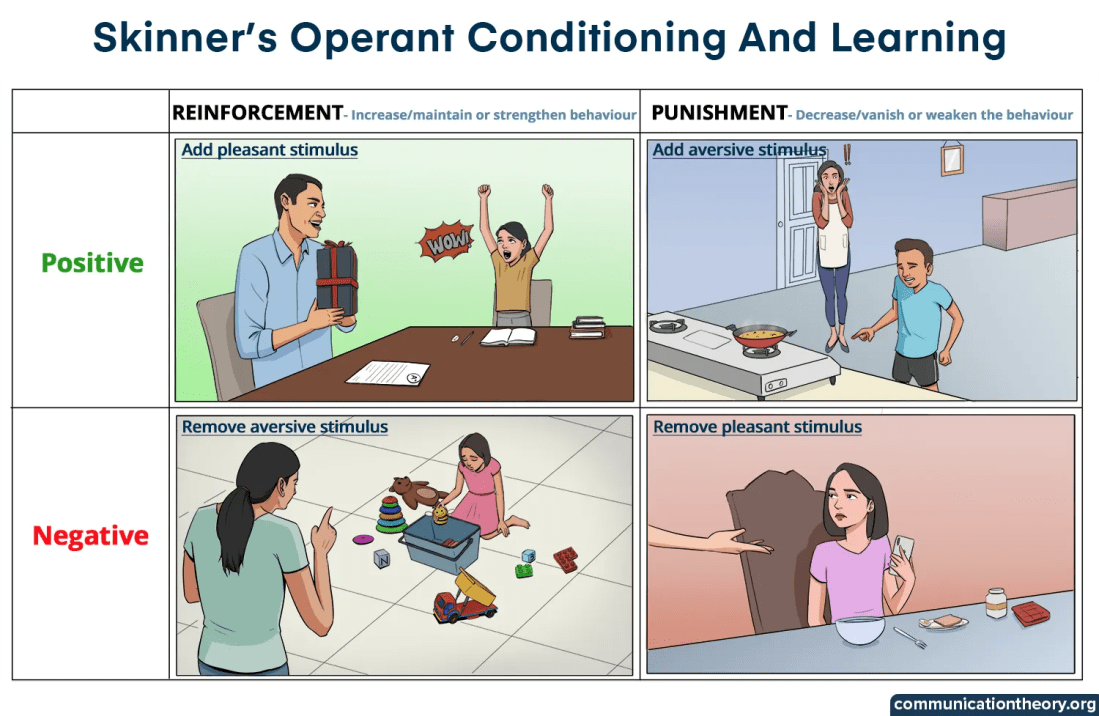
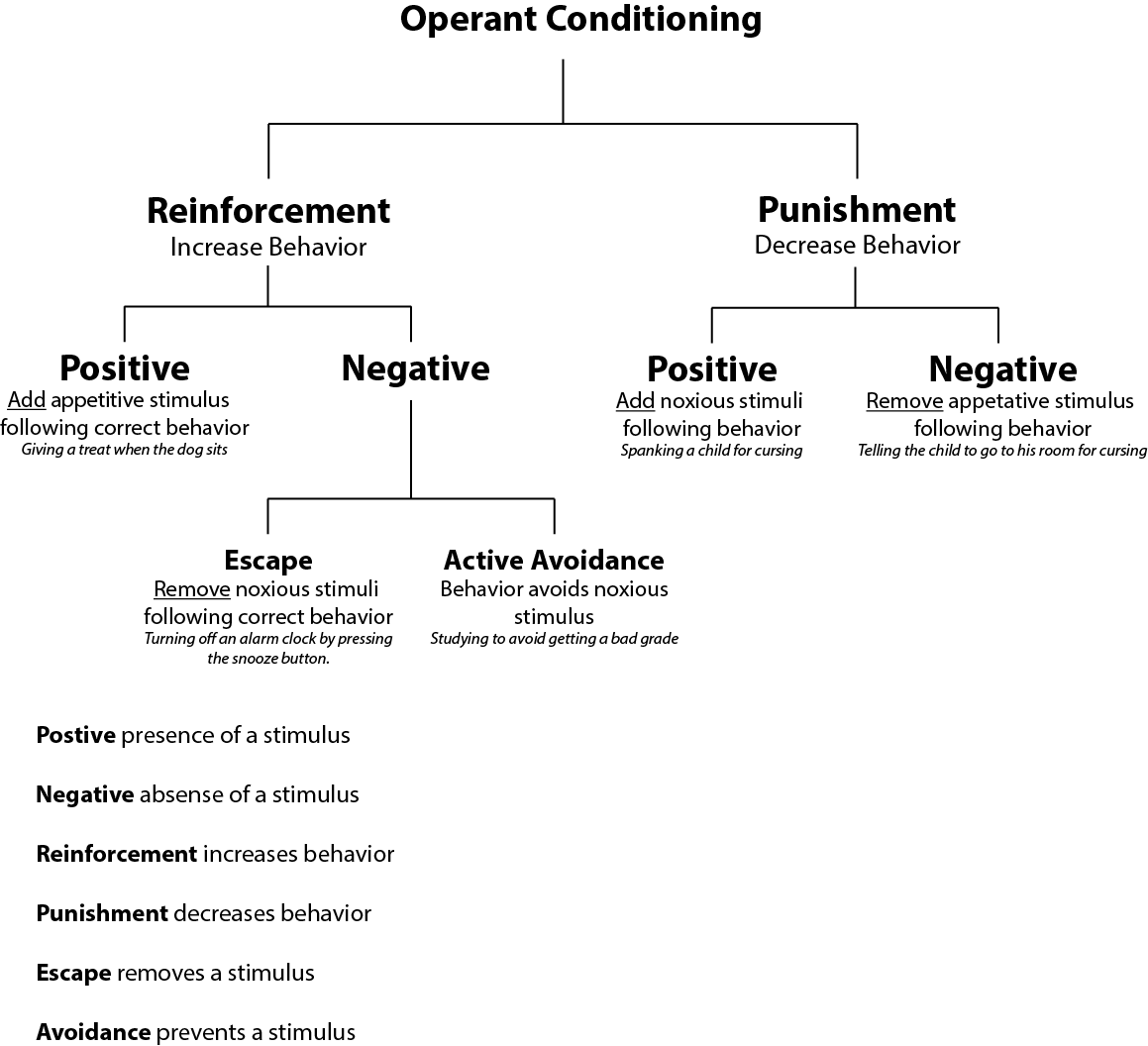
When humans and other animals learn to relate their behavior with reinforcing or punishing consequences, this is referred to as operant conditioning. In the Operant Conditioning Theory, there are basically four methods consisting of positive reinforcement, negative reinforcement, positive punishment, and negative punishment (Ettinger, 2018).
Reinforcement is a method that increases the chances and frequency that a response may occur. Positive reinforcers are stimulus awarded after a response that increases the probability of the response. Negative reinforcers are when stimulus is removed following a desired response, which increases the probability of the initial response (Ettinger, 2018). An example of positive reinforcement would be awarding a child an allowance for completing their chores. An example of negative reinforcement would be removing a curfew for a child completing their homework early. Specific techniques such as shaping, verbal instruction, physical guidance, modeling, and increasing motivation can be implemented to encourage the manifestation of an initial desired operant response. The schedule at which reinforcements are administered can also affect the response behavior. A continuous reinforcement schedule occurs when behavior is reinforced every time it takes place (Ettinger, 2018). An example of this would be rewarding a dog with a treat after it sits still for a determined amount of time. A partial reinforcement schedule occurs when behavior is reinforced for only part of the time (Ettinger, 2018). An example of this would be a fisherman being rewarded with catching fish throughout the day, but with the time in between catches varying. Partial schedules of reinforcement are slower to be instilled but are noticeably more lasting than when no reinforcement is implemented at all. Partial reinforcement schedules breakdown further into either ratio or interval schedules, where both may be either variable or fixed (Ettinger, 2018).
Punishment is a method where a stimulus implemented, either added (positive punishment) or removed (negative punishment) following a response affects a decrease in the frequency or chances of that response occurring. A punishment effectiveness in creating a desired change in behavior is determined by the punishment’s consistency, intensity, moderation and if there is a delay between a response and punishment. Also, combining a punishment with positive reinforcement may improve the effectiveness of the punishment (Ettinger, 2018). An example of positive punishment would be adding a curfew to a child in response to the child not completing their homework. An example of negative punishment would be to take away internet access due to the child not completing their homework.
(Admin & Admin, 2023)
Building of self-discipline and its relative behavior, is something that I was introduced to, through martial arts. I was 16 years-old at the time, and I experienced a very rigidly formatted version of operant conditioning. This is a very instrumental age for most people, where adolescence offers a time to begin to develop a sense of self, independence, identity, and self-awareness (Author Removed at Request of Original Publisher, 2015). Positive reinforcement is a tool used not only in most modern martial arts systems today, but also in coaching of sports, in schools, and other places of exercise to enhance fitness, well-being, self-discipline, stress management and many other reasons. In most martial arts schools, reinforcement and punishment are implemented as methods of operant learning. An individual is often rewarded here with a positive stimulus for a behavior that may be perceived as improving or growing stronger in character or punished by removal of stimulus for not improving or demonstrating good judgement. Particular to martial arts training, when a student starts on this path, most are educated that there exists a work and reward system of positive reinforcement delivered through a belt system. The belts range from the color spectrum where a white belt is a beginner to a blackbelt as having more proficiency, and then various degrees of blackbelt reflecting more expertise. When a student puts in the time and effort towards practicing and attempting to perfect the various exercises, techniques and relative sets or forms, they receive a reward of the next colored belt. I see the scheduling of this technique as partial reinforcement, in that a student doesn’t receive a new belt reflecting their progression after every class, but rather over a longer length of time demonstrating continual improvement.
Conversely, many instructors will use some methods of negative punishment where they maybe remove one-on-one time or personal instruction if a student does not demonstrate improvement of their skills or is perceived as not being serious about their own personal development. Or another example would be positive punishment where a student would be encouraged to stay after class to practice more in order to demonstrate that they are indeed serious about improving. While some of these methods may appear as outdated, harsh, or lacking compassion, I actually see them as being quite the opposite. If the end result and goal is for the individual to develop self-discipline and the infinite number of benefits that come with this trait, then the methods do justify the outcomes.
If instructors, coaches, teachers, and other positions of authority are to use punishment and other apathetic forms of control, they must be conscious of their potential impact. Although punishment may affect a response, it may also condition dysfunctional behaviors in the individual, by cultivating a conflict within the student-teacher relationship (Leeder, 2022).
Ettinger, R. H. (2018). Psychology: The Science of Behavior (6th ed.). BVT Publishing.
Leeder, T. (2022) Behaviorism, Skinner, and Operant Conditioning: Considerations for Sport Coaching Practice, Strategies, 35:3, 27-32, DOI:10.1080/08924562.2022.2052776
I teach and offer lectures about holistic health, physical fitness, stress management, human behavior, meditation, phytotherapy (herbs), music for healing, self-massage (acupressure), Daoyin (yoga), qigong, tai chi, and baguazhang.
Please contact me if you, your business, organization, or group, might be interested in hosting me to speak on a wide spectrum of topics relative to better health, fitness, and well-being.
I look forward to further sharing more of my message by partnering with hospitals, wellness centers, VA centers, schools on all levels, businesses, and individuals who see the value in building a stronger nation through building a healthier population.
I also have hundreds of FREE education video classes, lectures, and seminars available on my YouTube channel at:







 United Martial Arts Association
