The “Naegong House”: Internal Energy, Transmission, and the Reality Behind Esoteric Martial Traditions

Within the worlds of Neidan, Daoist cultivation, and certain internal martial arts traditions, there are recurring references to building an internal “house,” “furnace,” “cauldron,” or “vessel” capable of storing and refining cultivated energy. While terminology varies among lineages, the underlying concept remains remarkably consistent: before one can safely cultivate higher levels of internal development, one must first develop the structure capable of containing it.

In some traditions this concept is associated with Nei Dan (internal alchemy), while in Korean systems it may be discussed under Naegong or internal power cultivation. Although modern practitioners sometimes interpret these teachings literally or mystically, many of the ideas may also correspond to practical physiological, psychological, and neurological adaptations developed through long-term training.

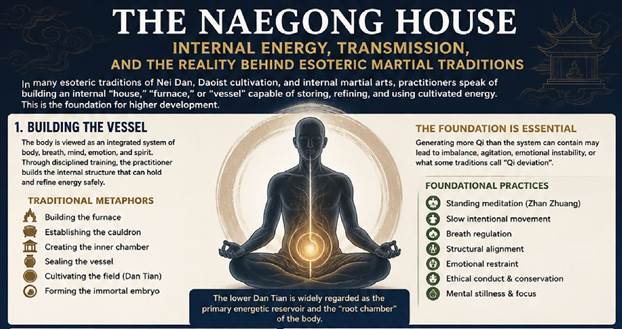
Building the Vessel

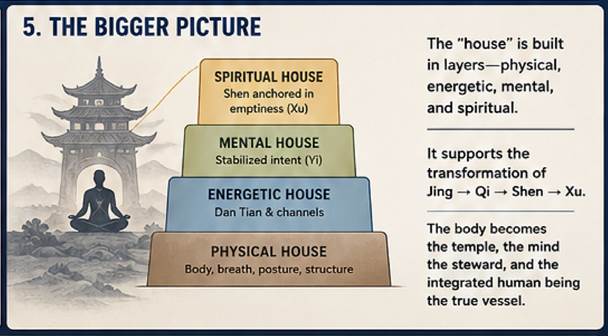
Traditional internal systems often describe the body as more than flesh and bone. The practitioner is viewed as an integrated system of body, breath, mind, emotion, and spirit. Through years of disciplined training, the individual gradually “builds the vessel” capable of stabilizing cultivated internal force.

Classical Daoist literature frequently uses symbolic language such as:

  • Building the furnace
  • Establishing the cauldron
  • Creating the inner chamber
  • Sealing the vessel
  • Cultivating the field
  • Forming the immortal embryo

These metaphors are generally associated with the development of the Dan Tian, especially the lower Dan Tian, which many traditions regard as the primary energetic reservoir of the body (Kohn, 2008).

The concept is not merely about accumulating “energy,” but about refining and integrating the practitioner as a whole. Traditional teachers often warned that attempting advanced energetic practices without sufficient preparation could result in imbalance, emotional instability, agitation, or what some systems referred to as “Qi deviation” (Despeux & Kohn, 2003).

For this reason, authentic systems historically emphasized foundational practices such as:

  • Standing meditation (Zhan Zhuang)
  • Slow intentional movement
  • Breath regulation
  • Structural alignment
  • Emotional restraint
  • Ethical conduct
  • Mental stillness
  • Conservation of vitality

In martial systems, these methods were believed to strengthen the body’s capacity to tolerate increased internal pressure, focus, and energetic intensity.

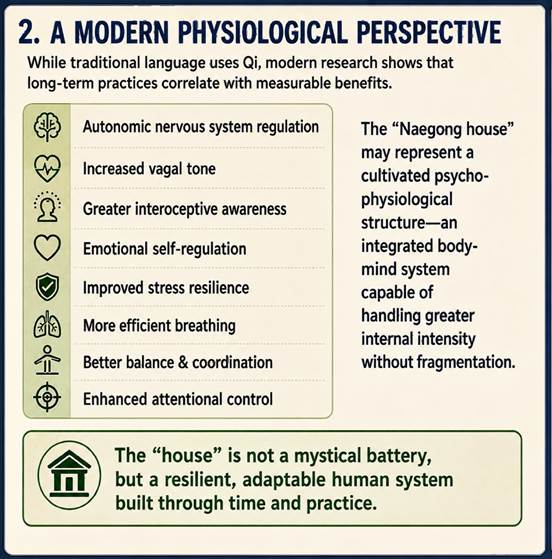
A Modern Physiological Perspective

Although traditional terminology uses the language of Qi and internal energy, some aspects of these practices may correlate with modern understandings of human physiology and psychology.

Long-term breath training, posture work, meditative focus, and slow movement practices have been associated with improvements in:

  • Autonomic nervous system regulation
  • Vagal tone
  • Interoceptive awareness
  • Emotional self-regulation
  • Stress resilience
  • Breath efficiency
  • Balance and coordination
  • Attentional control

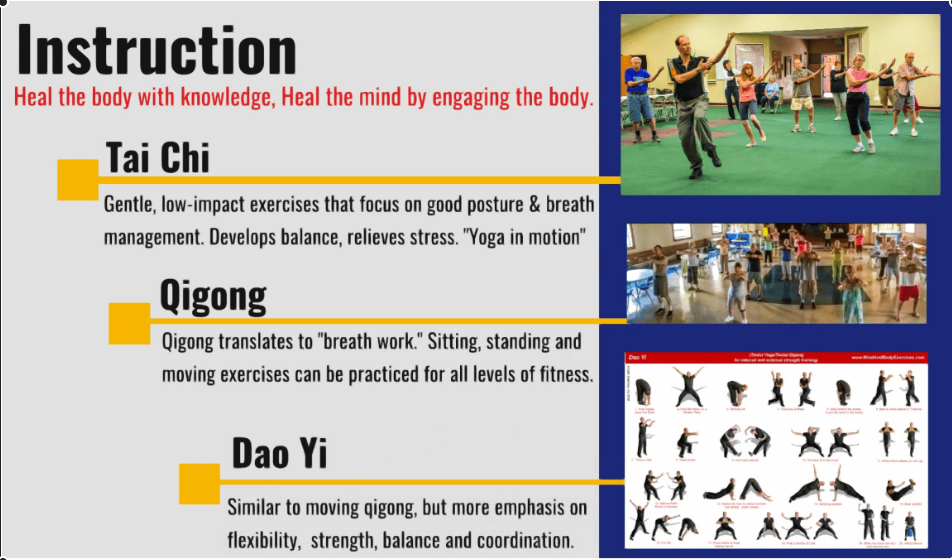
Research on contemplative movement systems such as Tai Chi and Qigong has shown measurable effects on stress reduction, mood regulation, balance, and psychophysiological health (Wayne & Kaptchuk, 2008; Wang et al., 2010).

From this perspective, the “Naegong house” may represent a metaphor for developing a more integrated and resilient body-mind system. The practitioner gradually becomes capable of handling greater internal intensity without fragmentation, impulsivity, or emotional instability.

In other words, the “house” may not be a mystical battery storing supernatural force, but rather a cultivated psychophysiological structure developed through years of disciplined practice.

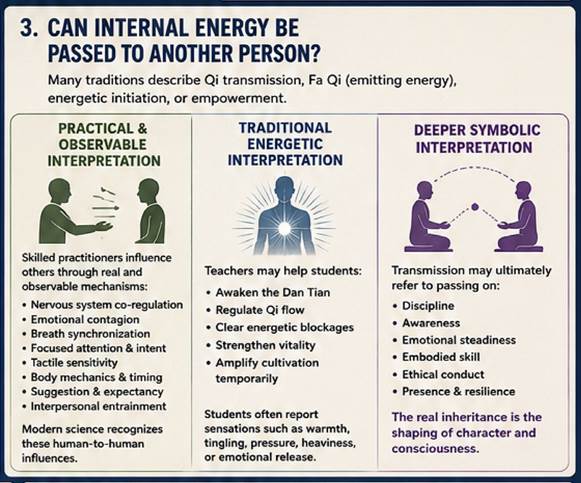
Can Internal Energy Be Passed to Another Person?

One of the more controversial aspects of internal martial and alchemical traditions involves the belief that cultivated energy or internal force can be transmitted from teacher to student.

Many traditional systems discuss concepts such as:

  • Qi transmission
  • Fa Qi (“emitting energy”)
  • Energetic initiation
  • Empowerment
  • Transmission of the “seed”
  • Establishing the furnace
  • Opening the channels

Some practitioners report sensations during such experiences including warmth, tingling, heaviness, emotional release, pressure, or involuntary movement. These reports are common across many contemplative and spiritual traditions worldwide.

However, interpretations of these experiences vary significantly.

The Practical and Observable Interpretation

A grounded interpretation suggests that experienced practitioners can indeed strongly influence others through mechanisms that are entirely real and observable.

These include:

  • Nervous system co-regulation
  • Emotional contagion
  • Breath synchronization
  • Focused attention
  • Tactile sensitivity
  • Body mechanics
  • Suggestion and expectancy
  • Interpersonal entrainment

Modern neuroscience and psychology recognize that human beings constantly influence one another physiologically and emotionally (Porges, 2011). A calm and highly regulated practitioner may affect another person’s breathing patterns, muscular tension, emotional state, and sense of safety.

Likewise, highly skilled internal martial artists often demonstrate remarkable efficiency through coordinated biomechanics, fascial connectivity, timing, and intent rather than brute muscular force alone.

To an outside observer, these effects may appear mysterious or “energetic,” even when rooted primarily in refined physical and neurological skill.

The Risk of Mystification

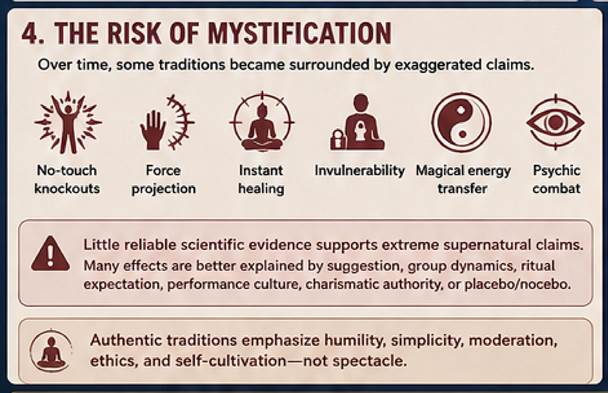
As with many esoteric traditions, internal martial arts also accumulated layers of mythologizing over time. Stories emerged involving:

  • No-touch knockouts
  • Supernatural force projection
  • Psychic combat
  • Instant healing abilities
  • Magical energy transfer
  • Invulnerability

While such claims remain popular in some circles, there is little reliable scientific evidence supporting extreme supernatural interpretations.

Many demonstrations of extraordinary “Qi powers” have failed under controlled testing conditions. In some cases, the effects may be better explained by:

  • Suggestion
  • Group dynamics
  • Compliance
  • Ritual expectation
  • Performance culture
  • Charismatic authority
  • Placebo and nocebo responses

This becomes especially important in high-control environments where mystical narratives can reinforce hierarchy, dependency, and unquestioned authority.

Historically, many authentic traditions actually warned against obsession with displays of power. Classical Daoist teachings frequently emphasized humility, simplicity, moderation, ethics, and self-cultivation over spectacle (Kohn, 2008).

The Deeper Meaning of Transmission

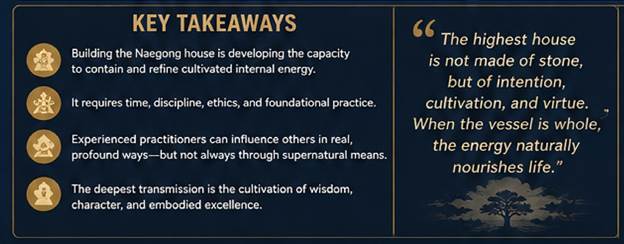
At its highest level, the idea of “passing the house” may not refer to transferring mystical energy at all. Instead, it may symbolize the transmission of cultivated human qualities developed through disciplined practice and lived experience.

A mature teacher may pass on:

  • Emotional steadiness
  • Discipline
  • Awareness
  • Presence
  • Resilience
  • Embodied knowledge
  • Ethical conduct
  • Refined perception

These qualities profoundly affect students over time.

In this sense, the real “transmission” may not be supernatural energy storage, but the gradual shaping of the practitioner’s nervous system, awareness, behavior, and character through years of intentional cultivation.

The body becomes the temple, the mind becomes the steward, and the “house” becomes the integrated human being itself.

References

Despeux, C., & Kohn, L. (2003). Women in Daoism. Three Pines Press. https://archive.org/details/womenindaoism0000desp

Kohn, L. (2008). Chinese healing exercises: The tradition of Daoyin. University of Hawai‘i Press. https://archive.org/details/chinesehealingex0000kohn

Porges, S. W. (2011). The polyvagal theory: Neurophysiological foundations of emotions, attachment, communication, and self-regulation. W. W. Norton & Company. https://archive.org/details/polyvagaltheoryn0000porg

Wang, C., Collet, J. P., & Lau, J. (2004). The effect of Tai Chi on health outcomes in patients with chronic conditions. Archives of Internal Medicine, 164(5), 493–501. https://doi.org/10.1001/archinte.164.5.493

Wang, F., Lee, E. K. O., Wu, T., Benson, H., Fricchione, G. L., Wang, W., & Yeung, A. S. (2010). The effects of Tai Chi on depression, anxiety, and psychological well-being: A systematic review and meta-analysis. International Journal of Behavioral Medicine, 17(4), 261–271. https://www.ncbi.nlm.nih.gov/books/NBK164598/

Wayne, P. M., & Kaptchuk, T. J. (2008). Challenges inherent to T’ai Chi research: Part I—T’ai Chi as a complex multicomponent intervention. Journal of Alternative and Complementary Medicine, 14(1), 95–102. https://doi.org/10.1089/acm.2007.7170A

As Above, So Within – The Hermetic Thread of the Warrior, Scholar & Sage

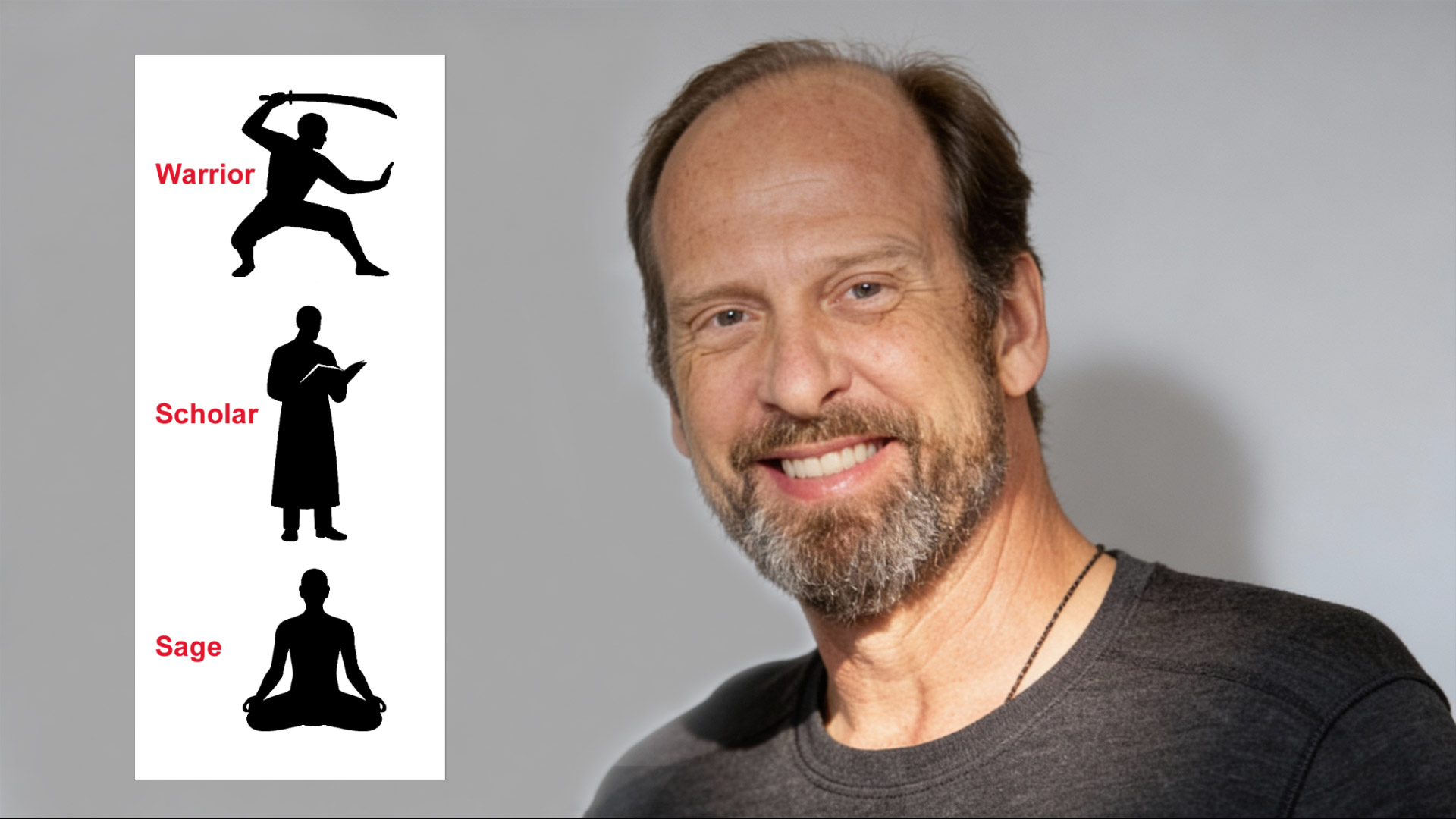
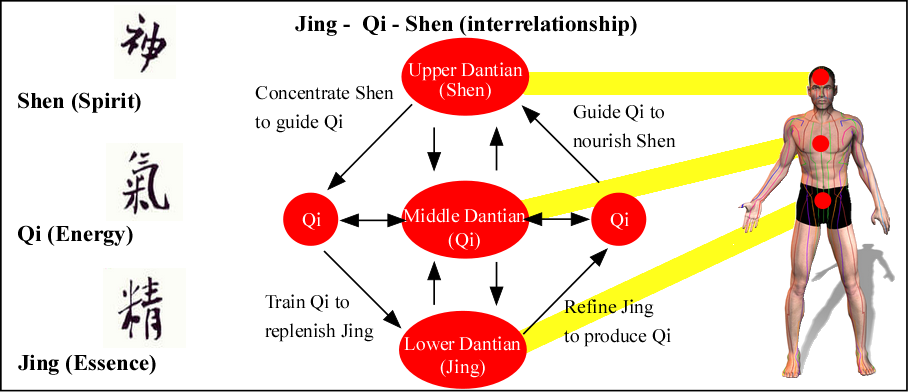
Every comprehensive system of human transformation contains a bridge, one that links the physical body to the invisible dimensions of mind and spirit. In the Eastern traditions this bridge is expressed through Jing (essence), Qi (vital energy), and Shen (consciousness). In the developmental framework I teach, it appears as the Warrior, Scholar, and Sage. In the Western esoteric lineage, the same bridge is known as Hermeticism, a philosophical and spiritual system attributed to Hermes Trismegistus, the “Thrice-Great” master of physical, intellectual, and spiritual wisdom.

These are not parallel systems by coincidence. They are structurally identical expressions of the same universal process of human refinement, or the ascent from embodiment to insight, and from insight to integrated wisdom. Across cultures and centuries, the language changes, but the architecture remains.

Hermeticism arises from Hellenistic Egypt, a fusion of Greek philosophy, Egyptian spirituality, early science, medicine, astronomy, and metaphysics (Copenhaver, 1992; Fowden, 1993). Its core message is simple but profound: reality is mental, patterned, cyclical, lawful, and capable of conscious transformation. The most famous Hermetic maxim from the Emerald Tablet expresses this truth succinctly:

This is not merely poetic symbolism. It is a functional statement of psychospiritual law: what is refined in the body shapes the mind; what is clarified in the mind refines the spirit; what is awakened in the spirit returns to illuminate the body.

The Eight Hermetic Principles and Their Living Expression

Hermetic philosophy is traditionally organized into eight fundamental principles (seven classical principles plus the unifying axiom of Integration & Moral Alignment). These principles are not abstract metaphysics; they describe how transformation actually happens in daily life.

Below is a brief, applied summary of each.

1. Mentalism – “All is Mind.”

Reality originates in consciousness.

Example:
Thought hygiene, attention control, emotional regulation, and metacognition all reflect the fact that perception shapes experience. In practice, this is where the Scholar refines Qi through disciplined awareness.

2. Correspondence – “As above, so below; as within, so without.”

Patterns repeat across all levels of existence.

Example:
Organ–emotion relationships, archetypal symbolism, and synchronicity reflect this principle. The Sage expresses it through Shen-based integration and purpose.

3. Vibration – “Nothing rests; everything moves.”

All things exist in motion and frequency.

Example:
Breath rhythm, posture, nervous system tone, and muscular tension all shape consciousness. This is the foundational work of the Warrior, refining Jing through somatic calibration.

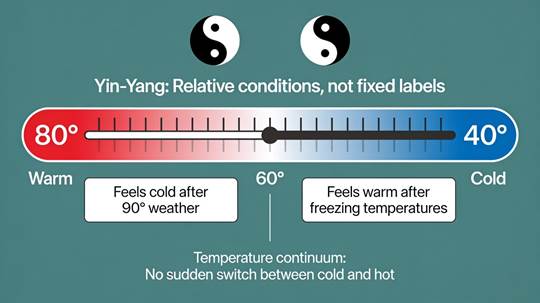
4. Polarity – “Opposites are identical in nature, differing only in degree.”

All dualities exist on a spectrum.

Example:
Fear and courage, stress and resilience, pain and growth are not opposites but transformations of the same continuum. This principle governs emotional alchemy and shadow integration.

5. Rhythm – “Everything flows in and out.”

Nature moves in cycles.

Example:
Circadian rhythms, seasonal cycles, recovery cycles in training, and emotional tides all operate under rhythmic law. Ignoring rhythm leads to burnout; honoring it leads to longevity.

6. Cause and Effect – “Every cause has its effect.”

Nothing is random.

Example:
Consistent practice compounds. Discipline produces capacity. Neglect produces decay. This principle governs training progression, psychological habit formation, and destiny itself.

7. Gender – “Masculine and feminine principles exist in everything.”

All creation arises from active and receptive forces.

Example:
Stillness and motion, force and yielding, analysis and intuition are necessary partners. In internal alchemy this corresponds to Kan and Li, or the inner marriage of fire and water.

8. The Unifying Principle – Integration & Moral Alignment

(Implicit throughout the Hermetic texts)

This is the alchemical ascent itself:
Matter → Energy → Consciousness → Unity
Warrior → Scholar → Sage
Jing → Qi → Shen

It describes the return of the fragmented human being to wholeness.

Hermeticism and Eastern Internal Alchemy: One Process, Two Languages

Western Hermeticism and Daoist Neidan (internal alchemy) describe the same three-stage refinement:

  1. Refining Jing (Warrior) – stability, grounding, structure, breath, stance
  2. Refining Qi (Scholar) – insight, emotional regulation, meaning
  3. Refining Shen (Sage) – awareness, wisdom, unity, purpose

In Hermetic terms this mirrors:

  • Earth → Air → Fire → Ether
  • Body → Mind → Spirit → Divine Mind
  • Alchemy → Knowledge → Illumination → Union

The training of the body becomes the furnace of consciousness. The mind becomes the instrument of refinement. The spirit becomes the field of meaning.

Jung and Psychology as Modern Hermetic Science

Carl Jung recognized Western and Eastern alchemy as symbolic maps of individuation, or the integration of the unconscious and conscious psyche (Jung, 1968). He interpreted alchemical stages as:

  • Shadow purification
  • Integration of opposites
  • Inner marriage (coniunctio)
  • Emergence of the unified Self

This is precisely the Warrior–Scholar–Sage progression expressed in psychological language.

Why Hermeticism Matters Now

Modern culture suffers from a dangerous fragmentation:

  • The Warrior has been reduced to stress and survival
  • The Scholar to data without wisdom
  • The Sage to abstraction without embodiment

Hermeticism restores their unity as a single ascending current of human evolution. It re-establishes the coherence between:

  • Body and breath
  • Thought and emotion
  • Discipline and compassion
  • Knowledge and service
  • Identity and purpose

This blog summary introduces the deeper work now fully developed in my newest release:

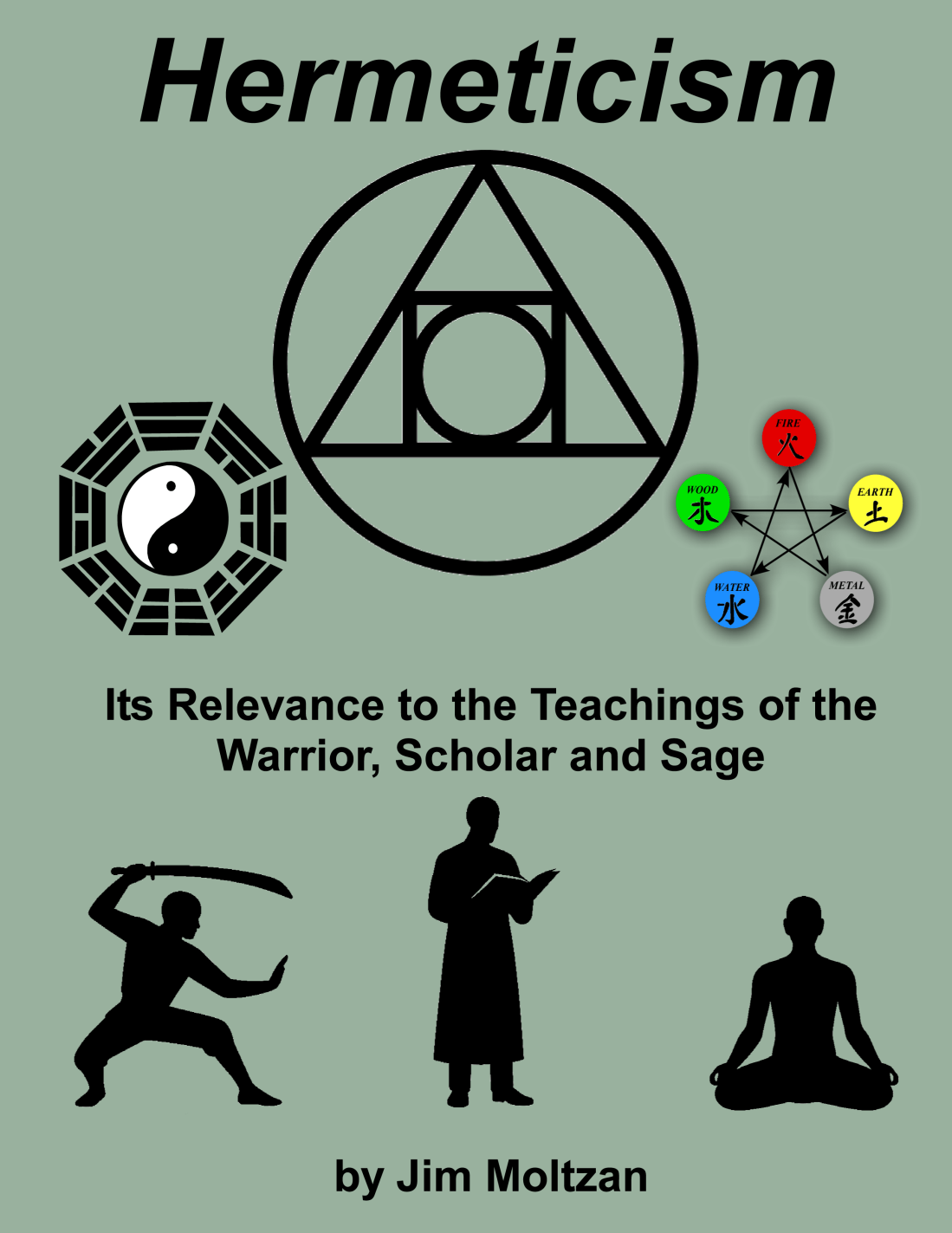
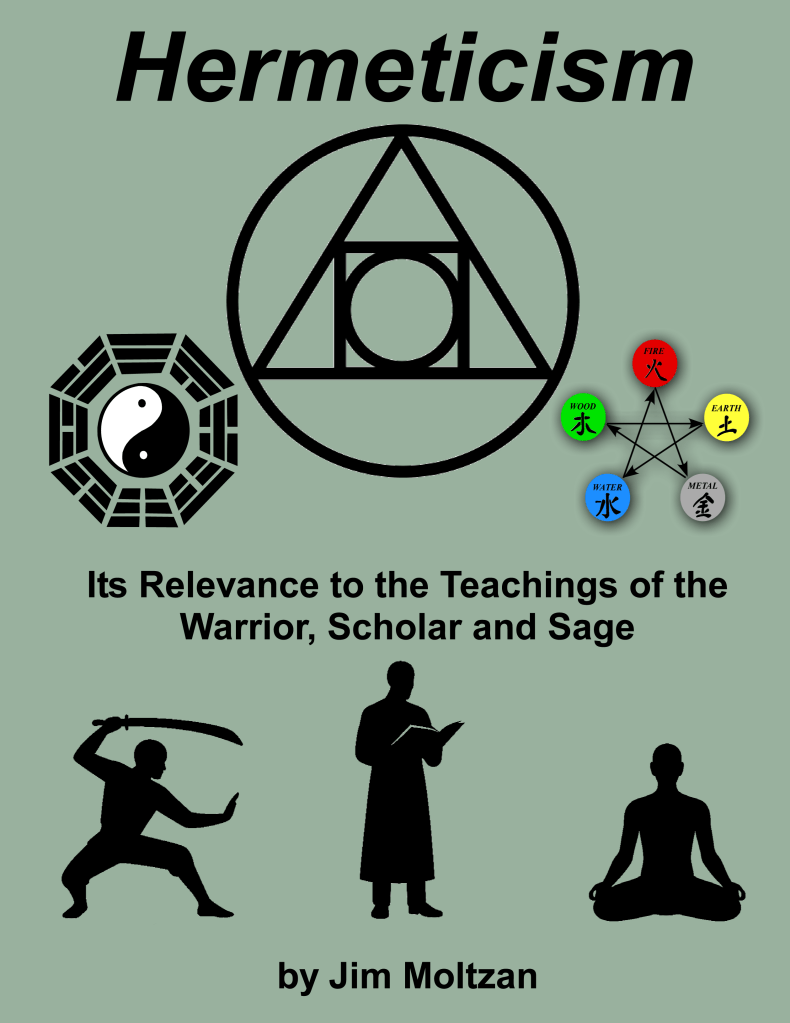
Book 38 – Hermeticism: Its Relevance to the Teachings of the Warrior, Scholar & Sage

This volume stands at the architectural center of my entire body of work. It reveals:

  • How the Warrior becomes the Scholar
  • How the Scholar becomes the Sage
  • How the Sage returns to unity
  • And how all three operate simultaneously as a single living process

It is not a theoretical book. It is a map of transformation, as it seeks to integrate Hermetic law, Eastern internal alchemy, Jungian psychology, nervous system science, breathwork, ethics, and the meaning-making process of human life.

Hermeticism is not something to believe. It is something to practice, embody, and become.

Available on Amazon at: https://a.co/d/fbD2mU0

References:

Copenhaver, B. P. (1992). Hermetica: The Greek Corpus Hermeticum and the Latin Asclepius. Cambridge University Press.

Faivre, A. (1994). Access to Western Esotericism. SUNY Press.

Fowden, G. (1993). The Egyptian Hermes: A historical approach to the late pagan mind. Princeton University Press. https://archive.org/details/egyptianhermeshi0000fowd

Jung, C. G. (1968). Alchemical studies (R. F. C. Hull, Trans.). Princeton University Press. https://www.jungiananalysts.org.uk/wp-content/uploads/2018/07/C.-G.-Jung-Collected-Works-Volume-13_-Alchemical-Studies.pdf

Mahé, J.-P. (1998). The treatise on the “Emerald Tablet.” Journal of the Warburg and Courtauld Institutes, 61, 1–20.

Principe, L. M. (2013). The Secrets of Alchemy. University of Chicago Press.

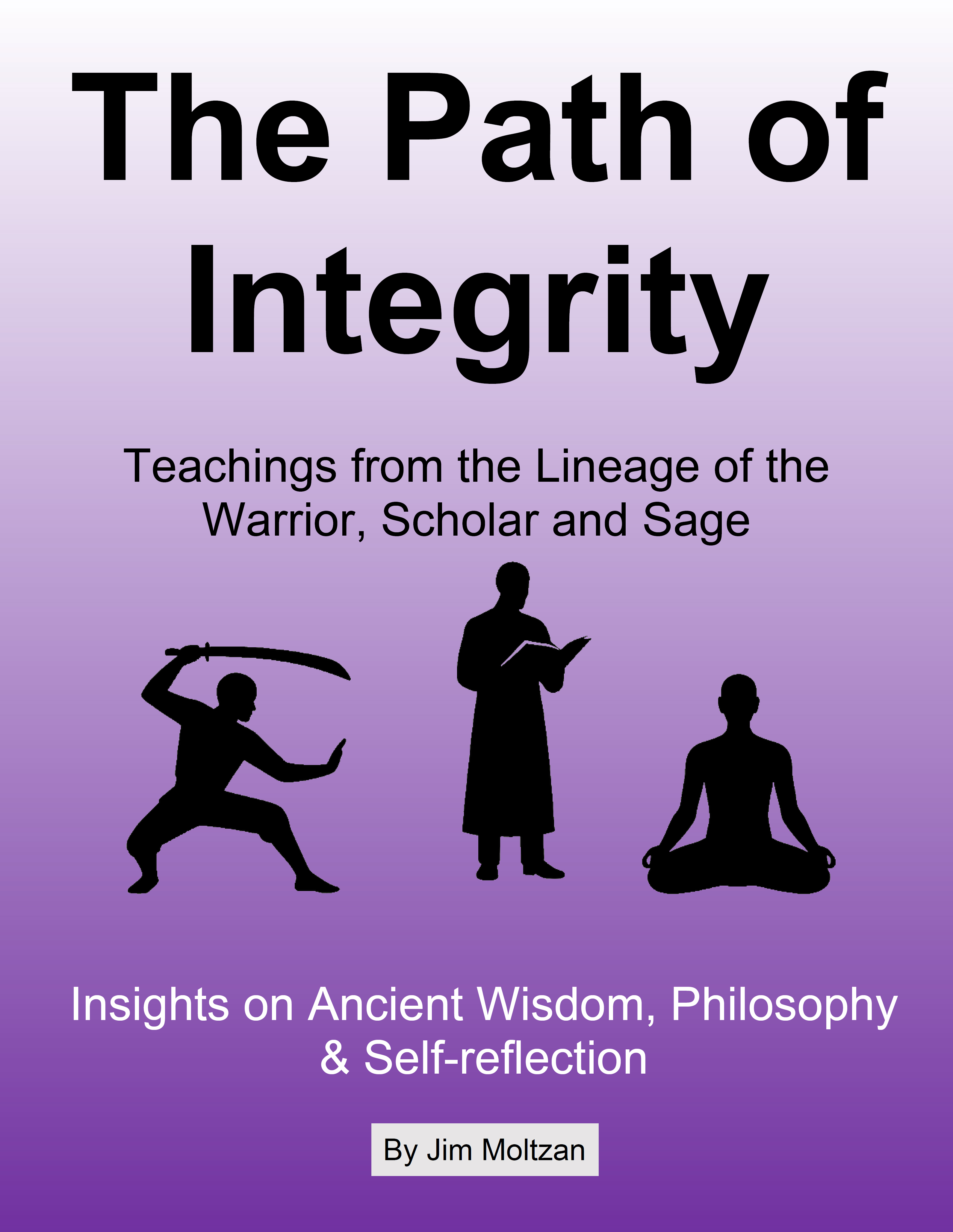
The Path of Integrity

Introducing a new book by Jim Moltzan

At its heart, The Path of Integrity is both a philosophical treatise and a psychological guide. A rare combination that bridges ancient wisdom traditions with contemporary understandings of human growth, resilience, and meaning-making.

From a psychological perspective, the manuscript reflects a humanistic foundation, echoing thinkers like Carl Rogers and Abraham Maslow in its focus on authenticity, self-knowledge, and the pursuit of a life aligned with core values. The text moves beyond prescriptive “self-help” to address the deeper internal architecture of the self in the mind, body, spirit, and relational being and how each must be cultivated in balance.

The book also engages with existential psychology, confronting questions of purpose, mortality, and moral responsibility. By drawing parallels between the “Path of Integrity” and the “Way of Dissonance,” it frames life as a series of choices that either bring us into alignment with our highest potential or lead us away from it. This dichotomy functions as a form of cognitive re-framing, helping readers see their daily decisions in a broader, values-driven context.

Importantly, the manuscript explores post-traumatic growth, not as an abstract theory but as a lived reality. It acknowledges that adversity, when met with awareness and intention, can deepen resilience, empathy, and wisdom. This theme is woven throughout personal reflections, martial philosophy, and spiritual principles to create a layered and authentic approach to transformation.

The emphasis on discipline, self-awareness, and service aligns closely with self-determination theory, which holds that autonomy, competence, and relatedness are essential to psychological well-being. The book’s integration of martial arts principles, such as inner guarding, patience, and strategic action, translates these abstract needs into concrete practices.

The style is psycho-educational, offering not only insight but also practical steps, from developing mental clarity and setting energetic boundaries to cultivating stillness as a tool for decision-making. This pedagogical approach makes it equally relevant to martial artists, spiritual seekers, and those navigating the complexities of modern life.

Psychologically, The Path of Integrity stands out because it addresses both the inner terrain (belief systems, emotional regulation, moral reasoning) and the outer application (relationships, teaching, leadership, legacy). This dual focus ensures that readers do not merely reflect but act, integrating new perspectives into daily living.

Ultimately, the book’s psychological message is clear. Integrity is not an abstract ideal. It is a lived state of alignment that requires ongoing attention, honest self-evaluation, and the courage to choose what is right over what is easy. By walking this path, we move beyond survival into a life of grounded purpose, resilience, and contribution.

The Path to Integrity is available at Amazon at: https://a.co/d/bgm7U2t

Announcing a Powerful Collaboration for Inner and Outer Transformation

After decades of study, practice, and teaching, I’ve come to a simple but powerful truth: personal transformation is possible. through committed effort, self-reflection, and time-proven methods that honor both the body and the spirit.

For over 40 years, I’ve dedicated my life to exploring and sharing the profound wisdom of holistic health, qigong, tai chi, martial arts, and traditional Eastern systems of healing and self-realization. These practices were once dismissed as esoteric or somewhat “out there,” but have never been more relevant. In a culture dominated by distraction, disconnection, and stress, they offer a lifeline back to balance, clarity, strength, and peace.

Today, I’m excited to share something new. A step forward in expanding the reach of this message.

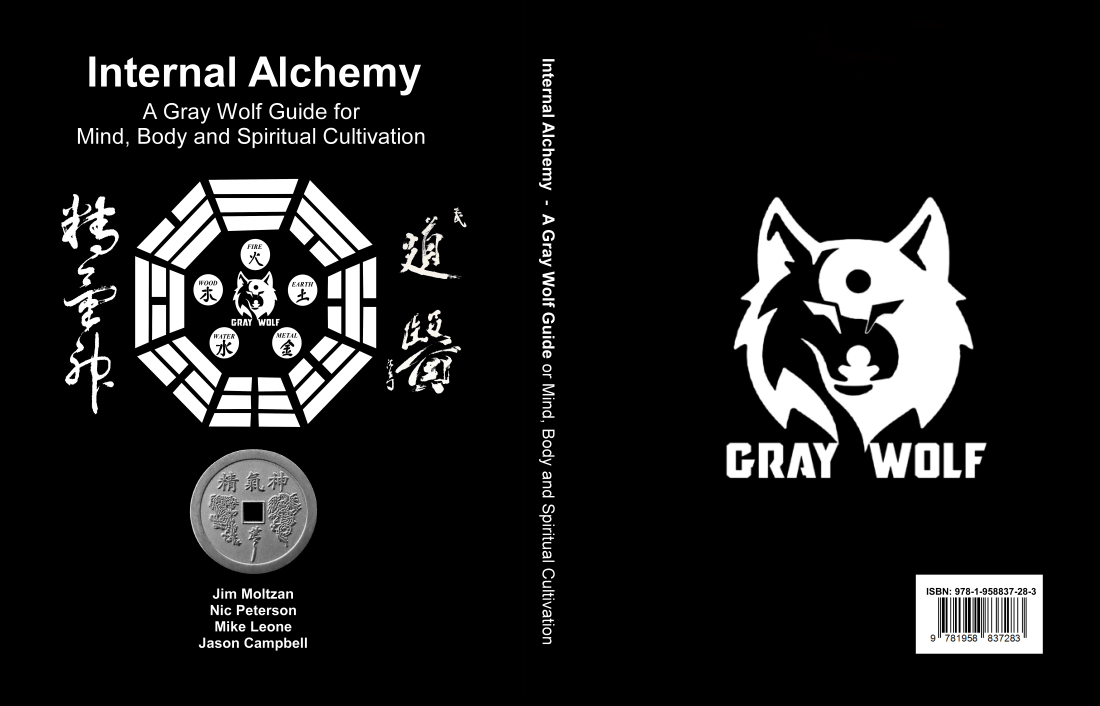
I’m partnering with Nic Peterson  (https:/www.nicpeterson.com/) a respected lineage holder of the Gray Wolf Clan, whose commitment to mastery, stewardship, and the preservation of traditional wisdom deeply aligns with my own. Nic recently wrote a powerful foreword for a private-label edition of one of my foundational works, newly titled Internal Alchemy: The Gray Wolf Guide to Body, Mind, and Consciousness. His contribution reflects the values we both hold dear of humility in teaching, discipline in practice, and the profound responsibility that comes with authentic knowledge.

We come from a warrior–scholar–sage tradition. Our masters are healers and fighters, philosophers and practitioners. They are as capable of restoring life as they are of taking it. Many other masters and grandmasters, though unnamed, have left their mark here too. That’s the nature of a true lineage: the teachings carry many hands, many voices.

Internal Alchemy is not a light read. It is a manual that is quite dense, and a deliberate reference that can (and should) be returned to time and again. Each page could be unpacked over days of study. It’s not meant to be skimmed; it’s meant to be integrated.

Alongside Nic, I am also honored to acknowledge the contributions of two remarkable individuals:

Michael Leone, my friend, peer, and sometimes teacher, a doctor of Chinese medicine, and a true warrior-scholar-sage, has been the wellspring of much of the knowledge this book is built upon. His insight into internal energetics, martial arts, and the healing systems of the East has deeply shaped my own understanding and practice. His teachings live within every page of Internal Alchemy, and his guidance continues to inform and inspire everything I share. Michael can be reached at: https://zenwellness.com/

Jason Campbell, a highly recognized teacher, musician, and meditation guide, adds a profound layer to this collaboration. His work bridges the gap between ancient practices and modern lives, using sound, rhythm, and stillness to create doorways into deeper awareness. His presence in this effort expands our ability to reach those seeking peace not just in body and mind, but also in spirit and daily life. Jason’s works can be found at: https://www.jasoncampbellmusic.com/

Together, we represent a community of practitioners who believe that ancient knowledge must be preserved, respected, and made relevant in the modern age. Our collaboration is a commitment to serving the global community of seekers who value depth over trends, practice over theory, and legacy over ego.

Internal Alchemy is more than a book. It’s a living transmission of teachings designed to support your path toward self-mastery and inner freedom. Whether you are a beginner or a lifelong practitioner, we invite you to join us on this journey.

If you feel the call to the mountain, to the stillness, to something deeper within, you’re already on the path.

To learning, growing, and giving back.

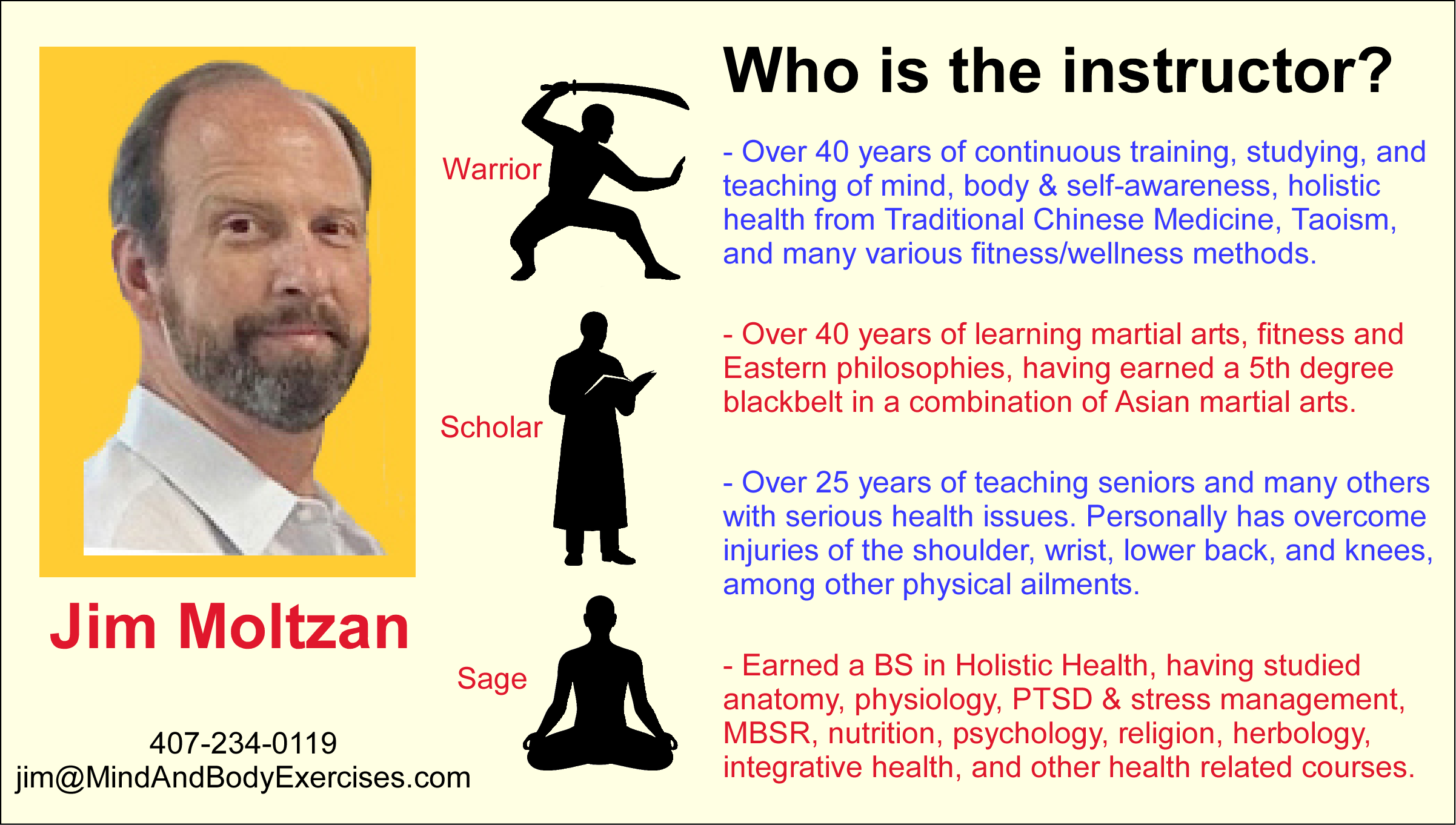
Jim Moltzan
Author, Educator, Practitioner

I teach and offer lectures about holistic health, physical fitness, stress management, human behavior, meditation, phytotherapy (herbs), music for healing, self-massage (acupressure), Daoyin (yoga), qigong, tai chi, and baguazhang.

Please contact me if you, your business, organization, or group, might be interested in hosting me to speak on a wide spectrum of topics relative to better health, fitness, and well-being.

I look forward to further sharing more of my message by partnering with hospitals, wellness centers, VA centers, schools on all levels, businesses, and individuals who see the value in building a stronger nation through building a healthier population.

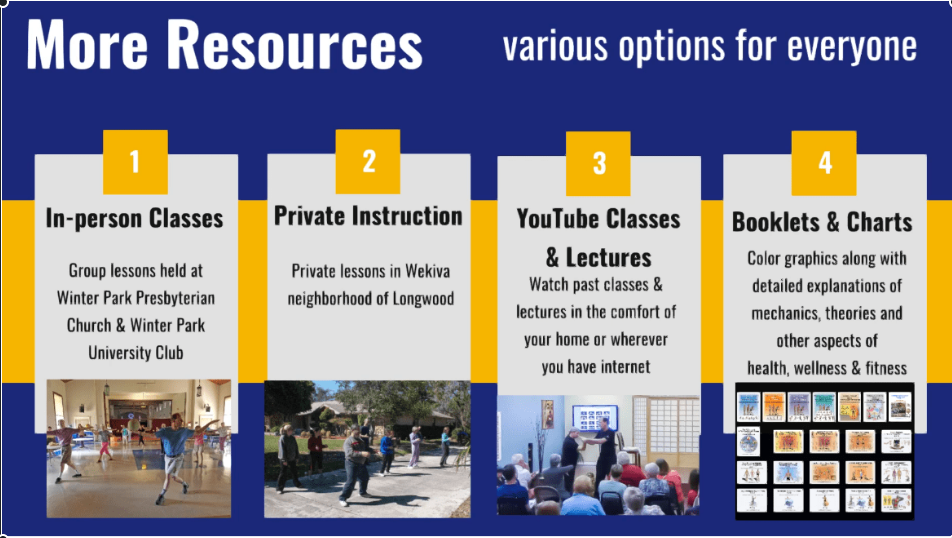
I also have hundreds of FREE education video classes, lectures, and seminars available on my YouTube channel at:

https://www.youtube.com/c/MindandBodyExercises

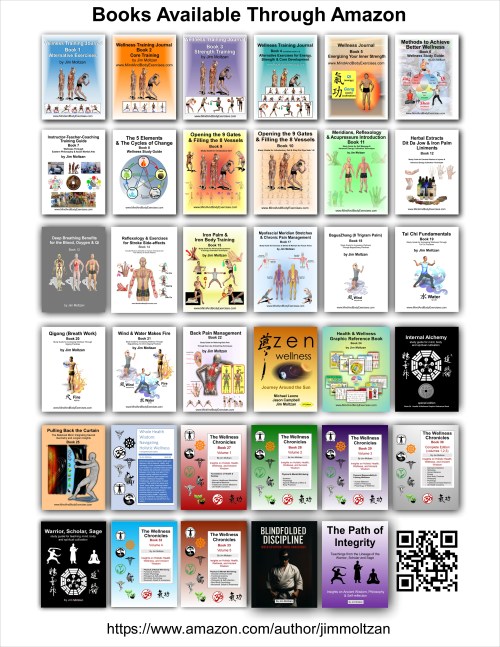
Many of my publications can be found on Amazon at:

http://www.Amazon.com/author/jimmoltzan

My holistic health blog is available at:

https://mindandbodyexercises.wordpress.com/

http://www.MindAndBodyExercises.com

Mind and Body Exercises on Google: https://posts.gle/aD47Qo

Jim Moltzan

407-234-0119

Is Gratitude and Appreciation Outdated?

The Good Book says it’s better to give than to receive
I do my best to do my part
Nothin’ in my pockets, I got nothin’ up my sleeve
I keep my magic in my heart
Keep up your spirit, keep up your faith, baby
I am counting on you
You know what you’ve got to do

(Triumph – 80’s rock band)

What is up with more recent generations, who often don’t say thank you or express appreciation for others’ paying bills, buying groceries, preparing meals, dining out, creating education opportunities, and many other instances where in the past, people did so? Has this been the new norm for a while now and I just missed the memo? Maybe the email got lost in my AOL spam folder. Perhaps I am behind the times.

I think that my observation touches on a fascinating dynamic: gratitude as a social and cultural norm seems to have diluted over generations, influenced by shifts in our values, communication styles, and societal structures. In the past, gratitude wasn’t just a taught virtue. Expression of gratitude often had real tangible stakes, such as maintaining social connections, securing resources, or avoiding ostracization. A lack of a call thanking an older relative for a birthday or graduation gift would consequently cease future generosities. The pendulum now seems to have swung, with younger generations often less in sync with older generations as to the importance of explicit expressions of gratitude, especially in personal and financial matters.

For example, take the following scenario with a person choosing to treat a small group to an expensive fine dining experience. The younger participants freely order appetizers, entrees, and alcohol without regard for cost or acknowledgment that there may be a budget. At the end of the meal, all comment on how good the meal was, and then go on their separate ways. Another instance may be where an aging grandparent distributes their wealth before their passing but receives little appreciation nor thanks for the efforts that might greatly influence the beneficiaries’ futures. This behavior might stem from several interconnected factors:

Why This Happens

  1. Changing Norms and Expectations
    • In the past, gratitude was tied to survival and societal belonging. Today, individualism and a sense of entitlement may inadvertently reduce the perceived need to express thanks.
    • Younger generations might see expressions of generosity as routine, expected or transactional, especially if they’ve grown up with parents or elders providing without clear expectations of acknowledgment.
  2. Generational Blind Spots
    • Many in their young adulthood haven’t had to manage substantial expenses themselves. Without the firsthand experience of the time and effort required to afford luxuries, they might not fully grasp the significance of such gestures.
    • Digital communication norms have shifted the way gratitude is expressed, with younger people often favoring indirect methods over explicit verbal thanks, such as via texting emojis or likes.
  3. Social and Economic Pressures
    • With stressors like social issues, economic uncertainty, college costs, and other debt, younger people may unconsciously prioritize their immediate pleasure over reflecting on the bigger picture of generosity and sacrifice.

Addressing the Issue

If someone cares to bridge this gap constructively, here are some strategies:

  1. Be the Example and Model by Discussing Gratitude
    • Share how you learned the value of expressing thanks and why it’s meaningful. For example, one might say, “When I was younger, I eventually realized how important it was to show my appreciation, not just out of politeness, but because it helps to build and strengthen relationships.”
    • Express your own gratitude openly, as this sets an example for others. For example, one could acknowledge the chef or server during the dining experience, demonstrating the power of recognition.
  2. Gently Raise Awareness
    • Reflect on the experience with them afterward. For instance: “I really enjoyed treating everyone to dinner, it was quite a special occasion for me. I hope you all felt the same way.”
    • If you can find it appropriate, bring up the idea of cost in a non-confrontational way, such as: “Fine dining is a real treat. It made me think about how much time and effort goes into making something like that possible and memorable.”
  3. Set Expectations Going Forward
    • For similar future outings, one could propose some light boundaries or discussions about the value of shared experiences. For example, “Let’s keep it simple and focus on enjoying the moment. Feel free to order what you’d like, but keep in mind that we’re here to share a meaningful time together.”

Big Picture

While it might feel disheartening in the moment, remember that younger generations often do appreciate acts of kindness but might lack the social tools or awareness to express it in a way that others may recognize. By modeling, discussing, and gently guiding, you can help foster an understanding of gratitude that feels authentic to both parties, ensuring these experiences are both enjoyable and meaningful.

I teach and offer lectures about holistic health, physical fitness, stress management, human behavior, meditation, phytotherapy (herbs), music for healing, self-massage (acupressure), Daoyin (yoga), qigong, tai chi, and baguazhang.

Please contact me if you, your business, organization, or group, might be interested in hosting me to speak on a wide spectrum of topics relative to better health, fitness, and well-being.

I look forward to further sharing more of my message by partnering with hospitals, wellness centers, VA centers, schools on all levels, businesses, and individuals who see the value in building a stronger nation through building a healthier population.

I also have hundreds of FREE education video classes, lectures, and seminars available on my YouTube channel at:

https://www.youtube.com/c/MindandBodyExercises

Many of my publications can be found on Amazon at:

http://www.Amazon.com/author/jimmoltzan

My holistic health blog is available at:

https://mindandbodyexercises.wordpress.com/

http://www.MindAndBodyExercises.com

Mind and Body Exercises on Google: https://posts.gle/aD47Qo

Jim Moltzan

407-234-0119