

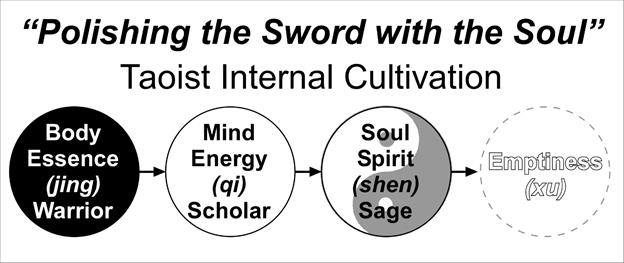
In Taoist cultivation theory, the “Three Treasures” (sān bǎo) of jīng, qì and shén describe successive refinements of being: from bodily substance to energy to spirit. Alongside and underpinning this transformative process is the principle of xū, often translated “emptiness”, “void”, or “hollow openness”. Xū is not mere nothingness, but a dynamic receptive ground that allows emergence, transformation, and return. This essay explicates the meaning of xū, its relation to the Three Treasures, and how classical Taoist texts articulate this interplay.
The Three Treasures: Jīng, Qì and Shén
The Three Treasures are central in Taoist internal alchemy (nèi dān) as the raw materials and vehicles of transformation.
| Treasure | Chinese | Key meaning | Role in cultivation |
| Essence | 精 (jīng) | The dense, material‐vital substance (including inherited vitality, reproductive substance) (Bartek, 2024) | Reserved, refined and conserved; the “root” of life and alchemical process. |
| Vital energy / breath | 氣 (qì) | The dynamic life‐force, movement, breath, transformation of substance into energy (Bartek, 2024) | Circulates, refines essence into spirit; bridges body and spirit. |
| Spirit / consciousness | 神 (shén) | The refined, luminous aspect of awareness, spirit, mind, divine seed (Pregadio, 2009) | The outcome of refinement; the luminous presence and the vehicle of transcendence. |
In internal‐alchemy texts such as the Wuzhen Pian attributed to Zhang Boduan, the Three Treasures are explicitly cited as the ingredients of the internal elixir:
“…the body contains the essential components: these Three Treasures are jīng, qì and shén.”
Thus, the alchemist’s work is to refine jīng → qì → shén and finally to integrate with the Way (道).
The Concept of Xū
Definition and nuance
The Chinese character 虛 (xū) conveys “emptiness”, “voidness”, “hollowness”, “open space”, “vacancy”, but importantly also “receptivity”, “openness”, “ungrasped potential”. In Taoist texts, xū is often the invisible space or still ground that allows form, movement, being, and return.
For example, in the classic Tao Te Ching by Laozi, Chapter 11 states:
“Thirty spokes join at one hub; it is the emptiness (xū) that makes the wagon useful. Cast clay into a vessel; it is the emptiness inside that makes it useful. Cut out doors and windows to make a room; it is the emptiness within that makes it inhabitable.” (Tao Te Ching by Lao Tzu – Verse 11 – Three Translations, 2021)
And Chapter 16:
“Attain complete emptiness (xū); hold fast to stillness. The myriad beings arise – yet each returns to its root.” (Tao Te Ching by Lao Tzu – Verse 11 – Three Translations, 2021)
Thus xū is both origin and destination. It is the silent ground from which being arises and to which it returns.
Xū in internal alchemy
In internal alchemy (nèi dān), xū becomes the “vessel” or “cauldron” within the practitioner, as an inner space, body‐mind field of openness, into which essence, energy and spirit are guided. According to scholarship:
“In meditative practices, they visualize the human body as a cauldron that refines the internal vital forces including essence (jīng), pneuma (qì), and spirit (shén) to produce an internal elixir…” (Wuzhen Pian 悟真篇 Also Known as “Essay on the [Immediate] Awakening to Truth”, “Chapters on Awakening to Perfection” – UBC Library Open Collections, n.d.)
Also:
“It regards humans as a set of tripods and stoves for refining and enhancing one’s own life energy (jīng, qì, shén) … The first stage involves replenishing jīng, qì and shén, … the final is returning to emptiness.” (Golden Elixir Press, n.d.)
Hence, xū is the operative “space” in which the refinement jīng → qì → shén occurs, and into which shén finally dissolves.
Relationship of Xū to the Three Treasures
Here is how xū operates at each stage of the alchemical process:
| Transformation stage | Role of Xū | Implication for cultivation |
| jīng → qì | The practitioner first quiets distractions, reserves essence, cultivates stillness—creating an inner emptiness (xū) so that jīng does not scatter. | Cultivating “emptied receptivity”: less sensory input, fewer desires, conserving jīng. |
| qì → shén | Energy (qì) flows within the “empty vessel” (xū), unimpeded by conceptual/motional turbulence; this allows qì to transform into shén. | Cultivation shifts to subtle awareness, opening to spirit, refining vital energy in the void. |
| shén → Return to Xū | At completion, the refined shén merges into emptiness (xū), dissolving the individual self into universal ground (道). The Three Treasures originate from xū and return to xū. | The goal: abiding in xū as “Spirit and Emptiness united as one”. |
In other words:
xū is neither an added “fourth treasure” nor merely an absence, but the field of transformation and integration of the Three Treasures. Without xū: jīng stagnates, qì scatters, shén remains bound. With xū: alchemy is possible, transformation flows, transcendence becomes attainable.
Classical Source Quotations
Here are selected quotations with Chinese original and annotated translation:
- From Tao Te Ching, Ch. 11
- “Thirty spokes join at one hub; yet it is the emptiness therein that gives the wheel its use. Kneading clay to form a vessel; yet it is the emptiness therein that makes the vessel useful…” (Dao De Jing [Tao Te Ching], by Lao Zi [Lao Tzu] in Side-by-Side Translation: Chapter 11, n.d.)
- From Tao Te Ching, Ch. 16
- “Attain complete emptiness; hold fast to stillness. The myriad beings all arise – I watch their return. The myriad things flourish and each returns to its root. Returning to the root is called stillness. Stillness is called returning to destiny. Returning to destiny is called the Constant. Knowing the Constant is called clarity…” (Garofalo, n.d.)
- From Wuzhen Pian
- Though specific lines are metaphorical and sparse, one commentary notes: “The body contains the essential components. These Three Treasures are jīng, qì and shén.” (Wikipedia contributors, 2025)
- And that this text visualizes the human body as a cauldron refining the Three Treasures. (Wuzhen Pian 悟真篇 Also Known as “Essay on the [Immediate] Awakening to Truth”, “Chapters on Awakening to Perfection” – UBC Library Open Collections, n.d.)
- Scholarly exegesis: “The first stage involves replenishing essence, breath and spirit … and the final is returning to emptiness.” (Golden Elixir Press, n.d.)
- Interpretation of the Three Treasures in Chinese culture: “The ancient Daoists believed that man exists inseparably between heaven and earth and that there is a mutual relationship between these three (heaven, earth, man) …” in relation to jīng, qì, shén. (Bartek, 2024)
Summary
- The Three Treasures (jīng, qì, shén) chart an inner alchemical journey: the body’s essence → refined energy → luminous spirit.
- Xū (emptiness) is not a fourth treasure but the primordial field within which the alchemical transformation occurs and to which it ultimately returns.
- Cultivation involves first creating receptivity and emptiness (xū) to conserve essence, then refining energy in the vessel of emptiness, and finally abiding in emptiness as spirit dissolves into the Way.
- The classical Taoist tradition (via Laozi’s Tao Te Ching and texts like Wuzhen Pian) illustrates this with metaphors of wheel hubs, vessels, cauldrons, and return to root.
- Practically, meditation and Qigong aim to “clear the vessel”, “quiet the hub”, “walk the empty path” so that the Three Treasures can operate in harmony.
References:
Bartek. (2024, June 28). Jing, Qi, Shen – Die drei Schätze. Path of Dao. https://path-of-dao-qigong.ch/en/jing-qi-shen/
Dao De Jing [Tao Te ching], by Lao Zi [Lao Tzu] in Side-by-Side Translation: Chapter 11. (n.d.). YellowBridge. https://www.yellowbridge.com/onlinelit/daodejing11.php?utm_source=chatgpt.com
Garofalo, M. P. (n.d.). Dao de Jing, Laozi, Chapter 16. https://mpgtaijiquan.blogspot.com/2015/05/dao-de-jing-laozi-chapter-16.html?utm_source=chatgpt.com
Golden Elixir Press. (n.d.). Foundations of Internal Alchemy — A slideshow. Scribd. https://www.scribd.com/document/99535352/Foundations-of-Internal-Alchemy-A-Slideshow?utm_source=chatgpt.com
Pregadio, F. (2009). Awakening to Reality: The “Regulated Verses” of the Wuzhen pian, a Taoist Classic of Internal Alchemy. In Golden Elixir Press. https://www.goldenelixir.com/files/Introduction_to_Awakening_to_Reality.pdf?utm_source=chatgpt.com
The Project Gutenberg eBook of Dao de Jing, by Lao Zi. (n.d.). https://www.gutenberg.org/files/49965/49965-h/49965-h.htm?utm_source=chatgpt.com
Tao Te Ching by Lao Tzu – Verse 11 – Three translations. (2021, November 30). Vishy’s Blog. https://vishytheknight.wordpress.com/2021/11/30/tao-te-ching-by-lao-tzu-verse-11-three-translations/?utm_source=chatgpt.com
Wikipedia contributors. (2025, October 1). Wuzhen pian. Wikipedia. https://en.wikipedia.org/wiki/Wuzhen_pian?utm_source=chatgpt.com
Wuzhen pian 悟真篇 also known as “Essay on the [Immediate] Awakening to Truth”, “Chapters on Awakening to Perfection” – UBC Library Open Collections. (n.d.). https://open.library.ubc.ca/cIRcle/collections/ubccommunityandpartnerspublicati/52387/items/1.0416054?utm_source=chatgpt.com
 United Martial Arts Association