
A Research-Supported Perspective on Human Energetic Influence
Human beings continuously influence one another through subtle behavioral, emotional, and physiological exchanges. Although the phrases “energy vampire” and “energy sun” originate from popular psychology, research from social neuroscience, organizational studies, and communication science supports the underlying concepts. These metaphors capture two recognizable interpersonal patterns. Some individuals leave others feeling depleted, tense, or emotionally burdened. Others create an atmosphere of ease, motivation, and uplift. Scientific findings show that these effects are not imagined. The emotional tone of individuals spreads through groups, shapes perceptions of social environments, influences health, and even alters network-level performance.
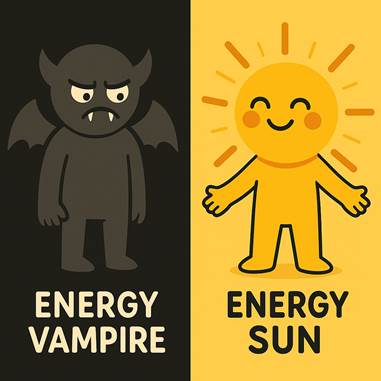
Emotional Contagion as the Foundation of Energetic Influence
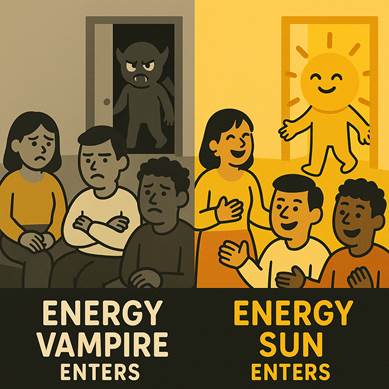
One of the most robust frameworks supporting these ideas is emotional contagion, the automatic transmission of mood between individuals. Hatfield, Cacioppo, and Rapson (1994) demonstrated that people unconsciously mimic facial expressions, posture, vocal tone, and behavioral cues. These physical micro-responses alter the observer’s own emotional state. When someone with chronic negativity enters a room, others may mirror their tension or irritability. When someone with warmth or enthusiasm enters, others tend to “catch” that energy instead.
Laboratory and field studies confirm this spreading effect. Group emotional tone shifts in measurable ways based on the mood of a single individual (Barsade, 2002). Even incidental exposure to positive or negative emotional expressions influences subsequent behavior. For instance, Kramer et al. (2014) found that altering the emotional content of social media feeds changed the emotional tone of users’ own posts. This suggests that emotional contagion is so fundamental that it occurs in digital environments without direct face-to-face interaction.
These findings support the core distinction between “energy vampires” and “energy suns.” The former transmits emotional states that narrow cognitive flexibility and elevate tension. The latter transmits states that promote openness, collaboration, and psychological ease.
Positive and Negative Energizers in Organizational Research
Within organizational psychology, there exists a well-developed framework that parallels this conceptual language. Researchers studying positive relational energy have identified individuals known as positive energizers. These people elevate motivation, creativity, and performance among peers (Cameron, 2012). Positive energizers are consistently described as supportive, trustworthy, solution oriented, and meaning oriented. They communicate hope, strength, and possibility. Teams with a high concentration of positive energizers demonstrate better job satisfaction, higher collaboration, and stronger organizational commitment.
Negative energizers are the opposite. They are sometimes referred to as “black holes” due to their draining effect (Baker, 2020). Their communication style often includes cynicism, complaint, emotional volatility, or self-focused interaction. Research mapping organizational networks shows that individuals who are widely perceived as negative energizers reduce the quality of teamwork and the performance of those around them. Notably, relational energy has been found to be more predictive of employee performance than information flow or hierarchical position (Cameron, 2012). In other words, how someone makes others feel is more important than how much technical authority they possess.
This research provides direct empirical support for distinguishing between “energy vampires” and “energy suns” in group dynamics.
Social Relationships, Stress Physiology, and Health
The effects of draining or nourishing individuals extend beyond mood. They influence physiology. Social isolation and chronically negative relationships are strongly associated with elevated stress hormones, heightened inflammation, and increased risk of depression and mortality (Holt-Lunstad et al., 2015). Conversely, emotionally supportive relationships act as buffers against stress. For example, women who received a brief supportive gesture from their romantic partners before a stressful task showed significantly reduced cortisol responses during the task (Grewen et al., 2003).
Physiological synchrony also occurs within relationships. Partners’ cortisol levels often rise and fall together, demonstrating a biochemical form of emotional contagion (Liu et al., 2013). A highly reactive or negative individual can elevate the stress physiology of those around them. A calm and emotionally regulated person can have the opposite effect.
These findings again support the idea that “energy vampires” consume psychological and physiological resources, while “energy suns” replenish them.
Social Networks and Life Satisfaction
Large-scale studies show that the structure and emotional quality of one’s social network predict well-being. People with more positive, frequent social contacts report greater life satisfaction, better cognitive functioning, and healthier aging (Litwin & Shiovitz-Ezra, 2011). Negative social ties predict stress, emotional exhaustion, and lower resilience.
Energy Vampire vs. Energy Sun: Comparison
| Category | Energy Vampire | Energy Sun |
| General Impact | Drains emotional resources; leaves others feeling heavy or tense | Replenishes emotional resources; leaves others feeling uplifted and clear |
| Emotional Contagion | Spreads negativity, irritability, or fear | Spreads calm, optimism, and emotional ease |
| Communication Style | Dominates conversations; complains; criticizes; focuses on problems | Communicates supportively; encourages; listens with presence; focuses on solutions |
| Effect on Group Dynamics | Reduces cohesion; causes withdrawal and decreased creativity | Increases cohesion; enhances engagement and creativity |
| Physiological Influence | Elevates stress responses; contributes to tension and emotional fatigue | Lowers stress; promotes relaxation and psychological safety |
| Behavioral Patterns | Seeks attention or validation; projects blame; emotionally reactive | Shares credit; takes responsibility; maintains emotional steadiness |
| Social Network Outcome | Creates toxic or draining relational patterns; weakens morale | Creates nourishing networks; strengthens morale and resilience |
| Resulting Environment | Heavy, tense, unmotivated atmosphere | Warm, collaborative, energized atmosphere |
While the terminology of “energy vampire” is metaphorical, the pattern aligns with empirically observed toxic social exchanges, characterized by constant criticism, excessive neediness, hostility, or emotional unpredictability. These relationships create cognitive load and drain psychological resources. The opposite pattern, nourishing and emotionally attuned relationships, aligns with “energy sun” qualities that brighten and stabilize group interactions.
The metaphors of “energy vampires” and “energy suns” are vivid representations of patterns strongly supported by scientific research. Emotional contagion explains how individuals transmit their inner states to others. Organizational studies show that positive or negative energizers dramatically influence group performance and satisfaction. Social neuroscience demonstrates that supportive or hostile interactions directly influence stress physiology. Network studies confirm that emotionally nourishing relationships consistently predict well-being and resilience.
In holistic health, psychology, and social dynamics, these insights converge into a simple but powerful truth. Individuals who enter a room have the capacity to uplift or deplete the collective environment. Recognizing these patterns allows people to cultivate protective boundaries, encourage energizing relationships, and consciously embody the qualities that make them an “energy sun” in the lives of others.
References:
Baker, W., Cross, R., & Wooten, M. (2003). Positive organizational network analysis and energizing relationships. In K. S. Cameron, J. E. Dutton, & R. E. Quinn (Eds.), Positive Organizational Scholarship: Foundations of a New Discipline (pp. 328–342). San Francisco, CA: Berrett-Koehler.
Barsade, S. G. (2002). The ripple effect: Emotional contagion and its influence on group behavior. Administrative Science Quarterly, 47(4), 644–675. https://doi.org/10.2307/3094912
Cameron, K. S. (2012). Positive leadership: Strategies for extraordinary performance. Berrett-Koehler.
Grewen, K. M., Anderson, B. J., Girdler, S. S., & Light, K. C. (2003). Warm partner contact is related to lower cardiovascular reactivity. Behavioral Medicine, 29(3), 123–130. https://doi.org/10.1080/08964280309596065
Holt-Lunstad, J., Smith, T., Baker, M., Harris, T., & Stephenson, D. (2015). Loneliness and social isolation as risk factors for mortality. Perspectives on Psychological Science, 10(2), 227–237. https://doi.org/10.1177/1745691614568352
Kramer, A. D. I., Guillory, J. E., & Hancock, J. T. (2014). Experimental evidence of massive-scale emotional contagion through social networks. Proceedings of the National Academy of Sciences, 111(24), 8788–8790. https://doi.org/10.1073/pnas.1320040111
Litwin, H., & Shiovitz-Ezra, S. (2011). Social network type and subjective well-being in later life. The Gerontologist, 51(3), 379–388. https://doi.org/10.1093/geront/gnq094
Liu, S., Rovine, M. J., Klein, L. C., & Almeida, D. M. (2013). Synchrony of diurnal cortisol pattern in couples. Journal of Family Psychology, 27(4), 579–588. https://doi.org/10.1037/a0033735
 United Martial Arts Association