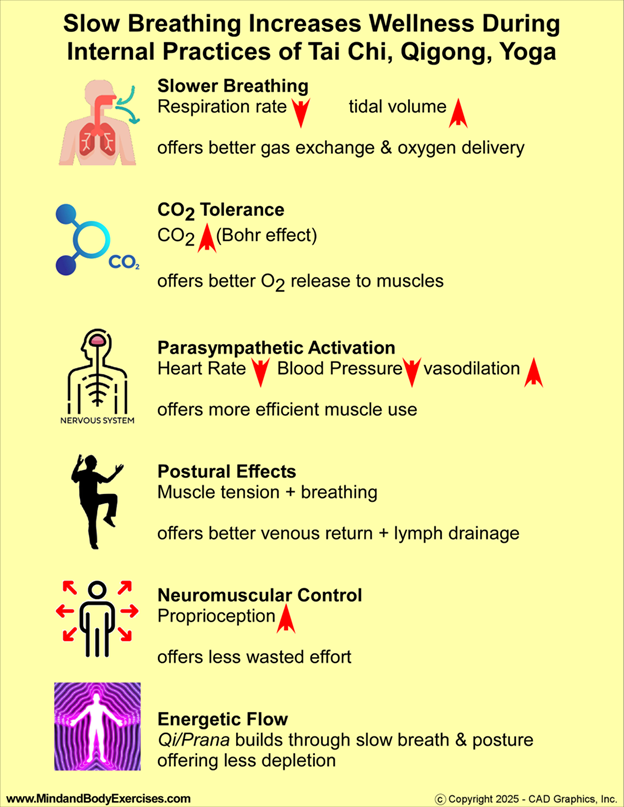

Internal practices like tai chi, qigong, and yoga: how slow, deep breathing can enhance rather than hinder oxygen delivery and energy during physically demanding postures. Let me unpack how this works from a Western physiological perspective, while also nodding to the energetic logic behind these practices.
Physiological Mechanisms at Play
1. Low Breathing Rate ≠ Low Oxygen Intake
- When breathing frequency is reduced intentionally, it’s usually paired with deeper, more diaphragmatic breaths (also called “belly breathing”).
- This increases tidal volume (the amount of air per breath), so although you’re breathing fewer times per minute, you may be getting the same or even more oxygen overall.
- Slower breathing also enhances alveolar gas exchange because air stays in the lungs longer, allowing more thorough oxygen and CO₂ exchange.
Normal respiration rate: ~12 to 15 breaths/min (18 or more BPM when stressed)
In skilled practice: ~4–6 breaths/min (or less), with full exhalation and longer pause phases
2. Parasympathetic Activation and Efficiency
- Slow, conscious breathing activates the parasympathetic nervous system (rest and digest), which:
- Slows heart rate
- Lowers blood pressure
- Enhances vasodilation (better blood flow to extremities)
- This reduces physiological tension, allowing the muscles to function more efficiently with less oxygen demand per unit of work.
3. Increased CO₂ Tolerance and Oxygen Utilization
- Practices that involve breath retention or very slow breathing increase carbon dioxide (CO₂) tolerance.
- Contrary to popular belief, CO₂ is the key signal for oxygen release via the Bohr effect:
- Higher CO₂ levels shift hemoglobin to release more O₂ into tissues.
- So, by tolerating higher CO₂, you actually increase oxygen delivery where it’s needed, especially in muscles under tension.
4. Improved Circulatory and Lymphatic Flow
- Many postures in tai chi, yoga, and qigong involve dynamic tension, twisting, and limb positioning that:
- Gently compress and release blood vessels (like a pump)
- Aid in venous return (blood going back to the heart)
- Enhance lymphatic drainage, helping with detox and immune function
- Combined with deep breathing (which changes intra-thoracic pressure), these techniques mimic a second circulatory pump, where the breath and posture work together.
5. Enhanced Proprioception and Motor Control
- By slowing breath and motion, practitioners become more aware of subtle muscle activation and joint positioning.
- The cerebellum and somatosensory cortex are engaged more deeply, improving neuromuscular efficiency, so less “effort” is needed for the same or better results.
- Muscles co-contract (yin-yang balance) with greater harmony, reducing unnecessary energy output.
Energetic and Traditional Viewpoint
From Traditional Chinese Medicine (TCM) or yogic perspectives:
- Breath (qi/prana) is not just oxygen; it’s vital energy that nourishes tissues.
- Slower breathing “builds” qi rather than expending it.
- Holding postures while breathing deeply and slowly opens energy meridians, improves energy flow, and harmonizes internal organs.
- In yoga, this aligns with pranayama and bandhas (locks), which store and redirect prana rather than dissipating it.
Summary: Why It Works
| Challenge | Physiological Adaptation |
| Low breath rate under tension | Increased tidal volume, better gas exchange |
| Increased CO₂ | Enhanced oxygen delivery via Bohr effect |
| Muscle demand | Greater circulatory efficiency, less waste buildup |
| Nervous system stress | Parasympathetic dominance reduces overexertion |
| Static/dynamic postures | Lymphatic drainage, better venous return |
| Breath–movement harmony | Improved motor control, proprioception, energetic alignment |
References
Brown, R. P., & Gerbarg, P. L. (2005). Sudarshan Kriya Yogic Breathing in the Treatment of Stress, Anxiety, and Depression: Part II—Clinical Applications and Guidelines. The Journal of Alternative and Complementary Medicine, 11(4), 711–717. https://doi.org/10.1089/acm.2005.11.711
Jerath, R., Edry, J. W., Barnes, V. A., & Jerath, V. (2006). Physiology of long pranayamic breathing: Neural respiratory elements may provide a mechanism that explains how slow deep breathing shifts the autonomic nervous system. Medical Hypotheses, 67(3), 566–571. https://doi.org/10.1016/j.mehy.2006.02.042
Bernardi, L., Gabutti, A., Porta, C., & Spicuzza, L. (2001).
Slow breathing reduces chemoreflex response to hypoxia and hypercapnia, and increases baroreflex sensitivity.
Journal of Hypertension, 19(12), 2221–2229.
https://doi.org/10.1097/00004872-200112000-00016
Slow breathing reduces chemoreflex response to hypoxia and. . . : Journal of Hypertension. (n.d.). LWW. https://journals.lww.com/jhypertension/abstract/2001/12000/slow_breathing_reduces_chemoreflex_response_to.16.aspx
Streeter, C., Gerbarg, P., Saper, R., Ciraulo, D., & Brown, R. (2012). Effects of yoga on the autonomic nervous system, gamma-aminobutyric-acid, and allostasis in epilepsy, depression, and post-traumatic stress disorder. Medical Hypotheses, 78(5), 571–579. https://doi.org/10.1016/j.mehy.2012.01.021
Lehrer, P. M., & Gevirtz, R. (2014). Heart rate variability biofeedback: how and why does it work? Frontiers in Psychology, 5. https://doi.org/10.3389/fpsyg.2014.00756
I look forward to further sharing more of my message by partnering with hospitals, wellness centers, VA centers, schools on all levels, businesses, and individuals who see the value in building a stronger nation through building a healthier population.
I also have hundreds of FREE education video classes, lectures, and seminars available on my YouTube channel at:
https://www.youtube.com/c/MindandBodyExercises
Many of my publications can be found on Amazon at:
http://www.Amazon.com/author/jimmoltzan
My holistic health blog is available at:
https://mindandbodyexercises.wordpress.com/
http://www.MindAndBodyExercises.com
Mind and Body Exercises on Google: https://posts.gle/aD47Qo
Jim Moltzan
407-234-0119