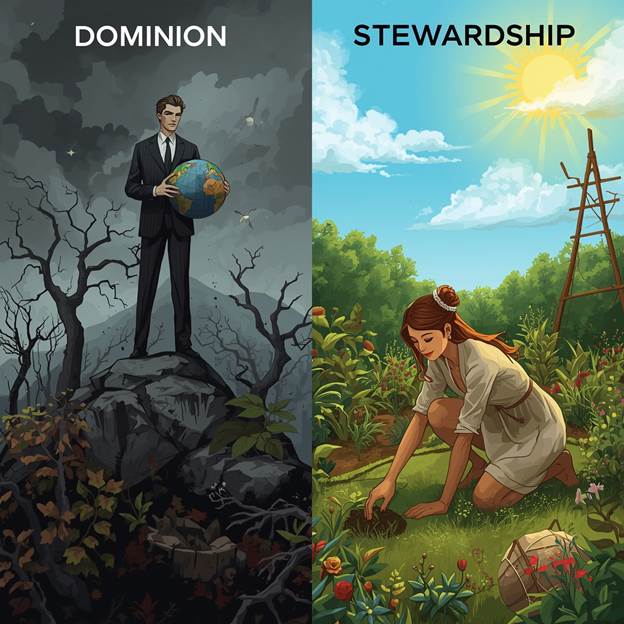
1) Biblical hierarchy and stewardship
In much of Christian theology, humans are uniquely imago Dei, or made “in the image of God” with dominion over other creatures (Genesis 1:26–28; Psalm 8:4–8; cf. Heb 2:7–8). Contemporary Christian environmental thought often reframes dominion as stewardship or “servant leadership,” emphasizing care and restraint rather than exploitation (Francis, 2015). Still, the structure remains anthropocentric: nonhuman nature tends to be valued in relation to human purposes and a theistic teleology (White, 1967; Francis, 2015).
Ethical implication: Duties toward animals and ecosystems are real, but typically derivative of humanity’s special role (Genesis 2:15; Francis, 2015).
2) Eastern and Indigenous alternatives: interdependence, not rank
Taoism treats humans, animals, and plants as natural expressions of the Dao; forcing order upon nature violates ziran (“self-so-ing/naturalness”) and wu-wei (non-coercive action) (Laozi, trans. 2003; Ames & Hall, 2003).
Buddhism grounds ethics in universal suffering and interdependence; compassion (karuṇā) extends to all sentient beings, often motivating non-harm (ahimsa) and vegetarian practice (Harvey, 2000).
Indigenous traditions frequently articulate kinship ethics, “all my relations” where rivers, mountains, animals, and plants are relatives to whom humans owe reciprocity (Kimmerer, 2013).
Ethical implication: Nature has intrinsic (not merely instrumental) value, and human flourishing is inseparable from the flourishing of other beings (Harvey, 2000; Kimmerer, 2013).
3) Modern ecological philosophies: intrinsic value and systems thinking
Deep ecology (Næss, 1973) argues that all beings possess intrinsic worth independent of usefulness to humans. Land-ethic thinking (Leopold, 1949) expands the moral community to “soils, waters, plants, and animals, or collectively: the land.” Gaia theory (Lovelock, 1979/2000) models Earth as a self-regulating system, underscoring the fragility of human-centric control.
Ethical implication: Policies should protect ecological integrity even when short-term human interests would benefit from extraction (Leopold, 1949; Næss, 1973).
4) Practical consequences for law, policy, and everyday ethics
Animal ethics
- Anthropocentric stewardship: Emphasizes humane treatment but often permits intensive animal agriculture if human benefits are high.
- Biocentric/rights-based approaches: Argue certain animals possess rights or strong interests that humans must not override (Regan, 1983; Singer, 1975).
Conservation and land use
- Stewardship model: Conservation is prudent management of resources for human and intergenerational benefit.
- Ecocentric model: Prioritizes ecosystem health and biodiversity for their own sake; restoration and rewilding become moral imperatives (Leopold, 1949).
Law and “standing”
- Anthropocentric legal systems: Traditionally require human victims to claim harm.
- Innovations influenced by ecocentrism: Proposals that forests, rivers, or ecosystems have legal standing (Stone, 1972/2010) reflect a shift toward recognizing nature as a rights-bearing subject, not merely a resource.
5) Is reconciliation possible?
Some Christian thinkers integrate stewardship with integral ecology, arguing that dominion rightly understood forbids domination and demands solidarity with nonhuman creation (Francis, 2015). Critics respond that even reinterpreted, the underlying hierarchy keeps human interests central in ways that can subtly re-authorize extractive patterns (White, 1967; Callicott, 1989).
Bottom line: Yes, there is real philosophical conflict. The biblical hierarchy, softened by stewardship, remains anthropocentric; many Eastern, Indigenous, and ecological philosophies are biocentric/ecocentric, grounding dignity and moral considerability in interdependence and intrinsic value. Those starting points reliably produce different judgments about animal agriculture, wildlife protection, climate policy, and the legal status of nature.
References:
Ames, R. T., & Hall, D. L. (2003). Dao De Jing: A philosophical translation. Ballantine.
Callicott, J. B. (1989). In defense of the land ethic: Essays in environmental philosophy. SUNY Press. https://archive.org/details/indefenseoflande0000call
Francis. (2015). Laudato Si’: On care for our common home. Vatican Press. https://archive.org/details/laudatosioncaref0000cath
Genesis 1:26-28 (NIV). (n.d.). Bible Gateway. https://www.biblegateway.com/passage/?search=Genesis%201%3A26-28%2CGenesis%202%3A18-25&version=NIV
Harvey, P. (2000). An introduction to Buddhist ethics: Foundations, values and issues. Cambridge University Press. https://archive.org/details/introductiontobu0000harv
Kimmerer, R. W. (2013). Braiding sweetgrass : indigenous wisdom, scientific knowledge and the teachings of plants (First Edition, pp. 1–312) [Book]. Milkweed Editions. https://archive.centerforthehumanities.org/files/downloads/Robin-Wall-Kimmerer_-The-Sacred-and-the-Superfund.pdf
Laozi. (2003). Tao Te Ching (D. C. Lau, Trans.). Penguin. (Original work ca. 6th–4th c. BCE)
Leopold, A. (1949). A sand county almanac. Oxford University Press.
Lovelock, J. (2000). Gaia: A new look at life on Earth (Rev. ed.). Oxford University Press. (Original work published 1979) https://archive.org/details/gaianewlookatlif00loverich/page/n5/mode/2up
Naess, A. (1973). The shallow and the deep, long-range ecology movement. Inquiry, 16(1–4), 95–100. https://doi.org/10.1080/00201747308601682
Regan, T. (1983). The case for animal rights. University of California Press. https://archive.org/details/caseforanimalrig00regarich
Singer, P. (1975). Animal liberation. HarperCollins.
Stone, C. D. (2010). Should trees have standing? Law, morality, and the environment (3rd ed.). Oxford University Press. (Original essay published 1972) https://archive.org/details/shouldtreeshaves00ston
White, L., Jr. (1967). The historical roots of our ecologic crisis. Science, 155(3767), 1203–1207. https://doi.org/10.1126/science.155.3767.1203