
A Symbolic Gesture Bridging Buddhism, Martial Arts, and Philosophy
Among the many ritual gestures in martial arts and Buddhist practice, few are as rich in symbolism as the one-handed bow and the Shaolin salute. These simple movements embody centuries of cultural synthesis, spanning Buddhist devotion, Confucian ethics, and Taoist philosophy. Though often performed without conscious reflection, these gestures are living links to profound stories of sacrifice, humility, and moral discipline.
It is also important to distinguish between “bowing toward” someone and “bowing down to” them. In Buddhist and martial traditions, a bow is not a sign of subjugation or inferiority, but rather a gesture of mutual respect, recognition, and presence. To bow toward someone is to acknowledge their humanity, their role as teacher or peer, or their shared path. In contrast, bowing down to someone implies surrender, hierarchy, or submission, a dynamic not typically encouraged in authentic Chan or martial teachings, which emphasize non-attachment, humility, and equality of spirit (Suzuki, 1956; Shahar, 2008). The gesture is not about worship, but about mindful reverence for the moment and the relationship.
The Story of Huike and the One-Handed Bow
The origins of the one-handed bow can be traced to a pivotal moment in Chan (Zen)Buddhist history. In the 5th or 6th century CE, the Indian monk Bodhidharma (Damo) traveled to China, bringing the profound teachings of Dhyana (meditation) Buddhism. According to legend, Bodhidharma secluded himself in a cave near the Shaolin Temple, meditating in silence for nine years (Suzuki, 1959).
During this time, a Chinese monk named Huike sought to become his disciple. Initially rejected, Huike demonstrated his unwavering determination by standing outside Bodhidharma’s cave through a snowstorm. To further prove his sincerity, Huike cut off his own hand and presented it to Bodhidharma. Moved by this act of sacrifice, Bodhidharma finally accepted him as a student (Cleary, 1999).
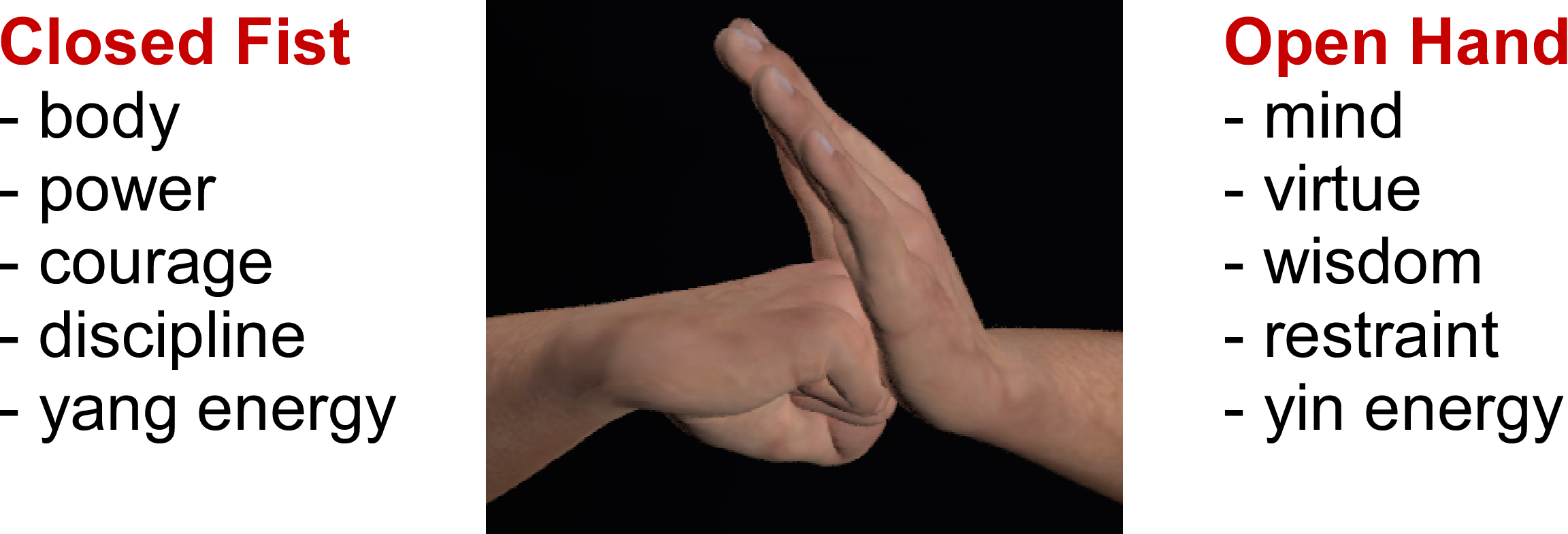
The one-handed bow evolved partly from this story. In Chan circles, bowing with one hand came to symbolize total devotion, humility, and the willingness to transcend ego and attachment. The gesture visually echoes Huike’s sacrifice, representing a commitment to the Dharma that goes beyond the physical form.
Practical Monastic Roots
Beyond its symbolic meaning, the one-handed bow also has practical origins. Buddhist monks traditionally carried alms bowls or staffs, often leaving one hand occupied. The gesture of bowing with the free hand thus became a mindful adaptation, embodying presence and respect even in simple actions (Strong, 2001).
In Shaolin monastic life, where martial training intertwined with Buddhist practice, this gesture naturally merged with martial etiquette. Over time, it evolved into the more formalized Shaolin salute, now widely recognized across martial arts traditions.
The Shaolin Salute (Fist Wrapped in Palm)
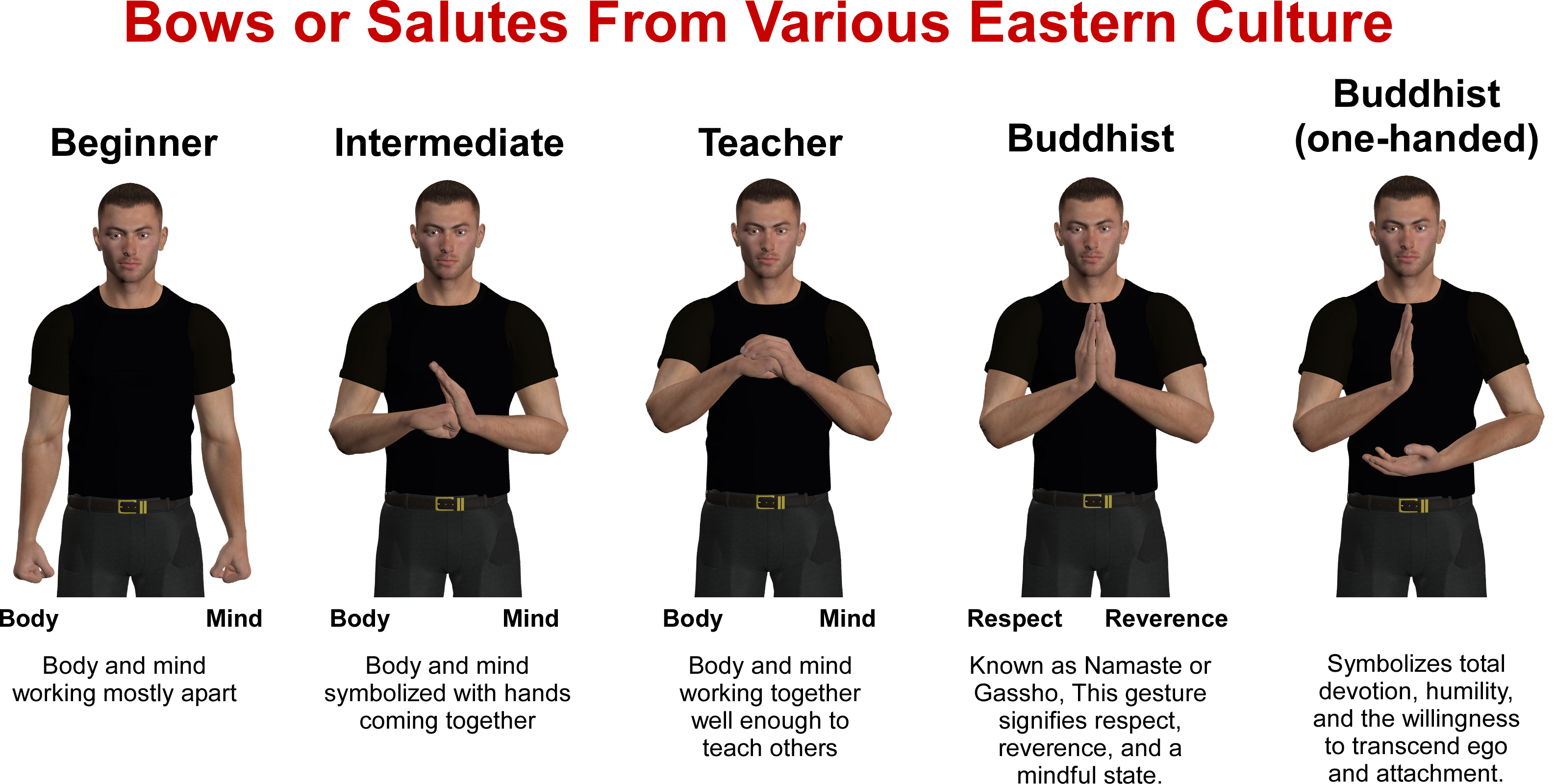
The Shaolin salute, performed with the left open palm wrapping over the right closed fist encapsulates a deep philosophical message:
- The left palm symbolizes wisdom, virtue, and restraint.
- The right fist represents martial strength and discipline.
- Together, they convey the ideal that strength must serve wisdom, and that martial power should always be governed by moral integrity (Henning, 1999).
The gesture is performed at the start and end of training, as a sign of respect toward teachers, fellow practitioners, and the lineage itself.
Northern vs. Southern Shaolin Variations
Northern Shaolin
- Gesture held closer to the chest, with a more upright posture.
- Strong emphasis on Chan Buddhist origins, honoring the story of Huike and Bodhidharma.
- Used as a reminder that martial arts is a spiritual path, not merely a physical practice.
Southern Shaolin
- Gesture held lower, sometimes with a deeper bow.
- Greater incorporation of Confucian and Taoist elements:
- The left palm represents civil virtue (wen).
- The right fist represents martial courage (wu).
- Symbolizes the ideal of the “complete person” where one who balances civil ethics with martial prowess.
Across both traditions, the salute serves as a bridge between physical mastery and spiritual cultivation, reminding practitioners to walk the martial path with awareness, humility, and virtue.
Philosophical Layers of the Salute
| Influence | Left Palm | Right Fist | Combined Gesture |
| Buddhism (Chan) | Wisdom, compassion | Strength, discipline | Strength governed by wisdom |
| Confucianism | Ritual propriety (礼, li) | Martial courage | Harmony of civil and martial virtues |
| Taoism | Yin (open hand) | Yang (closed fist) | Balance of opposites, alignment with Dao |
These layers reflect the syncretic nature of Chinese culture, where Buddhism, Confucianism, and Taoism enriched one another and deeply influenced the martial arts (Shahar, 2008).
The Gesture Today
In modern martial arts, the Shaolin salute is used worldwide. Yet, many practitioners are unaware of its spiritual and historical dimensions. The story of Huike’s sacrifice, the practicality of the one-handed bow, and the layered meaning of the salute all remind us that external movements can carry profound internal significance.
Every time a martial artist performs this gesture, they are participating in a lineage that spans centuries of wisdom, discipline, and moral cultivation. In a world often dominated by superficial strength, the Shaolin salute offers a timeless reminder:
True power lies in restraint, and the greatest warrior is one whose actions serve a higher wisdom.
Conclusion
The evolution of the one-handed bow and Shaolin salute exemplifies the essence of holistic practice, integrating the body, mind, and spirit. These gestures are not mere formalities; they are expressions of a worldview where humility tempers strength, and discipline serves compassion.
As we move through modern life, whether in the dojo, temple, or daily interactions, this simple bow invites us to embody presence, respect, and the pursuit of wisdom in every action.
References:
Cleary, T. (1999). Zen Dawn: Early Zen Texts from Tun Huang. Shambhala Publications.
Henning, S. E. (1981). The Chinese martial arts in historical perspective. In Military Affairs (Issue 4, pp. 173–179). Society for Military History. https://themartialscholar.yolasite.com/resources/henning.pdf
Shahar, M. (2008). The Shaolin Monastery: History, Religion, and the Chinese Martial Arts. University of Hawaii Press. The Shaolin Monastery: History, Religion, and the Chinese Martial Arts on JSTOR
Strong, J. S. (2001). The Experience of Buddhism: Sources and Interpretations (2nd ed.). Wadsworth/Thomson Learning. https://openlibrary.org/books/OL7785420M/The_Experience_of_Buddhism
Suzuki, D. T. (1959). Zen Buddhism and Its Influence on Japanese Culture. Princeton University Press. https://archive.org/details/in.gov.ignca.16794


 United Martial Arts Association