
In the world of holistic health, quality sleep is foundational to healing, regeneration, and mental clarity. Yet many people struggle with falling or staying asleep, unaware that their sleeping environment, particularly the temperature, may be working against them. Interestingly, both science and traditional wisdom agree: a cooler room helps the body sleep more deeply. But perhaps more surprising is the fact that a hot shower before bed can actually help you fall asleep faster. How can both be true?
Let’s explore the physiology of thermoregulation, circadian rhythms, and the role of temperature in sleep and what this means for your wellness routine.
Cooler Temperatures Support the Body’s Natural Sleep Rhythms
Human sleep is governed by the circadian rhythm, a 24-hour biological clock that regulates many body functions, including core body temperature. In a healthy cycle:
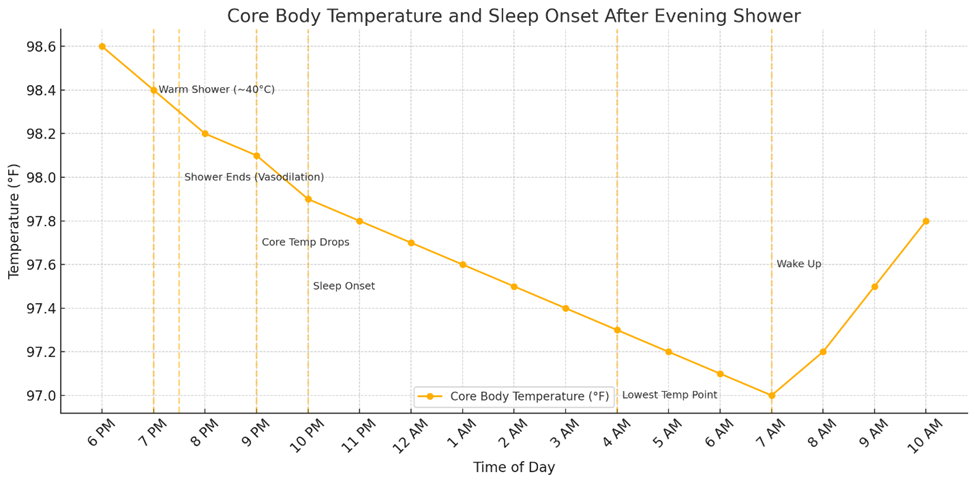
- Core temperature begins to drop in the late evening, signaling the brain to prepare for sleep.
- This drop continues through the night, reaching its lowest point around 4 a.m., then rising toward morning wakefulness.
- A cooler ambient temperature supports this process, helping initiate and sustain deeper stages of sleep.
In essence, cooling the body acts as a natural signal for the nervous system to wind down. When the room is too warm, the body struggles to release heat, leading to more wakefulness, disrupted REM cycles, and less restorative sleep.
According to research, temperatures between 60–67°F (15–19°C) are optimal for most adults to achieve better sleep efficiency and fewer nighttime awakenings (Kräuchi et al., 2000).
Why a Hot Shower Before Bed Helps – Through Cooling
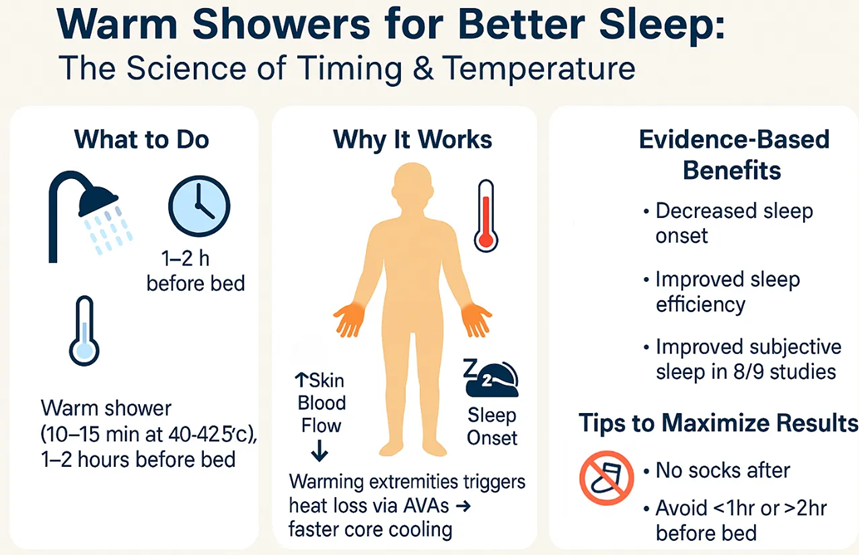
Here’s where it gets interesting. While cooler environments promote better sleep, a hot shower (or bath) about 1–2 hours before bed has also been shown to help people fall asleep faster. This isn’t a contradiction, it’s physiology in action.
Here’s how it works:
- A hot shower raises skin temperature, prompting the blood vessels near the surface (especially in hands, feet, and face) to dilate.
- This vasodilation enables the body to shed heat more effectively once you step out of the shower.
- As a result, your core body temperature rapidly decreases, mimicking the natural nighttime drop and signaling your brain to initiate sleep.
This process supports the body’s thermoregulation and helps shorten sleep onset latency, the time it takes to fall asleep.
A 2019 meta-analysis found that warm showers or baths taken 1–2 hours before bedtime reduced sleep onset time by up to 10 minutes, especially when combined with a cool sleeping environment (Haghayegh et al., 2019).
Holistic Implications: Sleep as a Ritual of Restoration
From a holistic health perspective, sleep is not merely a pause in activity. It is the body’s most profound period of healing and integration. Optimizing temperature regulation supports:
- Melatonin production, which rises as the core temperature drops
- Activation of the parasympathetic nervous system, the body’s natural “rest-and-digest” state
- Emotional regulation, immune repair, and neurocognitive processing during REM and deep sleep
In this context, a hot shower can become more than hygiene. It can become a pre-sleep ritual, one that invites the body into a state of balance. The transition from warmth (shower) to coolness (bedroom) becomes a symbolic and physiological descent into stillness.
This aligns beautifully with Eastern practices such as Taoist bath meditations and Ayurvedic evening routines (dinacharya), which emphasize gentle warming, grounding, and purification before rest.
Practical Tips for Holistic Sleep Support
If you’re struggling with sleep or just want to deepen your nightly restoration try this:
- Take a warm shower (104–109°F / 40–43°C) about 90 minutes before bed.
- Use the time to also slow your breathing, quiet your thoughts, and mentally disconnect from the day.
- After drying off, transition to a cool, dark room (60–67°F).
- Choose natural fiber bedding and avoid artificial light sources or screens.
- Consider mindful breathing, gentle stretching, or herbal teas to further activate the parasympathetic nervous system.
Honor the Body’s Rhythms
The human body has an elegant wisdom built into its rhythms. By working with rather than against these cycles, we allow sleep to unfold more naturally. In holistic wellness, small shifts, like adjusting your room temperature or adding a warm shower to your evening routine can have a profound impact on your physical, emotional, and spiritual vitality.
Instead of forcing sleep through stimulants or sedatives, let the body return to its own balance. Honor the descent into stillness and let cool darkness and gentle ritual guide you into healing rest.
References:
Cagnacci, A., Elliott, J. A., & Yen, S. S. (1992). Melatonin: a major regulator of the circadian rhythm of core temperature in humans. The Journal of clinical endocrinology and metabolism, 75(2), 447–452. https://doi.org/10.1210/jcem.75.2.1639946
Haghayegh, S., Khoshnevis, S., Smolensky, M. H., Diller, K. R., & Castriotta, R. J. (2019). Before-bedtime passive body heating by warm shower or bath to improve sleep: A systematic review and meta-analysis. Sleep Medicine Reviews, 46, 124–135. https://doi.org/10.1016/j.smrv.2019.04.008
Kräuchi, K., Cajochen, C., Werth, E., & Wirz-Justice, A. (2000). Functional link between distal vasodilation and sleep-onset latency? American Journal of Physiology-Regulatory, Integrative and Comparative Physiology, 278(3), R741–R748. https://doi.org/10.1152/ajpregu.2000.278.3.R741
Luu, B., MD. (2025, May 22). Unlock Better Sleep with a Warm Shower. Brandon Luu MD. https://brandonluumd.substack.com/p/unlock-better-sleep-with-a-warm-shower


