
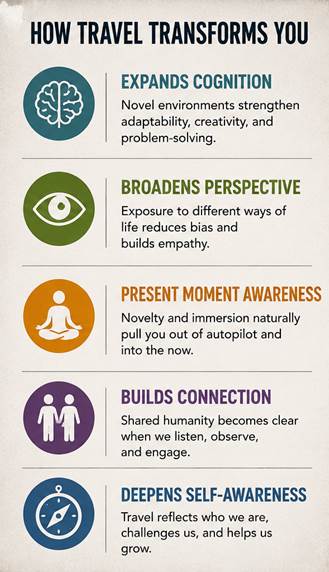
How Travel Expands Cognition, Perspective, and Present-Moment Awareness
Many people read books, study history, watch documentaries, and intellectually explore the customs, politics, and philosophies of other nations. These pursuits are valuable and often essential. Through literature, education, and observation, one can gain important knowledge about geography, economics, religion, language, and cultural behavior. However, there remains a profound difference between learning about a culture and physically stepping into it. To travel is not merely to relocate the body across geographical boundaries; it is often to reposition the mind beyond habitual assumptions, challenge personal perspectives, and invite a deeper awareness of oneself and others.
Having traveled throughout much of the United States, while also visiting Canada, the Bahamas, and parts of Europe, I have repeatedly observed that travel offers something books alone cannot fully replicate: lived immersion. One can read about how societies differ, but standing within those environments by walking unfamiliar streets, hearing another language, adapting to different social norms, witnessing architecture shaped by centuries of history, and observing how people move through daily life, often provides a far deeper education. Travel becomes more than movement; it becomes embodied learning.

The Difference Between Knowing and Experiencing
Cognitive psychologists have long distinguished between declarative knowledge (facts and concepts) and experiential knowledge (learning through direct interaction and experience) (Kolb, 1984). Reading about another country may build intellectual understanding, but physically experiencing a place often integrates emotional, sensory, and contextual learning that deepens retention and insight.
A traveler who studies France may understand historical facts, social systems, or cuisine. Yet walking through neighborhoods in Paris, observing social etiquette, public transportation rhythms, street culture, and local behavioral norms creates a multidimensional learning experience. The brain does not simply process information through abstraction; it interprets experience through sensory and emotional encoding.
This aligns with experiential learning theory, which suggests that concrete experience followed by reflection produces stronger adaptation and understanding than passive acquisition alone (Kolb, 1984). In many ways, the traveler becomes both student and participant.
Travel and Cognitive Flexibility
One of the greatest psychological benefits of travel is enhanced cognitive flexibility, where one develops the ability to adapt thinking, shift perspectives, and respond effectively to unfamiliar situations. Routine environments often reinforce fixed patterns of thought. Travel disrupts these patterns.
Unfamiliar currencies, transportation systems, languages, social customs, food practices, and interpersonal expectations require the brain to continuously reassess, compare, and adapt. This process challenges rigid thinking and may strengthen executive functioning associated with attention, working memory, and adaptive reasoning (Diamond, 2013).
Research suggests that multicultural exposure and international experiences can improve creativity and cognitive complexity because individuals are forced to reconcile multiple viewpoints and behavioral frameworks (Maddux & Galinsky, 2009). Exposure to difference can expand problem-solving capacity by reducing overly simplistic “one-way” thinking.
From the perspective of the Scholar, travel becomes cognitive training.
Travel as a Means to Put Oneself “In the Moment”
Modern life often places people on cognitive autopilot. Familiar roads, repetitive schedules, predictable environments, and habitual routines can reduce conscious attention. Many individuals move through daily life physically present, yet mentally elsewhere, thinking about deadlines, obligations, worries, or digital distractions.
Travel often interrupts this pattern.
When one enters an unfamiliar city, boards a train in another country, navigates a foreign airport, or walks through a cultural district unlike anything at home, attention naturally heightens. The brain becomes alert because novelty demands engagement.
This is one of travel’s overlooked benefits: it places people in the moment.
Psychological research suggests that novelty increases attentional engagement and memory encoding because unfamiliar stimuli require more active cognitive processing (Kandel et al., 2013). A person walking through a market in another country notices sounds, accents, smells, architecture, body language, and social rhythms more consciously than they may notice their own neighborhood.
This resembles mindfulness—not necessarily formal meditation, but situational presence.
Instead of operating through habitual mental drift, the traveler becomes more aware of:
- surroundings
- movement
- sensory detail
- interpersonal behavior
- timing
- uncertainty
- emotional responses
In Eastern traditions, awareness is often cultivated through presence, observation, and reduction of unnecessary mental distraction. Taoist and contemplative systems emphasize alignment with reality as it unfolds rather than attachment to internal agitation or distraction (Lao Tzu, trans. 1988). Travel can unintentionally foster this state by requiring full engagement with the immediate environment.
From the lens of the Warrior, travel sharpens awareness.
Embodied Learning and Sensory Cognition
Travel is not merely intellectual. It is somatic.
The body learns through movement, orientation, climate adaptation, fatigue, rhythm, and sensory immersion. Walking unfamiliar streets, standing in long transit lines, climbing hills, adjusting to jet lag, hearing non-native speech patterns, tasting unfamiliar foods, and experiencing different physical spaces all contribute to embodied cognition.
Embodied cognition theory suggests that cognition is deeply influenced by physical interaction with the environment rather than existing solely as abstract mental processing (Wilson, 2002). This means learning through travel is partly neurological and partly physiological.
When people physically experience different climates, infrastructure, public norms, and spatial organization, they often understand societal differences in a much deeper way.
From the Scholar and Sage, travel teaches through both observation and embodiment.
Humility, Perspective, and Reduced Ethnocentrism
Travel also challenges egocentric and ethnocentric assumptions.
Many individuals unconsciously view their own societal norms as “normal” or superior simply because they are familiar. Exposure to different systems of governance, transportation, food culture, social etiquette, family dynamics, healthcare, work-life patterns, and public behavior can challenge narrow assumptions.
This does not require idealizing other nations. Every society carries strengths, weaknesses, contradictions, and complexities. Yet observing other systems often reminds us that our worldview is only one lens among many.
Intercultural exposure has been associated with increased openness, empathy, and reduced social rigidity (Nguyen & Benet-Martínez, 2013). Perspective broadening may help individuals better tolerate ambiguity and diversity.
From the Sage, travel cultivates humility.
Travel, Time Perception, and Richer Memory
One fascinating cognitive phenomenon is that travel often makes time feel fuller.
Routine compresses memory. Repetitive days blend together because the brain encodes fewer distinct markers. Novel experiences, however, often create stronger episodic memory formation.
This helps explain why one week abroad may feel psychologically richer than several ordinary weeks at home.
Novel environments create stronger hippocampal encoding, which contributes to vivid recall and perceived experiential depth (Kandel et al., 2013). Travel may therefore enhance not only memory, but the felt richness of life.
Being “in the moment” contributes to this effect.
Travel as a Mirror of Self-Awareness
Perhaps one of travel’s most powerful lessons is not what we discover about other cultures, but what we discover about ourselves.
Unfamiliar environments often reveal:
- patience or impatience
- fear or courage
- gratitude or entitlement
- adaptability or rigidity
- curiosity or resistance
- emotional resilience under uncertainty
Without familiar comforts, many internal patterns become visible. Travel can therefore serve as a mirror.
The Warrior learns resilience.
The Scholar gains perspective.
The Sage develops humility.
A Holistic View of Travel and Human Development
From a holistic wellness perspective, meaningful travel can support cognitive growth, emotional intelligence, sensory awareness, adaptability, humility, and present-moment engagement.
Books educate the intellect.
Travel educates the whole person.
To read is valuable.
To study is essential.
To immerse oneself is transformative.
When approached mindfully, travel becomes more than recreation. It becomes a practice of awareness, a disruption of autopilot living, and an opportunity to refine perspective. In a world increasingly shaped by digital observation rather than lived participation, stepping physically into unfamiliar places may be one of the most practical ways to strengthen cognition, deepen empathy, and reconnect with the present moment.
Sometimes the greatest education begins when we leave the familiar behind.
References
Diamond, A. (2013). Executive functions. Annual Review of Psychology, 64, 135–168. https://doi.org/10.1146/annurev-psych-113011-143750
Kandel, E. R., Schwartz, J. H., Jessell, T. M., Siegelbaum, S. A., & Hudspeth, A. J. (2013). Principles of neural science (5th ed.). McGraw-Hill.
Kolb, D. A. (1984). Experiential learning: Experience as the source of learning and development. Prentice Hall.
Lao Tzu. (1988). Tao Te Ching (S. Mitchell, Trans.). Harper Perennial.
Maddux, W. W., & Galinsky, A. D. (2009). Cultural borders and mental barriers: The relationship between living abroad and creativity. Journal of Personality and Social Psychology, 96(5), 1047–1061. https://doi.org/10.1037/a0014861
Nguyen, A. M. D., & Benet-Martínez, V. (2013). Biculturalism and adjustment: A meta-analysis. Journal of Cross-Cultural Psychology, 44(1), 122–159. https://doi.org/10.1177/0022022111435097
Wilson, M. (2002). Six views of embodied cognition. Psychonomic Bulletin & Review, 9(4), 625–636. https://doi.org/10.3758/BF03196322



… reposted this!
LikeLiked by 1 person