Why Meaningful Encounters Leave Both Warmth and Ache
As I have grown older, I have come to deeply appreciate meaningful time spent with old friends, new acquaintances, and those brief but sincere encounters that remind us of our shared humanity. Whether it is reconnecting with someone from years past, sharing thoughtful conversation with a newer friend, or simply experiencing genuine fellowship, these moments often leave me feeling renewed, uplifted, and more grounded. They nourish something deeper than casual entertainment. They touch the mind, the heart, and perhaps even the soul.
Human beings are inherently social creatures. While some of us may value solitude, introspection, and self-cultivation, there remains a fundamental biological and psychological need for connection. Positive social interaction has been associated with activation of several beneficial neurochemical pathways, including dopamine, oxytocin, endorphins, and serotonin-related mood regulation, all of which can contribute to feelings of reward, trust, emotional warmth, and general well-being (Cacioppo & Cacioppo, 2014; Holt-Lunstad et al., 2010).
When we spend quality time with people who enrich our lives, there is often a subtle but noticeable sense of vitality. Conversation flows. Laughter feels restorative. Shared memories strengthen identity. New perspectives sharpen awareness. In many ways, meaningful relationships can become a form of emotional nourishment.

Yet, as many of us know, there is another side to this experience.
Eventually, the visit ends. The phone call concludes. The gathering disperses. The trip home begins. What was once full of warmth, movement, and engagement slowly gives way to quietness. Sometimes this transition carries a subtle emotional ache. Not necessarily depression, nor even sadness in its conventional sense, but perhaps a kind of reflective emptiness. A longing. A desire for just a little more time.
From a neuropsychological standpoint, this may reflect the shift from social stimulation and engagement back into relative stillness. While it may feel like a “chemical drop,” it is perhaps more accurate to say the nervous system transitions from heightened relational reward and stimulation into comparative emotional quiet (Lieberman, 2013). The contrast itself is what becomes so noticeable.
This dynamic reminds me greatly of the ancient Daoist principle of yin and yang, where opposite yet complementary forces continuously interact, balance, and transform.
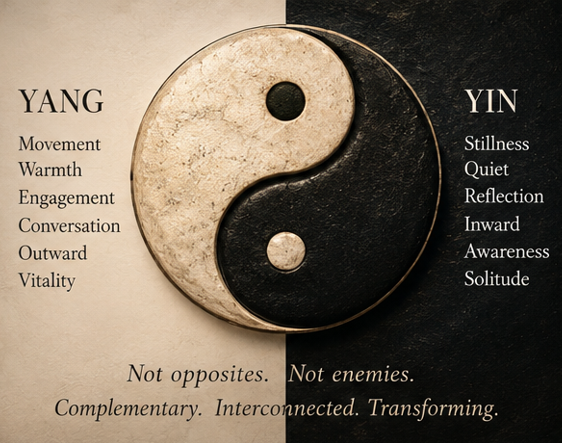
Yang may represent:
- movement
- warmth
- social engagement
- conversation
- outward expression
- vitality
Yin may represent:
- stillness
- quiet reflection
- absence
- inward awareness
- emotional softness
- contemplative solitude
When we gather with people we care about, we often experience a distinctly yang state: active, warm, relational, and expansive. When those encounters conclude, yin emerges: quiet, introspective, and inward.
Yet Eastern philosophy reminds us that yin and yang are not enemies. They are not “good” versus “bad.” Rather, they are mutually arising, mutually dependent, and forever transforming into one another.
Without separation, reunion loses some of its sweetness.
Without silence, conversation has less depth.
Without temporary absence, presence can become less appreciated.
Without longing, gratitude may not fully mature.
This bittersweet interplay is deeply human.
Modern psychology often refers to this as bittersweetness or poignant emotion, where gratitude and sorrow can coexist within the same experience. These emotional states often deepen memory, perspective, appreciation, and even existential meaning (Larsen et al., 2001).
Perhaps what we call longing after meaningful encounters is not simply loneliness. Perhaps it is evidence that we still recognize value in genuine connection, purpose, and shared humanity.
As I reflect through my own lens of the Warrior, Scholar, and Sage, this becomes even clearer.
The Warrior shows up fully in relationship, valuing loyalty, courage, and presence.
The Scholar understands impermanence, recognizing that all meetings, seasons, and relationships naturally shift.
The Sage learns to appreciate connection deeply while not clinging to permanence.
In many ways, healthy human connection mirrors all of life: arrival and departure, fullness and emptiness, warmth and stillness, sweetness and ache.
So perhaps the deeper lesson is this:
Better to have experienced meaningful connection, even if it leaves behind a bittersweet longing, than to have never known such connection at all.
That ache may simply be proof that something valuable occurred.
And that, perhaps, is the enduring yin and yang of human connection.

References
Cacioppo, J. T., & Cacioppo, S. (2014). Social relationships and health: The toxic effects of perceived social isolation. Social and Personality Psychology Compass, 8(2), 58–72. https://doi.org/10.1111/spc3.12087
Holt-Lunstad, J., Smith, T. B., & Layton, J. B. (2010). Social relationships and mortality risk: A meta-analytic review. PLoS Medicine, 7(7), e1000316. https://doi.org/10.1371/journal.pmed.1000316
Larsen, J. T., McGraw, A. P., & Cacioppo, J. T. (2001). Can people feel happy and sad at the same time? Journal of Personality and Social Psychology, 81(4), 684–696. https://doi.org/10.1037/0022-3514.81.4.684
Lieberman, M. D. (2013). Social: Why our brains are wired to connect. Crown Publishers. https://archive.org/details/socialwhyourbrai0000lieb