The Complexity of Nutrition, Constitution, and Digestive Harmony
Modern society often reduces nutrition to simplistic slogans such as “eat healthy,” “consume more fruits and vegetables,” or “avoid processed foods.” While these recommendations contain some truth, genuine nutritional wellness is far more complex than merely selecting foods labeled as healthy. A food that nourishes one person may aggravate another. Likewise, foods considered nutritious may still contain pesticides, preservatives, additives, artificial flavorings, or processing methods that alter their original biological integrity. Furthermore, ancient systems such as Traditional Chinese Medicine (TCM) and Ayurveda have long proposed that foods possess energetic qualities that can either support or disrupt an individual depending upon their unique constitution, digestive strength, environment, and even the time of day they are consumed (Pitchford, 2002; Lad, 2002).
The modern nutritional landscape has become increasingly confusing because individuals are attempting to improve their health while unknowingly participating in habits that may undermine digestion, metabolism, hormonal regulation, and overall vitality. In many ways, nutrition is not merely about calories, protein, fats, or carbohydrates. It is also about compatibility, timing, preparation, temperature, rhythm, and the body’s ability to efficiently transform food into usable energy and tissue.
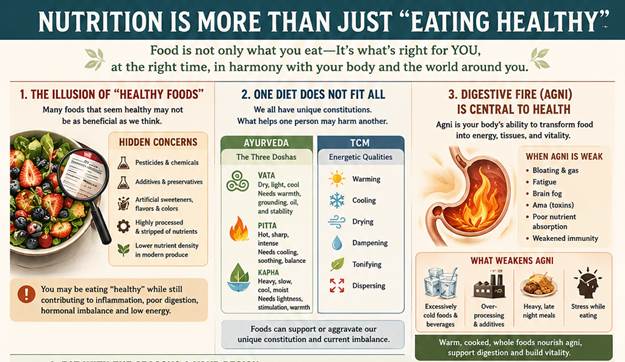
The Illusion of “Healthy Foods”
Many consumers assume that fruits, vegetables, protein bars, juices, smoothies, or “organic” packaged products are automatically beneficial. However, modern food production often introduces complications that were less prevalent generations ago. Produce may contain pesticide residues, wax coatings, preservatives, or chemical treatments intended to prolong shelf life and improve appearance during transportation (Mostafalou & Abdollahi, 2017). Even foods marketed as natural may be highly processed or stripped of essential nutrients.
For example, fruit juices often contain concentrated sugars without the fiber matrix naturally found in whole fruit. Packaged “health foods” may contain stabilizers, emulsifiers, seed oils, artificial sweeteners, or hidden sodium levels that negatively affect metabolism and inflammation (Monteiro et al., 2019). Consequently, individuals may sincerely believe they are eating well while unknowingly contributing to metabolic dysfunction, digestive irritation, or chronic low-grade inflammation.
Additionally, food quality itself has changed. Modern agricultural practices frequently prioritize yield, appearance, and shelf stability over nutrient density. Some research suggests declines in mineral and micronutrient content in certain produce over the past several decades due to soil depletion and industrial farming practices (Davis et al., 2004).
One Diet Does Not Fit Everyone
One of the greatest flaws in modern nutritional culture is the assumption that a single dietary strategy is universally ideal. Human beings possess different constitutions, metabolic rates, digestive strengths, activity levels, genetics, climates, stress responses, and microbiomes. A diet that helps one individual lose weight or gain energy may leave another fatigued, bloated, anxious, or deficient.
Traditional systems of medicine recognized this complexity thousands of years ago. In Ayurveda, individuals are categorized according to constitutional patterns known as doshas: Vata, Pitta, and Kapha. Each dosha possesses unique tendencies involving digestion, energy, emotional disposition, temperature regulation, and susceptibility to imbalance (Lad, 2002). Certain foods may calm or aggravate these constitutions. For example, cold raw foods may aggravate a Vata constitution characterized by dryness, anxiety, and weak digestion, while excessive spicy foods may aggravate Pitta individuals who already tend toward heat and inflammation.
Similarly, TCM categorizes foods according to energetic properties such as warming, cooling, dampening, drying, tonifying, or dispersing (Pitchford, 2002). A person experiencing coldness, fatigue, weak digestion, and low energy may benefit from warm soups, cooked vegetables, ginger, cinnamon, or slow-cooked foods. Conversely, excessive consumption of cold smoothies, iced drinks, and raw salads may weaken digestive vitality further.
From this perspective, health is not determined merely by whether a food is “good” or “bad,” but rather whether it is appropriate for a specific individual under specific conditions.
Digestive Fire and Metabolic Burden
Both Ayurveda and TCM place enormous emphasis on digestive strength. Ayurveda refers to this as agni, or digestive fire. Agni represents the body’s ability to transform food into nourishment, energy, tissue, and consciousness. When agni is weak, even nutritious foods may become difficult to digest, leading to stagnation, bloating, fatigue, mucus accumulation, or toxic buildup known as ama (Lad, 2002).
Modern physiology parallels some of these ideas through concepts involving metabolism, enzyme activity, gut microbiota, autonomic nervous system regulation, and thermogenesis. Digestion requires significant physiological resources. Blood flow increases to the digestive tract, enzymes are secreted, hormones fluctuate, and energy is allocated toward breaking food down and assimilating nutrients.
From both Eastern and modern perspectives, extremely cold foods and beverages may place additional stress upon digestion. Ice-cold drinks, frozen desserts, or refrigerated foods may temporarily constrict blood vessels and require the body to expend additional energy to warm substances closer to core temperature before efficient digestion can occur. While the body is remarkably adaptable, chronic consumption of excessively cold foods may impair digestive comfort in susceptible individuals, particularly those with weakened digestive function or cold constitutions (Pitchford, 2002).
This may explain why many traditional cultures favored soups, teas, broths, and cooked meals rather than large quantities of iced beverages and raw refrigerated foods. Warm foods tend to support circulation, digestive enzyme activity, and parasympathetic relaxation, often improving digestive comfort and nutrient assimilation.
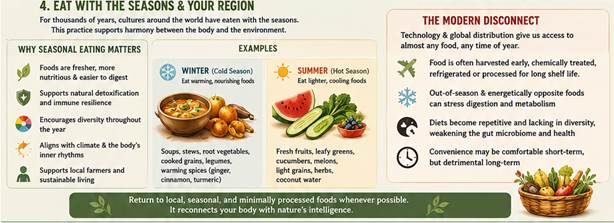
Seasonal Eating and Regional Wisdom
Another important aspect of nutrition that modern society has largely disconnected from is the concept of seasonal and regional eating. For thousands of years, cultures throughout the world naturally adjusted their diets according to climate, geography, and seasonal availability. People traditionally consumed foods that were fresh, locally grown, and appropriate for the environmental conditions surrounding them. In many respects, the rhythms of nature helped regulate the rhythms of the body.
Traditional systems such as Ayurveda and TCM strongly emphasize seasonal adaptation. During colder months, individuals were encouraged to consume warmer, denser, and more nourishing foods such as soups, stews, root vegetables, cooked grains, and warming spices. In hotter seasons, lighter and more cooling foods such as melons, cucumbers, leafy greens, and fruits were more commonly consumed (Pitchford, 2002). These approaches were not merely cultural traditions but attempts to maintain physiological balance between the body and the external environment.
Modern technology and global food distribution have dramatically changed humanity’s relationship with food. Americans now have access to strawberries in winter, tropical fruits year-round, heavily refrigerated beverages in cold climates, and highly processed convenience foods at virtually any hour of the day. While this accessibility appears beneficial on the surface, it may also disconnect people from natural biological and environmental rhythms.
Foods transported long distances are often harvested prematurely, chemically treated, irradiated, refrigerated for extended periods, or genetically modified for durability rather than nutrient density or digestibility. Additionally, constantly consuming foods that are energetically opposite to the external environment may place greater stress upon digestion and metabolic regulation. For example, excessive consumption of iced beverages and cooling foods during winter months may weaken digestion in susceptible individuals according to both TCM and Ayurvedic theory (Lad, 2002; Pitchford, 2002).
Seasonal eating also encourages dietary diversity throughout the year. Historically, humans naturally rotated foods according to harvest cycles, which exposed the body to varying nutrient profiles and phytochemicals. Modern eating habits, however, often consist of the same highly processed foods consumed repeatedly throughout the year with little variation. This monotony may negatively influence gut microbiome diversity, metabolic flexibility, and overall nutritional resilience (Bibbo et al., 2016).
In many ways, convenience has become a double-edged sword. Although modern distribution systems provide abundance and comfort, they may simultaneously contribute to disconnection from natural rhythms that historically helped regulate digestion, immunity, energy balance, and overall health. Returning to a more seasonal and regionally mindful way of eating may help restore a healthier relationship between the human organism and the environment in which it lives.
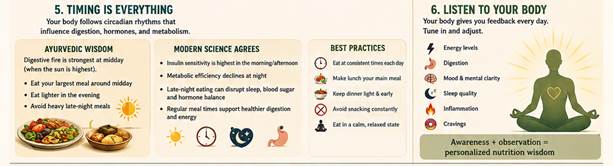
Circadian Rhythms and Meal Timing
Nutrition is not only about what we eat, but also when we eat. The body operates according to circadian rhythms that influence hormone secretion, insulin sensitivity, digestive efficiency, body temperature, and cellular repair processes (Panda, 2018). Eating in opposition to these biological rhythms may contribute to metabolic dysfunction and poor digestion.
Ayurveda has long taught that digestive fire is strongest around midday, corresponding with the sun’s peak intensity. Consequently, larger meals are often recommended earlier in the day, while lighter meals are advised in the evening. Modern chronobiology increasingly supports similar concepts, suggesting that insulin sensitivity and metabolic efficiency tend to decline later at night (Longo & Panda, 2016).
Late-night eating, irregular meal timing, excessive snacking, and heavy evening meals may disrupt sleep quality, blood sugar regulation, digestive recovery, and hormonal balance. Likewise, chronic stress while eating may impair digestion through sympathetic nervous system activation. In essence, many individuals are not only eating inappropriate foods, but are also eating under physiologically inappropriate conditions.
Awareness, Individuality, and Nutritional Wisdom
Perhaps the most important lesson is that nutritional wellness requires awareness rather than rigid ideology. The body constantly provides feedback through energy levels, digestion, inflammation, mood, sleep quality, mental clarity, cravings, and overall vitality. Unfortunately, many people have become disconnected from these signals due to overstimulation, marketing, convenience culture, and conflicting nutritional narratives.
A truly holistic approach to nutrition recognizes individuality. It respects modern scientific understanding while also acknowledging the wisdom embedded within traditional systems such as Ayurveda and TCM. It appreciates that food possesses not only chemical properties, but also energetic, thermal, seasonal, and constitutional effects upon the human organism.
Good nutrition is therefore less about blindly following trends and more about cultivating self-awareness, observing patterns, understanding one’s constitution, and learning how foods interact with the body over time. Health is dynamic rather than static. What nourishes an individual during one season of life may not be appropriate during another.
Ultimately, true nutritional wisdom may arise when individuals stop asking, “What foods are healthy?” and instead begin asking, “What foods are healthy for me, at this time, under these conditions?”

References
Bibbò, S., Ianiro, G., Giorgio, V., Scaldaferri, F., Masucci, L., Gasbarrini, A., & Cammarota, G. (2016). The role of diet on gut microbiota composition. European review for medical and pharmacological sciences, 20(22), 4742–4749.
Davis, D. R., Epp, M. D., & Riordan, H. D. (2004). Changes in USDA food composition data for 43 garden crops, 1950 to 1999. Journal of the American College of Nutrition, 23(6), 669–682. https://doi.org/10.1080/07315724.2004.10719409
Lad, V. (2002). Textbook of Ayurveda: Fundamental principles (Vol. 1). The Ayurvedic Press.
Longo, V. D., & Panda, S. (2016). Fasting, circadian rhythms, and time-restricted feeding in healthy lifespan. Cell Metabolism, 23(6), 1048–1059. https://doi.org/10.1016/j.cmet.2016.06.001
Monteiro, C. A., Cannon, G., Levy, R. B., Moubarac, J. C., Louzada, M. L. C., Rauber, F., Khandpur, N., Cediel, G., Neri, D., Martinez-Steele, E., Baraldi, L. G., & Jaime, P. C. (2019). Ultra-processed foods: What they are and how to identify them. Public Health Nutrition, 22(5), 936–941. https://doi.org/10.1017/S1368980018003762
Mostafalou, S., & Abdollahi, M. (2017). Pesticides: An update of human exposure and toxicity. Archives of Toxicology, 91(2), 549–599. https://doi.org/10.1007/s00204-016-1849-x
Panda, S. (2018). The circadian code: Lose weight, supercharge your energy, and transform your health from morning to midnight. Rodale Books.
Pitchford, P. (2002). Healing with whole foods: Asian traditions and modern nutrition (3rd ed.). North Atlantic Books. https://archive.org/details/healing-with-whole-foods