Yin and Yang: Understanding the Degrees Between the Opposites

When people are first introduced to the concept of yin and yang, it is easy to see it simply as a philosophy of opposites. Yin is often represented as dark, while yang is light. Yin is stillness, while yang is movement. Yin is inward, while yang is outward. Yin is soft, while yang is hard. These comparisons are useful when we are first learning the concept, but yin and yang become much more interesting when we stop thinking about them as simply black and white. Between the two extremes are countless degrees of difference.

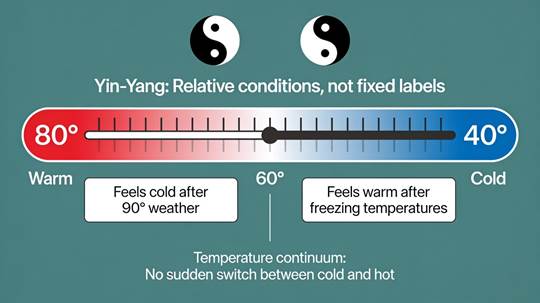
One of the easiest ways I have found to explain this is to think about a thermometer. We might say that 80 degrees is warm and 40 degrees is cold, but what about everything in between? There is no magical point where cold suddenly becomes hot. Temperature moves through degrees along a continuum. Even our perception of temperature depends upon what we are comparing it to. Sixty degrees may feel cold after several days of 90-degree weather, while the same 60 degrees may feel wonderfully warm after several weeks of freezing temperatures. Yin and yang can be understood in much the same way. They describe relative conditions rather than permanent labels.

This becomes clearer when we consider what I refer to in my teaching as the five manifestations or relationships of yin and yang: opposition, interdependence, mutual consuming and increasing, mutual transformation, and infinite divisibility. These concepts help move our understanding beyond the familiar black-and-white yin-yang symbol and into something we can actually observe throughout nature and our own lives.
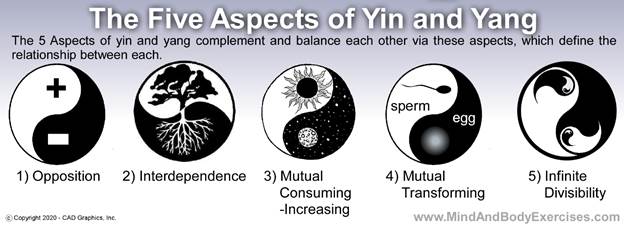
Opposition is probably the easiest manifestation to recognize. Day and night, activity and rest, heat and cold, expansion and contraction all demonstrate contrasting qualities. Yet opposition does not necessarily mean conflict. The two sides actually help us recognize and define one another. We understand darkness partly because we have experienced light, and we recognize stillness because we understand movement.

This leads naturally into interdependence. Yin and yang do not exist independently of one another. We cannot meaningfully describe something as hot without having some concept of cold. Movement is understood in relation to stillness, just as day has meaning partly because there is night. Each side provides a reference point for the other. This is one reason yin and yang should not be viewed as competing forces where one side must eventually defeat the other. Their relationship is complementary.

The manifestation I find especially useful when discussing the stages of our lives is mutual consuming and increasing. This describes how, as one aspect increases, the other relatively decreases. We can observe this simply by watching a day unfold. As morning progresses toward midday, the yang qualities of light, warmth and activity generally increase. As afternoon moves toward evening, these qualities begin to decline while the yin qualities of darkness, coolness and rest gradually increase.

There is no precise moment when day suddenly becomes night. Sunrise itself is a transition. Darkness gradually gives way to light. The sun rises higher, the air warms and activity increases. Later, the process reverses. The sun descends, shadows become longer, temperatures begin dropping and eventually darkness returns. Yang has gradually decreased while yin has increased. Then, during the night, the process eventually begins moving in the opposite direction again.

This is very similar to the thermometer. The temperature does not have to drop from 80 degrees to 60 degrees. It passes through 79, 78, 77 and all of the smaller measurements in between. Nature tends to move through transitions rather than constantly jumping between absolutes. Yin and yang provide a philosophical way of describing these changing relationships.
This also helps us understand why balance does not necessarily mean maintaining a perfect 50/50 relationship between yin and yang. Nature rarely seems interested in remaining perfectly balanced in that sense. Summer does not contain exactly the same amount of warmth and daylight as winter. Noon does not contain the same amount of light as midnight. The relationship is constantly adjusting. Balance, therefore, can be dynamic rather than static.

We can see this same process across the course of a human lifetime. The earlier stages of life tend to contain many yang characteristics. Children run, climb, jump, explore and seemingly move simply for the sake of moving. Young adults often continue this outward expansion as we build careers, raise families, compete, travel, accumulate experiences and test ourselves against the world. There is often considerable emphasis upon doing, achieving and moving outward into life.

As we grow older, the proportions may gradually change. This does not happen on a particular birthday, nor do we suddenly become “yin” because we have reached a certain age. Instead, the degrees begin shifting. We may become more selective about where we spend our physical and emotional energy. Physical training may gradually shift from concerns about how much weight we can lift, how fast we can run or how hard we can strike toward maintaining mobility, balance, coordination, breathing, posture and overall health.

Our priorities may change as well. Experiences can become more important than possessions. Understanding may become more valuable than proving ourselves correct. Listening can become as important as speaking, and reflection may begin accompanying action. This can be viewed as another example of mutual consuming and increasing. Some of the yang characteristics that dominated earlier stages of life may gradually decrease while certain yin characteristics increase.

Of course, this does not mean that older people are yin and younger people are yang. That would simply return us to the black-and-white thinking we are trying to move beyond. A 70-year-old lifting weights or hiking a mountain is expressing relatively yang qualities. That same person sitting quietly afterward, practicing breathing exercises or reflecting upon the day’s experiences is expressing relatively more yin qualities. Likewise, a young martial artist practicing a slow tai chi form may be expressing more yin qualities than an older practitioner performing vigorous strength training. Yin and yang always depend upon what we are comparing.

This is also where infinite divisibility becomes important. Even something we categorize as yang contains different degrees of yin and yang within itself. Exercise may generally be considered yang compared with sitting quietly, but walking is relatively yin compared with sprinting. Jogging might be more yang than walking but more yin than running at full speed. We can continue making these distinctions almost indefinitely. The same principle applies to yin. Sitting quietly may be yin compared with walking, while deep sleep may be even more yin compared with sitting awake. Every time we divide something into yin and yang, those divisions can themselves be divided again.

The principle of mutual transformation takes this relationship another step further. Under the appropriate circumstances, yin can transform into yang and yang into yin. Night eventually becomes day, just as day eventually becomes night. Vigorous activity eventually creates the need for rest, while sufficient rest restores our capacity for activity. Winter eventually gives way to spring, and the quiet dormant period of nature becomes the foundation for renewed growth.

I have noticed a similar transformation within martial arts and mind-body practices. When we are younger, we may be fascinated primarily by speed, strength, flexibility, techniques, forms, fighting applications and physical accomplishments. We want to learn more and do more. Over time, however, some practitioners begin asking different questions. Instead of simply asking how to perform a movement, we begin asking why we are performing it. Instead of constantly collecting another form, another technique or another exercise, we may spend considerably more time examining the principles contained within movements we already know.
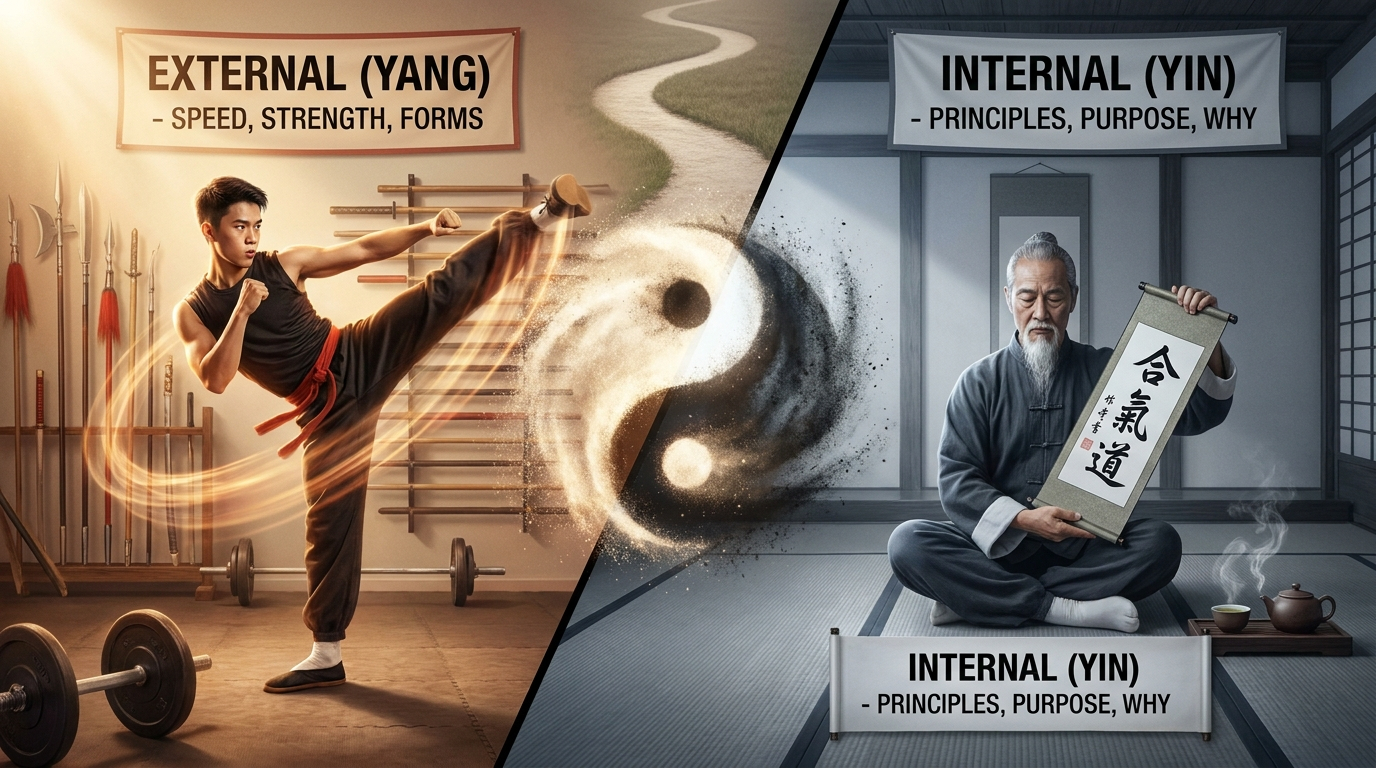
The external practice gradually creates an opportunity for internal observation. Tai chi, qigong, yoga, meditation and many traditional martial arts contain this possibility. At first we may be concerned primarily with what our body looks like from the outside. Where does the foot go? Where should the hand be? How low should the stance be? Eventually our attention may begin turning inward toward what the movement actually feels like, where we are holding unnecessary tension, how our breathing changes and whether we can sense our balance shifting before we lose it. The exercise may look almost identical from the outside, yet the experience occurring within the practitioner may be considerably different.

This brings us to an observation from the Swiss psychiatrist Carl Jung. In a 1916 letter, Jung wrote, “Who looks outside dreams; who looks inside awakes.” The statement appeared within a longer discussion about the importance of turning attention inward and examining oneself (Jung, 1973). I think this provides an interesting bridge between Western psychology and some of the ideas we encounter within yin-yang philosophy.

Much of our younger life is understandably directed outward. We wonder what we can accomplish, what we can obtain, where we can go and what we can become. We are concerned with establishing ourselves within families, careers and communities. These are not foolish or superficial concerns. They are important parts of interacting with the world and developing ourselves within it.
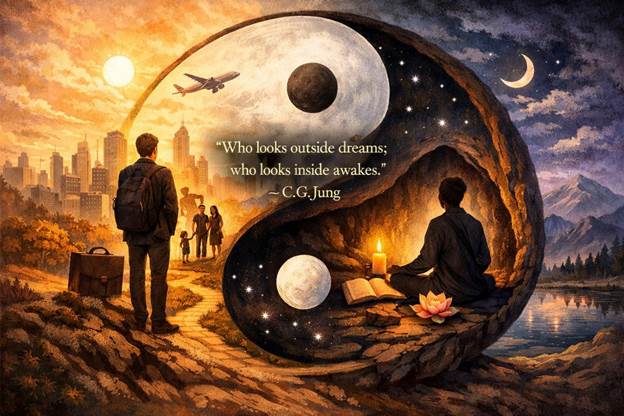
Over time, however, another set of questions may become increasingly important. Why do I believe what I believe? Why do certain situations bother me? Why have I repeatedly made some of the same choices? What have my experiences actually taught me? What should I continue carrying with me, and what should I finally let go? These are quieter and more inward-looking questions. In that sense, looking outward might be considered relatively more yang, while looking inward and reflecting upon ourselves might be considered relatively more yin.

Neither direction is necessarily superior. Too much outward activity without reflection can leave us constantly busy without understanding why we are doing what we are doing. Too much inward reflection without action can leave us contemplating life without actually living it. There are times to act and times to wait, times to speak and times to listen, times to push ourselves and times to recover. There are times to experience the world around us and times to consider what those experiences have taught us.

Even within a single day, we continually move through these degrees. We awaken from the relatively yin state of sleep and become increasingly yang as we get out of bed and begin moving. We work, exercise, interact with people and engage the outside world. Eventually activity begins to decline. Evening arrives, the lights dim, conversations quiet down and the body prepares for sleep. Yang gradually decreases as yin increases. Then morning comes and the cycle begins again.

Perhaps this is one of the most practical lessons contained within yin-yang philosophy. Life is rarely absolute. We like categories because they make the world easier to understand: hot or cold, strong or weak, active or passive, young or old, healthy or unhealthy. But much of human experience exists somewhere between these extremes.

The five manifestations of yin and yang help us understand why. Opposites define one another. They depend upon one another. As one increases, the other relatively decreases. Under the appropriate circumstances, one can transform into the other. And within every distinction we make, further degrees of yin and yang can still be discovered.

As we move through life, our own relationship between these qualities changes as well. What served us at 25 may not serve us in exactly the same way at 65. That does not necessarily mean that something has been lost. It may simply mean that our position along the continuum has changed. The outward journey can gradually become accompanied by a deeper inward journey. Movement becomes increasingly balanced by stillness, speaking by listening, doing by reflecting and accumulating experiences by trying to understand what those experiences actually mean.

Perhaps wisdom itself involves becoming increasingly comfortable with these changing degrees. Yin and yang remind us that we do not always have to choose one side and reject the other. Instead, we can learn to recognize where we are at a particular moment, what the circumstances require and when the balance may naturally begin moving in another direction.

Just as daylight gradually becomes darkness, summer eventually gives way to winter, activity leads toward rest and rest eventually prepares us for activity again, our lives continue to move through different degrees of yin and yang.

The degrees are always changing, and so are we.

Reference

Jung, C. G. (1973). Letters of C. G. Jung: Volume 1, 1906–1950 (G. Adler & A. Jaffé, Eds.; R. F. C. Hull, Trans.). Princeton University Press. (Original letter written October 22, 1916)

Gear Acquisition Syndrome: When Acquiring More Replaces Becoming More

There is nothing inherently wrong with having good equipment. A musician needs an instrument, a photographer needs a camera, a martial artist may benefit from training equipment, and someone exercising at home may reasonably purchase weights or other useful tools. Likewise, there is nothing wrong with continuing our education, attending seminars, studying with different teachers, or expanding our knowledge.

The problem begins when acquiring more becomes a substitute for developing what we already have.

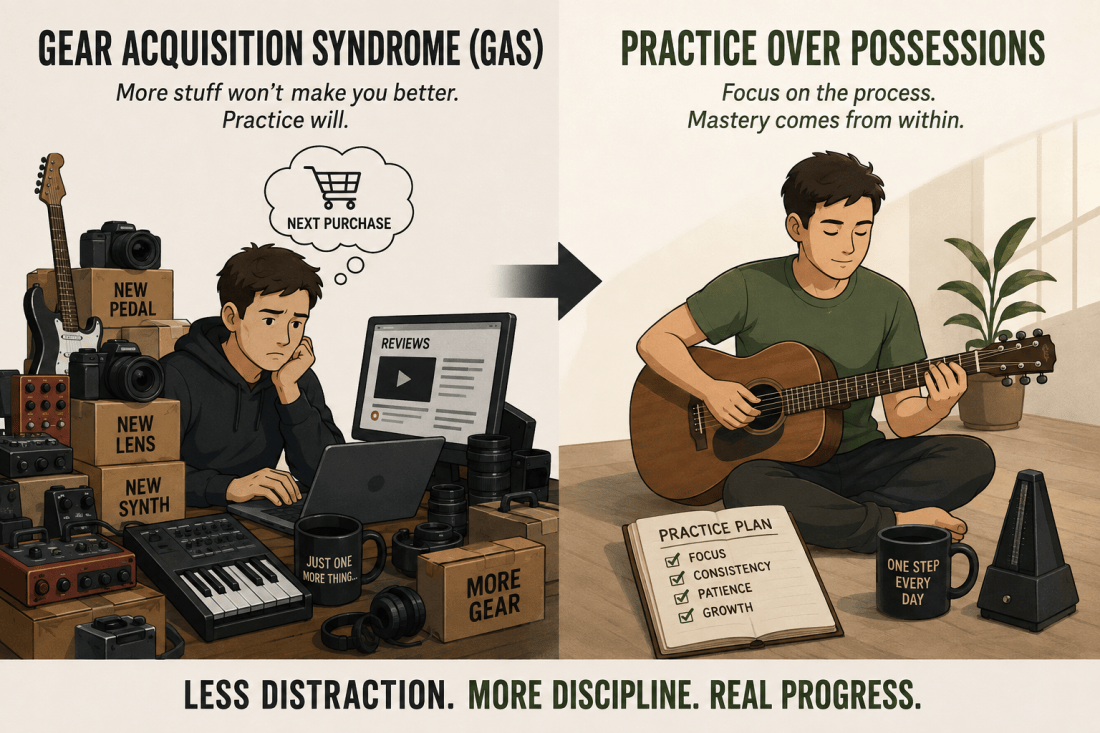
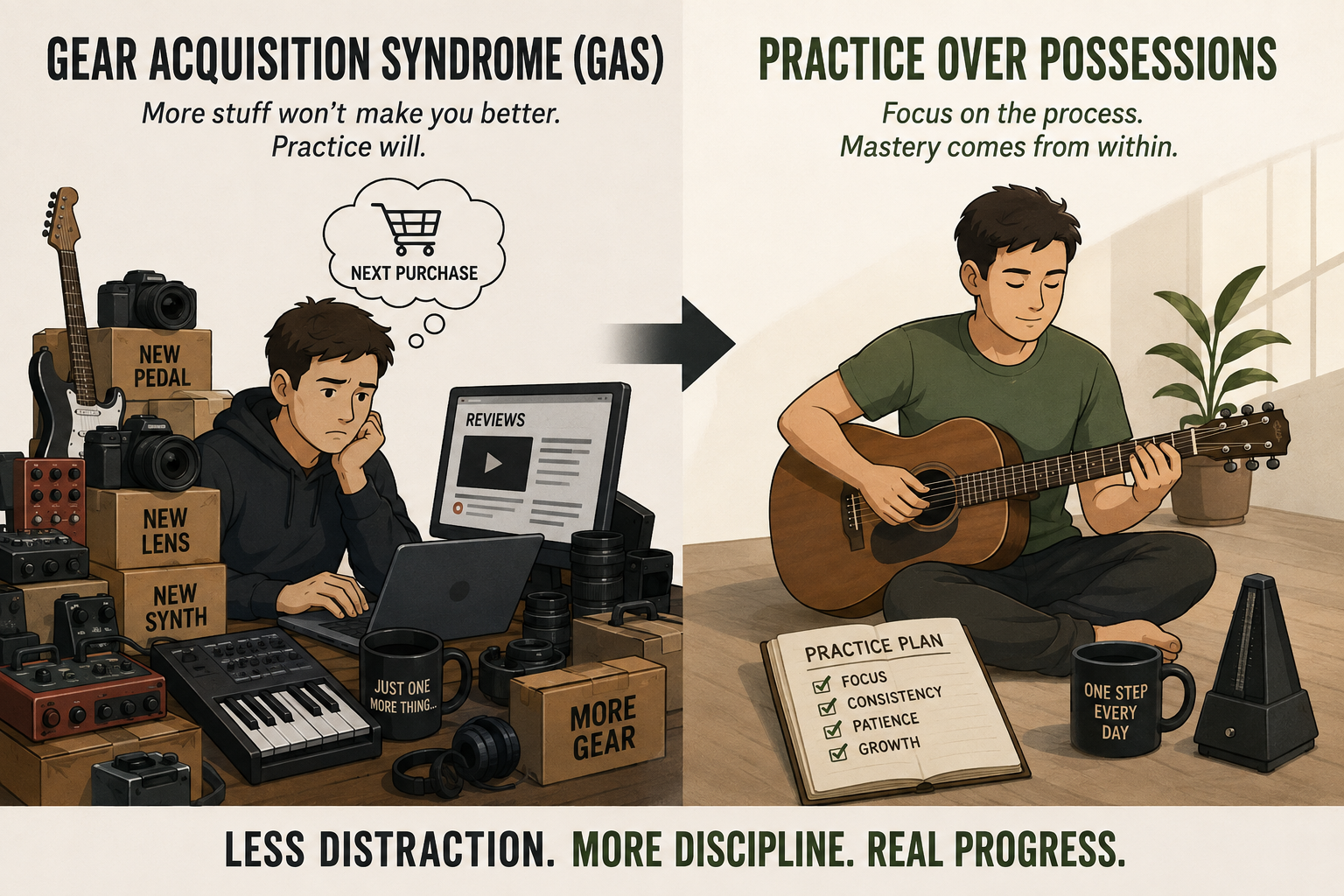
There is a somewhat humorous term for one version of this tendency: Gear Acquisition Syndrome, commonly abbreviated GAS. The expression originated among musicians and was initially associated with “Guitar Acquisition Syndrome.” It eventually broadened into “Gear Acquisition Syndrome” as people recognized that the behavior extended well beyond guitars. Researcher Jan-Peter Herbst examined the phenomenon among electric guitar players and described GAS as the persistent desire to acquire equipment, often connected with expectations concerning sound, creativity, identity, or satisfaction (Herbst, 2017).

Gear Acquisition Syndrome is not a recognized psychiatric diagnosis. The word “syndrome” is being used somewhat tongue-in-cheek. Nevertheless, the behavior describes something very real about human nature, and I believe the principle extends well beyond simply buying things.

Sometimes the “gear” we acquire is not physical equipment at all. It may be another technique, another form, another seminar, another certification, another teacher, another herbal formula, or another supposedly secret body of knowledge. In each case, the important question may be whether we are acquiring something because it genuinely contributes to our development, or because acquiring something new feels like development.

Those are not necessarily the same thing.

The Attraction of the Next Thing

Most of us have experienced the excitement of getting something new. We research it, compare alternatives, read reviews, watch videos, and imagine what we will be able to accomplish once we finally have it.

Part of this attraction involves anticipation itself. Dopamine is often casually described as a “pleasure chemical,” but its role is considerably more complicated. Dopamine is involved in motivation, reward learning, anticipation, and behaviors directed toward potentially rewarding outcomes (Berridge & Robinson, 2016). In other words, the hunt itself can become rewarding.

This may explain why researching and anticipating a purchase can sometimes be more exciting than owning it. The item arrives, the novelty eventually fades, and before long our attention turns toward something else.

There is nothing particularly unusual about enjoying something new. Problems arise when we repeatedly confuse novelty with progress.

This can also become a subtle form of procrastination because acquisition often feels productive. Someone may spend hours researching exercise equipment while doing very little exercise. A musician can study amplifiers instead of practicing. A martial artist can spend an evening researching training equipment while neglecting the exercises already available to them.

Because the activity is related to the goal, it can masquerade as progress.

Researching the method is not practicing the method. Buying the tool is not developing the skill. Preparing to begin is not necessarily beginning.

Eventually information has to become application.

When Knowledge Becomes Another Possession

I have seen another version of this throughout the martial arts world. In this case, the person may not be collecting equipment at all. They may be collecting knowledge.

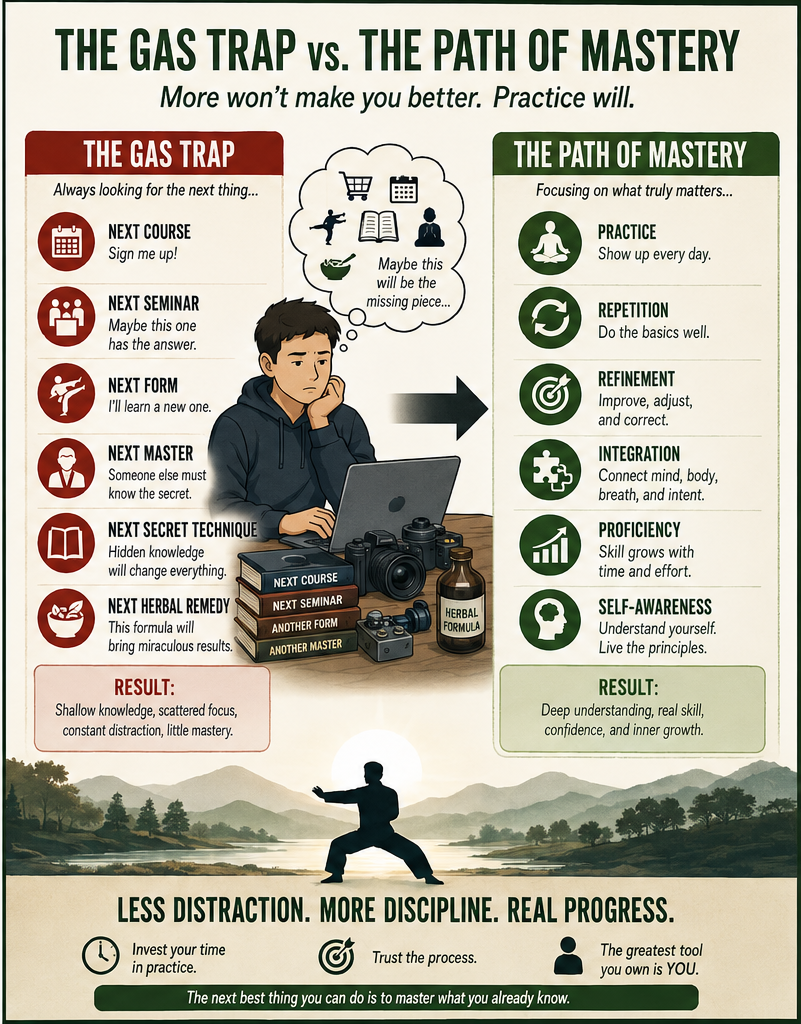
Some martial arts enthusiasts seem to be continually pursuing the next course, the next seminar, the next form, the next system, or the next master. They barely finish learning one form before wanting another. They return from one seminar and immediately begin looking for the next. They accumulate techniques, certificates, memberships, books, videos, and associations with respected teachers.

There is certainly nothing wrong with continuing to learn. Much of my own life has involved studying different martial arts, health practices, philosophies, and mind-body disciplines. Exposure to different teachers and perspectives can broaden our understanding and can sometimes help us recognize misconceptions that we previously accepted.

But there is a difference between breadth of exposure and depth of understanding.

Someone may know the choreography of twenty forms without being particularly proficient in any of them. Another person may have attended dozens of seminars while rarely practicing the material once the seminar is over. Someone else may possess numerous certificates while still struggling with basic posture, balance, timing, breathing, coordination, or movement.

This creates an interesting paradox. A person can continually become more knowledgeable without necessarily becoming more capable.

Knowledge acquisition and skill acquisition overlap, but they are not identical.

Sometimes the constant pursuit of something new can actually prevent us from discovering what is contained within something old. A relatively simple exercise practiced for years may reveal subtleties that were completely invisible when we first learned it. The exercise has not changed. We have.

This is one reason returning to foundational material after many years of practice can be surprisingly enlightening. We are no longer the same student encountering the same information.

The Search for the Secret

Martial arts and traditional wellness practices introduce another variation of this tendency: the perpetual search for hidden knowledge.

There always seems to be another secret breathing method, qigong exercise, internal-energy practice, pressure point, lineage teaching, herbal formula, or method supposedly known only to a small group of advanced practitioners.

Sometimes traditional practices genuinely contain information unfamiliar to the general public. Historical martial arts and healing traditions often preserved and transmitted knowledge very differently from modern educational systems. We should therefore be careful about automatically dismissing something simply because it is unfamiliar.

At the same time, unfamiliarity is not evidence of effectiveness, and secrecy is not evidence of depth of wisdom.

The allure of secret knowledge can become its own version of Gear Acquisition Syndrome. Instead of purchasing another piece of equipment, we acquire another concept or another promise. Somewhere in the background is the hope that perhaps this will finally be the missing piece.

The same tendency can appear in the wellness world. Someone may continually move from one supplement, herb, tea, mushroom, tincture, traditional formula, detoxification program, or healing method to another, hoping to discover something that will provide extraordinary benefits.

Traditional herbal medicine has a long history, and many plant compounds possess genuine biological and pharmacological activity. At the same time, herbal products can cause adverse effects and interact with medications, while claims about their effectiveness vary considerably in the quality of supporting evidence (Ekor, 2014).

The issue is therefore not whether herbs or traditional practices are good or bad. The more useful distinction is between seeking realistic benefits and miraculous ones.

When every new teacher, exercise, seminar, remedy, philosophy, or secret method is expected to contain the missing piece, perhaps it is worth considering whether the missing ingredient is something far less exciting: time, practice, patience, critical thinking, and consistency.

The Less Exciting Road to Proficiency

One of the difficulties with genuine skill development is that much of it is repetitive.

Knowing about a movement is different from being able to perform it. Performing it under comfortable conditions is different from performing it dynamically. Performing it dynamically is different from applying it against resistance. Eventually, something that initially required considerable conscious effort may become increasingly integrated through repetition and experience.

Research on expertise has long emphasized the importance of sustained and purposeful practice. Ericsson, Krampe, and Tesch-Römer (1993) famously examined the role of deliberate practice in developing expert performance. Later research challenged overly simplistic interpretations suggesting that practice alone explains expertise, but practice nevertheless remains an important contributor to performance and skill development (Macnamara et al., 2014).

Martial artists understood this principle long before psychologists studied expertise. Skill takes time. That simple reality is sometimes difficult to accept in a culture where almost everything else seems to be getting faster. Information that once required years to locate can now be found within seconds. Videos demonstrating thousands of exercises and martial arts forms are immediately available. Equipment can arrive at our homes the next day. Courses can be purchased instantly.

But our nervous system has not suddenly become an overnight delivery service. Muscles still require time to adapt. Coordination still requires repetition. Balance has to be challenged. Experience has to accumulate. Understanding often has to mature.

There are no certificates we can purchase that substitute for these processes, and there are no weekend seminars that eliminate them.

When the Tools Become the Identity

There is another side to this discussion that deserves consideration. Sometimes equipment and accumulated knowledge become part of how we see ourselves.

The clothing, books, weapons, certificates, gadgets, supplements, and other possessions associated with an activity can reinforce the feeling that we belong to that world. Psychological research has even examined how clothing may influence thoughts and behavior, a concept called enclothed cognition (Adam & Galinsky, 2012), although subsequent research suggests that these effects are more complicated and context-dependent than early findings implied (Burns et al., 2019).

There is nothing inherently wrong with enjoying the culture surrounding an activity. A martial artist may enjoy collecting weapons. A musician may simply love guitars. Someone may collect books knowing full well that they will never read all of them. Hobbies do not always have to justify themselves through productivity.

The important element is awareness.

There is a considerable difference between saying, “I enjoy collecting these things,” and convincing ourselves that owning them is making us more skilled.

Likewise, there is a difference between continuing our education because we genuinely want to broaden our understanding and constantly seeking another teacher because we believe the next person will finally reveal the secret that eliminates the need for patient practice.

Perhaps the Real Upgrade Is Ourselves

Before buying another piece of equipment, registering for another seminar, learning another form, or pursuing another secret method, perhaps the most useful question is simply: What limitation am I actually trying to solve?

Sometimes the answer really is equipment. Sometimes we genuinely need additional knowledge. Sometimes another teacher can provide a perspective that changes our understanding. Sometimes a seminar opens an entirely new direction for study. But sometimes the limitation is much closer to home.

Perhaps we have not practiced enough. Perhaps our fundamentals remain weak. Perhaps we have become bored with repetition. Perhaps we have accumulated far more information than we have integrated. Or perhaps searching for something new is simply more exciting than confronting our present level of ability. No purchase can permanently solve those problems.

This is why Gear Acquisition Syndrome can serve as a useful metaphor for something much larger than shopping. Human beings have a remarkable tendency to search outside ourselves for solutions to problems that require internal development. It can be easier to buy another book than apply the previous one, easier to attend another seminar than spend months practicing what we learned at the last one, and certainly more exciting to discover a secret technique than to practice a basic movement for the ten-thousandth time.

Yet the basics have an annoying tendency to remain important.

None of this means we should stop buying things, stop learning, stop attending seminars, or stop seeking knowledgeable teachers. Curiosity and lifelong education are valuable qualities. New tools and new information can expand what we are capable of doing.

The issue is one of discernment. We need to recognize when acquisition is supporting our development and when acquisition has quietly become a substitute for it.

Eventually, the finest equipment cannot create skill. A collection of forms cannot create proficiency. Certificates cannot create understanding. A succession of masters cannot give us what we are unwilling to cultivate ourselves. And no secret herbal concoction or ancient formula should be expected to provide miraculous benefits simply because it is exotic, traditional, expensive, or difficult to obtain.

Tools can support us. Teachers can guide us. Knowledge can inform us. New experiences can broaden our perspective. But eventually we have to stop searching long enough to work with what we have already found.

Perhaps the next level is not always found by adding something new. Sometimes it is found by going deeper into what we already have.

References

Adam, H., & Galinsky, A. D. (2012). Enclothed cognition. Journal of Experimental Social Psychology, 48(4), 918–925. https://doi.org/10.1016/j.jesp.2012.02.008

Berridge, K. C., & Robinson, T. E. (2016). Liking, wanting, and the incentive-sensitization theory of addiction. American Psychologist, 71(8), 670–679. https://doi.org/10.1037/amp0000059

Burns, D. M., Fox, E. L., Greenstein, M., Olbright, G., & Montgomery, D. (2019). An old task in new clothes: A preregistered direct replication attempt of enclothed cognition effects on Stroop performance. Journal of Experimental Social Psychology, 83, 150–156. https://doi.org/10.1016/j.jesp.2018.10.001

Ekor, M. (2014). The growing use of herbal medicines: Issues relating to adverse reactions and challenges in monitoring safety. Frontiers in Pharmacology, 4, Article 177. https://doi.org/10.3389/fphar.2013.00177

Ericsson, K. A., Krampe, R. T., & Tesch-Römer, C. (1993). The role of deliberate practice in the acquisition of expert performance. Psychological Review, 100(3), 363–406. https://doi.org/10.1037/0033-295X.100.3.363

Herbst, J.-P. (2017). “Gear Acquisition Syndrome”: A survey of electric guitar players. In J. Merrill (Ed.), Popular music studies today (pp. 139–148). Springer VS. https://doi.org/10.1007/978-3-658-17740-9_15

Macnamara, B. N., Hambrick, D. Z., & Oswald, F. L. (2014). Deliberate practice and performance in music, games, sports, education, and professions: A meta-analysis. Psychological Science, 25(8), 1608–1618. https://doi.org/10.1177/0956797614535810

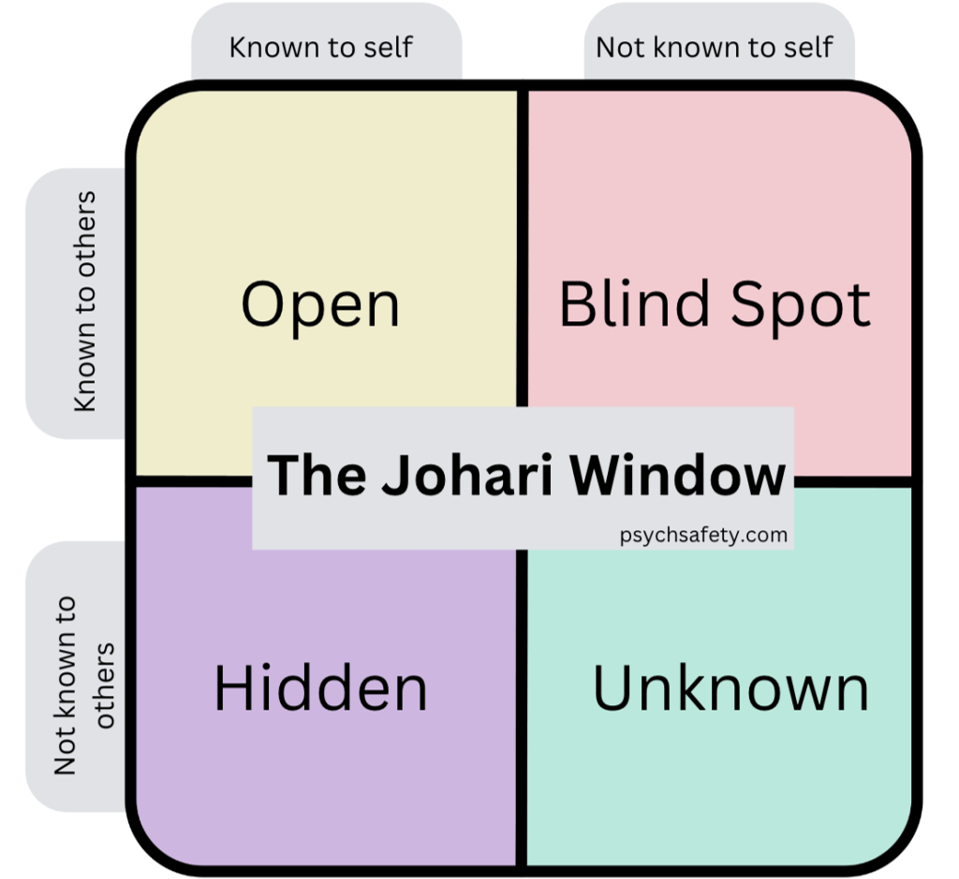
The Johari Window

What We Know About Ourselves, What Others Know About Us, and What We Have Yet to Discover

One of the more practical yet often overlooked psychological models for understanding ourselves and our relationships with others is known as the Johari Window. Developed in 1955 by psychologists Joseph Luft and Harrington Ingham, the model has remained relevant for more than seventy years because it addresses a timeless aspect of human nature: our inability to fully know ourselves. Whether we are teachers, parents, students, business leaders, healthcare providers, martial artists, or simply individuals striving for personal growth, we all possess strengths, weaknesses, biases, talents, and blind spots that influence how we think and behave.

The Johari Window reminds us that personal development is not merely about learning new information. It is equally about discovering aspects of ourselves that have always existed but remained hidden. Some are hidden intentionally. Others remain concealed simply because we have never looked deeply enough or because others have never shared their observations with us.

Throughout my years teaching wellness, martial arts, Tai Chi, Qigong, and holistic health, I have often found that people spend far more time trying to understand the world around them than understanding themselves. Yet genuine self-awareness may be one of the greatest skills we can cultivate. Before we attempt to improve our health, relationships, careers, or spiritual lives, we first need an honest picture of who we currently are.

Understanding the Four Quadrants

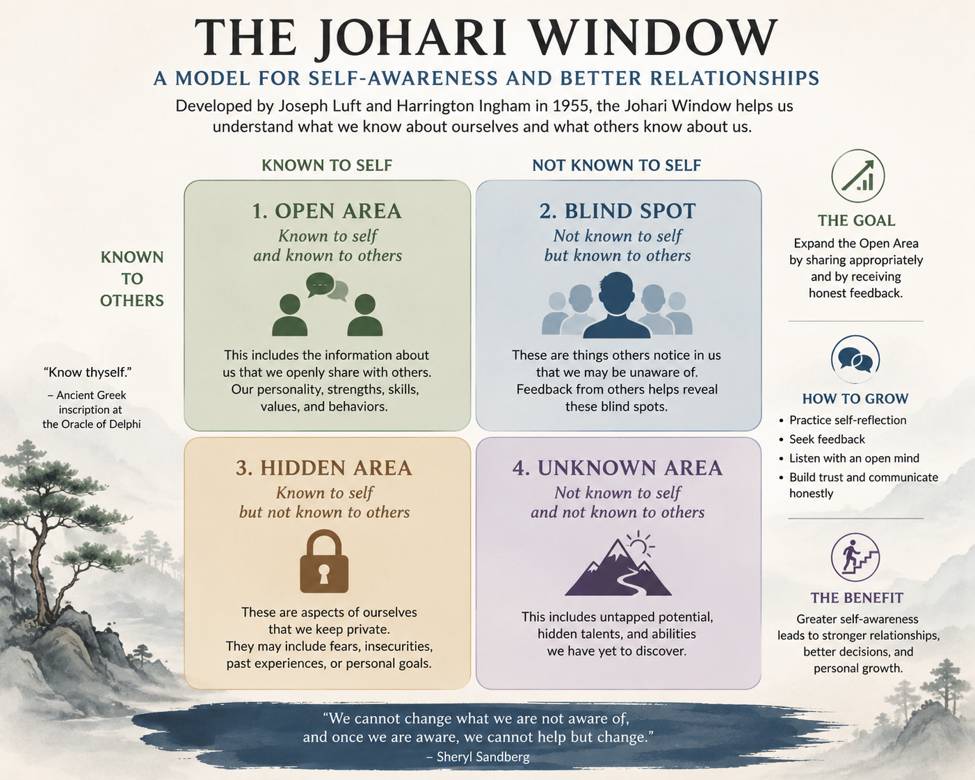
The Johari Window is divided into four sections, each representing different levels of awareness between ourselves and others.

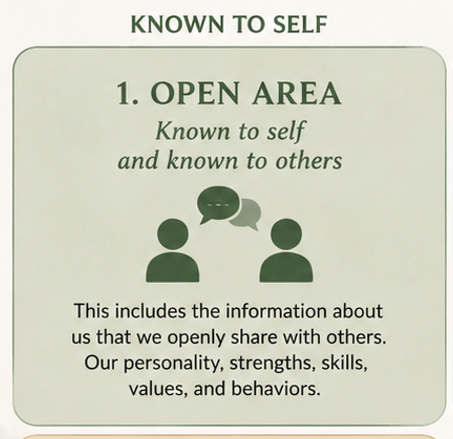
1. The Open Area

The Open Area consists of characteristics known both to ourselves and to other people. These include our visible personality traits, habits, abilities, beliefs, communication style, and behaviors.

This is the portion of ourselves that requires the least explanation because it is openly expressed. Friends may recognize our sense of humor, coworkers may appreciate our reliability, students may value our patience, and family members may know our daily routines.

Ideally, this area grows over time as trust develops and communication becomes more honest. When people openly share their thoughts and receive constructive feedback, misunderstandings decrease and relationships strengthen (Luft & Ingham, 1955).

Unfortunately, many people never intentionally expand this area. Instead, they spend much of life protecting an image rather than revealing their authentic selves.

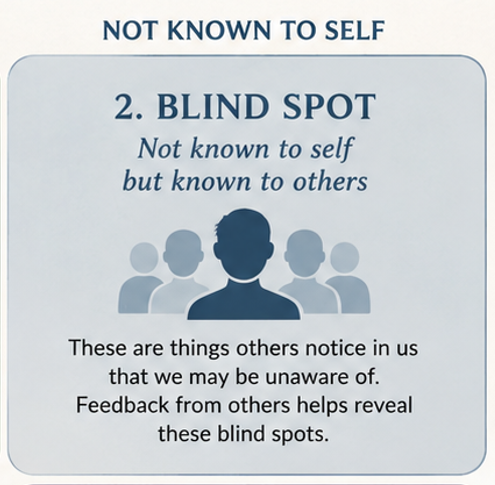
2. The Blind Spot

Perhaps the most fascinating portion of the Johari Window is the Blind Spot. These are characteristics that others clearly recognize in us but that we fail to see ourselves. Someone may consistently interrupt conversations without realizing it. Another person may project arrogance while believing they appear confident. A teacher may sincerely believe they communicate clearly while their students remain confused. A leader may think they encourage open discussion while unknowingly intimidating everyone around them.

Blind spots exist because human beings are naturally limited by their own perspectives. We experience life from inside our own minds, making it difficult to objectively observe our own behavior. This is why honest feedback is so valuable.

Unfortunately, many people never receive accurate feedback because those around them fear confrontation, wish to avoid conflict, or simply tell them what they want to hear. This phenomenon is related to concepts such as pluralistic ignorance, groupthink, conformity, and impression management (Janis, 1972; Solomon Asch, 1956).

Receiving thoughtful criticism can be uncomfortable, yet it often becomes one of the greatest catalysts for personal growth.

Throughout my own journey, I have had to acknowledge that some things I once confidently taught were later discovered to be incomplete or even inaccurate. While this realization was initially uncomfortable, accepting new evidence ultimately made me a better teacher. Blind spots do not disappear by ignoring them. They shrink only through humility, education, and honest reflection.

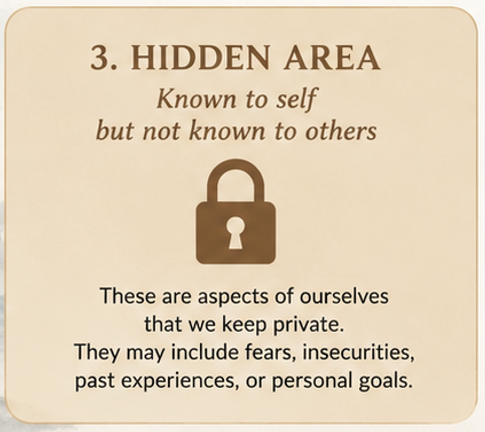
3. The Hidden Area

The Hidden Area contains information we know about ourselves but intentionally keep from others. These may include fears, insecurities, regrets, disappointments, painful experiences, private ambitions, or even personal successes that we choose not to disclose. There is nothing inherently wrong with privacy. Healthy boundaries are important. Not every thought or life experience needs to be shared. However, problems arise when fear prevents healthy disclosure.

Many individuals spend years wearing emotional masks, believing that revealing vulnerability will make them appear weak. Ironically, research consistently demonstrates that appropriate vulnerability often strengthens relationships by increasing trust and authenticity (Brown, 2012). As trust develops, portions of the Hidden Area gradually move into the Open Area.

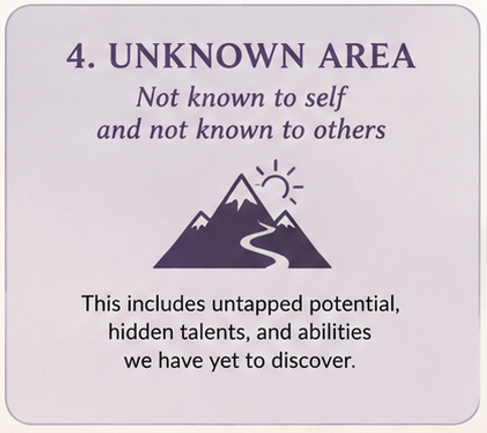
4. The Unknown Area

The final quadrant represents aspects unknown both to ourselves and to everyone else.

These include untapped abilities, hidden talents, unconscious motivations, future potential, and reactions that have simply never been tested. A person may never realize they possess exceptional leadership abilities until placed in a crisis. Someone may discover artistic talent later in life after retirement. Others uncover remarkable resilience only after surviving illness, trauma, or adversity.

Modern psychology refers to many of these experiences as post-traumatic growth, where adversity becomes the catalyst for discovering strengths previously unknown (Tedeschi & Calhoun, 2004). The Unknown Area also reminds us to remain humble. No matter how much education, experience, or wisdom we accumulate, there will always be aspects of ourselves waiting to be discovered.

Expanding the Open Window

The overall goal of the Johari Window is to expand the Open Area while reducing the Hidden and Blind areas. This occurs through two complementary processes. The first is appropriate self-disclosure. By honestly sharing our thoughts, experiences, goals, and concerns with trusted individuals, we allow others to know the authentic person behind the public image.

The second is receiving constructive feedback. Listening carefully to others allows us to identify habits and behaviors that may otherwise remain invisible. Neither process is easy. Both require humility, courage, and emotional maturity. Yet these same qualities are fundamental to lifelong learning.

The Johari Window in Everyday Life

The Johari Window applies almost everywhere.

Parents benefit from understanding how their children perceive them. Teachers become more effective by inviting student feedback. Healthcare providers improve patient relationships through greater empathy and communication. Business leaders strengthen organizations by encouraging psychological safety and honest dialogue. Martial artists discover that technical skill alone is insufficient without self-awareness, emotional regulation, and humility.

Even our closest relationships benefit when assumptions give way to honest conversations. Often, conflicts persist not because people disagree but because neither side truly understands how they are being perceived.

Wisdom Requires Seeing Ourselves Clearly

Many philosophical traditions have emphasized self-knowledge for thousands of years. The ancient Greek maxim, “Know thyself,” remains as relevant today as ever. Eastern traditions likewise encourage continual observation of one’s thoughts, emotions, habits, and attachments through meditation and mindful awareness.

Modern neuroscience supports these ancient practices. Mindfulness has been shown to improve emotional regulation, self-awareness, and interpersonal functioning (Siegel, 2010). The Johari Window provides another practical framework for this same lifelong pursuit. Rather than asking only, “What do I know?” it encourages us to ask: “What don’t I yet know about myself?” That question alone can transform one’s personal growth.

The older I become, the less interested I am in appearing knowledgeable and the more interested I become in continuing to learn. Life has repeatedly shown me that confidence without humility often leads to blind spots, while curiosity keeps those blind spots shrinking.

The Johari Window reminds us that every one of us possesses areas of certainty, areas of privacy, areas of blindness, and areas of untapped potential. None of us has a complete picture of ourselves. That realization should not discourage us. Instead, it should inspire us.

If we remain teachable, invite honest feedback, examine ourselves objectively, and maintain the humility to change when presented with better evidence, our understanding of ourselves continues to grow. In doing so, we not only become better students of life but also better teachers, mentors, leaders, spouses, parents, friends, and human beings.

Perhaps true wisdom is not believing we finally know ourselves completely. Rather, it is recognizing that self-discovery is a lifelong process, one that continues for as long as we remain open to learning.

References

Asch, S. E. (1956). Studies of independence and conformity: I. A minority of one against a unanimous majority. Psychological Monographs, 70(9), 1-70. https://doi.org/10.1037/h0093718

Brown, B. (2012). Daring greatly: How the courage to be vulnerable transforms the way we live, love, parent, and lead. Gotham Books.

Janis, I. L. (1972). Victims of groupthink. Houghton Mitllin Company. Retrieved from https://ia902805.us.archive.org/2/items/victimsofgroupthinkirvingl.janis/Victims%20of%20GROUPTHINK%20-%20Irving%20Janis.pdf

Luft, J., & Ingham, H. (1955). The Johari Window: A graphic model for interpersonal awareness. Proceedings of the Western Training Laboratory in Group Development, University of California, Los Angeles.

Siegel, D. J. (2010). Mindsight: The new science of personal transformation. Bantam Books.

Tedeschi, R. G., & Calhoun, L. G. (2004). Posttraumatic growth: Conceptual foundations and empirical evidence. Psychological Inquiry, 15(1), 1-18.

Learning to Think in Another Language: How Language Reshapes the Mind

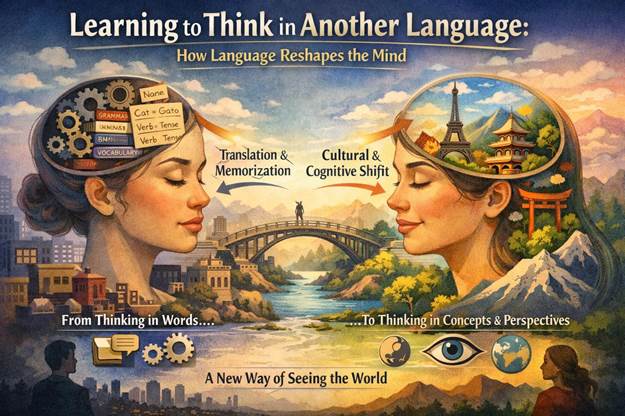
Most people approach foreign language learning as the memorization of vocabulary, grammar rules, pronunciation, and sentence structure. While these components are essential, true fluency extends far beyond translation and communication. At deeper levels of mastery, language learning becomes a process of cognitive transformation. One no longer simply speaks another language but gradually begins to think within another cultural and psychological framework. This distinction is profound.

A beginner often thinks in their native language first and then mentally translates into the target language. An advanced speaker, however, begins bypassing translation altogether. Thoughts arise directly within the new language. Emotional associations, humor, social awareness, symbolism, and patterns of perception begin reorganizing themselves according to the structure of that language. In this sense, language learning becomes not merely educational, but neurological, psychological, and even philosophical.

Language as a Framework for Reality

Every language contains embedded assumptions about reality. Language does not simply describe the world; it helps organize how individuals perceive and interpret it. Different languages emphasize different aspects of human experience.

For example:

  • English often favors directness, categorization, and linear explanation.
  • Japanese commonly encodes hierarchy, respect, and social relationship directly into grammar.
  • German allows highly specific conceptual compounds.
  • Classical Chinese and Daoist language patterns often emphasize process, harmony, balance, and relational dynamics over rigid categorization.

As individuals become immersed in another language, these linguistic patterns begin influencing cognition itself.

This idea is associated with the linguistic relativity hypothesis proposed by Edward Sapir and Benjamin Lee Whorf. Their work suggested that language can influence habitual patterns of thought and perception (Whorf, 1956). While modern scholars debate strong deterministic interpretations of this theory, research supports the idea that language can shape attention, memory, categorization, and emotional interpretation (Boroditsky, 2011).

In practical terms, individuals exposed to multiple languages often develop increased cognitive flexibility because they learn that reality can be organized through more than one symbolic framework.

Thinking About a Language vs. Thinking In a Language

There is a significant difference between knowing the mechanics of a language and internally operating within it.

A student may memorize thousands of words yet still mentally translate every sentence. This process creates cognitive friction and slows communication. Over time, however, the language can become embodied. The learner no longer consciously translates. Instead:

  • Internal dialogue begins occurring in the new language.
  • Emotional reactions become linked directly to foreign words and phrases.
  • Humor and metaphor become intuitive rather than analytical.
  • Dreams may occur in the target language.
  • Communication becomes spontaneous rather than calculated.

This process resembles many mind-body training systems found in martial arts, meditation, qigong, and tai chi. In the early stages of training, movement is intellectual and mechanical. Over time, however, movement becomes instinctive and integrated into the nervous system. The body no longer “thinks” step-by-step. Language acquisition follows a similar progression.

Repeated exposure gradually transforms conscious effort into unconscious competency.

Neuroplasticity and the Multilingual Brain

Modern neuroscience suggests that multilingualism physically alters the brain through neuroplastic adaptation. Research indicates that language learning may strengthen executive functioning, attentional control, working memory, and cognitive flexibility (Bialystok, Craik, & Luk, 2012).

Studies using brain imaging have demonstrated structural and functional changes in regions associated with language processing and attentional regulation among bilingual individuals (Li, Legault, & Litcofsky, 2014). These changes appear related to the ongoing management of multiple linguistic systems simultaneously.

From a holistic perspective, learning another language can be viewed as a form of cognitive cross-training. Just as physical exercise challenges the muscles and cardiovascular system, language learning challenges the brain’s adaptive capacities. The mind becomes more flexible, less rigid, and more capable of shifting perspectives.

This cognitive flexibility may extend beyond language itself into broader emotional and social functioning.

Emotional Meaning and Cultural Consciousness

Words rarely carry identical emotional weight across cultures. Every language contains unique concepts that reflect the values, worldview, and lived experiences of the people who developed it.

Certain ideas resist direct translation because they represent entire modes of consciousness rather than isolated definitions.

For example:

  • The Japanese concept of ma refers to meaningful space, interval, or emptiness.
  • The African philosophical concept of ubuntu emphasizes shared humanity and interconnectedness.
  • Daoist concepts such as Dao and wu wei describe natural harmony, effortless action, and alignment with the flow of existence.

These terms cannot be fully reduced to simple English equivalents because they carry layers of cultural, philosophical, and experiential meaning.

This is one reason many Eastern traditions preserve original terminology in martial arts, meditation, yoga, Traditional Chinese Medicine, and philosophy. Translation may communicate information, but often loses subtle experiential depth.

Language therefore becomes more than communication. It becomes participation in another mode of perception and awareness.

Language and Identity

Many multilingual individuals report feeling psychologically different depending upon the language they are speaking. Some describe becoming:

  • More formal.
  • More emotionally expressive.
  • More analytical.
  • More humorous.
  • More reserved or socially aware.

These shifts may occur because language activates associated cultural conditioning, emotional memories, behavioral expectations, and social frameworks.

In this sense, language acts almost like a psychological operating system. Different languages encourage different modes of self-expression and social interaction.

From both psychological and Eastern philosophical perspectives, repeated mental and verbal patterns gradually shape consciousness itself. Daoist and Buddhist traditions have long emphasized that repeated thought and speech influence perception, intention, and identity. Modern neuroscience similarly recognizes that repeated neural activity reinforces cognitive and behavioral pathways through neuroplasticity.

Thus, learning another language may partially reshape how an individual experiences reality.

The Deeper Value of Language Learning

The greatest value of language learning may not be practical communication alone. Its deeper benefit may be the expansion of consciousness itself.

Learning another language can cultivate:

  • Greater empathy.
  • Increased cultural humility.
  • Enhanced adaptability.
  • Broader cognitive flexibility.
  • Reduced egocentric thinking.
  • Greater awareness of multiple perspectives.

A person who truly learns another language often discovers that their native way of thinking is not the only possible interpretation of reality.

This realization can be transformative.

In many ways, learning another language is not simply the acquisition of new words, but the temporary experience of becoming another version of oneself. It reveals that human perception is not fixed, but shaped continuously through language, culture, attention, and experience.

From a holistic perspective, language learning becomes a form of self-cultivation, one that expands not only communication, but awareness itself.

References

Bialystok, E., Craik, F. I. M., & Luk, G. (2012). Bilingualism: Consequences for mind and brain. Trends in Cognitive Sciences, 16(4), 240–250. https://doi.org/10.1016/j.tics.2012.03.001

Boroditsky, L. (2011). How language shapes thought. Scientific American, 304(2), 62–65. https://doi.org/10.1038/scientificamerican0211-62

Li, P., Legault, J., & Litcofsky, K. A. (2014). Neuroplasticity as a function of second language learning: Anatomical changes in the human brain. Cortex, 58, 301–324. https://doi.org/10.1016/j.cortex.2014.05.001

Whorf, B. L. (1956). Language, thought, and reality: Selected writings of Benjamin Lee Whorf. MIT Press. Language, Thought, and Reality: https://www.jstor.org/stable/j.ctt5hhbx2

The French Paradox, Lifestyle, and the Forgotten Art of Living Well

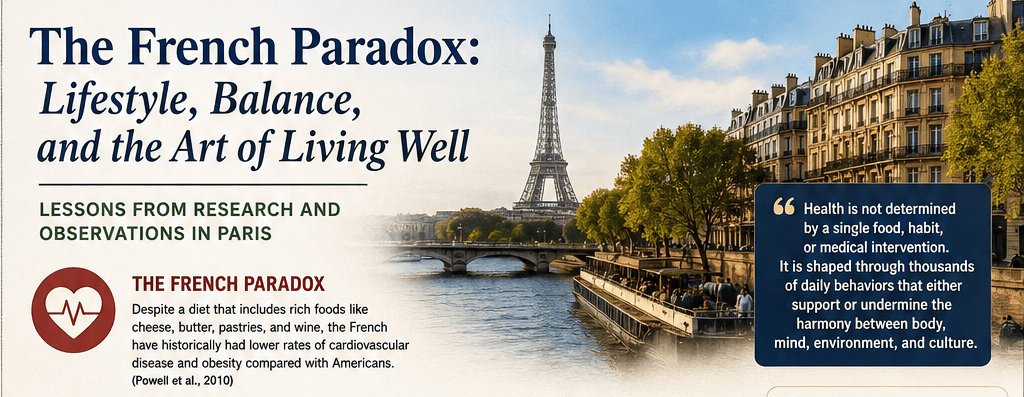
For decades, many Americans have heard about the so-called “French Paradox.” The basic observation is simple: despite consuming foods traditionally viewed as rich in fats, such as cheese, butter, and wine, the French have historically demonstrated lower rates of cardiovascular disease and obesity than Americans (Powell et al., 2010). Yet perhaps the real paradox is not found in French food itself, but in the broader cultural relationship with food, movement, stress, and daily living.

From a holistic health perspective, this discussion reveals an important truth: health is rarely the result of a single nutrient, supplement, pharmaceutical intervention, or isolated behavior. Instead, long-term wellbeing emerges from the interaction of lifestyle, environment, mindset, movement, social behavior, stress regulation, genetics, access to healthcare, and thousands of daily habits.

The modern American mindset often seeks isolated solutions to complex health problems. One week fat is considered the enemy. The next week carbohydrates become the villain. Coffee is good, but only in moderation, and now some experts suggest that as many as five cups per day may provide certain health benefits for some people (Castro, 2026). Then sugar, gluten, seed oils, cholesterol, or red meat takes center stage.

Yet the body does not function in isolated compartments. Human physiology reflects an interconnected system of behaviors, emotions, habits, environmental influences, and biological responses. The French Paradox highlights this reality.

Researchers examining lifestyle differences between France and the United States have noted several behavioral patterns among the French population. Compared with Americans, French citizens have traditionally walked more frequently, consumed more water, eaten more fresh fruits and vegetables, consumed fewer sweetened beverages, and engaged in more mindful eating behaviors (Powell et al., 2010). Meals were often smaller, slower, and more socially integrated rather than rushed and distracted. This distinction is significant.

Seeing the French Paradox Firsthand

During my recent visit to France, particularly while spending time in Paris, I was able to observe many of the lifestyle factors commonly used to explain the French Paradox. These were no longer simply ideas presented in a study, travel program, or cultural comparison. I could see many of them firsthand.

People walked almost everywhere. They walked through neighborhoods, along the Seine, between shops, to cafés, to Metro stations, and through long corridors connecting public transportation systems. They routinely climbed stairs, carried groceries, stood while waiting for trains, and incorporated physical activity into the normal activities of daily life.

I also noticed what appeared to be fewer overweight individuals and considerably fewer people with morbid obesity than I commonly observe in many parts of the United States. This was only my personal observation and not a controlled scientific assessment. Nevertheless, people across a range of ages seemed, on average, leaner, more mobile, and more physically functional.

Older adults were frequently walking through the city, using public transportation, shopping, and navigating stairs without the same degree of visible physical limitation that I often see elsewhere. Many people appeared to maintain a level of practical fitness, not necessarily because they attended gyms or followed highly structured exercise programs, but because movement remained integrated into the architecture and rhythm of everyday life.

The environment itself encouraged activity. Compact neighborhoods, public transportation, smaller shops, pedestrian areas, and limited dependence on automobiles made walking a necessity rather than merely an optional form of exercise. It became increasingly clear to me that the design of a community can either support health or quietly discourage it.

The eating culture also appeared different. People often sat at cafés and restaurants rather than eating hurriedly in their cars. Meals appeared to be social occasions and opportunities for conversation. Portions often seemed more moderate, and there appeared to be greater emphasis on the experience and quality of food rather than simply consuming as much as possible, as quickly as possible.

These observations seemed to support many of the lifestyle explanations commonly associated with the French Paradox. However, another highly visible behavior complicated the picture. Smoking tobacco and vaping appeared to be widespread among people of many ages and demographics. I saw young adults, middle-aged individuals, older adults, men, and women smoking cigarettes or using vaping devices outside cafés, on sidewalks, near public buildings, and while socializing. The irony was difficult to overlook.

On one hand, many people appeared leaner, more active, and more physically capable. On the other hand, tobacco and nicotine use were openly integrated into everyday life. This serves as an important reminder that appearing thin or fit does not automatically mean that someone is healthy. Body size is only one outward indicator, and it cannot reveal lung function, vascular damage, blood pressure, cholesterol, cancer risk, emotional wellbeing, or the cumulative effects of nicotine exposure.

A culture may perform well in one dimension of health while struggling in another. The French may benefit from greater daily movement, smaller portions, and stronger social rituals surrounding food, while simultaneously carrying substantial health risks related to smoking, alcohol consumption, hypertension, and other cardiovascular factors.

This is precisely why holistic health requires a broader view.

The American Contrast

In the United States, eating often occurs while driving, working, watching television, scrolling through social media, or functioning under psychological stress. Meals are frequently consumed rapidly and in excessive portions.

Ultra-processed foods dominate much of the modern dietary landscape, contributing to excessive intake of sodium, refined sugars, additives, preservatives, and industrially formulated fats. Many of these products are specifically engineered for convenience and hyper-palatability rather than nourishment, making it easier to consume large quantities before the body’s natural satiety signals have time to respond (Monteiro et al., 2019).

Holistically speaking, this creates more than a nutritional problem. It also creates metabolic, behavioral, emotional, and nervous system problems.

The human organism does not function optimally while chronically stressed, overstimulated, sleep deprived, sedentary, emotionally dysregulated, and disconnected from natural rhythms. Traditional Eastern systems such as Traditional Chinese Medicine and Ayurveda have long emphasized that digestion is influenced by emotional balance, stress, circulation, breathing, rest, and lifestyle behaviors.

Modern research increasingly examines similar relationships through the study of inflammation, autonomic nervous system regulation, metabolic syndrome, the microbiome, and the gut-brain axis (Mayer, 2016).

Interestingly, the traditional French approach to eating appears to support the parasympathetic, or “rest and digest,” side of the nervous system. Meals are often approached as experiences rather than fuel-loading events. Walking remains incorporated into daily life. Social connection around meals is common. Portion control may be supported through pacing and satiety awareness rather than calorie obsession.

This does not mean that French culture is perfect, nor does it mean that red wine is a magical health tonic. Researchers have cautioned against oversimplifying the paradox and attributing it to wine or any other single factor (Law & Wald, 1999).

Health outcomes are more likely to arise from multiple interacting lifestyle, cultural, medical, economic, and environmental variables.

Is the French Paradox Partly a Statistical Paradox?

Although the French Paradox remains an interesting and useful concept, it should not be accepted without critical examination. Some researchers have questioned whether France’s historically low reported coronary heart disease mortality reflects only superior health, or whether part of the difference may be related to the ways disease and death were diagnosed, classified, and reported.

One proposed source of bias is the under-certification of coronary heart disease on French death certificates. A death influenced by coronary disease might sometimes have been attributed to heart failure, an unspecified circulatory condition, sudden death, or another immediate complication rather than to the underlying coronary disease itself.

Law and Wald (1999) examined this possibility and concluded that differences in death certification could explain a meaningful portion of the apparent mortality difference between France and countries such as Britain, although they did not suggest that reporting differences explained the entire phenomenon.

Other researchers have reached a similar conclusion. Ferrières (2004) acknowledged that French physicians may have under-certified some coronary deaths. However, after researchers examined standardized data from the World Health Organization’s MONICA project, France still demonstrated comparatively low coronary attack and mortality rates. Therefore, underreporting appears to be a possible bias, but probably not a complete explanation for the French Paradox (Ferrières, 2003).

This distinction is important. It would be inaccurate to say that the French Paradox is entirely a statistical illusion. At the same time, it would also be unwise to assume that mortality figures from different countries are perfectly comparable.

Death certificates are completed by individual physicians, and the accuracy of the final classification depends on available medical information, diagnostic practices, terminology, coding systems, and the physician’s judgment. French research comparing electronic and paper death certification found that electronic certificates included more reported causes and were considerably less likely to contain imprecise information, demonstrating that even the method used to record a death can affect the quality of national statistics (Lefeuvre et al., 2013).

Therefore, the more accurate statement may be that France historically had lower recorded coronary mortality, but some portion of the difference could have resulted from how coronary deaths were documented and categorized.

Underdiagnosis Is Not the Same as Good Health

Mortality statistics present only one part of the picture. People may live for many years with hypertension, diabetes, high cholesterol, vascular disease, or early-stage coronary disease without knowing that they have these conditions.

Recent reporting from Santé publique France found that awareness of major metabolic risk factors remains surprisingly low. Among French adults affected by these conditions, approximately 23% of those with diabetes and as many as 45% of those with hypertension were unaware that they had the condition (Olié et al., 2025).

This means that health problems do not necessarily have to be intentionally concealed or deliberately unreported to remain absent from national surveys. Many people simply do not know that they have them.

A person may appear thin, walk daily, and function well while still having elevated blood pressure, high LDL cholesterol, insulin resistance, or developing atherosclerosis. Conversely, an overweight individual may be actively improving their diet, exercising, sleeping well, and receiving appropriate preventive care.

Visible body composition provides useful information, but it never tells the whole story.

Current data also show that cardiovascular disease remains the second-leading cause of death in France, while hypertension, obesity, diabetes, and elevated LDL cholesterol continue to represent substantial public health concerns. France is healthier than some countries according to certain measures, but it is not immune to the chronic diseases affecting other industrialized nations. (“Assessment of the Quality of Death Certificates in France: The Role of Electronic Certification,” 2013)

The World Health Organization also notes that France now has relatively complete and high-quality cause-of-death registration. This suggests that historical reporting bias should be considered without assuming that modern French health statistics are generally unreliable (“France,” n.d.).

The Limits of Population-Level Comparisons

Another weakness in many explanations of the French Paradox is that they rely on broad national averages. Researchers may compare average saturated-fat consumption, average wine consumption, and national coronary mortality, but these figures do not prove that the individuals eating the most saturated fat or drinking the most wine are the same individuals avoiding heart disease.

This is sometimes called an ecological limitation or ecological fallacy.

Population-level associations cannot establish individual cause and effect. They may also overlook differences in food quality, meal timing, total caloric intake, socioeconomic status, healthcare access, stress, genetics, physical activity, smoking, and the types of fats being consumed (Ferrières, 2004).

Even the phrase “the French diet” may be misleading. France contains different regions, socioeconomic groups, cultural traditions, occupational patterns, and levels of access to quality food and healthcare. A physically active Parisian who shops daily and walks to public transportation may live very differently from someone in a more car-dependent or economically disadvantaged area.

Similarly, there is no single American lifestyle. The habits of an active individual who eats whole foods and regularly engages with a supportive community should not be equated with those of someone who is isolated, sedentary, sleep deprived, and dependent on ultra-processed food.

National labels can help us identify broad patterns, but they can also hide important differences between individuals.

The Time-Lag Explanation

Law and Wald (1999) offered another challenge to simplistic interpretations of the French Paradox. They suggested that coronary mortality often reflects dietary patterns from decades earlier rather than only what a population is eating today.

A population may increase its intake of saturated fat, processed food, or total calories, but the full cardiovascular consequences may not become visible for many years. France’s historically lower coronary mortality may therefore have reflected earlier dietary and lifestyle conditions rather than complete protection from more recent habits.

This time-lag explanation reminds us that chronic disease develops gradually. Atherosclerosis, insulin resistance, loss of mobility, and metabolic dysfunction may progress quietly for years before producing obvious symptoms or a medical crisis.

The consequences of today’s collective habits may not be fully visible until years or even decades from now.

Learning Without Romanticizing

The purpose of examining the French Paradox should not be to romanticize France, condemn America, or suggest that one culture has solved the health equation.

Every culture contains both strengths and contradictions.

France may offer valuable lessons about walking, portion awareness, food quality, social meals, public transportation, and integrating movement into everyday life. At the same time, the prevalence of smoking and vaping that I witnessed firsthand demonstrates how a visibly active population can continue to normalize behaviors that undermine cardiovascular, respiratory, and long-term systemic health.

The United States has reduced cigarette smoking considerably over recent decades, yet it continues to struggle with obesity, sedentary living, chronic stress, sleep disruption, social isolation, and the widespread consumption of ultra-processed food.

One country’s strengths may expose another country’s weaknesses, but its weaknesses should also prevent us from treating it as an ideal.

A holistic perspective asks a better question: Which cultural patterns support human wellbeing, which patterns undermine it, and what can we thoughtfully learn from both?

The Body Responds to Patterns

Health cannot be fully outsourced to pharmaceuticals, wearable technology, supplements, or calorie-tracking applications while fundamental lifestyle dysfunction remains unaddressed.

One cannot chronically overeat ultra-processed foods, avoid movement, live under constant stress, sleep poorly, and expect long-term wellness simply by taking medications or vitamins. At the same time, one should not assume that walking frequently or maintaining a lower body weight will erase the harms associated with smoking, excessive alcohol consumption, poor sleep, or untreated hypertension.

The body responds to patterns. Walking daily, breathing deeply, social connections, preparing meals, eating slowly, time in nature, adequate sleep, emotional regulation, and stress management are all factors that determine wellness. Avoiding tobacco matters. Receiving appropriate preventive screening and medical care also matters.

Human beings evolved within rhythms of movement, sunlight, labor, recovery, and community, not endless stimulation, convenience foods, digital overload, and physical inactivity.

The French Paradox may therefore be less about French cuisine and more about the complex consequences of lifestyle patterns within modern industrial cultures. Some of these patterns may protect health, some may undermine it, and others may take decades to reveal their full effects.

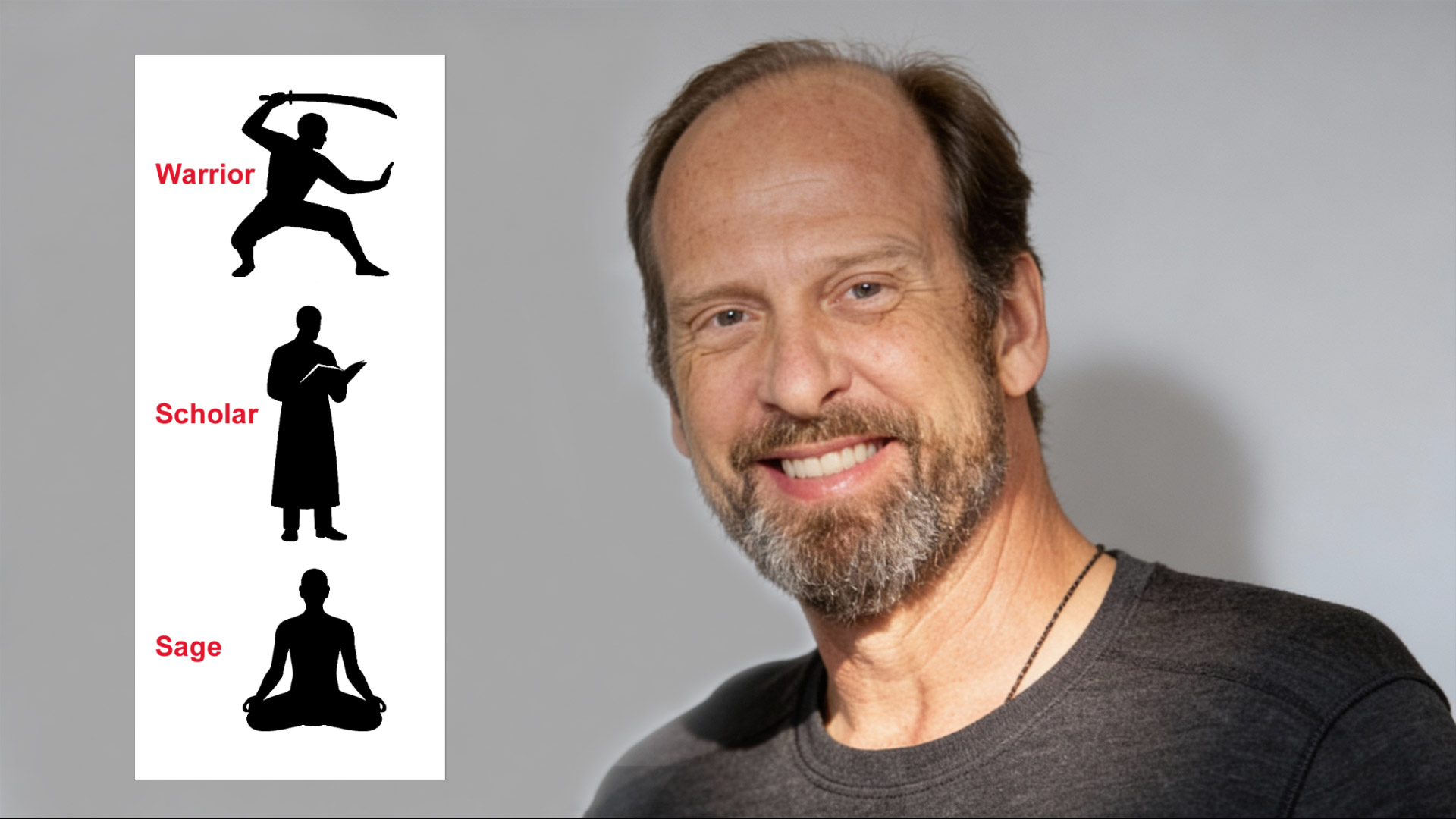
The Warrior, Scholar, and Sage

From the perspective of the Warrior, Scholar, and Sage framework, true wellness requires balance among physical discipline, intellectual awareness, and emotional and spiritual regulation.

The Warrior cultivates movement, resilience, strength, and physical vitality.

The Scholar develops knowledge and discernment regarding nutrition, research, statistics, behavior, and culture. The Scholar also recognizes that an attractive theory should not be accepted uncritically simply because it confirms what we would like to believe.

The Sage practices moderation, mindfulness, gratitude, and intentional living. The Sage understands that no country, culture, diet, or healthcare system possesses all the answers.

Ultimately, holistic wellbeing is not built upon isolated hacks, miracle foods, romanticized lifestyles, or national stereotypes. It is cultivated through daily patterns that support harmony among the body, mind, behavior, environment, and community.

My recent visit to France allowed me to see many of the factors commonly associated with the French Paradox firsthand. I saw more daily walking, apparently lower levels of severe obesity, active older adults, smaller portions, social meals, and communities designed around human movement.

I also saw widespread smoking and vaping, reminding me that wellbeing cannot be determined solely by appearance, body weight, or one favorable set of statistics.

Perhaps the greatest lesson hidden within the French Paradox is not that the French have discovered a secret that allows them to consume rich foods without consequences. Perhaps it is that health is complex, statistics require interpretation, cultures contain contradictions, and wellbeing is not merely about what we eat.

It is about how we live.

References

Assessment of the quality of death certificates in France: The role of Electronic certification. (2013, March 5). Retrieved from https://www.santepubliquefrance.fr/en/docs/article/assessment-quality-death-certificates-france-role-electronic-certification?utm_source=chatgpt.com

Castro, A. (2026, July 20). Scientists reveal why up to 5 cups of coffee a day may benefit heart health. Newsweek.

Ferrières, J. (2004). The French paradox: Lessons for other countries. Heart, 90(1), 107–111. https://doi.org/10.1136/heart.90.1.107

France. (n.d.). Retrieved from https://data.who.int/countries/250

Law, M., & Wald, N. (1999). Why heart disease mortality is low in France: The time lag explanation. BMJ, 318(7196), 1471–1480. https://doi.org/10.1136/bmj.318.7196.1471

Lefeuvre, D., Pavillon, G., Aouba, A., Lamarche-Vadel, A., Fouillet, A., Jougla, E., & Rey, G. (2013). Assessment of the quality of death certificates in France: The role of electronic certification. Bulletin Épidémiologique Hebdomadaire, (7), 57–60.

Mayer, E. A. (2016). The mind-gut connection: How the hidden conversation within our bodies impacts our mood, our choices, and our overall health. Harper Wave.

Monteiro, C. A., Cannon, G., Levy, R. B., Moubarac, J. C., Louzada, M. L. C., Rauber, F., Khandpur, N., Cediel, G., Neri, D., Martinez-Steele, E., Baraldi, L. G., & Jaime, P. C. (2019). Ultra-processed foods: What they are and how to identify them. Public Health Nutrition, 22(5), 936–941. https://doi.org/10.1017/S1368980018003762

Olié, V., Gabet, A., Grave, C., Helft, G., Fosse-Edorh, S., Piffaretti, C., Lailler, G., Verdot, C., Deschamps, V., Vay-Demouy, J., Vidal-Petiot, E., Duly-Bouhanik, B., Tuppin, P., Ferrières, J., Halimi, J. M., & Blacher, J. (2025). Epidemiology of cardiovascular risk factors: Non-behavioral risk factors. Bulletin Épidémiologique Hebdomadaire, special issue, 102–116.

Powell, L. H., Kazlauskaite, R., Shima, C., & Appelhans, B. M. (2010). Lifestyle in France and the United States: An American perspective. Journal of the American Dietetic Association, 110(6), 845–847. https://doi.org/10.1016/j.jada.2010.03.029