
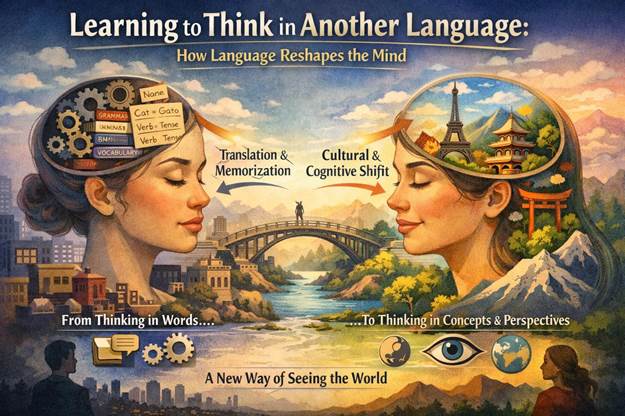
Most people approach foreign language learning as the memorization of vocabulary, grammar rules, pronunciation, and sentence structure. While these components are essential, true fluency extends far beyond translation and communication. At deeper levels of mastery, language learning becomes a process of cognitive transformation. One no longer simply speaks another language but gradually begins to think within another cultural and psychological framework. This distinction is profound.
A beginner often thinks in their native language first and then mentally translates into the target language. An advanced speaker, however, begins bypassing translation altogether. Thoughts arise directly within the new language. Emotional associations, humor, social awareness, symbolism, and patterns of perception begin reorganizing themselves according to the structure of that language. In this sense, language learning becomes not merely educational, but neurological, psychological, and even philosophical.

Language as a Framework for Reality
Every language contains embedded assumptions about reality. Language does not simply describe the world; it helps organize how individuals perceive and interpret it. Different languages emphasize different aspects of human experience.
For example:
- English often favors directness, categorization, and linear explanation.
- Japanese commonly encodes hierarchy, respect, and social relationship directly into grammar.
- German allows highly specific conceptual compounds.
- Classical Chinese and Daoist language patterns often emphasize process, harmony, balance, and relational dynamics over rigid categorization.
As individuals become immersed in another language, these linguistic patterns begin influencing cognition itself.
This idea is associated with the linguistic relativity hypothesis proposed by Edward Sapir and Benjamin Lee Whorf. Their work suggested that language can influence habitual patterns of thought and perception (Whorf, 1956). While modern scholars debate strong deterministic interpretations of this theory, research supports the idea that language can shape attention, memory, categorization, and emotional interpretation (Boroditsky, 2011).
In practical terms, individuals exposed to multiple languages often develop increased cognitive flexibility because they learn that reality can be organized through more than one symbolic framework.
Thinking About a Language vs. Thinking In a Language
There is a significant difference between knowing the mechanics of a language and internally operating within it.
A student may memorize thousands of words yet still mentally translate every sentence. This process creates cognitive friction and slows communication. Over time, however, the language can become embodied. The learner no longer consciously translates. Instead:
- Internal dialogue begins occurring in the new language.
- Emotional reactions become linked directly to foreign words and phrases.
- Humor and metaphor become intuitive rather than analytical.
- Dreams may occur in the target language.
- Communication becomes spontaneous rather than calculated.
This process resembles many mind-body training systems found in martial arts, meditation, qigong, and tai chi. In the early stages of training, movement is intellectual and mechanical. Over time, however, movement becomes instinctive and integrated into the nervous system. The body no longer “thinks” step-by-step. Language acquisition follows a similar progression.
Repeated exposure gradually transforms conscious effort into unconscious competency.
Neuroplasticity and the Multilingual Brain
Modern neuroscience suggests that multilingualism physically alters the brain through neuroplastic adaptation. Research indicates that language learning may strengthen executive functioning, attentional control, working memory, and cognitive flexibility (Bialystok, Craik, & Luk, 2012).
Studies using brain imaging have demonstrated structural and functional changes in regions associated with language processing and attentional regulation among bilingual individuals (Li, Legault, & Litcofsky, 2014). These changes appear related to the ongoing management of multiple linguistic systems simultaneously.
From a holistic perspective, learning another language can be viewed as a form of cognitive cross-training. Just as physical exercise challenges the muscles and cardiovascular system, language learning challenges the brain’s adaptive capacities. The mind becomes more flexible, less rigid, and more capable of shifting perspectives.
This cognitive flexibility may extend beyond language itself into broader emotional and social functioning.
Emotional Meaning and Cultural Consciousness
Words rarely carry identical emotional weight across cultures. Every language contains unique concepts that reflect the values, worldview, and lived experiences of the people who developed it.
Certain ideas resist direct translation because they represent entire modes of consciousness rather than isolated definitions.
For example:
- The Japanese concept of ma refers to meaningful space, interval, or emptiness.
- The African philosophical concept of ubuntu emphasizes shared humanity and interconnectedness.
- Daoist concepts such as Dao and wu wei describe natural harmony, effortless action, and alignment with the flow of existence.
These terms cannot be fully reduced to simple English equivalents because they carry layers of cultural, philosophical, and experiential meaning.
This is one reason many Eastern traditions preserve original terminology in martial arts, meditation, yoga, Traditional Chinese Medicine, and philosophy. Translation may communicate information, but often loses subtle experiential depth.
Language therefore becomes more than communication. It becomes participation in another mode of perception and awareness.
Language and Identity
Many multilingual individuals report feeling psychologically different depending upon the language they are speaking. Some describe becoming:
- More formal.
- More emotionally expressive.
- More analytical.
- More humorous.
- More reserved or socially aware.
These shifts may occur because language activates associated cultural conditioning, emotional memories, behavioral expectations, and social frameworks.
In this sense, language acts almost like a psychological operating system. Different languages encourage different modes of self-expression and social interaction.
From both psychological and Eastern philosophical perspectives, repeated mental and verbal patterns gradually shape consciousness itself. Daoist and Buddhist traditions have long emphasized that repeated thought and speech influence perception, intention, and identity. Modern neuroscience similarly recognizes that repeated neural activity reinforces cognitive and behavioral pathways through neuroplasticity.
Thus, learning another language may partially reshape how an individual experiences reality.
The Deeper Value of Language Learning
The greatest value of language learning may not be practical communication alone. Its deeper benefit may be the expansion of consciousness itself.
Learning another language can cultivate:
- Greater empathy.
- Increased cultural humility.
- Enhanced adaptability.
- Broader cognitive flexibility.
- Reduced egocentric thinking.
- Greater awareness of multiple perspectives.
A person who truly learns another language often discovers that their native way of thinking is not the only possible interpretation of reality.
This realization can be transformative.
In many ways, learning another language is not simply the acquisition of new words, but the temporary experience of becoming another version of oneself. It reveals that human perception is not fixed, but shaped continuously through language, culture, attention, and experience.
From a holistic perspective, language learning becomes a form of self-cultivation, one that expands not only communication, but awareness itself.
References
Bialystok, E., Craik, F. I. M., & Luk, G. (2012). Bilingualism: Consequences for mind and brain. Trends in Cognitive Sciences, 16(4), 240–250. https://doi.org/10.1016/j.tics.2012.03.001
Boroditsky, L. (2011). How language shapes thought. Scientific American, 304(2), 62–65. https://doi.org/10.1038/scientificamerican0211-62
Li, P., Legault, J., & Litcofsky, K. A. (2014). Neuroplasticity as a function of second language learning: Anatomical changes in the human brain. Cortex, 58, 301–324. https://doi.org/10.1016/j.cortex.2014.05.001
Whorf, B. L. (1956). Language, thought, and reality: Selected writings of Benjamin Lee Whorf. MIT Press. Language, Thought, and Reality: https://www.jstor.org/stable/j.ctt5hhbx2



 United Martial Arts Association