
There is nothing inherently wrong with having good equipment. A musician needs an instrument, a photographer needs a camera, a martial artist may benefit from training equipment, and someone exercising at home may reasonably purchase weights or other useful tools. Likewise, there is nothing wrong with continuing our education, attending seminars, studying with different teachers, or expanding our knowledge.
The problem begins when acquiring more becomes a substitute for developing what we already have.
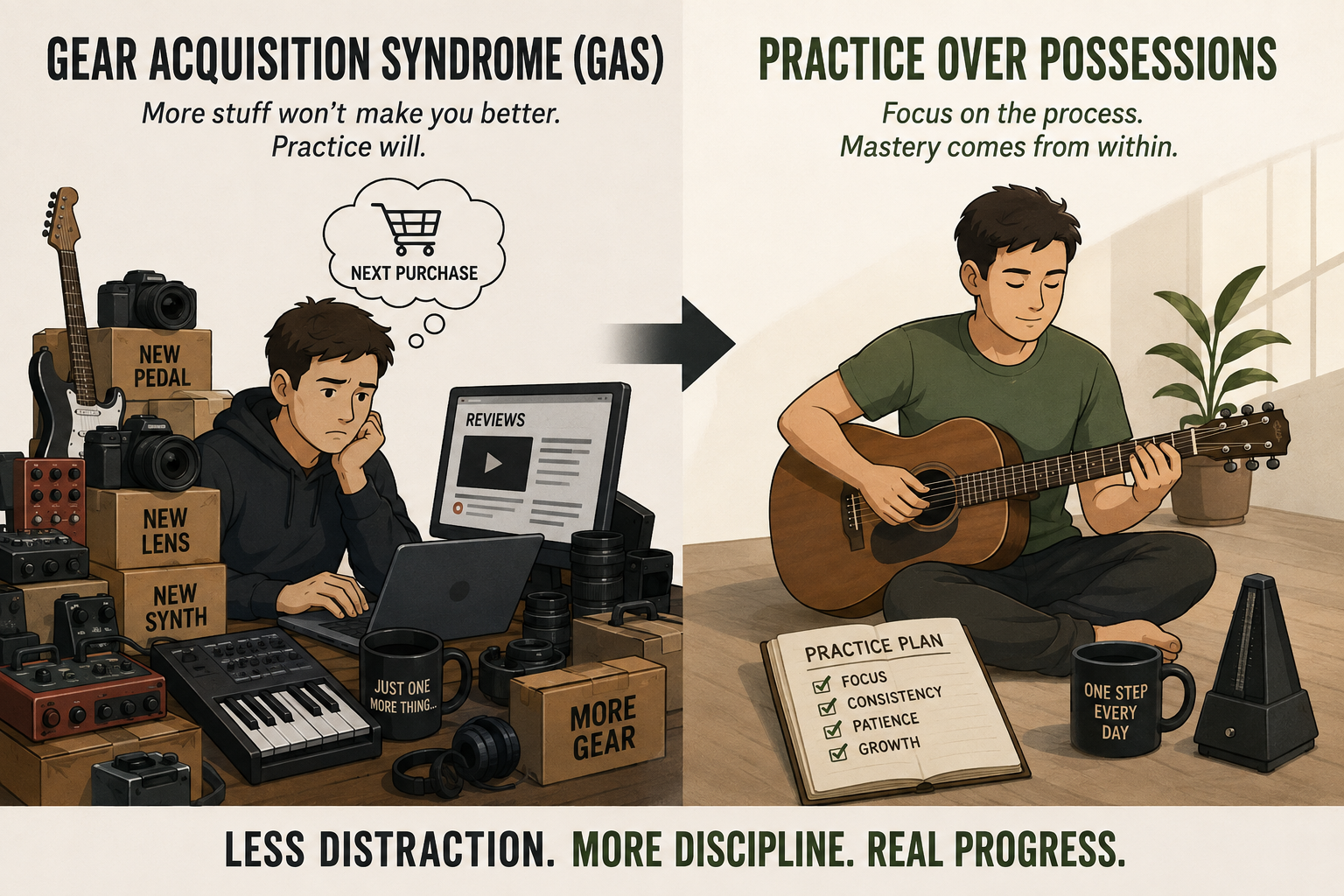
There is a somewhat humorous term for one version of this tendency: Gear Acquisition Syndrome, commonly abbreviated GAS. The expression originated among musicians and was initially associated with “Guitar Acquisition Syndrome.” It eventually broadened into “Gear Acquisition Syndrome” as people recognized that the behavior extended well beyond guitars. Researcher Jan-Peter Herbst examined the phenomenon among electric guitar players and described GAS as the persistent desire to acquire equipment, often connected with expectations concerning sound, creativity, identity, or satisfaction (Herbst, 2017).
Gear Acquisition Syndrome is not a recognized psychiatric diagnosis. The word “syndrome” is being used somewhat tongue-in-cheek. Nevertheless, the behavior describes something very real about human nature, and I believe the principle extends well beyond simply buying things.
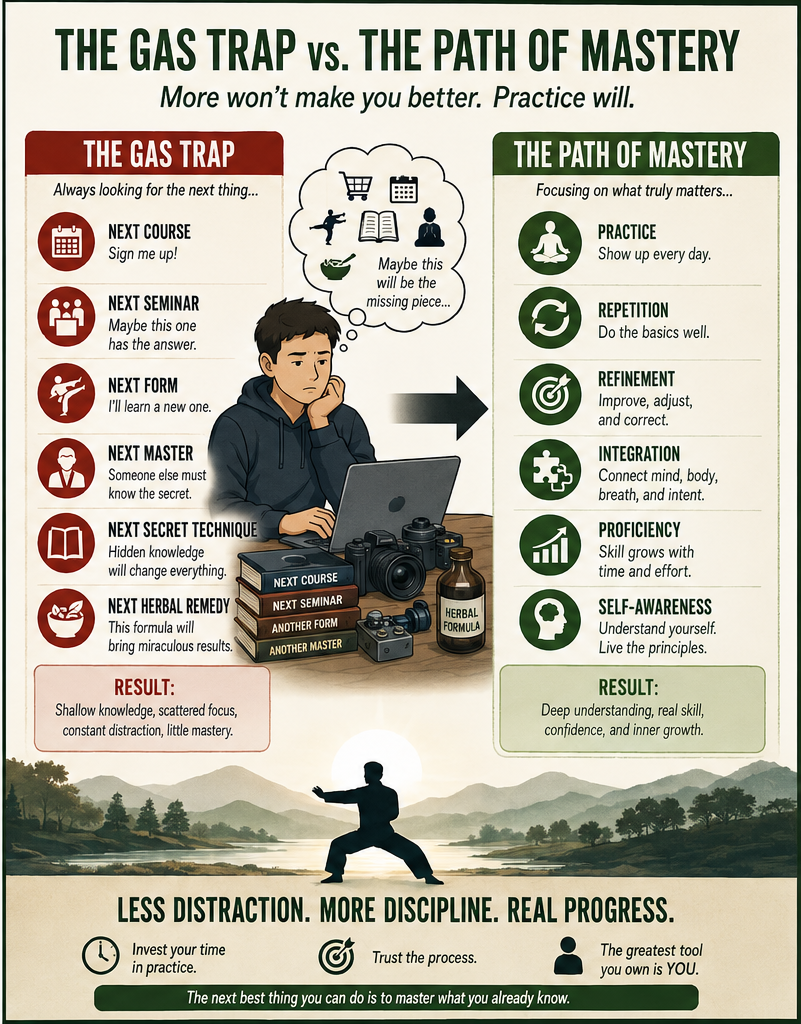
Sometimes the “gear” we acquire is not physical equipment at all. It may be another technique, another form, another seminar, another certification, another teacher, another herbal formula, or another supposedly secret body of knowledge. In each case, the important question may be whether we are acquiring something because it genuinely contributes to our development, or because acquiring something new feels like development.
Those are not necessarily the same thing.
The Attraction of the Next Thing
Most of us have experienced the excitement of getting something new. We research it, compare alternatives, read reviews, watch videos, and imagine what we will be able to accomplish once we finally have it.
Part of this attraction involves anticipation itself. Dopamine is often casually described as a “pleasure chemical,” but its role is considerably more complicated. Dopamine is involved in motivation, reward learning, anticipation, and behaviors directed toward potentially rewarding outcomes (Berridge & Robinson, 2016). In other words, the hunt itself can become rewarding.
This may explain why researching and anticipating a purchase can sometimes be more exciting than owning it. The item arrives, the novelty eventually fades, and before long our attention turns toward something else.
There is nothing particularly unusual about enjoying something new. Problems arise when we repeatedly confuse novelty with progress.
This can also become a subtle form of procrastination because acquisition often feels productive. Someone may spend hours researching exercise equipment while doing very little exercise. A musician can study amplifiers instead of practicing. A martial artist can spend an evening researching training equipment while neglecting the exercises already available to them.
Because the activity is related to the goal, it can masquerade as progress.
Researching the method is not practicing the method. Buying the tool is not developing the skill. Preparing to begin is not necessarily beginning.
Eventually information has to become application.
When Knowledge Becomes Another Possession
I have seen another version of this throughout the martial arts world. In this case, the person may not be collecting equipment at all. They may be collecting knowledge.
Some martial arts enthusiasts seem to be continually pursuing the next course, the next seminar, the next form, the next system, or the next master. They barely finish learning one form before wanting another. They return from one seminar and immediately begin looking for the next. They accumulate techniques, certificates, memberships, books, videos, and associations with respected teachers.
There is certainly nothing wrong with continuing to learn. Much of my own life has involved studying different martial arts, health practices, philosophies, and mind-body disciplines. Exposure to different teachers and perspectives can broaden our understanding and can sometimes help us recognize misconceptions that we previously accepted.
But there is a difference between breadth of exposure and depth of understanding.
Someone may know the choreography of twenty forms without being particularly proficient in any of them. Another person may have attended dozens of seminars while rarely practicing the material once the seminar is over. Someone else may possess numerous certificates while still struggling with basic posture, balance, timing, breathing, coordination, or movement.
This creates an interesting paradox. A person can continually become more knowledgeable without necessarily becoming more capable.
Knowledge acquisition and skill acquisition overlap, but they are not identical.
Sometimes the constant pursuit of something new can actually prevent us from discovering what is contained within something old. A relatively simple exercise practiced for years may reveal subtleties that were completely invisible when we first learned it. The exercise has not changed. We have.
This is one reason returning to foundational material after many years of practice can be surprisingly enlightening. We are no longer the same student encountering the same information.
The Search for the Secret
Martial arts and traditional wellness practices introduce another variation of this tendency: the perpetual search for hidden knowledge.
There always seems to be another secret breathing method, qigong exercise, internal-energy practice, pressure point, lineage teaching, herbal formula, or method supposedly known only to a small group of advanced practitioners.
Sometimes traditional practices genuinely contain information unfamiliar to the general public. Historical martial arts and healing traditions often preserved and transmitted knowledge very differently from modern educational systems. We should therefore be careful about automatically dismissing something simply because it is unfamiliar.
At the same time, unfamiliarity is not evidence of effectiveness, and secrecy is not evidence of depth of wisdom.
The allure of secret knowledge can become its own version of Gear Acquisition Syndrome. Instead of purchasing another piece of equipment, we acquire another concept or another promise. Somewhere in the background is the hope that perhaps this will finally be the missing piece.
The same tendency can appear in the wellness world. Someone may continually move from one supplement, herb, tea, mushroom, tincture, traditional formula, detoxification program, or healing method to another, hoping to discover something that will provide extraordinary benefits.
Traditional herbal medicine has a long history, and many plant compounds possess genuine biological and pharmacological activity. At the same time, herbal products can cause adverse effects and interact with medications, while claims about their effectiveness vary considerably in the quality of supporting evidence (Ekor, 2014).
The issue is therefore not whether herbs or traditional practices are good or bad. The more useful distinction is between seeking realistic benefits and miraculous ones.
When every new teacher, exercise, seminar, remedy, philosophy, or secret method is expected to contain the missing piece, perhaps it is worth considering whether the missing ingredient is something far less exciting: time, practice, patience, critical thinking, and consistency.
The Less Exciting Road to Proficiency
One of the difficulties with genuine skill development is that much of it is repetitive.
Knowing about a movement is different from being able to perform it. Performing it under comfortable conditions is different from performing it dynamically. Performing it dynamically is different from applying it against resistance. Eventually, something that initially required considerable conscious effort may become increasingly integrated through repetition and experience.
Research on expertise has long emphasized the importance of sustained and purposeful practice. Ericsson, Krampe, and Tesch-Römer (1993) famously examined the role of deliberate practice in developing expert performance. Later research challenged overly simplistic interpretations suggesting that practice alone explains expertise, but practice nevertheless remains an important contributor to performance and skill development (Macnamara et al., 2014).
Martial artists understood this principle long before psychologists studied expertise. Skill takes time. That simple reality is sometimes difficult to accept in a culture where almost everything else seems to be getting faster. Information that once required years to locate can now be found within seconds. Videos demonstrating thousands of exercises and martial arts forms are immediately available. Equipment can arrive at our homes the next day. Courses can be purchased instantly.
But our nervous system has not suddenly become an overnight delivery service. Muscles still require time to adapt. Coordination still requires repetition. Balance has to be challenged. Experience has to accumulate. Understanding often has to mature.
There are no certificates we can purchase that substitute for these processes, and there are no weekend seminars that eliminate them.
When the Tools Become the Identity
There is another side to this discussion that deserves consideration. Sometimes equipment and accumulated knowledge become part of how we see ourselves.
The clothing, books, weapons, certificates, gadgets, supplements, and other possessions associated with an activity can reinforce the feeling that we belong to that world. Psychological research has even examined how clothing may influence thoughts and behavior, a concept called enclothed cognition (Adam & Galinsky, 2012), although subsequent research suggests that these effects are more complicated and context-dependent than early findings implied (Burns et al., 2019).
There is nothing inherently wrong with enjoying the culture surrounding an activity. A martial artist may enjoy collecting weapons. A musician may simply love guitars. Someone may collect books knowing full well that they will never read all of them. Hobbies do not always have to justify themselves through productivity.
The important element is awareness.
There is a considerable difference between saying, “I enjoy collecting these things,” and convincing ourselves that owning them is making us more skilled.
Likewise, there is a difference between continuing our education because we genuinely want to broaden our understanding and constantly seeking another teacher because we believe the next person will finally reveal the secret that eliminates the need for patient practice.
Perhaps the Real Upgrade Is Ourselves
Before buying another piece of equipment, registering for another seminar, learning another form, or pursuing another secret method, perhaps the most useful question is simply: What limitation am I actually trying to solve?
Sometimes the answer really is equipment. Sometimes we genuinely need additional knowledge. Sometimes another teacher can provide a perspective that changes our understanding. Sometimes a seminar opens an entirely new direction for study. But sometimes the limitation is much closer to home.
Perhaps we have not practiced enough. Perhaps our fundamentals remain weak. Perhaps we have become bored with repetition. Perhaps we have accumulated far more information than we have integrated. Or perhaps searching for something new is simply more exciting than confronting our present level of ability. No purchase can permanently solve those problems.
This is why Gear Acquisition Syndrome can serve as a useful metaphor for something much larger than shopping. Human beings have a remarkable tendency to search outside ourselves for solutions to problems that require internal development. It can be easier to buy another book than apply the previous one, easier to attend another seminar than spend months practicing what we learned at the last one, and certainly more exciting to discover a secret technique than to practice a basic movement for the ten-thousandth time.
Yet the basics have an annoying tendency to remain important.
None of this means we should stop buying things, stop learning, stop attending seminars, or stop seeking knowledgeable teachers. Curiosity and lifelong education are valuable qualities. New tools and new information can expand what we are capable of doing.
The issue is one of discernment. We need to recognize when acquisition is supporting our development and when acquisition has quietly become a substitute for it.
Eventually, the finest equipment cannot create skill. A collection of forms cannot create proficiency. Certificates cannot create understanding. A succession of masters cannot give us what we are unwilling to cultivate ourselves. And no secret herbal concoction or ancient formula should be expected to provide miraculous benefits simply because it is exotic, traditional, expensive, or difficult to obtain.
Tools can support us. Teachers can guide us. Knowledge can inform us. New experiences can broaden our perspective. But eventually we have to stop searching long enough to work with what we have already found.
Perhaps the next level is not always found by adding something new. Sometimes it is found by going deeper into what we already have.
References
Adam, H., & Galinsky, A. D. (2012). Enclothed cognition. Journal of Experimental Social Psychology, 48(4), 918–925. https://doi.org/10.1016/j.jesp.2012.02.008
Berridge, K. C., & Robinson, T. E. (2016). Liking, wanting, and the incentive-sensitization theory of addiction. American Psychologist, 71(8), 670–679. https://doi.org/10.1037/amp0000059
Burns, D. M., Fox, E. L., Greenstein, M., Olbright, G., & Montgomery, D. (2019). An old task in new clothes: A preregistered direct replication attempt of enclothed cognition effects on Stroop performance. Journal of Experimental Social Psychology, 83, 150–156. https://doi.org/10.1016/j.jesp.2018.10.001
Ekor, M. (2014). The growing use of herbal medicines: Issues relating to adverse reactions and challenges in monitoring safety. Frontiers in Pharmacology, 4, Article 177. https://doi.org/10.3389/fphar.2013.00177
Ericsson, K. A., Krampe, R. T., & Tesch-Römer, C. (1993). The role of deliberate practice in the acquisition of expert performance. Psychological Review, 100(3), 363–406. https://doi.org/10.1037/0033-295X.100.3.363
Herbst, J.-P. (2017). “Gear Acquisition Syndrome”: A survey of electric guitar players. In J. Merrill (Ed.), Popular music studies today (pp. 139–148). Springer VS. https://doi.org/10.1007/978-3-658-17740-9_15
Macnamara, B. N., Hambrick, D. Z., & Oswald, F. L. (2014). Deliberate practice and performance in music, games, sports, education, and professions: A meta-analysis. Psychological Science, 25(8), 1608–1618. https://doi.org/10.1177/0956797614535810


