What We Know About Ourselves, What Others Know About Us, and What We Have Yet to Discover
One of the more practical yet often overlooked psychological models for understanding ourselves and our relationships with others is known as the Johari Window. Developed in 1955 by psychologists Joseph Luft and Harrington Ingham, the model has remained relevant for more than seventy years because it addresses a timeless aspect of human nature: our inability to fully know ourselves. Whether we are teachers, parents, students, business leaders, healthcare providers, martial artists, or simply individuals striving for personal growth, we all possess strengths, weaknesses, biases, talents, and blind spots that influence how we think and behave.
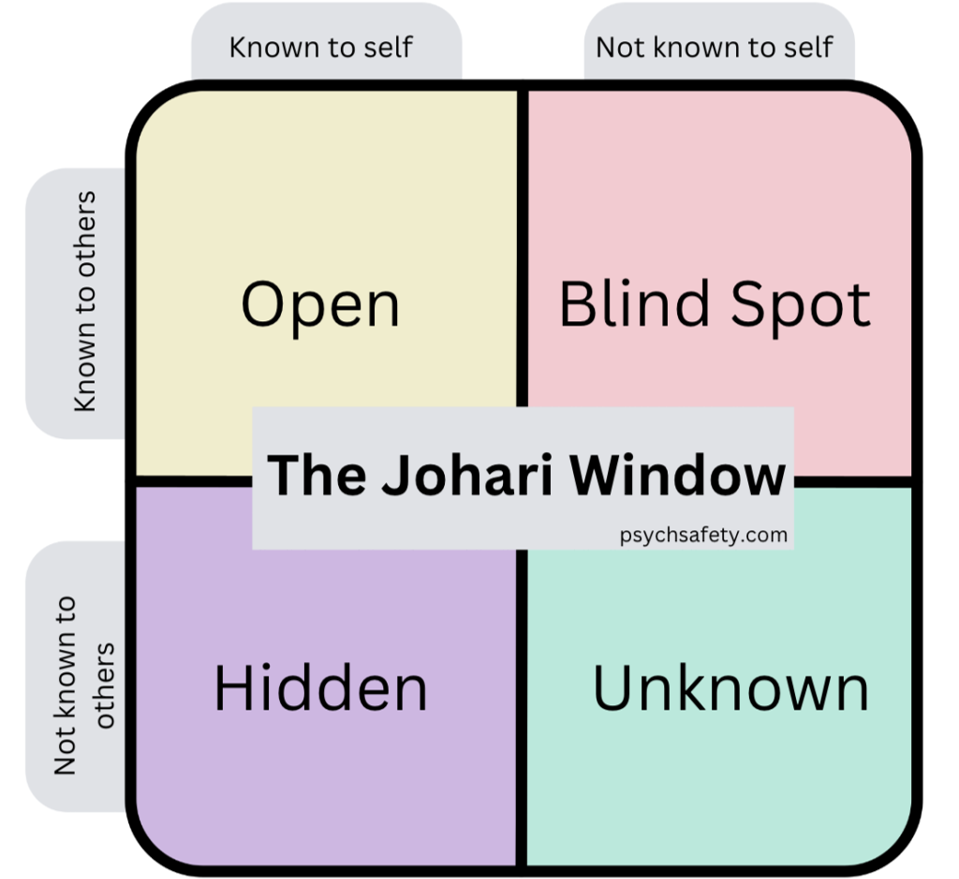
The Johari Window reminds us that personal development is not merely about learning new information. It is equally about discovering aspects of ourselves that have always existed but remained hidden. Some are hidden intentionally. Others remain concealed simply because we have never looked deeply enough or because others have never shared their observations with us.
Throughout my years teaching wellness, martial arts, Tai Chi, Qigong, and holistic health, I have often found that people spend far more time trying to understand the world around them than understanding themselves. Yet genuine self-awareness may be one of the greatest skills we can cultivate. Before we attempt to improve our health, relationships, careers, or spiritual lives, we first need an honest picture of who we currently are.
Understanding the Four Quadrants
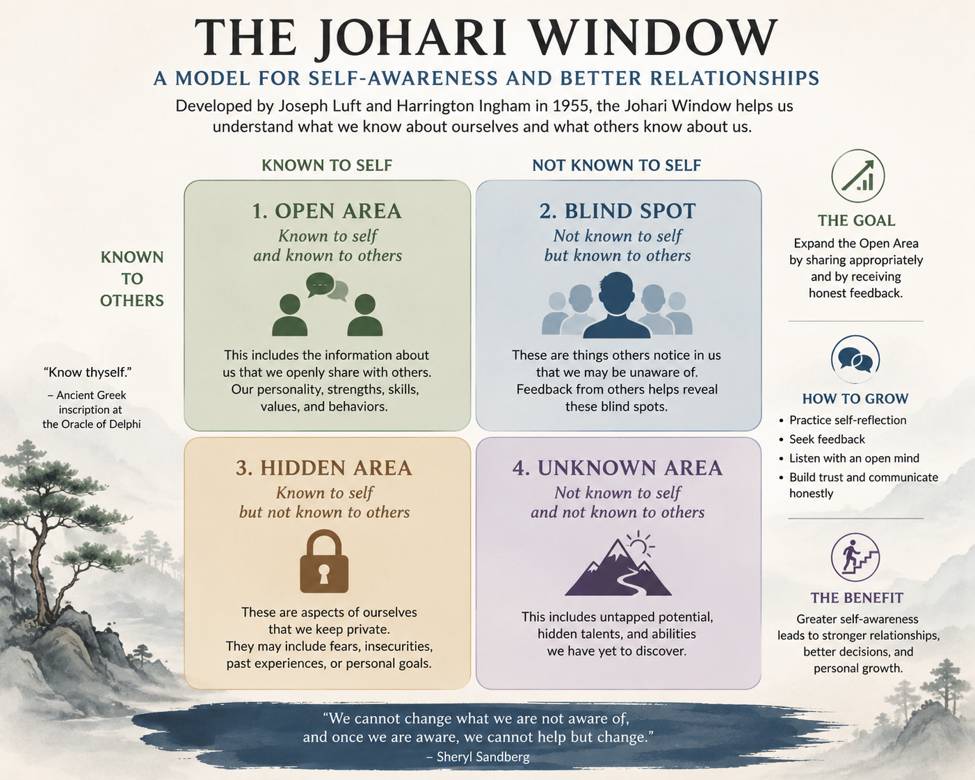
The Johari Window is divided into four sections, each representing different levels of awareness between ourselves and others.
1. The Open Area
The Open Area consists of characteristics known both to ourselves and to other people. These include our visible personality traits, habits, abilities, beliefs, communication style, and behaviors.
This is the portion of ourselves that requires the least explanation because it is openly expressed. Friends may recognize our sense of humor, coworkers may appreciate our reliability, students may value our patience, and family members may know our daily routines.
Ideally, this area grows over time as trust develops and communication becomes more honest. When people openly share their thoughts and receive constructive feedback, misunderstandings decrease and relationships strengthen (Luft & Ingham, 1955).
Unfortunately, many people never intentionally expand this area. Instead, they spend much of life protecting an image rather than revealing their authentic selves.
2. The Blind Spot
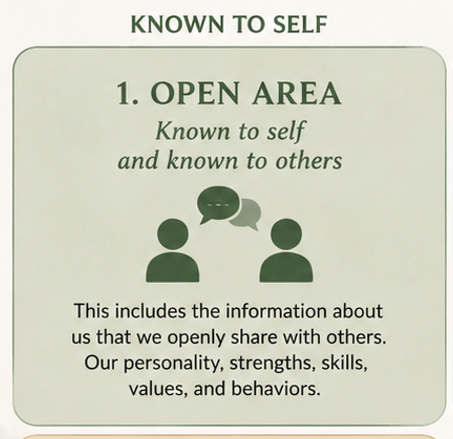
Perhaps the most fascinating portion of the Johari Window is the Blind Spot. These are characteristics that others clearly recognize in us but that we fail to see ourselves. Someone may consistently interrupt conversations without realizing it. Another person may project arrogance while believing they appear confident. A teacher may sincerely believe they communicate clearly while their students remain confused. A leader may think they encourage open discussion while unknowingly intimidating everyone around them.
Blind spots exist because human beings are naturally limited by their own perspectives. We experience life from inside our own minds, making it difficult to objectively observe our own behavior. This is why honest feedback is so valuable.
Unfortunately, many people never receive accurate feedback because those around them fear confrontation, wish to avoid conflict, or simply tell them what they want to hear. This phenomenon is related to concepts such as pluralistic ignorance, groupthink, conformity, and impression management (Janis, 1972; Solomon Asch, 1956).
Receiving thoughtful criticism can be uncomfortable, yet it often becomes one of the greatest catalysts for personal growth.
Throughout my own journey, I have had to acknowledge that some things I once confidently taught were later discovered to be incomplete or even inaccurate. While this realization was initially uncomfortable, accepting new evidence ultimately made me a better teacher. Blind spots do not disappear by ignoring them. They shrink only through humility, education, and honest reflection.
3. The Hidden Area
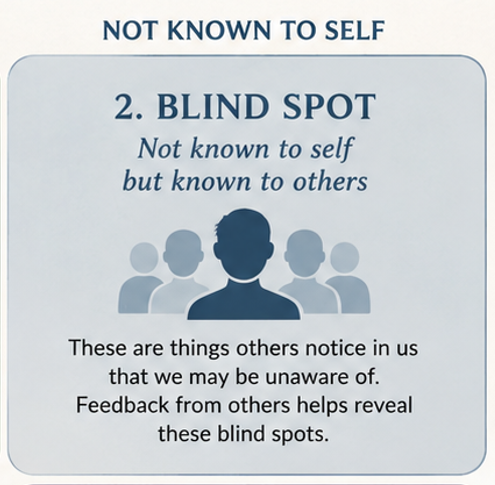
The Hidden Area contains information we know about ourselves but intentionally keep from others. These may include fears, insecurities, regrets, disappointments, painful experiences, private ambitions, or even personal successes that we choose not to disclose. There is nothing inherently wrong with privacy. Healthy boundaries are important. Not every thought or life experience needs to be shared. However, problems arise when fear prevents healthy disclosure.
Many individuals spend years wearing emotional masks, believing that revealing vulnerability will make them appear weak. Ironically, research consistently demonstrates that appropriate vulnerability often strengthens relationships by increasing trust and authenticity (Brown, 2012). As trust develops, portions of the Hidden Area gradually move into the Open Area.
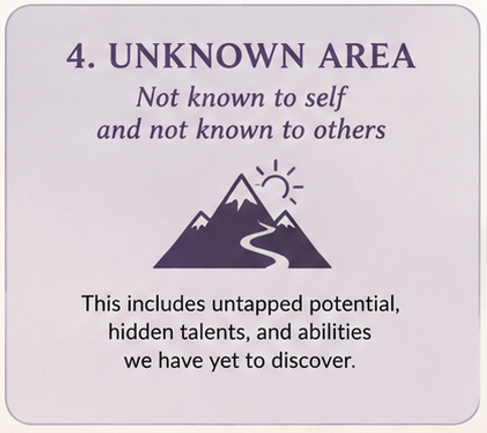
4. The Unknown Area
The final quadrant represents aspects unknown both to ourselves and to everyone else.
These include untapped abilities, hidden talents, unconscious motivations, future potential, and reactions that have simply never been tested. A person may never realize they possess exceptional leadership abilities until placed in a crisis. Someone may discover artistic talent later in life after retirement. Others uncover remarkable resilience only after surviving illness, trauma, or adversity.
Modern psychology refers to many of these experiences as post-traumatic growth, where adversity becomes the catalyst for discovering strengths previously unknown (Tedeschi & Calhoun, 2004). The Unknown Area also reminds us to remain humble. No matter how much education, experience, or wisdom we accumulate, there will always be aspects of ourselves waiting to be discovered.
Expanding the Open Window
The overall goal of the Johari Window is to expand the Open Area while reducing the Hidden and Blind areas. This occurs through two complementary processes. The first is appropriate self-disclosure. By honestly sharing our thoughts, experiences, goals, and concerns with trusted individuals, we allow others to know the authentic person behind the public image.
The second is receiving constructive feedback. Listening carefully to others allows us to identify habits and behaviors that may otherwise remain invisible. Neither process is easy. Both require humility, courage, and emotional maturity. Yet these same qualities are fundamental to lifelong learning.
The Johari Window in Everyday Life
The Johari Window applies almost everywhere.
Parents benefit from understanding how their children perceive them. Teachers become more effective by inviting student feedback. Healthcare providers improve patient relationships through greater empathy and communication. Business leaders strengthen organizations by encouraging psychological safety and honest dialogue. Martial artists discover that technical skill alone is insufficient without self-awareness, emotional regulation, and humility.
Even our closest relationships benefit when assumptions give way to honest conversations. Often, conflicts persist not because people disagree but because neither side truly understands how they are being perceived.
Wisdom Requires Seeing Ourselves Clearly
Many philosophical traditions have emphasized self-knowledge for thousands of years. The ancient Greek maxim, “Know thyself,” remains as relevant today as ever. Eastern traditions likewise encourage continual observation of one’s thoughts, emotions, habits, and attachments through meditation and mindful awareness.
Modern neuroscience supports these ancient practices. Mindfulness has been shown to improve emotional regulation, self-awareness, and interpersonal functioning (Siegel, 2010). The Johari Window provides another practical framework for this same lifelong pursuit. Rather than asking only, “What do I know?” it encourages us to ask: “What don’t I yet know about myself?” That question alone can transform one’s personal growth.
The older I become, the less interested I am in appearing knowledgeable and the more interested I become in continuing to learn. Life has repeatedly shown me that confidence without humility often leads to blind spots, while curiosity keeps those blind spots shrinking.
The Johari Window reminds us that every one of us possesses areas of certainty, areas of privacy, areas of blindness, and areas of untapped potential. None of us has a complete picture of ourselves. That realization should not discourage us. Instead, it should inspire us.
If we remain teachable, invite honest feedback, examine ourselves objectively, and maintain the humility to change when presented with better evidence, our understanding of ourselves continues to grow. In doing so, we not only become better students of life but also better teachers, mentors, leaders, spouses, parents, friends, and human beings.
Perhaps true wisdom is not believing we finally know ourselves completely. Rather, it is recognizing that self-discovery is a lifelong process, one that continues for as long as we remain open to learning.
References
Asch, S. E. (1956). Studies of independence and conformity: I. A minority of one against a unanimous majority. Psychological Monographs, 70(9), 1-70. https://doi.org/10.1037/h0093718
Brown, B. (2012). Daring greatly: How the courage to be vulnerable transforms the way we live, love, parent, and lead. Gotham Books.
Janis, I. L. (1972). Victims of groupthink. Houghton Mitllin Company. Retrieved from https://ia902805.us.archive.org/2/items/victimsofgroupthinkirvingl.janis/Victims%20of%20GROUPTHINK%20-%20Irving%20Janis.pdf
Luft, J., & Ingham, H. (1955). The Johari Window: A graphic model for interpersonal awareness. Proceedings of the Western Training Laboratory in Group Development, University of California, Los Angeles.
Siegel, D. J. (2010). Mindsight: The new science of personal transformation. Bantam Books.
Tedeschi, R. G., & Calhoun, L. G. (2004). Posttraumatic growth: Conceptual foundations and empirical evidence. Psychological Inquiry, 15(1), 1-18.