Legendary Origins of Tai Chi: Zhang Sanfeng and Daoist Transmission

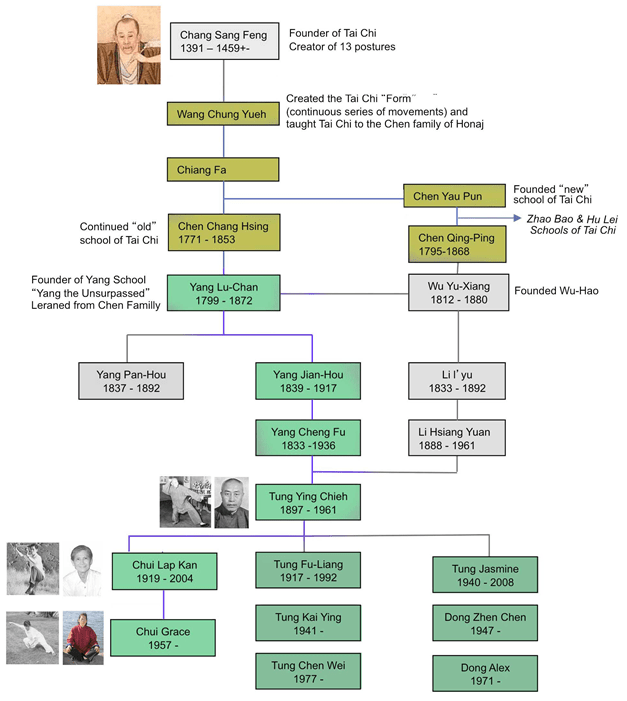
Long before Chen Village records appear in the 17th century, traditional accounts attribute Tai Chi’s creation to the Daoist monk Zhang Sanfeng, often associated with Wudang Mountain. According to legend, Zhang observed a fight between a snake and a crane. The snake yielded and coiled; the crane struck with precision. From this encounter, he is said to have synthesized principles of softness overcoming hardness, a living embodiment of Yin and Yang theory (Henning, 1994; Wile, 1996).

While modern historians generally regard this account as mythological rather than empirically verifiable, its philosophical significance is undeniable. The story reflects core Taijiquan principles:

  • Yielding over resisting
  • Circularity over linear force
  • Softness overcoming rigidity
  • Strategic adaptability

Henning (1994) notes that the Zhang Sanfeng narrative likely emerged during the late Ming and early Qing periods as part of broader cultural movements that sought to root martial systems in Daoist cosmology.

Thus, although Chen style represents the earliest documented system, the conceptual foundations of Tai Chi are traditionally traced to Daoist internal cultivation traditions centuries earlier.


Chen Style: The Foundational Documented System

Chen style originated in Chen Village (Chenjiagou), Henan Province, during the 17th century. It is traditionally attributed to Chen Wangting (1600–1680), a retired Ming dynasty military officer who synthesized battlefield methods, classical philosophy, and health exercises (Wile, 1996).

Chen style preserves features that clearly reflect martial structure:

  • Silk-reeling spirals (chan si jin)
  • Alternation of slow movement and explosive release (fa jin)
  • Low stances
  • Cannon Fist (Pao Chui)
  • Embedded combat applications

Scholars note that Chen style retains overt expressions of issuing power and structural coiling less visible in later styles (Henning, 1994).


Philosophical Foundations Across All Authentic Systems

Regardless of stylistic differences, authentic Tai Chi systems are unified by shared theoretical foundations rooted in classical Chinese cosmology.

Yin and Yang Theory

Tai Chi (Taiji) itself refers to the “Supreme Ultimate,” the dynamic interplay of Yin and Yang described in the Yijing (Book of Changes). Every movement in Tai Chi expresses:

  • Substantial and insubstantial
  • Open and close
  • Rising and sinking
  • Full and empty

This alternation is not metaphorical — it is biomechanical, energetic, and tactical.

Wuxing (Five Phases)

The Five Phase theory — Wood, Fire, Earth, Metal, and Water — informs martial strategy, organ theory, and energetic transformation. Although more explicit in some internal arts like Xingyiquan, Wuxing principles underlie Tai Chi’s cyclical power generation and transformational mechanics (Sun, 2003; Wile, 1996).

Bagua (Eight Trigrams)

The Eight Trigrams symbolize dynamic change and directional transformation. Circular stepping, angular redirection, and strategic yielding in Tai Chi mirror Bagua cosmology. Even when not overtly labeled, trigram theory informs structural shifts and directional transitions embedded in form practice.

Thus, while the choreography differs among Chen, Yang, Wu, and Sun styles, their cosmological framework remains consistent.


Yang Style: Adaptation and Public Transmission

Yang Luchan (1799–1872) studied under Chen Changxing and later taught in Beijing (Henning, 1994; Wile, 1996).

Adaptations included:

  • Smoother continuity
  • Reduced explosive emphasis
  • Elevated stances
  • Standardized pacing

His grandson Yang Chengfu formalized the large-frame slow form now widely practiced (Yang, 2005).Yang style reflects pedagogical expansion rather than dilution.


Wu Style: Refinement and Synthesis

Wu Jianquan studied within the Yang lineage and developed a system characterized by:

  • Narrower stance width
  • Slight forward inclination
  • Subtle structural alignment
  • Emphasis on push-hands sensitivity

Wu style reflects internal refinement and biomechanical precision rather than overt amplitude (Henning, 1994).


Sun Style Tai Chi

Sun Lutang (1860–1933) was already an accomplished practitioner of Xingyiquan and Baguazhang before studying Tai Chi. His system integrates principles from these “internal sister arts,” emphasizing:

  • Agile step-follow footwork
  • Upright posture
  • Smooth transitions
  • Strong reliance on intent (Yi)

Sun’s writings illustrate the synthesis of internal martial theory across systems (Sun, 2003). His style demonstrates that Tai Chi’s evolution included both lineage transmission and cross-disciplinary integration.


Why 108? Symbolism and Counting Variations

Traditional long forms are often referred to as “108 postures.” The number 108 carries symbolic significance in Chinese and Buddhist traditions, often representing completeness or cosmic totality (Wile, 1996). However, posture counts vary because:

  • Movements are repeated on both sides
  • Transitional sequences may or may not be counted
  • Different lineages classify postures differently

Thus, identical choreography may be described as 85, 88, 108, or more. Historically, long forms functioned as mnemonic archives for transmitting combat principles and conditioning methods, rather than as standardized numerical routines.


The 24 and 48 Forms: Modern Standardization

In 1956, the Chinese government introduced the 24 Simplified Form, derived primarily from Yang style. Its purpose was public health promotion and ease of instruction during a period of national physical culture reform (Frank, 2006). Repetitions and complex martial sequences were reduced to make the system accessible to large populations.

In 1976, the 48 Form was created as a more technically demanding standardized routine incorporating elements from Chen, Yang, Wu, and Sun styles. It was designed for demonstration and competitive wushu contexts (Frank, 2006).

These shorter forms reflect broader sociopolitical changes:

  • Clan-based transmission → public instruction
  • Martial preservation → health emphasis
  • Village secrecy → national standardization

Evolution Rather Than Dilution

From Chen to Yang to Wu to Sun, Tai Chi evolved in response to changing audiences and historical conditions. While stylistic expression differs in frame size, stance height, and visible power release, the core principles remain consistent:

  • Rooting and structural alignment
  • Whole-body integration
  • Relaxed yet connected movement
  • Intent directing force

Tai Chi is not a static artifact of the past. It is a living system shaped by centuries of adaptation. Its diversity reflects not fragmentation, but resilience

References

Frank, A. (2006). Taijiquan and the search for the little old Chinese man: Understanding identity through martial arts. Palgrave Macmillan.

Henning, S. (1994). Ignorance, Legend and Taijiquan. In Journal of the Chen Style Taijiquan Research Association of Hawaii (Vol. 2, Issue 3, pp. 1–7). https://crnagorataiji.wordpress.com/wp-content/uploads/2015/12/legend-in-tai-chi.pdf

Lutang, S. (2003). A study of Taijiquan. North Atlantic Books.

Wile, D. (1996). Lost T’ai-chi Classics from the Late Ch’ing Dynasty. State University of New York Press. https://doi.org/10.2307/jj.18255579

Yang, J. (2005). The essence and applications of Taijiquan. YMAA Publication Center.

The Iterative Self: How Human Encounters Refine Identity Over Time

Human identity is not static. It is neither a fixed trait nor a finished product. Rather, it is an evolving system continually shaped by interaction. Each encounter, relationship, and exposure to another person serves as a catalyst for subtle psychological recalibration. These recalibrations may be nearly imperceptible in isolation, yet cumulatively they produce profound transformation. In modern language, one might describe this process as a series of “upgrades” or successive versions of the self-emerging through lived experience. Very much the same as how we currently view upgrades to a computer, its operating system or software applications.

This observation is meant to perfectly capture the fluid nature of identity. I chose to eloquently summarize several complex psychological and sociological ideas into a cohesive metaphor. The idea that we are not static beings, but rather perpetual works-in-progress continually shaped by the “data” of human interaction. I find this concept to be quite profound.

Furthermore, I would like to expand upon this concept, exploring the mechanics of how these “upgrades” happen and extending the metaphor of versions and models.

The Human Operating System: An Iterative Process

The comparison to software versions, upgrades, and improved models is quite relevant to modern culture. If our foundational personality, determined by genetics and early childhood, is the “base code” or the operating system (v1.0), then every subsequent interaction acts as a patch, a feature update, or sometimes, a complete system overhaul.

Here is how we can break down this process of refinement through encounter:

1. The Mechanism of the “Upgrade”

How exactly does exposure to another person translate into an internal change?

Osmosis and Mirroring – Often, these adjustments are subconscious. We spend time with someone witty, and we find our own sense of humor sharpening. We hang around someone anxious, and we detect a new hum of nervousness in our own baseline. We “download” their emotional states and behavioral patterns through mirror neurons, adopting features that aren’t natively ours until they become integrated into our code.

The Looking-Glass Self – Sociologist Charles Cooley introduced the concept of the “looking-glass self.” We do not know who we are in a vacuum. We learn who we are by seeing how our actions bounce off other people. Example: You tell a joke you think is funny. The new acquaintance stares blankly. That is critical new data. Your internal model of “what is humorous” receives a minute adjustment based on that feedback failure.

Friction as a Catalyst – Often, the most significant upgrades come not from seamless interactions, but from friction. When we encounter someone whose values or methods diametrically oppose our own, it forces our internal system to run a diagnostic check. We have to actively defend, analyze, or adapt our own viewpoint in response to the challenge.

2. Types of Releases

Not all interactions carry the same weight. By extending my metaphor, I can categorize these encounters:

Minor Patches (v1.1.2 to v1.1.3): These are fleeting encounters, such as with the polite cashier, the person you hold the door for. They reinforce our “social protocols” code, perhaps slightly adjusting our mood, but they don’t change the core programming.

Feature Updates (v1.2 to v1.5): These are friendships, colleagues, or mentors. They introduce new functionality to our personality. From a friend, you might “install” an appreciation for a new genre of music; from a mentor, you might adopt a new framework for problem-solving.

Major Version Releases (v2.0 to v3.0): These are the life-altering relationships: deeply intense romances, traumatic breakups, the birth of a child, or the loss of a loved one. These events dismantle significant portions of the previous code. The person that emerges on the other side often operates so differently that they are unrecognizable from the previous “version.”

3. The Nuance: Not All “Improvements” Feel Good

It is important to recognize that “refinement” or “new model” doesn’t always mean “happier” or “more open.”

Sometimes, the new information we receive from an encounter is harmful. If someone betrays our trust, the “upgrade” we receive is a security patch that makes a firewall thicker. We become more cynical, guarded, or hesitant.

This is still a refinement, an adaptation to the reality presented to us, even if it feels like a regression in overall happiness. It is the system adjusting to ensure survival in a newly perceived hostile environment.

In conclusion, I find this overall perspective as a healthy way to view personal growth. It removes the pressure to be a “finished product.” Instead, it allows us to view every person we meet, whether a brief encounter or a lifelong partner, as a collaborator in the endless project of building the self. We are never truly done; we are just waiting for the next bit of data to arrive.

Light Bulb, Flashbulb and Lollipop Moments

Human experiences are filled with defining moments that shape our understanding of ourselves and our relationships with others. Three metaphors that capture different yet equally transformative experiences are the light bulb moment, the flashbulb moment, and the lollipop moment. While all represent instances of change and meaning, their sources and impacts differ substantially. A light bulb moment represents a sudden spark of personal insight or discovery. A flashbulb moment captures the power of memory by anchoring us to a specific point in time during a significantly shared event. A lollipop moment, by contrast, highlights how a seemingly small act can have an unexpectedly profound impact on another person’s life. Examining these three concepts reveals not only how individuals grow through personal insight and memory but also how they shape one another’s lives through small, often unrecognized gestures.

Light Bulb Moments: Personal Realization

The term light bulb moment is commonly used to describe the sudden emergence of clarity, understanding, or inspiration. Rooted in imagery popularized by early cartoons, where a light bulb appeared above a character’s head to symbolize a new idea, the expression reflects how insight can feel instantaneous (Gladwell, 2005). These moments are often associated with cognitive restructuring, when a problem once perceived as insurmountable suddenly becomes solvable. Psychologists identify such experiences as insight learning, a process where new connections are drawn between previously unrelated concepts (Bowden et al., 2005).

For example, a student struggling with a mathematics problem may suddenly “see” the solution after hours of confusion. This type of realization brings both intellectual satisfaction and emotional reinforcement, often motivating individuals to continue exploring and learning. In a broader sense, light bulb moments underscore the human capacity for creativity and problem-solving, marking them as critical turning points in education, science, and personal growth.

Flashbulb Moments: Distinct Memories in Time

Alongside the concept of the light bulb moment, psychologists also describe what are known as flashbulb moments. Unlike the personal insight of a light bulb moment, a flashbulb moment refers to a vivid and enduring memory of where one was and what one was doing during a significant historical or emotional event. These memories are often tied to collective experiences, such as the 1969 moon landing, the terrorist attacks on September 11, 2001, or the explosion of the space shuttle Challenger in 1986.

Brown and Kulik (1977) first introduced the term, noting how individuals can recall with great detail their surroundings, emotions, and even conversations during such events. Although research shows that the accuracy of these memories may fade over time, the confidence in them remains strong (Talarico & Rubin, 2003). Flashbulb moments therefore highlight the powerful role of emotion and societal significance in shaping human memory, standing in contrast to the personal realization of a light bulb moment and the interpersonal influence of a lollipop moment.

Lollipop Moments: Impact on Others

By contrast, the lollipop moment emphasizes interpersonal influence rather than internal realization. The term was introduced by leadership educator Drew Dudley in his TEDx talk Everyday Leadership (2010). Dudley shared a story of how he casually handed a lollipop to a nervous new student during orientation, making a humorous remark that helped her feel more comfortable. What he considered an insignificant act turned out to be transformative, as the student later credited the gesture as a pivotal moment in her decision to remain in school and eventually meet her future spouse.

Lollipop moments illustrate how simple actions, often forgotten by the initiator, can have life-altering effects for others. Scholars of positive psychology highlight the importance of micro-moments of connection, such as kindness, encouragement, or recognition, in building resilience and well-being (Fredrickson, 2013). Unlike light bulb moments, which center on self-discovery, lollipop moments demonstrate the ripple effect of human interaction, where a small spark of generosity or empathy can catalyze growth, healing, or confidence in others.

Comparing the Three

Although light bulb, flashbulb, and lollipop moments are distinct, they are complementary in the landscape of human experience. Light bulb moments transform the self by providing clarity and insight, flashbulb moments connect us to shared historical and emotional contexts, and lollipop moments transform relationships by creating meaning for others. Each concept represents a unique dimension of human development: cognition, memory, and social connection.

Together, they remind us of the multidimensional nature of growth and meaning. Intellectual breakthroughs drive progress, emotionally charged memories bind us to the larger human story, and interpersonal kindness fosters community and belonging. Without light bulb moments, innovation and self-awareness would stagnate. Without flashbulb moments, our shared cultural narrative would lose its depth. Without lollipop moments, compassion and leadership would lose their everyday relevance. Recognizing all three encourages us to value the sudden spark of discovery, the unforgettable imprint of memory, and the subtle, transformative power of everyday kindness.

References:

Bowden, E. M., Jung-Beeman, M., Fleck, J., & Kounios, J. (2005). New approaches to demystifying insight. Trends in Cognitive Sciences, 9(7), 322–328. https://doi.org/10.1016/j.tics.2005.05.012

Brown, R., & Kulik, J. (1977). Flashbulb memories. Cognition, 5(1), 73–99. https://doi.org/10.1016/0010-0277(77)90018-X

designer. (2017, October 17). THE RIPPLE EFFECT – Embrace the challenge. https://embracethechallenge.org/the-ripple-effect/

Dudley, D. (2010). Everyday leadership [Video]. TEDxToronto. https://www.ted.com/talks/drew_dudley_everyday_leadership

Fredrickson, B. L. (2013). Love 2.0: Finding happiness and health in moments of connection. Hudson Street Press. https://archive.org/details/love20creatingha0000fred

Gladwell, M. (2005). Blink: The power of thinking without thinking. Little, Brown and Company. https://psycnet.apa.org/record/2006-01628-000

Talarico, J. M., & Rubin, D. C. (2003). Confidence, not consistency, characterizes flashbulb memories. Psychological Science, 14(5), 455–461. https://doi.org/10.1111/1467-9280.02453

The Grace of Endings

A Reflection on Relationships, Impermanence, and the Wisdom of Final Chapters

I have lived long enough, to see many of my personal relationships come to an end. Relationships with family, friends and neighbors. Also, in the workplace, or with casual acquaintances and even with most beloved pets. There is no way to escape the fact that all of our relationships,… good, bad or otherwise… will eventually wind down and consequently, … cease to exist.

Some relationships ended gently, like the fading of a season. Some ended abruptly, with sharp edges and unfinished words. Others dissolved so slowly that I did not recognize their ending until much later. Some lasted for only seconds as meaningful encounters, while others have lasted for decades, ranging from superficial to those with much depth and connection.

A few were taken from me through death, reminding me that time is not something we negotiate.

If there is one truth I now accept without resistance, it is this: every relationship ends. The only uncertainty is how.

All Relationships End — But Not All Endings Are Equal

A relationship can end in many ways:

  • Physical separation
  • Emotional drifting
  • Conflict or betrayal
  • Mutual completion
  • Growth in different directions
  • Death

The ending is inevitable. The quality of the ending, however, is not. Two relationships can last the same number of years. One ends with resentment, bitterness, and silence. The other ends in gratitude, dignity, and respect. Same duration, but very different legacies. And legacy is what remains when presence is gone.

When I was younger, I assumed continuity. Friendships felt permanent. Partnerships felt anchored. Mentorships felt enduring. Even conflict seemed temporary. I moved through life with the quiet belief that what was present would remain.

Age has corrected that assumption.

In both Buddhism and Taoism, impermanence is not considered tragic; it is considered structural. Everything that arises eventually passes. Seasons change. Roles evolve. Bodies age. The river moves forward regardless of how tightly we grip the bank.

Relationships are no exception. This realization is not cynical. However, it is clarifying.

What I have come to understand is that while every relationship will end, not every ending carries the same weight. The way something concludes often determines how it is remembered. Behavioral science supports this idea through what is known as the peak–end rule, a concept associated with Daniel Kahneman. Human beings tend to remember experiences not by averaging every moment, but by recalling emotional peaks and how the experience ended.

In my own life, I have seen this play out repeatedly. Some relationships ended in mutual respect. Those I remember with gratitude, even if sadness accompanied the goodbye. Other endings were strained or unresolved. In those cases, the final chapter colored the memory of the entire story. Not because the good years disappeared, but because the emotional signature shifted.

The ending becomes a lens. Over time, I stopped asking whether a relationship lasted “long enough.” Instead, I began asking whether I conducted myself well when it mattered most. Did I speak truthfully but without cruelty? Did I take responsibility for my part? Did I protect confidence even when I was hurt? Did I leave with dignity?

Ending well does not mean avoiding hard conversations. It does not mean suppressing disappointment or pretending harm did not occur. It means refusing to allow bitterness to become part of one’s identity. It means honoring what was real, even if it cannot continue.

Not All Endings Are Mutual

Here is where the idea becomes more nuanced.

Sometimes:

  • One person wants to leave.
  • One person is hurt.
  • One person feels betrayed.

The closing of a relationship is not always evenly distributed. One may feel relief while the other feels loss. One may feel clarity while the other feels confusion.

We cannot control how another person chooses to exit. But we can control whether we exit with integrity.

Not all of my endings were graceful. I have spoken too quickly at times. I have clung when I should have released. I have walked away when I should have stayed. But even the painful endings became teachers. Each one revealed something about attachment, ego, expectation, and fear.

Not all relationships are meant to last.

Some are teachers.
Some are mirrors.
Some are initiations.
Some are seasonal.

But how we exit determines whether the experience becomes:

  • Trauma
  • Bitterness
  • Or growth

Each one forced me to refine who I was.

If I have gained anything from the relationships that have ended — well or poorly — it is perspective.

Now, as I enter what many call the golden years of life, I do not assume longevity in any relationship. I try to be present. I strive to be responsible. I presume that any conversation could be the last meaningful exchange. That awareness changes how I speak. It softens unnecessary conflict and reduces trivial ego battles. It encourages gratitude.

It also deepens intentionality.

When we recognize that every relationship has a final chapter, we begin to live differently in the earlier ones. We may express appreciation more freely. We may forgive more quickly. We can choose our words more carefully. We can protect what matters and release what does not.

Relationships do not truly end when contact stops. They continue within us. They shape habits, perspectives, and character. Some leave behind wisdom. Some leave behind warnings. Some leave behind quiet gratitude. All leave impressions.

The quality of the ending influences the emotional afterlife of the relationship.

If I could offer anything to those who are younger, it would not be advice on how to make every relationship last forever. That is not within our control. Instead, I would suggest this:

Conduct yourself in such a way that, if the relationship ended tomorrow, you would not regret your final chapter.

Try not to weaponize vulnerability. Try not to humiliate in anger. Do not rewrite history to protect pride. Do not allow ego to eclipse shared humanity.

You cannot control how others leave. But you can control how you do.

In the end, our legacy is not built upon how long relationships lasted, but upon how we treated others within them. Especially when they were ending. Dignity under pressure is remembered. Respect in conflict is remembered. Gratitude in goodbye is remembered.

Every relationship will one day close. That is not a morbid thought, but rather a refining one.

Knowing this has not made me withdraw. It has made me more attentive, careful. and grateful. More willing to release without resentment.

The final chapter will come for every connection I still hold. When it does, I hope the memory left behind is steady, respectful, and honest. Not perfect, but principled.

If endings are inevitable, then grace becomes essential. And perhaps that is one of the quiet purposes of aging: to understand that relationships are not possessions to secure, but gifts to steward right up until their final page.

One Truth, Many Experiences — And the Need for Discernment

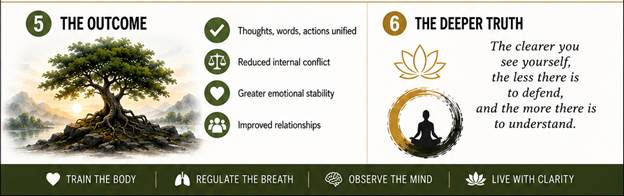
There can only be one truth about a particular thing. A tree is a tree. It does not become something else because someone prefers it to be different. It has roots, a trunk, branches, and leaves. It grows according to its nature.

Truth, in that sense, is singular.

Yet there are countless ways to experience that truth. One person sees shade. Another sees lumber. A child sees a playground. A farmer sees fruit. A bird sees shelter. An artist sees beauty. The tree remains what it is, but its meaning expands through relationship.

However, there is another layer we must not ignore.

Not all trees are healthy.

From a distance, a tree may appear strong with an upright trunk, full canopy, green leaves. Yet beneath the surface, its roots may be rotting. Insects may be boring into its core. Disease may be spreading through its vascular system. It may produce some healthy fruit and some spoiled fruit at the same time.

What appears stable may, in fact, be compromised. This complicates the simplicity at seeking truth, but only at face value.

The truth of the tree includes both its visible form and its hidden condition. Its outward strength does not automatically equal inward integrity. The shade it provides may still be real. The fruit it produces may still nourish. But the structural truth of the tree might be deteriorating. And if the roots are compromised long enough, collapse becomes inevitable.

This is where discernment enters the conversation.

Experience alone is not enough.
Observation alone is not enough.
Surface-level impressions are not enough.

We must look deeper. A person may experience comfort beneath a tree that is slowly dying. That comfort is real, but temporary. Someone may harvest fruit without realizing that decay has already begun in the roots. Another may lean against the trunk, unaware that termites are hollowing it from within.

The tree remains a tree. But the condition of the tree matters. This is true of ideas. It is true of institutions, leaders, relationships, and it is true of ourselves.

Something may look strong on the outside while its foundation is unstable. This thing may produce good results occasionally while carrying hidden corruption. This entity may offer shade while preparing to fall.

Truth is singular; however, truth is also layered. There is the truth of identity — what a particular thing is. And there is the truth of condition — how healthy or diseased it is. Wisdom requires that we examine both.

In human life, this means we must not confuse appearance with integrity. A smiling face does not guarantee emotional health. A successful career does not guarantee moral grounding. A large organization does not guarantee structural soundness. A belief system that produces some good fruit may still carry internal rot.

Discernment asks:
What do the roots look like?
What nourishes this system?
Is the fruit consistently healthy, or only occasionally?
Is there hidden decay beneath visible strength?

The tree teaches us again. We may approach it for shade, for fruit, for beauty, and those experiences are valid. But maturity asks us to step back and assess the whole. To look beneath the bark. To examine the roots. To recognize that outward form and inward health are not always identical.

Reality does not change because we ignore decay. Collapse does not wait for consensus. And yet, even here, the metaphor holds hope.

A diseased tree can sometimes be pruned. Infestation can sometimes be treated.
Roots can sometimes be strengthened. But only if the condition is acknowledged.

One truth. Many experiences. And beneath them all, is the responsibility to look deeper.

The tree is what it is…. But not all as it may seem, … at first glance. To find truth, we might need to look at many perspectives.