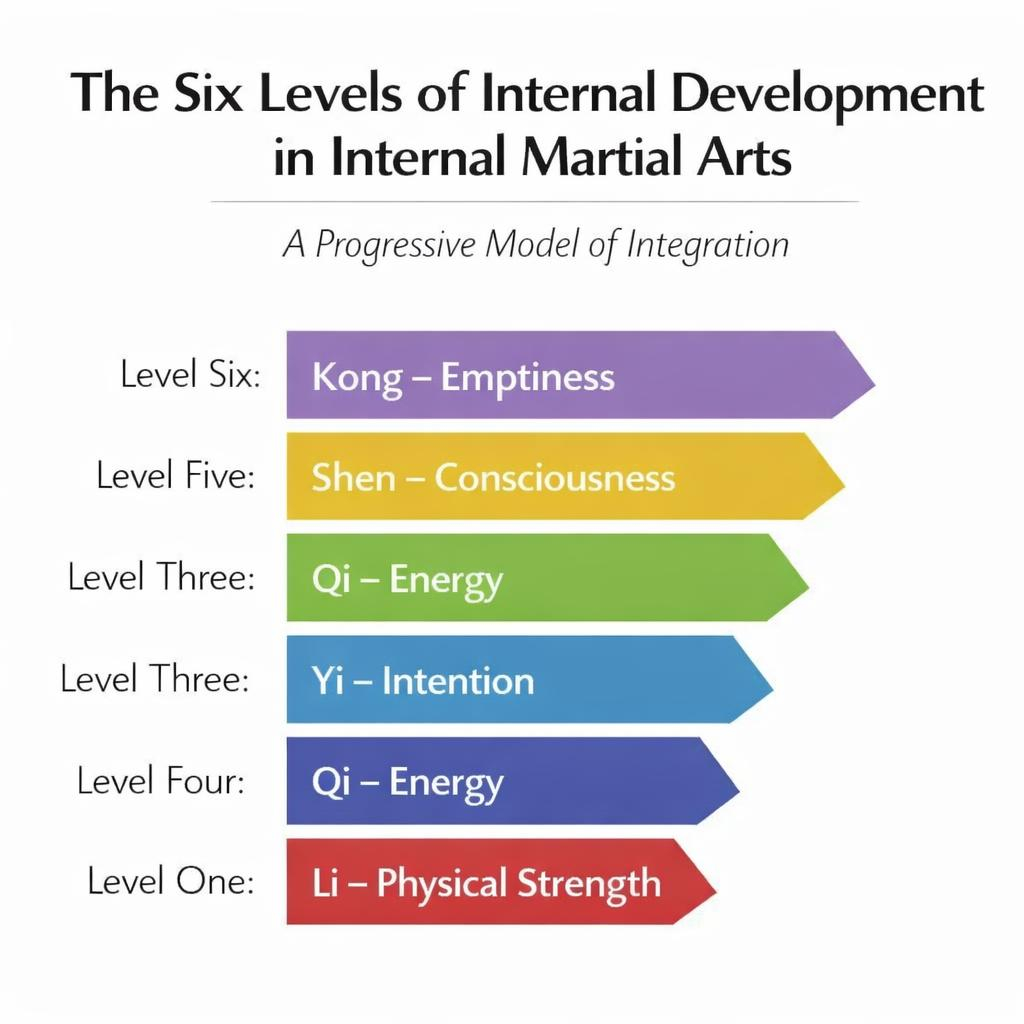
A Progressive Model of Integration
Level One: Li – Physical Strength
Level Two: Jin – Refined Force
Level Three: Yi – Intention
Level Four: Qi – Energy
Level Five: Shen – Consciousness
Level Six: Kong – Emptiness
The internal martial arts, commonly referred to as Neijia, represent a sophisticated system of human development that integrates body, mind, and consciousness through progressive refinement. The three most widely recognized internal martial arts are Hsing Yi, Tai Chi Chuan and BaguaZhang. Within these traditions, a frequently cited developmental model describes six interrelated levels: Li (力), Jin (勁), Yi (意), Qi (氣), Shen (神), and Kong (空). While not universally standardized across all lineages, this framework reflects a coherent synthesis of classical Chinese martial, medical, and philosophical thought (Yang, 1998; Chen, 2004; Kohn, 2008).
These levels are not discrete stages to be completed and abandoned, but rather nested layers of integration, each refining and reorganizing the preceding level. The progression reflects a shift from gross physical force toward subtle awareness and spontaneous action, paralleling Daoist internal alchemical models such as Jing–Qi–Shen–Xu (emptiness) (Kohn, 2008).
Level One: Li (力) – Physical Strength
Li refers to raw muscular strength and mechanical force, representing the most basic level of martial capacity. At this stage, movement is driven primarily by localized muscle contraction, often resulting in segmented and inefficient force production.
From a biomechanical perspective, Li relies heavily on voluntary muscular activation and leverage, with limited integration across the kinetic chain (McGinnis, 2013). While essential as a foundational attribute, Li is inherently limited. It is expendable, fatigue-prone, and easily countered by superior structure or timing.
Traditional training methods emphasize:
- Static postures (e.g., horse stance, bo stance, twisted stance, etc.)
- Repetitive conditioning drills
- Strength and endurance development
Despite its limitations, Li provides the necessary structural and physiological base upon which higher levels are cultivated.
Level Two: Jin (勁) – Refined Force
Jin represents a qualitative transformation of force, from isolated muscular effort to integrated, whole-body power. It is often described as “trained strength” or “refined force,” characterized by efficient transmission of energy through aligned structure and connective tissues (Yang, 1998).
Biomechanically, Jin reflects:
- Kinetic chain integration
- Elastic recoil through fascia and tendons
- Ground-reaction force transmission
This level corresponds with modern understandings of tensegrity and fascialconnectivity, where force is distributed across the entire body rather than generated locally (Myers, 2014).
Classical expressions of Jin include:
- Peng (expansive, buoyant force)
- Lu (yielding and redirecting)
- Ji (pressing)
- An (sinking)
The transition from Li to Jin marks a critical threshold in internal training: effort decreases while effectiveness increases.
Level Three: Yi (意) – Intention
Yi, often translated as intention or intentional awareness, serves as the directive principle that organizes movement and force. In classical texts, it is said that “Yi leads Qi, and Qi leads the body” (Yang, 1998).
At this level, movement becomes:
- Less reliant on conscious muscular control
- More guided by pre-reflective awareness
- Increasingly efficient and anticipatory
Neuroscientifically, Yi may be understood as the integration of:
- Motor planning (premotor cortex)
- Attentional control networks
- Sensorimotor prediction
This aligns with research demonstrating that intention and attention significantly influence motor coordination and performance efficiency (Wulf & Lewthwaite, 2016).
The practitioner begins to experience a shift from doing movement to allowing movement to be directed internally.
Level Four: Qi (氣) – Functional Energy
Qi is among the most debated concepts in both Eastern and Western discourse. Rather than interpreting Qi as a mystical substance, contemporary scholarship often frames it as a functional integration of physiological systems, including:
- Breath and respiratory efficiency
- Circulation and fluid dynamics
- Neural signaling and proprioception
- Fascial continuity
From this perspective, Qi represents the emergent coherence of the organism as a unified system (Chen, 2004; Jahnke, 2002).
Empirical studies on Qigong and Tai Chi suggest improvements in:
- Cardiovascular regulation
- Balance and coordination
- Stress reduction and autonomic balance
These findings support the interpretation of Qi as system-wide functional optimization rather than an isolated energy entity (Wayne & Kaptchuk, 2008).
Level Five: Shen (神) – Consciousness and Presence
Shen refers to consciousness, awareness, and the quality of presence. In both Traditional Chinese Medicine and Daoist philosophy, Shen is associated with the clarity and stability of the mind (Kohn, 2008).
At this level:
- Perception becomes refined and immediate
- Emotional reactivity diminishes
- Action arises from calm awareness rather than impulse
Shen is closely related to constructs studied in modern psychology, such as:
- Mindfulness
- Meta-awareness
- Flow states
Research indicates that such states are associated with enhanced performance, reduced stress, and improved cognitive flexibility (Csikszentmihalyi, 1990; Tang et al., 2015).
In martial application, Shen manifests as timing, sensitivity, and effortless responsiveness.
Level Six: Kong (空) – Emptiness
Kong, often translated as emptiness, represents the culmination of internal development. Rooted in both Daoist and Buddhist philosophy, it does not imply nihilism, but rather freedom from attachment, rigidity, and fixed identity (Kohn, 2008).
At this level:
- Action is spontaneous and uncontrived
- There is no separation between intention and execution
- The practitioner is no longer bound by technique or conceptual frameworks
This state parallels advanced descriptions of:
- Non-dual awareness
- Effortless action (wu wei)
- Self-transcendent experience
From a performance standpoint, Kong reflects complete integration, where body, mind, and environment function as a unified field.
Integrative Perspective: From Force to Emptiness
The progression from Li to Kong reflects a continuum of refinement:
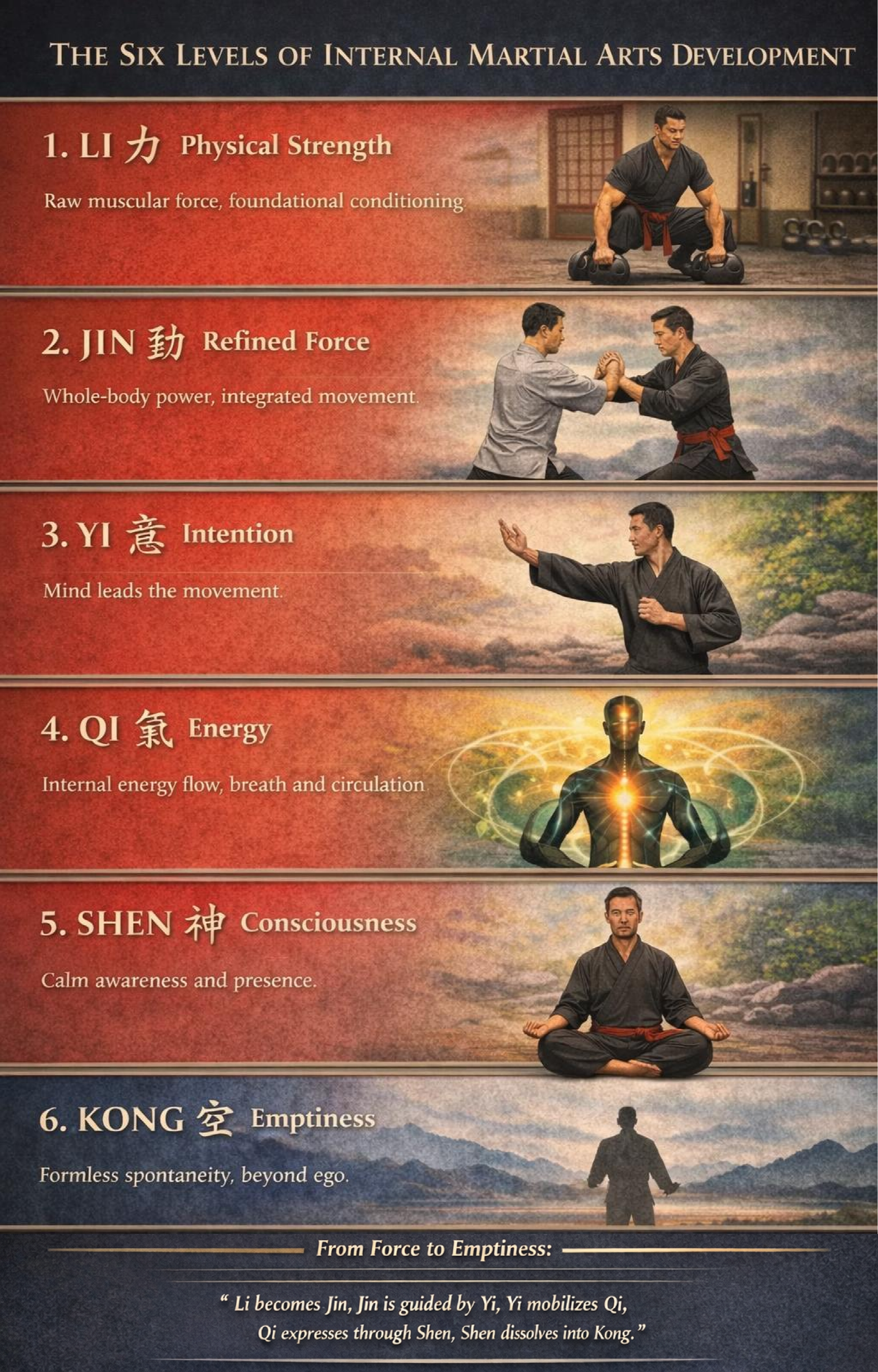
- Li becomes organized into Jin
- Jin is directed by Yi
- Yi mobilizes Qi
- Qi expresses through Shen
- Shen dissolves into Kong
Importantly, advanced practitioners do not abandon earlier levels; rather, they embody all levels simultaneously, with each functioning in harmony.
This model closely parallels:
- Daoist internal alchemy (Jing → Qi → Shen → Xu)
- Psychophysiological integration models
- Contemporary frameworks of embodied cognition
Implications for Training and Practice
A critical issue in modern practice is the misinterpretation or premature pursuit of higher levels. Many practitioners:
- Remain at the level of Li while believing they are expressing Jin
- Seek Qi experiences without structural integrity
- Conceptualize Yi without embodied application
Effective training requires:
- Structural foundation (Li → Jin)
- Intentional refinement (Yi)
- Physiological integration (Qi)
- Conscious awareness (Shen)
- Letting go of fixation (Kong)
This progression underscores a central principle of internal arts:
True development is not the accumulation of techniques, but the refinement of the practitioner.
References
Chen, M. (2004). Chen style taijiquan: The source of taiji boxing. New World Press.
Csikszentmihalyi, M. (1990). Flow: the psychology of optimal experience. ResearchGate. https://www.researchgate.net/publication/224927532_Flow_The_Psychology_of_Optimal_Experience
Jahnke, R. (2002). The healing promise of Qi: Creating extraordinary wellness through Qigong and Tai Chi. McGraw-Hill.
Kohn, L. (2008). Chinese Healing Exercises: The Tradition of Daoyin. University of Hawai’i Press. http://www.jstor.org/stable/j.ctt6wqs77
McGinnis, P. M. (2013). Biomechanics of sport and exercise (3rd ed.). Human Kinetics. Biomechanics of Sport and Exercise (3rd Ed)
Myers, T. W. (2014). Anatomy trains: Myofascial meridians for manual and movement therapists (3rd ed.). Elsevier.
Tang, Y. Y., Hölzel, B. K., & Posner, M. I. (2015). The neuroscience of mindfulness meditation. Nature Reviews Neuroscience, 16(4), 213–225. https://doi.org/10.1038/nrn3916
Wayne, P. M., & Kaptchuk, T. J. (2008). Challenges inherent to t’ai chi research: part I–t’ai chi as a complex multicomponent intervention. Journal of alternative and complementary medicine (New York, N.Y.), 14(1), 95–102. https://doi.org/10.1089/acm.2007.7170a
Wulf, G., & Lewthwaite, R. (2016). Optimizing performance through intrinsic motivation and attention for learning: The OPTIMAL theory of motor learning. Psychonomic Bulletin & Review, 23(5), 1382–1414. https://doi.org/10.3758/s13423-015-0999-9
Yang, J. M. (1998). The root of Chinese Qigong: Secrets of health, longevity, and enlightenment. YMAA Publication Center.