Human beings are social creatures. We learn from one another, depend upon one another, and often seek belonging within families, communities, organizations, religious groups, businesses, and social circles. Throughout history, cooperation has been one of humanity’s greatest strengths. Working together has allowed us to survive, innovate, and build civilizations.
Yet this same tendency toward cooperation can sometimes become a liability.
When the desire for acceptance, harmony, loyalty, or conformity becomes more important than truth, groups can begin to distort reality. Under certain circumstances, these distortions can become so powerful that entire organizations, communities, or even societies begin believing things that are inaccurate, exaggerated, or completely disconnected from objective evidence. While psychologists reserve the term hallucination for sensory experiences that occur without external stimuli, there is another phenomenon that might be described as a collective hallucination, where a shared belief system that persists despite contradictory evidence.
The question is not whether this happens. History clearly demonstrates that it does. The more important question is why intelligent, sincere, and often well-intentioned people become vulnerable to it.
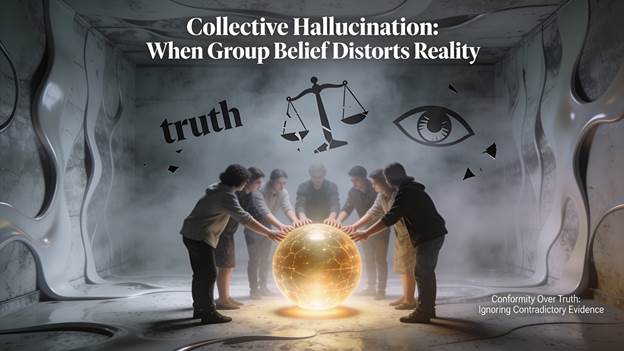
Understanding Groupthink
The psychologist Irving Janis (1972) coined the term groupthink to describe situations in which the desire for consensus overrides critical thinking and objective evaluation.
In healthy groups, members are encouraged to ask questions, challenge assumptions, and explore alternative viewpoints. In unhealthy groups, disagreement is often viewed as disruptive, disloyal, or disrespectful.
Over time, members may begin to:
- Suppress doubts and concerns
- Self-censor opposing opinions
- Rationalize contradictions
- Dismiss outside criticism
- Place excessive trust in leaders
- Conform to the majority viewpoint
- Develop the illusion that the group cannot be wrong
The result is often a gradual separation from reality. What begins as cooperation slowly transforms into conformity.
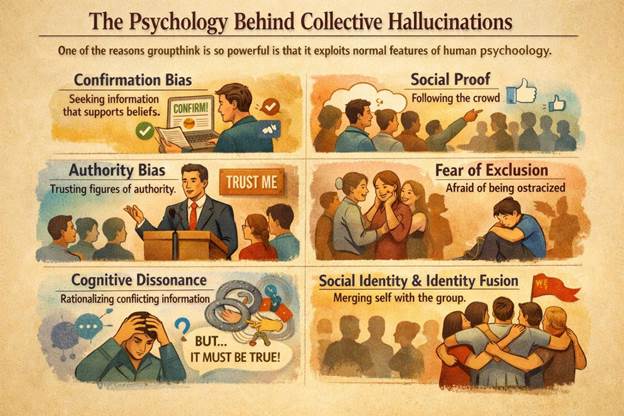
The Psychology Behind Collective Hallucinations
One of the reasons groupthink is so powerful is that it exploits normal features of human psychology.
Confirmation Bias
Human beings naturally seek information that supports existing beliefs while overlooking information that contradicts them (Kahneman, 2011). When individuals already believe a particular narrative, they tend to notice evidence that confirms it while minimizing evidence that challenges it. This tendency becomes amplified in groups where everyone is reinforcing the same assumptions.
Social Proof
Psychologist Robert Cialdini (2021) describes social proof as our tendency to assume that if many people believe something, it must be true. This mental shortcut is often useful. If everyone evacuates a building during a fire alarm, following the crowd may be wise. However, social proof can also mislead us. If enough people repeat an inaccurate idea, the sheer number of believers can create the illusion of legitimacy.
Authority Bias
Human beings are inclined to trust perceived experts, leaders, teachers, mentors, and authority figures. Authority itself is not the problem. Competent leadership is valuable. The problem arises when individuals stop evaluating claims on their own merits and instead accept them solely because of who made them. History repeatedly demonstrates that authority and accuracy are not always the same thing.
Fear of Exclusion
Perhaps one of the most powerful forces influencing human behavior is the fear of social rejection.
For most of human history, exclusion from the tribe could threaten survival. Consequently, many people learn to remain silent even when they privately disagree.
Psychologists refer to this phenomenon as pluralistic ignorance. Individuals may privately doubt a belief while publicly appearing to support it because they assume everyone else agrees (Myers & Twenge, 2024).
Ironically, entire groups may privately harbor doubts while collectively maintaining the illusion of certainty.
Cognitive Dissonance
When reality conflicts with deeply held beliefs, people experience psychological discomfort known as cognitive dissonance (Festinger, 1957). Rather than changing the belief, individuals often reinterpret the evidence. This helps explain why some groups become increasingly committed to a narrative even after significant contradictions emerge. The greater the investment of time, energy, money, or identity, the more difficult it becomes to admit being mistaken.
Social Identity and Identity Fusion
According to Social Identity Theory, people derive part of their sense of self from the groups to which they belong (Tajfel & Turner, 1986). When this identification becomes excessive, criticism of the group’s beliefs may feel like a personal attack. At that point, defending the narrative becomes less about seeking truth and more about protecting identity.
When Good Intentions Are Not Enough
One of the greatest misconceptions surrounding groupthink is the assumption that it requires malicious intent. It does not. Many leaders, teachers, mentors, and authority figures genuinely believe they are helping others. Many organizations begin with noble goals. Many participants sincerely believe they are acting in everyone’s best interests.
Yet good intentions alone do not guarantee good outcomes. A teacher can be sincere and mistaken. A leader can be confident and wrong. A group can be united and still be disconnected from reality. This distinction is critically important because it shifts our attention away from assigning blame and toward developing discernment.
The issue is not whether someone means well. The issue is whether their beliefs and actions align with reality.
High-Control Groups and Closed Systems
The risk of collective distortion increases dramatically within high-control environments. Whenever questioning is discouraged, dissent is punished, or outside perspectives are dismissed, reality testing becomes increasingly difficult. Members may gradually begin to:
- Reinterpret past events
- Rationalize contradictions
- Idealize leadership
- Rewrite personal memories
- Accept extraordinary claims without evidence
- Distrust their own observations
Over time, individuals may come to trust the group’s interpretation of reality more than their own direct experiences. This phenomenon is not limited to religious organizations or cults. It can occur within corporations, healthcare systems, educational institutions, political movements, social organizations, martial arts and yoga schools and perhaps others. Any system that values loyalty more than truth becomes vulnerable.
Lessons from History
History provides countless examples of collective distortions.
- The Salem Witch Trials demonstrated how fear, authority, and social pressure can lead communities to accept extraordinary claims without evidence.
- Political movements throughout history have produced periods of mass hysteria, scapegoating, and ideological conformity.
- Financial bubbles have repeatedly convinced large populations that unrealistic expectations were perfectly rational.
Although the specific circumstances differ, the psychological mechanisms remain remarkably consistent. The common denominator is not a lack of intelligence. It is a lack of critical examination.
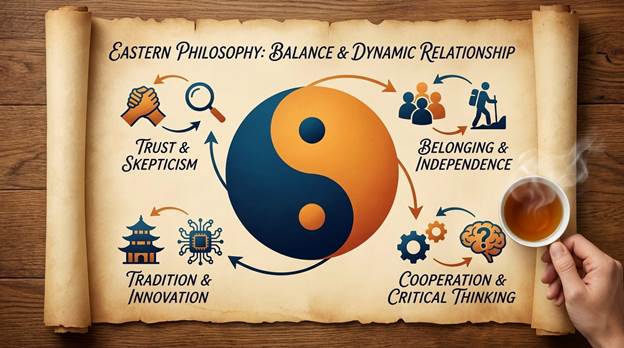
A Holistic Perspective
From a holistic perspective, groupthink represents an imbalance between belonging and awareness. Human beings need connection. We need community, relationships, and shared purpose. However, we also need independent thought, self-reflection, and personal responsibility.
Eastern philosophy has long emphasized the importance of balance. The Taoist concept of yin and yang reminds us that seemingly opposing forces often exist in dynamic relationship with one another. Trust and skepticism. Belonging and independence. Tradition and innovation. Cooperation and critical thinking. Problems often arise when one side overwhelms the other.
Excessive individualism can lead to isolation. Excessive conformity can lead to collective blindness. Wisdom lies in finding the appropriate balance.
The Importance of Discernment
One of the recurring themes throughout my own studies and writings is understanding “when to do and when not to do.” The same principle applies here. There is a time to trust and a time to verify. There is a time to follow and a time to question. There is a time to support a group and a time to stand apart from it.
Healthy skepticism is not cynicism. Critical thinking is not disloyalty. Asking questions is not disrespect. In fact, these qualities are often essential to preserving truth and integrity. The healthiest organizations are not those that eliminate disagreement. They are those that can tolerate disagreement without fear, punishment, or retaliation.
Open communication is not merely the freedom to speak. It is the freedom to question. It is the freedom to challenge assumptions. It is the freedom to respectfully disagree. Without these qualities, communication may appear open while remaining fundamentally closed.
In summary, perhaps the greatest danger of groupthink is not that people stop thinking altogether. Rather, it is that they begin to mistake consensus for truth. When enough people repeat the same story long enough, it can begin to feel more real than reality itself. History repeatedly demonstrates that intelligent, educated, and sincere individuals can become caught in collective distortions of perception. None of us are immune.
This realization should not make us cynical. It should make us humble. The Warrior cultivates the courage to question. The Scholar cultivates the knowledge to investigate. The Sage cultivates the wisdom to recognize that even their own perceptions may occasionally be incomplete.
Ironically, one of the strongest protections against collective hallucination is the willingness to acknowledge the possibility of personal hallucination. The pursuit of truth begins not with certainty, but with humility.

References
Cialdini, R. B. (2021). Influence: The psychology of persuasion (Rev. ed.). Harper Business.
Festinger, L. (1957). A theory of cognitive dissonance. Stanford University Press. https://archive.org/details/theoryofcognitiv0000fest/page/n5/mode/2up
Janis, I. L. (1972). Victims of groupthink: A psychological study of foreign-policy decisions and fiascoes. Houghton Mifflin. https://archive.org/details/victimsofgroupth0000jani
Kahneman, D. (2011). Thinking, fast and slow. Farrar, Straus and Giroux.
Myers, D. G., & Twenge, J. M. (2024). Social psychology (14th ed.). McGraw-Hill Education.
Tajfel, H., & Turner, J. C. (1986). The social identity theory of intergroup behavior. In S. Worchel & W. G. Austin (Eds.), Psychology of intergroup relations (pp. 7–24). Nelson-Hall.