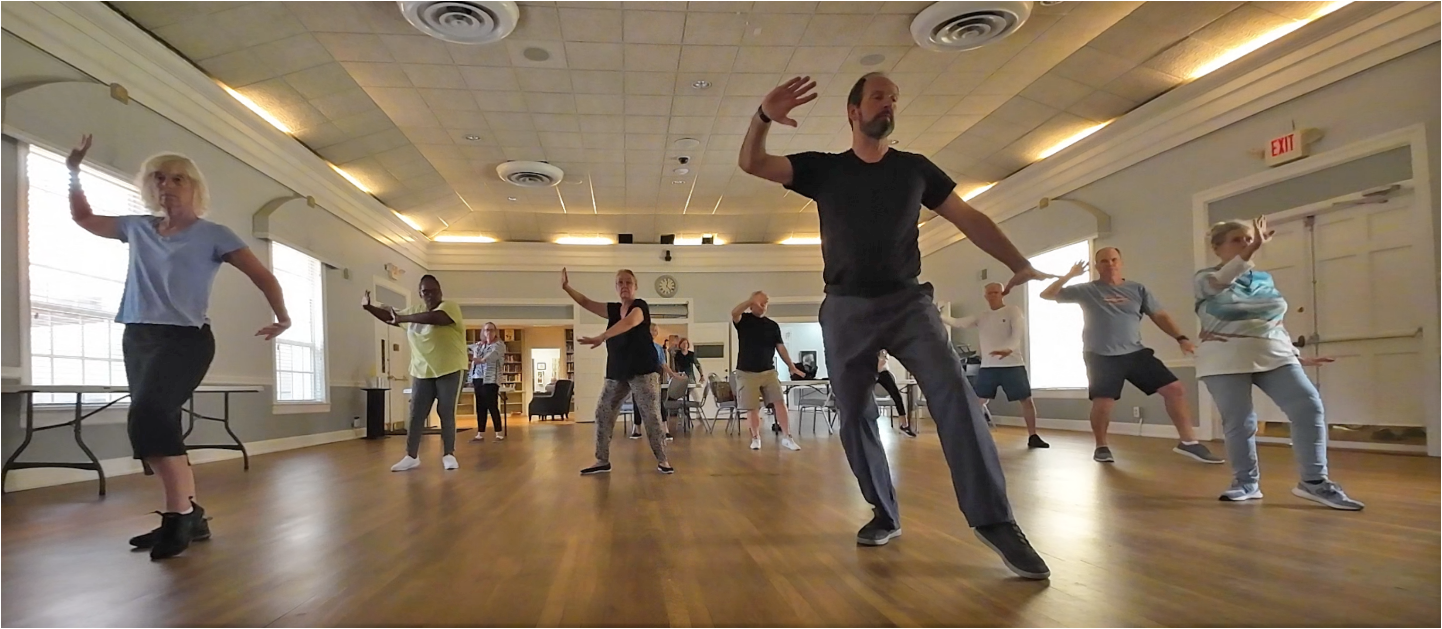
Many people are introduced to Tai Chi Chuan through its slow, flowing movements. They learn a sequence of postures, practice them repeatedly, and often experience improvements in balance, flexibility, coordination, relaxation, and overall well-being. While these benefits are certainly valuable, traditional Tai Chi was never intended to be merely a series of physical exercises.
Authentic Tai Chi Chuan is built upon a foundation of principles. The movements themselves are only the visible expression of deeper concepts involving posture, biomechanics, breathing, awareness, intention, and self-cultivation. In my experience, many practitioners spend years learning forms yet receive little instruction regarding the principles that govern them. They learn the choreography but not necessarily the reasons behind it.
One of the most influential sets of teachings comes from Yang Chengfu (1883–1936), whose Ten Essentials of Tai Chi Chuan have guided generations of practitioners and teachers (Yang, 1982). Although these principles were originally developed within the context of martial arts, they also serve as a blueprint for physical health, mental discipline, energetic development, and personal growth.
The form is the vehicle. The Ten Essentials are the operating principles that make the vehicle function.
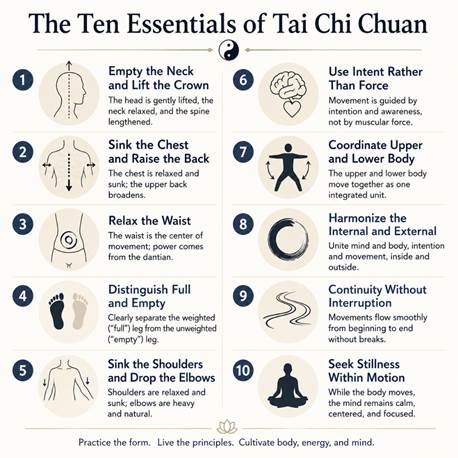
The Ten Essentials of Tai Chi Chuan
1. Empty the Neck and Lift the Crown
(Xu Ling Ding Jin)
The head should feel as though it is gently suspended from above while the neck remains relaxed. The chin is slightly tucked, and the spine lengthens naturally.
This principle promotes proper postural alignment and allows the body to move efficiently. From a holistic perspective, it encourages alertness without tension and awareness without rigidity. Rather than collapsing downward or straining upward, the practitioner seeks a balanced middle ground.
2. Sink the Chest and Raise the Back
(Han Xiong Ba Bei)
Many people habitually puff out the chest or hold tension in the upper body. Tai Chi teaches the opposite.
The chest remains relaxed while the upper back broadens slightly. This encourages more natural breathing, reduces unnecessary muscular tension, and creates a more connected body structure. The goal is not slouching but rather allowing the torso to become relaxed and integrated.
3. Relax the Waist
(Song Yao)
Traditional Tai Chi refers to the waist as the commander of movement.
The waist and hips act as the central axis from which movement originates. When the waist is relaxed and mobile, power can be transmitted efficiently from the feet through the legs and torso into the arms and hands (kinetic linking).
Many beginners attempt to move with their shoulders and arms. Advanced practitioners learn to move from the center.
4. Distinguish Full and Empty
(Fen Xu Shi)
One of the most important principles in Tai Chi is clearly distinguishing between the weighted leg (full) and the unweighted leg (empty).
This constant shifting develops balance, stability, agility, and awareness. Philosophically, it reflects the dynamic relationship between yin and yang. Fullness cannot exist without emptiness. Stability cannot exist without mobility.
5. Sink the Shoulders and Drop the Elbows
(Chen Jian Zhui Zhou)
Tension in the shoulders and arms is one of the most common obstacles to efficient movement.
The shoulders should remain relaxed and the elbows naturally heavy. This allows force to travel through the body without interruption and prevents excessive muscular effort.
In practical terms, relaxation often produces greater efficiency than brute strength.
6. Use Intent Rather Than Force
(Yong Yi Bu Yong Li)
Perhaps no Tai Chi principle is more misunderstood.
Using intention rather than force does not mean abandoning strength. Rather, it means that movement is guided by awareness, focus, and purpose instead of excessive muscular tension (Wile, 1983).
In traditional Chinese thought, intention (yi) directs energy and action. Modern neuroscience similarly recognizes the importance of attention and motor planning in efficient movement. Where the mind goes, the body tends to follow.
7. Coordinate the Upper and Lower Body
(Shang Xia Xiang Sui)
The body should move as a unified whole.
The hands, feet, torso, and hips do not operate independently. Instead, all parts work together in a coordinated manner. “When one parts moves, all parts move.”
Modern movement specialists often describe this concept as kinetic-chain integration. Tai Chi practitioners have been cultivating this principle for centuries.
8. Harmonize the Internal and External
(Nei Wai Xiang He)
The internal aspects of practice in awareness, intention, breathing, and emotional state, must be integrated with external movement.
Many people separate physical exercise from mental development. Tai Chi seeks to unify them.
This principle transforms exercise into moving meditation and turns movement into a form of self-observation.
9. Continuity Without Interruption
(Xiang Lian Bu Duan)
Tai Chi movements should flow like a river.
One posture leads naturally into the next without abrupt starts, stops, or breaks in attention. This continuity develops coordination, concentration, and mental presence.
Life itself is a continuous process of adaptation. Tai Chi teaches us to move with change rather than resist it.
10. Seek Stillness Within Motion
(Dong Zhong Qiu Jing)
The final essential may be the most profound.
Although the body is moving, the mind remains calm and centered. Rather than becoming agitated by activity, the practitioner cultivates inner stillness amid external motion.
This principle extends far beyond the practice hall. It becomes a way of approaching work, relationships, adversity, and daily life.
More Than Physical Exercise
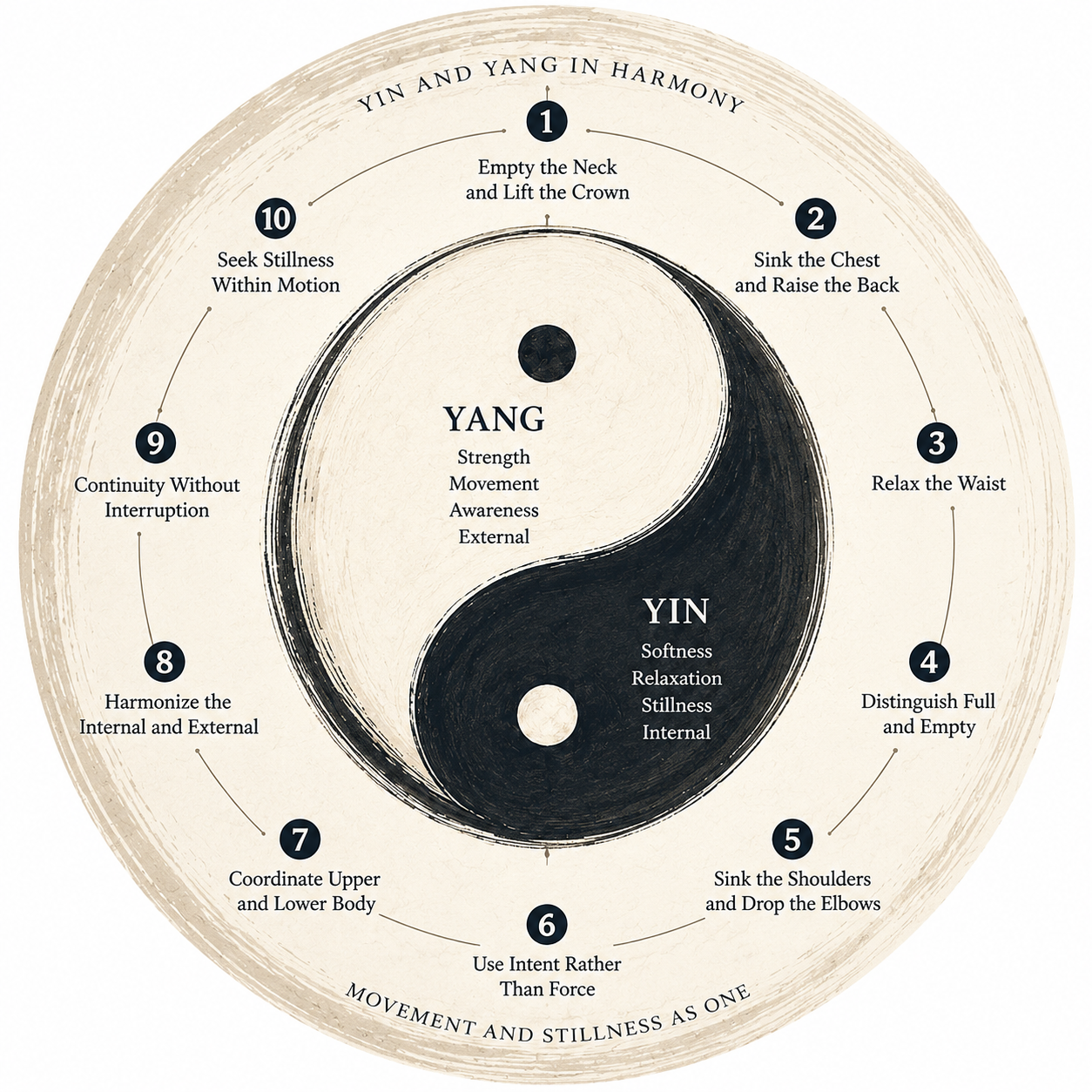
Viewed collectively, the Ten Essentials reveal that Tai Chi is much more than a fitness activity. At the physical level, these principles improve posture, balance, coordination, flexibility, mobility, and body awareness. At the mental level, they cultivate concentration, focus, patience, and emotional regulation. At the energetic level, traditional Chinese medicine associates these principles with improving the smooth circulation of qi and harmonizing bodily functions (Maciocia, 2015). At the philosophical level, they provide a practical means of experiencing the principles of yin and yang. Full and empty, movement and stillness, strength and softness, effort and relaxation all exist as complementary opposites rather than contradictions.
The Warrior, Scholar, and Sage Perspective
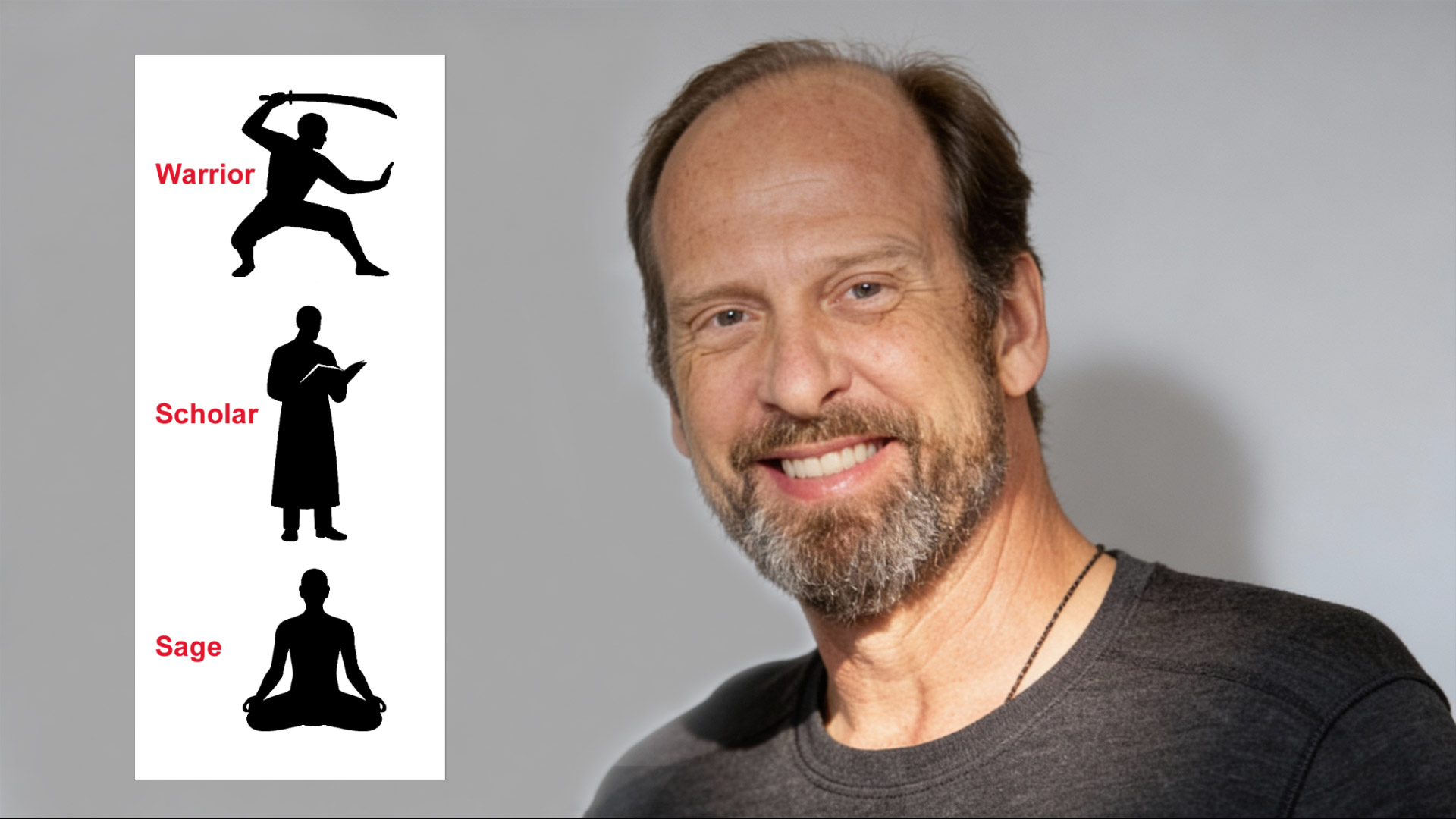
Over the years, I have come to view the Ten Essentials through the lens of the Warrior, Scholar, and Sage.
The Warrior develops structure, discipline, balance, rooting, and physical competence. They learn where to place their feet, how to align the body, and how to move efficiently.
The Scholar studies the underlying principles. They seek to understand biomechanics, breathing, awareness, philosophy, and the interconnected nature of the human body and mind. They learn not only what to do, but why it works.
The Sage recognizes that Tai Chi is ultimately a vehicle for self-cultivation. The movements become less important than the qualities they develop. Patience, awareness, humility, adaptability, resilience, and wisdom gradually emerge through consistent practice.
In many ways, the Ten Essentials represent a progressive journey. The first principles establish proper structure. The middle principles cultivate integration and awareness. The final principles point toward refinement of consciousness itself.
The Real Purpose of the Form
One of the greatest misconceptions surrounding Tai Chi is that the form itself is the goal. The form is not the goal. The form is the laboratory. It provides an environment in which we can observe ourselves, refine our posture, regulate our breathing, improve our movement patterns, quiet the mind, and cultivate greater awareness. Without the principles, the form is little more than choreography. With the principles, the form becomes a method of transformation.
The longer I practice, the less interested I become in how impressive a form appears from the outside. What matters more is what the practice produces on the inside. Authentic Tai Chi Chuan is not measured solely by graceful movements or memorized sequences. It is measured by the gradual refinement of body, mind, and spirit.
The Ten Essentials provide a roadmap for that lifelong journey.
References
Maciocia, G. (2015). The foundations of Chinese medicine: A comprehensive text for acupuncturists and herbalists (3rd ed.). Elsevier.
Wile, D. (1983). Tai Chi touchstones: Yang family secret transmissions. Sweet Ch’i Press.
Yang, C. F. (1982). Essence and applications of Taijiquan. North Atlantic Books.