
We often hear that Tai Chi is good for balance, relaxation, and overall health. But the deeper question is this:
Why does it work so well?
In The Harvard Medical School Guide to Tai Chi, Peter M. Wayne introduces the concept of the “8 active ingredients” of Tai Chi. His research-based perspective frames Tai Chi not as a single exercise, but as a multi-system method that integrates body, mind, and breath into a unified practice (Wayne & Fuerst, 2013; Wayne, 2014).
From my perspective, after more than four decades of training, teaching, and living these methods, these “ingredients” map clearly into a timeless framework:
Train like a Warrior
Study like a Scholar
Live like a Sage
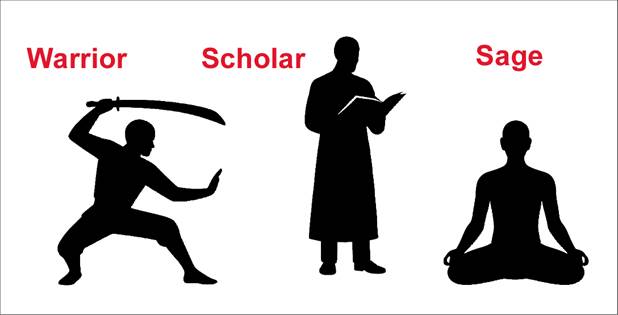
This triad provides a practical and philosophical lens to understand how Tai Chi truly develops the human being.
Tai Chi as a Complete System
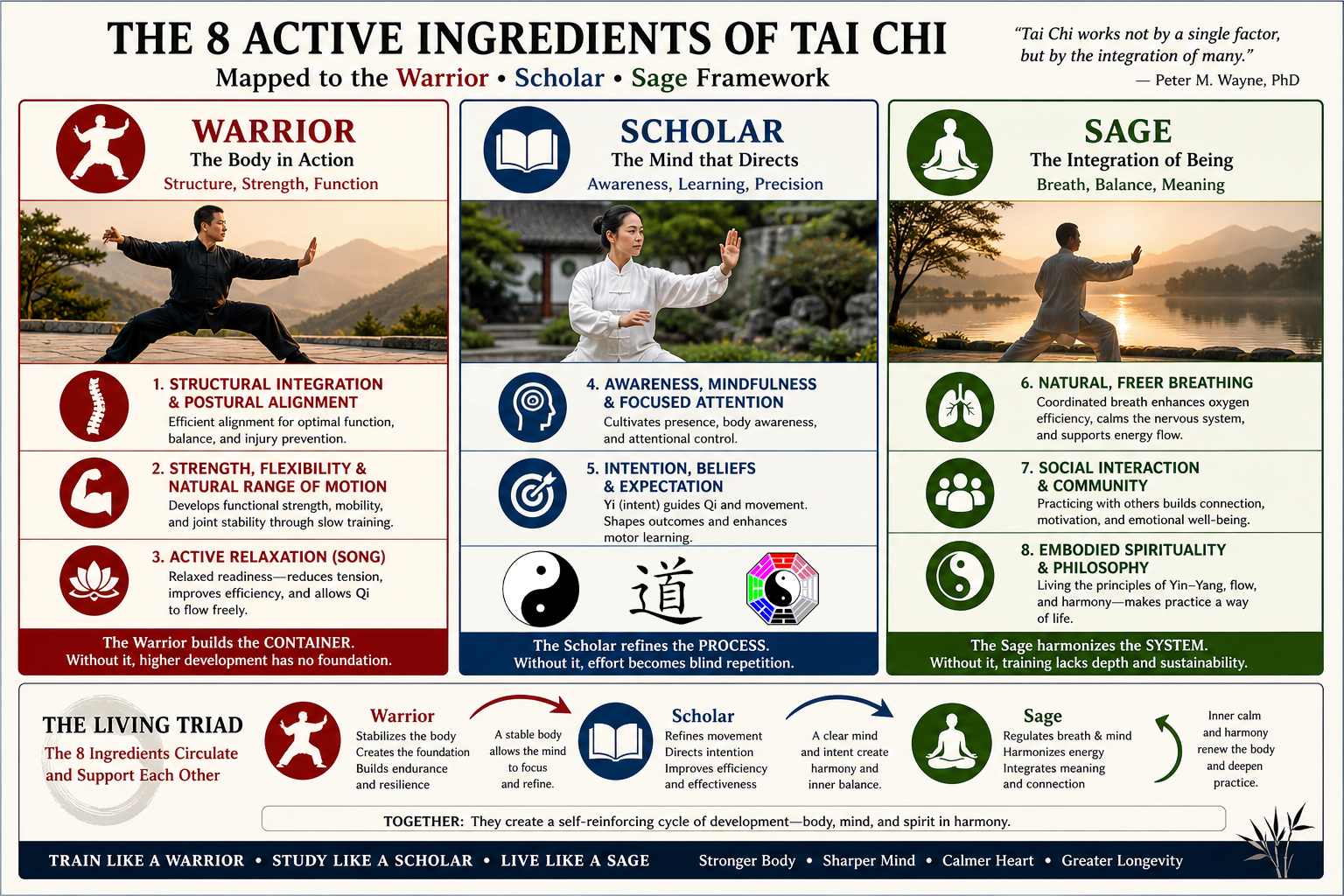
Wayne’s eight ingredients include:
- Awareness and mindfulness
- Intention and expectation
- Structural alignment
- Active relaxation (song)
- Strength and flexibility
- Breathing
- Social interaction
- Philosophy and meaning
Individually, each has value. But together, they create something far more powerful:
A self-reinforcing system of physical conditioning, mental refinement, and internal regulation (Wayne & Fuerst, 2013).
Research on Tai Chi consistently shows improvements across multiple systems, including musculoskeletal strength, balance, cardiovascular health, and psychological well-being, supporting its role as a multicomponent intervention rather than a single-modality exercise (Wang et al., 2010; Wayne et al., 2014).
The Warrior: Building the Body
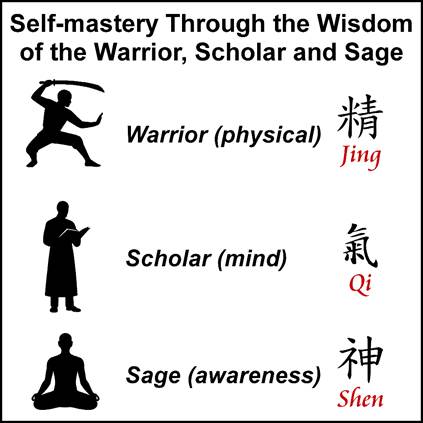
The Warrior represents the physical foundation of practice.
This includes:
- Structural alignment and posture (somatic re-calibration)
- Functional strength and mobility
- Active relaxation under load
Through stance training, controlled movement, and progressive endurance, the body becomes:
- Stable
- Rooted
- Reliable under stress
This is not bodybuilding. It is functional integrity.
Modern research supports Tai Chi’s ability to improve balance, lower extremity strength, and reduce fall risk, particularly in aging populations (Li et al., 2005; Wayne et al., 2014).
In Traditional Chinese terms, this develops the body’s Jing, the physical essence that supports all higher functions.
Without the Warrior, there is no foundation.
_____
The Scholar: Refining the Mind
The Scholar represents awareness, learning, and intention.
This includes:
- Mindfulness and focused attention
- The use of intention (Yi) to guide movement
- Continuous self-correction and refinement (iterative cultivation)
This is where practice shifts from repetition to intelligent training.
You begin to notice:
- Where tension exists
- Where alignment breaks down
- Where effort is wasted
The mind becomes an active participant, not a passive observer.
Research in neuroscience shows that mindful movement practices like Tai Chi enhance attention, cognitive function, and neuroplasticity, while also reducing stress-related reactivity (Larkey et al., 2009; Wayne et al., 2014).
This aligns with the cultivation of Qi, the functional energy that animates movement and coordination.
Without the Scholar, effort becomes blind repetition.
_____
The Sage: Integrating the System
The Sage represents balance, breath, and meaning.
This includes:
- Natural, coordinated breathing
- Nervous system regulation
- Philosophical understanding (yin and yang, flow, harmony)
- Connection with others through shared practice
- All of the above = transmutation
At this level, Tai Chi becomes more than exercise. It becomes:
- Restorative
- Meditative
- Sustainable for a lifetime
Breathing practices associated with Tai Chi have been shown to enhance parasympathetic activity, improve heart rate variability, and support emotional regulation (Brown & Gerbarg, 2005; Wayne et al., 2014).
Social engagement and group-based movement practices also contribute to improved adherence and psychological well-being (Wayne & Fuerst, 2013).
This is the cultivation of Shen, the spirit or integrated awareness.
Without the Sage, training lacks depth and sustainability.
_____
The Living Triad: How It All Works Together
These are not separate stages. They are interdependent processes.
- The Warrior stabilizes the body
- The Scholar refines the method
- The Sage harmonizes the system
And in return:
- A calm mind improves movement
- Better movement improves structure
- Strong structure supports deeper relaxation
This creates a continuous loop of development:
Body → Mind → Breath → Awareness → Back to Body
This systems-based interaction is precisely why Tai Chi produces broad, cross-domain health benefits, influencing physical, cognitive, and emotional systems simultaneously (Wayne et al., 2014; Wang et al., 2010).
A Practical Takeaway
If you are practicing—or teaching—Tai Chi, consider this simple framework:
- Train like a Warrior
Build strength, structure, and endurance - Study like a Scholar
Refine awareness, intention, and precision - Live like a Sage
Breathe, balance, and harmonize
When all three are present, practice becomes complete.
Modern science is beginning to validate what traditional systems have long understood:
True development is not isolated. It is integrated.The body, mind, and spirit are not separate systems to be trained independently, but aspects of a single, living process.
Tai Chi, when practiced correctly, is one of the clearest expressions of this truth (Wayne & Fuerst, 2013; Wayne et al., 2014).
References
Brown, R. P., & Gerbarg, P. L. (2005). Sudarshan Kriya yogic breathing in the treatment of stress, anxiety, and depression: Part I—Neurophysiologic model. Journal of Alternative and Complementary Medicine, 11(1), 189–201. https://doi.org/10.1089/acm.2005.11.189
Larkey, L., Jahnke, R., Etnier, J., & Gonzalez, J. (2009). Meditative movement as a category of exercise: Implications for research. Journal of Physical Activity and Health, 6(2), 230–238. https://doi.org/10.1123/jpah.6.2.230
Li, F., Harmer, P., Fisher, K. J., & McAuley, E. (2005). Tai Chi and fall reductions in older adults: A randomized controlled trial. Journals of Gerontology Series A: Biological Sciences and Medical Sciences, 60(2), 187–194. https://doi.org/10.1093/gerona/60.2.187
Wang, C., Collet, J. P., & Lau, J. (2004). The effect of Tai chi on health outcomes in patients with chronic conditions. Archives of Internal Medicine, 164(5), 493. https://doi.org/10.1001/archinte.164.5.493
Wayne, P. M., Berkowitz, D. L., Litrownik, D. E., Buring, J. E., & Yeh, G. Y. (2014). What do we really know about the safety of tai chi?: A systematic review of adverse event reports in randomized trials. Archives of Physical Medicine and Rehabilitation, 95(12), 2470–2483. https://doi.org/10.1016/j.apmr.2014.05.005
Wayne, P. & Mark Fuerst. (2012). The Harvard Medical School Guide to Tai Chi: 12 weeks to a healthy body, strong heart, and Sharp mind [Health]. In The Harvard Medical School Guide to Tai Chi (12 Weeks). Harvard Health Publications. https://honhuhai.wordpress.com/wp-content/uploads/2016/08/tai-chi-the_harvard_m.pdf
Wayne, P. M. (2014). The active ingredients of Tai Chi. Harvard Health Publishing.

