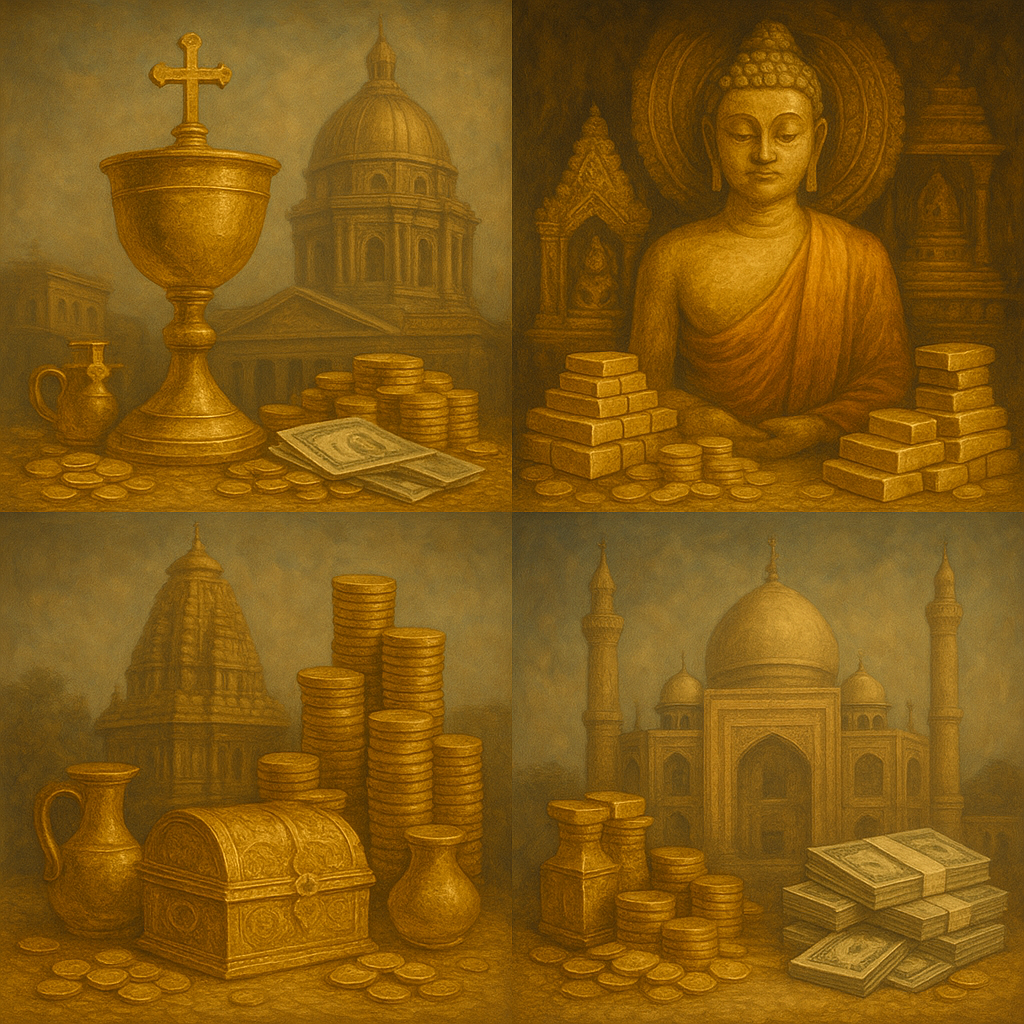
Across time and cultures, the greatest spiritual teachers have emphasized simplicity, humility, and inner transformation. Yet, paradoxically, the institutions that grow around these teachings often accumulate material wealth, political power, and ego-driven prestige.
Christianity, Buddhism, Hinduism, Islam, all at their core, advocate for the shedding of worldly attachments. Yet many of their largest institutions exhibit the very materialism and hierarchy their founders warned against. In light of today’s cultural unrest, consumerism, and spiritual seeking, these contradictions deserve closer reflection.
A Humble Beginning
Jesus of Nazareth lived with radical humility. His birth in a manger (Luke 2:7, New International Version [NIV]), his itinerant lifestyle (“the Son of Man has no place to lay his head,” Luke 9:58, NIV), and his repeated critiques of religious legalism (Matthew 23:1–28, NIV) demonstrate a clear rejection of material power and ritualized pretense.
He warned against storing up treasures on earth, urging people instead to seek spiritual treasures (Matthew 6:19–21, NIV). His message was direct: inner transformation and compassion mattered more than public ritual or personal gain.
And yet, centuries later, the Roman Catholic Church emerged from the very empire that crucified him, to became one of the wealthiest and most ritualized institutions in human history (MacCulloch, 2011).
A Universal Paradox
This irony is not exclusive to Christianity. It is a universal pattern across major belief systems:
- Buddhism: Siddhartha Gautama, the Buddha, renounced his royal status to seek enlightenment through simplicity and meditation. His core teaching of the elimination of craving and attachment became institutionalized into monasteries and sects, some of which, over centuries, accumulated wealth, political influence, and hierarchical authority (Lopez, 2001).
- Hinduism: Early Vedic teachings stressed detachment from material life through paths like Jnana (knowledge) and Bhakti (devotion). Yet, sprawling temple complexes, priestly hierarchies, and caste structures often mirrored societal materialism and status-seeking (Flood, 1996).
- Islam: The Prophet Muhammad lived simply, called for humility, and emphasized equality among believers. Yet throughout history, caliphates and modern regimes alike have at times entangled faith with vast political and material ambitions (Esposito, 1998).
Again and again, humanity seems to be drawn to codify spiritual simplicity into worldly complexity.
Why Does This Happen?
From a psychological and sociological standpoint, this paradox might stem from natural human tendencies:
- Desire for Security: Spiritual communities often accumulate resources to protect their teachings and communities from external threats.
- Institutionalization: Movements grow into organizations, and organizations seek stability, leading to bureaucracy and hierarchy.
- Human Ego: Even with the best intentions, individuals and groups may seek recognition, authority, and influence, contradicting the original teachings.
As the Tao Te Ching observes, “The higher the structure, the farther from the Way” (Laozi, trans. Mitchell, 1988).
Cultural Relevance Today
Today’s society, riddled with consumerism, curated self-images, and institutional distrust, mirrors these spiritual paradoxes. Many seekers are disillusioned with religious structures not because they reject faith, but because they crave authenticity.
Holistic health practitioners recognize that wellness is found in true balance of mind, body, and spirit, and requires stripping away external noise and realigning with essential truths. It’s not in grandeur but in simplicity that healing often occurs.
The example of figures like Jesus, Buddha, and Muhammad calls us back not to ritualized identity, but to the living essence of humility, compassion, and conscious living.
A Personal Reflection
This reflection isn’t a condemnation of all spiritual institutions. Rather, it is a call to vigilance:
- Are we aligning with the heart of spiritual wisdom or merely its outer forms?
- Are we living simply, authentically, and compassionately, or becoming entangled in ego, status, and recognition?
As individuals seeking holistic well-being, we are invited to live in the spirit rather than merely follow the form.
Spiritual maturity requires discernment and choosing the inward journey over external display, whether in religion, health, or daily life.
References
Esposito, J. L. (1998). Islam: The straight path (3rd ed.). Oxford University Press.
Flood, G. (1996). An introduction to Hinduism. Cambridge University Press.
Lopez, D. S., Jr. (2001). THE STORY OF BUDDHISM. HarperSanFrancisco. http://www.chanreads.org/wp-content/uploads/2022/09/The-Story-of-Buddhism-A-Concise-Guide-to-Its-History-Teachings-Donald-S.-Lopez-Jr.-chanreads.org_.pdf
MacCulloch, D. (2011). Christianity: The first three thousand years. Penguin Books.
Mitchell, S. (Trans.). (1988). Tao Te Ching (Lao Tzu). Harper & Row.
The Holy Bible, New International Version. (2011). Biblica, Inc. (Original work published 1978)