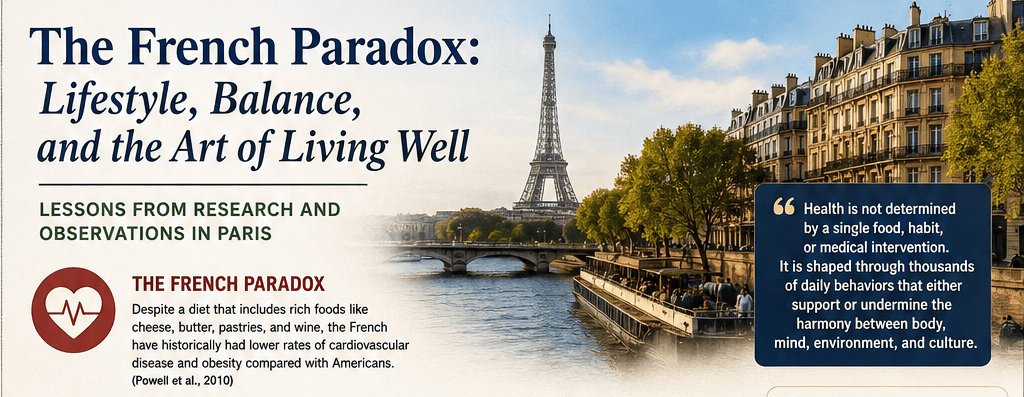
For decades, many Americans have heard about the so-called “French Paradox.” The basic observation is simple: despite consuming foods traditionally viewed as rich in fats, such as cheese, butter, and wine, the French have historically demonstrated lower rates of cardiovascular disease and obesity than Americans (Powell et al., 2010). Yet perhaps the real paradox is not found in French food itself, but in the broader cultural relationship with food, movement, stress, and daily living.
From a holistic health perspective, this discussion reveals an important truth: health is rarely the result of a single nutrient, supplement, pharmaceutical intervention, or isolated behavior. Instead, long-term wellbeing emerges from the interaction of lifestyle, environment, mindset, movement, social behavior, stress regulation, genetics, access to healthcare, and thousands of daily habits.
The modern American mindset often seeks isolated solutions to complex health problems. One week fat is considered the enemy. The next week carbohydrates become the villain. Coffee is good, but only in moderation, and now some experts suggest that as many as five cups per day may provide certain health benefits for some people (Castro, 2026). Then sugar, gluten, seed oils, cholesterol, or red meat takes center stage.
Yet the body does not function in isolated compartments. Human physiology reflects an interconnected system of behaviors, emotions, habits, environmental influences, and biological responses. The French Paradox highlights this reality.
Researchers examining lifestyle differences between France and the United States have noted several behavioral patterns among the French population. Compared with Americans, French citizens have traditionally walked more frequently, consumed more water, eaten more fresh fruits and vegetables, consumed fewer sweetened beverages, and engaged in more mindful eating behaviors (Powell et al., 2010). Meals were often smaller, slower, and more socially integrated rather than rushed and distracted. This distinction is significant.
Seeing the French Paradox Firsthand
During my recent visit to France, particularly while spending time in Paris, I was able to observe many of the lifestyle factors commonly used to explain the French Paradox. These were no longer simply ideas presented in a study, travel program, or cultural comparison. I could see many of them firsthand.
People walked almost everywhere. They walked through neighborhoods, along the Seine, between shops, to cafés, to Metro stations, and through long corridors connecting public transportation systems. They routinely climbed stairs, carried groceries, stood while waiting for trains, and incorporated physical activity into the normal activities of daily life.
I also noticed what appeared to be fewer overweight individuals and considerably fewer people with morbid obesity than I commonly observe in many parts of the United States. This was only my personal observation and not a controlled scientific assessment. Nevertheless, people across a range of ages seemed, on average, leaner, more mobile, and more physically functional.
Older adults were frequently walking through the city, using public transportation, shopping, and navigating stairs without the same degree of visible physical limitation that I often see elsewhere. Many people appeared to maintain a level of practical fitness, not necessarily because they attended gyms or followed highly structured exercise programs, but because movement remained integrated into the architecture and rhythm of everyday life.
The environment itself encouraged activity. Compact neighborhoods, public transportation, smaller shops, pedestrian areas, and limited dependence on automobiles made walking a necessity rather than merely an optional form of exercise. It became increasingly clear to me that the design of a community can either support health or quietly discourage it.
The eating culture also appeared different. People often sat at cafés and restaurants rather than eating hurriedly in their cars. Meals appeared to be social occasions and opportunities for conversation. Portions often seemed more moderate, and there appeared to be greater emphasis on the experience and quality of food rather than simply consuming as much as possible, as quickly as possible.
These observations seemed to support many of the lifestyle explanations commonly associated with the French Paradox. However, another highly visible behavior complicated the picture. Smoking tobacco and vaping appeared to be widespread among people of many ages and demographics. I saw young adults, middle-aged individuals, older adults, men, and women smoking cigarettes or using vaping devices outside cafés, on sidewalks, near public buildings, and while socializing. The irony was difficult to overlook.
On one hand, many people appeared leaner, more active, and more physically capable. On the other hand, tobacco and nicotine use were openly integrated into everyday life. This serves as an important reminder that appearing thin or fit does not automatically mean that someone is healthy. Body size is only one outward indicator, and it cannot reveal lung function, vascular damage, blood pressure, cholesterol, cancer risk, emotional wellbeing, or the cumulative effects of nicotine exposure.
A culture may perform well in one dimension of health while struggling in another. The French may benefit from greater daily movement, smaller portions, and stronger social rituals surrounding food, while simultaneously carrying substantial health risks related to smoking, alcohol consumption, hypertension, and other cardiovascular factors.
This is precisely why holistic health requires a broader view.
The American Contrast
In the United States, eating often occurs while driving, working, watching television, scrolling through social media, or functioning under psychological stress. Meals are frequently consumed rapidly and in excessive portions.
Ultra-processed foods dominate much of the modern dietary landscape, contributing to excessive intake of sodium, refined sugars, additives, preservatives, and industrially formulated fats. Many of these products are specifically engineered for convenience and hyper-palatability rather than nourishment, making it easier to consume large quantities before the body’s natural satiety signals have time to respond (Monteiro et al., 2019).
Holistically speaking, this creates more than a nutritional problem. It also creates metabolic, behavioral, emotional, and nervous system problems.
The human organism does not function optimally while chronically stressed, overstimulated, sleep deprived, sedentary, emotionally dysregulated, and disconnected from natural rhythms. Traditional Eastern systems such as Traditional Chinese Medicine and Ayurveda have long emphasized that digestion is influenced by emotional balance, stress, circulation, breathing, rest, and lifestyle behaviors.
Modern research increasingly examines similar relationships through the study of inflammation, autonomic nervous system regulation, metabolic syndrome, the microbiome, and the gut-brain axis (Mayer, 2016).
Interestingly, the traditional French approach to eating appears to support the parasympathetic, or “rest and digest,” side of the nervous system. Meals are often approached as experiences rather than fuel-loading events. Walking remains incorporated into daily life. Social connection around meals is common. Portion control may be supported through pacing and satiety awareness rather than calorie obsession.
This does not mean that French culture is perfect, nor does it mean that red wine is a magical health tonic. Researchers have cautioned against oversimplifying the paradox and attributing it to wine or any other single factor (Law & Wald, 1999).
Health outcomes are more likely to arise from multiple interacting lifestyle, cultural, medical, economic, and environmental variables.
Is the French Paradox Partly a Statistical Paradox?
Although the French Paradox remains an interesting and useful concept, it should not be accepted without critical examination. Some researchers have questioned whether France’s historically low reported coronary heart disease mortality reflects only superior health, or whether part of the difference may be related to the ways disease and death were diagnosed, classified, and reported.
One proposed source of bias is the under-certification of coronary heart disease on French death certificates. A death influenced by coronary disease might sometimes have been attributed to heart failure, an unspecified circulatory condition, sudden death, or another immediate complication rather than to the underlying coronary disease itself.
Law and Wald (1999) examined this possibility and concluded that differences in death certification could explain a meaningful portion of the apparent mortality difference between France and countries such as Britain, although they did not suggest that reporting differences explained the entire phenomenon.
Other researchers have reached a similar conclusion. Ferrières (2004) acknowledged that French physicians may have under-certified some coronary deaths. However, after researchers examined standardized data from the World Health Organization’s MONICA project, France still demonstrated comparatively low coronary attack and mortality rates. Therefore, underreporting appears to be a possible bias, but probably not a complete explanation for the French Paradox (Ferrières, 2003).
This distinction is important. It would be inaccurate to say that the French Paradox is entirely a statistical illusion. At the same time, it would also be unwise to assume that mortality figures from different countries are perfectly comparable.
Death certificates are completed by individual physicians, and the accuracy of the final classification depends on available medical information, diagnostic practices, terminology, coding systems, and the physician’s judgment. French research comparing electronic and paper death certification found that electronic certificates included more reported causes and were considerably less likely to contain imprecise information, demonstrating that even the method used to record a death can affect the quality of national statistics (Lefeuvre et al., 2013).
Therefore, the more accurate statement may be that France historically had lower recorded coronary mortality, but some portion of the difference could have resulted from how coronary deaths were documented and categorized.
Underdiagnosis Is Not the Same as Good Health
Mortality statistics present only one part of the picture. People may live for many years with hypertension, diabetes, high cholesterol, vascular disease, or early-stage coronary disease without knowing that they have these conditions.
Recent reporting from Santé publique France found that awareness of major metabolic risk factors remains surprisingly low. Among French adults affected by these conditions, approximately 23% of those with diabetes and as many as 45% of those with hypertension were unaware that they had the condition (Olié et al., 2025).
This means that health problems do not necessarily have to be intentionally concealed or deliberately unreported to remain absent from national surveys. Many people simply do not know that they have them.
A person may appear thin, walk daily, and function well while still having elevated blood pressure, high LDL cholesterol, insulin resistance, or developing atherosclerosis. Conversely, an overweight individual may be actively improving their diet, exercising, sleeping well, and receiving appropriate preventive care.
Visible body composition provides useful information, but it never tells the whole story.
Current data also show that cardiovascular disease remains the second-leading cause of death in France, while hypertension, obesity, diabetes, and elevated LDL cholesterol continue to represent substantial public health concerns. France is healthier than some countries according to certain measures, but it is not immune to the chronic diseases affecting other industrialized nations. (“Assessment of the Quality of Death Certificates in France: The Role of Electronic Certification,” 2013)
The World Health Organization also notes that France now has relatively complete and high-quality cause-of-death registration. This suggests that historical reporting bias should be considered without assuming that modern French health statistics are generally unreliable (“France,” n.d.).
The Limits of Population-Level Comparisons
Another weakness in many explanations of the French Paradox is that they rely on broad national averages. Researchers may compare average saturated-fat consumption, average wine consumption, and national coronary mortality, but these figures do not prove that the individuals eating the most saturated fat or drinking the most wine are the same individuals avoiding heart disease.
This is sometimes called an ecological limitation or ecological fallacy.
Population-level associations cannot establish individual cause and effect. They may also overlook differences in food quality, meal timing, total caloric intake, socioeconomic status, healthcare access, stress, genetics, physical activity, smoking, and the types of fats being consumed (Ferrières, 2004).
Even the phrase “the French diet” may be misleading. France contains different regions, socioeconomic groups, cultural traditions, occupational patterns, and levels of access to quality food and healthcare. A physically active Parisian who shops daily and walks to public transportation may live very differently from someone in a more car-dependent or economically disadvantaged area.
Similarly, there is no single American lifestyle. The habits of an active individual who eats whole foods and regularly engages with a supportive community should not be equated with those of someone who is isolated, sedentary, sleep deprived, and dependent on ultra-processed food.
National labels can help us identify broad patterns, but they can also hide important differences between individuals.
The Time-Lag Explanation
Law and Wald (1999) offered another challenge to simplistic interpretations of the French Paradox. They suggested that coronary mortality often reflects dietary patterns from decades earlier rather than only what a population is eating today.
A population may increase its intake of saturated fat, processed food, or total calories, but the full cardiovascular consequences may not become visible for many years. France’s historically lower coronary mortality may therefore have reflected earlier dietary and lifestyle conditions rather than complete protection from more recent habits.
This time-lag explanation reminds us that chronic disease develops gradually. Atherosclerosis, insulin resistance, loss of mobility, and metabolic dysfunction may progress quietly for years before producing obvious symptoms or a medical crisis.
The consequences of today’s collective habits may not be fully visible until years or even decades from now.
Learning Without Romanticizing
The purpose of examining the French Paradox should not be to romanticize France, condemn America, or suggest that one culture has solved the health equation.
Every culture contains both strengths and contradictions.
France may offer valuable lessons about walking, portion awareness, food quality, social meals, public transportation, and integrating movement into everyday life. At the same time, the prevalence of smoking and vaping that I witnessed firsthand demonstrates how a visibly active population can continue to normalize behaviors that undermine cardiovascular, respiratory, and long-term systemic health.
The United States has reduced cigarette smoking considerably over recent decades, yet it continues to struggle with obesity, sedentary living, chronic stress, sleep disruption, social isolation, and the widespread consumption of ultra-processed food.
One country’s strengths may expose another country’s weaknesses, but its weaknesses should also prevent us from treating it as an ideal.
A holistic perspective asks a better question: Which cultural patterns support human wellbeing, which patterns undermine it, and what can we thoughtfully learn from both?
The Body Responds to Patterns
Health cannot be fully outsourced to pharmaceuticals, wearable technology, supplements, or calorie-tracking applications while fundamental lifestyle dysfunction remains unaddressed.
One cannot chronically overeat ultra-processed foods, avoid movement, live under constant stress, sleep poorly, and expect long-term wellness simply by taking medications or vitamins. At the same time, one should not assume that walking frequently or maintaining a lower body weight will erase the harms associated with smoking, excessive alcohol consumption, poor sleep, or untreated hypertension.
The body responds to patterns. Walking daily, breathing deeply, social connections, preparing meals, eating slowly, time in nature, adequate sleep, emotional regulation, and stress management are all factors that determine wellness. Avoiding tobacco matters. Receiving appropriate preventive screening and medical care also matters.
Human beings evolved within rhythms of movement, sunlight, labor, recovery, and community, not endless stimulation, convenience foods, digital overload, and physical inactivity.
The French Paradox may therefore be less about French cuisine and more about the complex consequences of lifestyle patterns within modern industrial cultures. Some of these patterns may protect health, some may undermine it, and others may take decades to reveal their full effects.
The Warrior, Scholar, and Sage
From the perspective of the Warrior, Scholar, and Sage framework, true wellness requires balance among physical discipline, intellectual awareness, and emotional and spiritual regulation.
The Warrior cultivates movement, resilience, strength, and physical vitality.
The Scholar develops knowledge and discernment regarding nutrition, research, statistics, behavior, and culture. The Scholar also recognizes that an attractive theory should not be accepted uncritically simply because it confirms what we would like to believe.
The Sage practices moderation, mindfulness, gratitude, and intentional living. The Sage understands that no country, culture, diet, or healthcare system possesses all the answers.
Ultimately, holistic wellbeing is not built upon isolated hacks, miracle foods, romanticized lifestyles, or national stereotypes. It is cultivated through daily patterns that support harmony among the body, mind, behavior, environment, and community.
My recent visit to France allowed me to see many of the factors commonly associated with the French Paradox firsthand. I saw more daily walking, apparently lower levels of severe obesity, active older adults, smaller portions, social meals, and communities designed around human movement.
I also saw widespread smoking and vaping, reminding me that wellbeing cannot be determined solely by appearance, body weight, or one favorable set of statistics.
Perhaps the greatest lesson hidden within the French Paradox is not that the French have discovered a secret that allows them to consume rich foods without consequences. Perhaps it is that health is complex, statistics require interpretation, cultures contain contradictions, and wellbeing is not merely about what we eat.
It is about how we live.
References
Assessment of the quality of death certificates in France: The role of Electronic certification. (2013, March 5). Retrieved from https://www.santepubliquefrance.fr/en/docs/article/assessment-quality-death-certificates-france-role-electronic-certification?utm_source=chatgpt.com
Castro, A. (2026, July 20). Scientists reveal why up to 5 cups of coffee a day may benefit heart health. Newsweek.
Ferrières, J. (2004). The French paradox: Lessons for other countries. Heart, 90(1), 107–111. https://doi.org/10.1136/heart.90.1.107
France. (n.d.). Retrieved from https://data.who.int/countries/250
Law, M., & Wald, N. (1999). Why heart disease mortality is low in France: The time lag explanation. BMJ, 318(7196), 1471–1480. https://doi.org/10.1136/bmj.318.7196.1471
Lefeuvre, D., Pavillon, G., Aouba, A., Lamarche-Vadel, A., Fouillet, A., Jougla, E., & Rey, G. (2013). Assessment of the quality of death certificates in France: The role of electronic certification. Bulletin Épidémiologique Hebdomadaire, (7), 57–60.
Mayer, E. A. (2016). The mind-gut connection: How the hidden conversation within our bodies impacts our mood, our choices, and our overall health. Harper Wave.
Monteiro, C. A., Cannon, G., Levy, R. B., Moubarac, J. C., Louzada, M. L. C., Rauber, F., Khandpur, N., Cediel, G., Neri, D., Martinez-Steele, E., Baraldi, L. G., & Jaime, P. C. (2019). Ultra-processed foods: What they are and how to identify them. Public Health Nutrition, 22(5), 936–941. https://doi.org/10.1017/S1368980018003762
Olié, V., Gabet, A., Grave, C., Helft, G., Fosse-Edorh, S., Piffaretti, C., Lailler, G., Verdot, C., Deschamps, V., Vay-Demouy, J., Vidal-Petiot, E., Duly-Bouhanik, B., Tuppin, P., Ferrières, J., Halimi, J. M., & Blacher, J. (2025). Epidemiology of cardiovascular risk factors: Non-behavioral risk factors. Bulletin Épidémiologique Hebdomadaire, special issue, 102–116.
Powell, L. H., Kazlauskaite, R., Shima, C., & Appelhans, B. M. (2010). Lifestyle in France and the United States: An American perspective. Journal of the American Dietetic Association, 110(6), 845–847. https://doi.org/10.1016/j.jada.2010.03.029