
Dr. Andrew Huberman’s exploration of cortisol profoundly reframed its role: it is far more than a “stress hormone.” Cortisol functions as a daily energy distributor, mobilizing glucose, especially to the brain so individuals can wake up, focus, and function effectively.
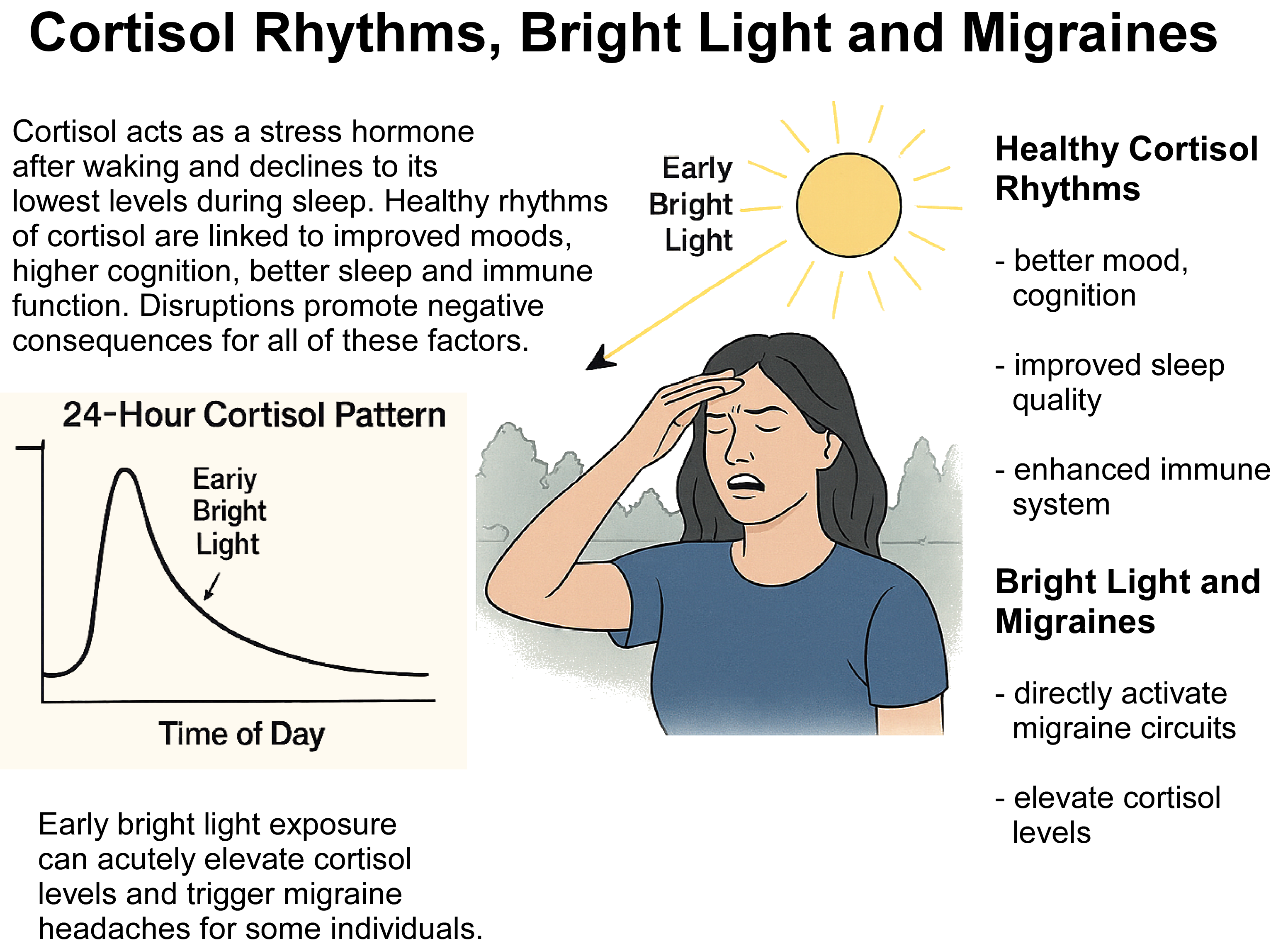
Cortisol exhibits a reliable 24-hour rhythm: following the cortisol awakening response (CAR), levels peak within 30–45 minutes of waking and subsequently decline to the lowest levels during early sleep (Fries, Dettenborn, & Kirschbaum, 2009; Rüger et al., 2006). When this rhythm remains intact, it supports resilience, mood, cognition, sleep, and immune function. Disruption via stress, poor habits, or inconsistent sleep can impair these domains (Franklyn-Miller, 2025).
Dr. Huberman describes how the HPA axis and the suprachiasmatic nucleus (SCN) collaborate to regulate cortisol. He advocates for morning light exposure (ideally natural sunlight) to boost early-day cortisol release and support circadian timing (Huberman Lab, 2025). Complementary strategies include hydration upon waking, delaying caffeine by an hour, exercising consistently, and supporting sustained energy through nutrition. Also, sometimes using agents like grapefruit or black licorice to modestly extend cortisol’s effects (with caution due to potential risks). Evening strategies include dimming lights, especially minimizing blue light, avoiding late caffeine, incorporating starchy carbohydrates at dinner, and using non-sleep deep rest (NSDR) or slow breathing to facilitate healthy cortisol decline.
Huberman also outlines burnout archetypes: those who wake wired but crash afternoon, and those sluggish in the morning but restless at night, each necessitating tailored protocols. He warns of cortisol’s long-term neurological impact: chronic mis-timed elevation can damage the hippocampus, a key structure for learning and memory, and aging or chronic illness often blunt the cortisol curve, increasing health risks and decreasing resilience (Franklyn-Miller, 2025; Huberman Lab, 2025).
Empirical Migraine Observations Connect with Cortisol and Light
Across four decades of journaling, I myself have observed that bright light exposure near the time of sunrise consistently triggered migraines. This pattern occurred regardless of hydration, caffeine, food, or sleep quality, which indicates a robust and reliable relationship between early-day light and migraine onset.
Scientific literature supports a dual pathway effect:
- Morning light influences the CAR – some studies show early-light exposure enhances CAR (Petrowski et al., 2019; Petrowski et al., 2022), while others reveal variability based on timing, intensity, and wavelength (Jung, 2010; Rahman et al., 2019; Leproult, Colecchia, L’Hermite-Baleriaux, & Van Cauter, 2001).
- Light directly triggers migraine via ipRGCs – melanopsin-containing intrinsically photosensitive retinal ganglion cells transmit light signals not only to the SCN but also to pain-processing regions (Noseda et al., 2010; McAdams et al., 2020). In migraineurs, these cells are hypersensitive to blue light; blocking their activity or using optical tints can reduce photophobia and pain (Posternack et al., 2023; Nagata et al., 2024). Experimental research confirms blue light triggers stronger pupillary and neurological responses than other wavelengths in migraine patients (Ali et al., 2021; Antemie et al., 2023).
____________
A Dual-Trigger Model
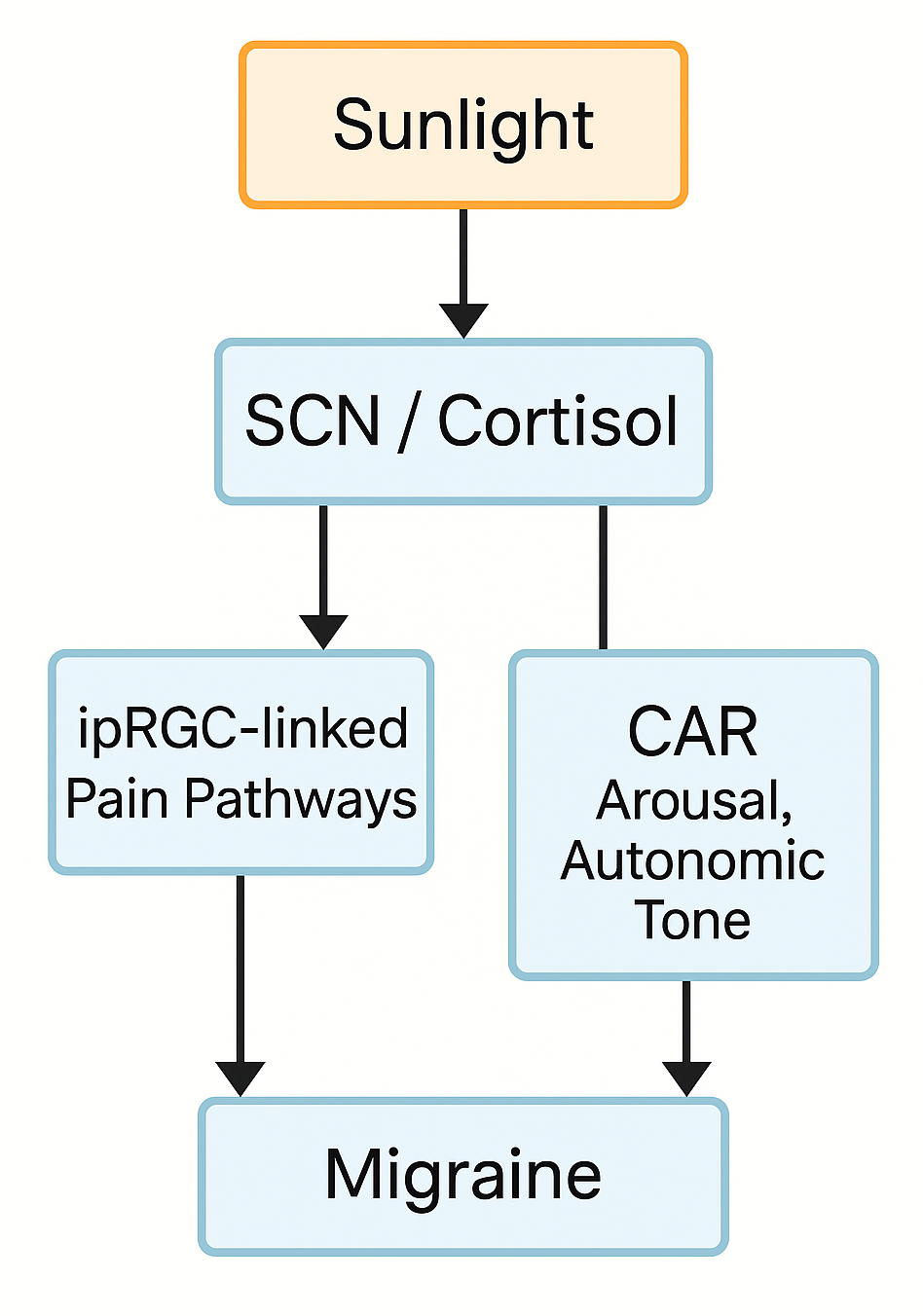
The data supports a dual-trigger model:
- Immediate photonic activation: Intense early light activates ipRGC-driven migraine pathways.
- Cortisol modulation: Simultaneously, light affects the CAR, either amplifying or suppressing cortisol, which may modulate susceptibility to migraine, increasing vulnerability in sensitized individuals.
This model explains why identical light exposures may be innocuous for many but debilitating for individuals with migraine sensitivity tied to cortisol and ipRGC pathways.
Evidence-Based Strategy for Prevention
Combining biological insights with lived experience suggests effective strategies:
- Minimize direct sunrise glare – via hats, dawn-dimming curtains, or adjustable blinds.
- Delay full bright-light exposure until later in the morning.
- Use green-enriched lighting during early hours, as green wavelengths are less likely to trigger migraine (BrainFacts, 2019; Antemie et al., 2023).
- Maintain consistent routines (hydration, caffeine timing, exercise) to stabilize cortisol rhythm.
- Consider optical tints targeting ipRGC stimuli as adjunct preventive tools (Posternack et al., 2023).
Conclusion
Cortisol is a pivotal entrainer of daily energy rhythms, yet bright light, though beneficial for circadian health, can serve as a migraine trigger. In individuals with long-established patterns, sunrise light carries dual potency: energizing via cortisol rhythms and activating pain pathways via ipRGCs. By recognizing and balancing these realities, and protecting against light-triggered migraines while preserving circadian rhythm integrity, individuals can optimize energy, cognition, and long-term health.
References:
Ali, E. N., et al. (2021). Assessing migraine patients with multifocal pupillographic perimetry: pupillary abnormalities following migraine attacks. BMC Neurology, 21, Article 239. https://doi.org/10.1186/s12883-021-02239-z
Antemie, R. G., et al. (2023). Blue light—ocular and systemic damaging effects. International Journal of Molecular Sciences, 24(6), 5998. https://doi.org/10.3390/ijms24065998
Fries, E., Dettenborn, L., & Kirschbaum, C. (2009). The cortisol awakening response (CAR): Facts and future directions. International Journal of Psychophysiology, 72(1), 67–73. https://doi.org/10.1016/j.ijpsycho.2008.03.014
Franklyn-Miller, A. (2025, July 20). Expert shares the surprising role cortisol plays in our sleep—and why it’s just as important as melatonin. Tom’s Guide. Retrieved from Tom’s Guide website. https://health.yahoo.com/wellness/sleep/articles/expert-shares-surprising-role-cortisol-053000626.html
Huberman Lab. (2025, March). Using light for health [Newsletter]. Huberman Lab. Retrieved from Huberman Lab website.
Jung, C. M., Khalsa, S. B. S., Scheer, F. a. J. L., Cajochen, C., Lockley, S. W., Czeisler, C. A., & Wright, K. P. (2010). Acute effects of bright light exposure on cortisol levels. Journal of Biological Rhythms, 25(3), 208–216. https://doi.org/10.1177/0748730410368413
Leproult, R., Colecchia, E. F., L’Hermite-Balériaux, M., & Van Cauter, E. (2001). Transition from Dim to Bright Light in the Morning Induces an Immediate Elevation of Cortisol Levels1. The Journal of Clinical Endocrinology & Metabolism, 86(1), 151–157. https://doi.org/10.1210/jcem.86.1.7102
McAdams, H., et al. (2020). Selective amplification of ipRGC signals accounts for paradoxical behavioral light aversion in migraine patients. Proceedings of the National Academy of Sciences, 117(38), 23276–23283. https://doi.org/10.1073/pnas.2007402117
Noseda, R., Kainz, V., Jakubowski, M., Gooley, J. J., Saper, C. B., Digre, K., & Burstein, R. (2010). A neural mechanism for exacerbation of headache by light. Nature Neuroscience, 13(2), 239–245. https://doi.org/10.1038/nn.2475
Nagata, E., et al. (2024). Hypersensitivity of intrinsically photosensitive retinal ganglion cells in migraine. International Journal of Molecular Sciences, 25(14), 7980. https://doi.org/10.3390/ijms25147980
Petrowski, K., Schmalbach, B., Linhardt, M., Mekschrat, L., & Rohleder, N. (2022). The inflammatory immune system after wake up in healthy male individuals: A highly standardized and controlled study. Brain Behavior & Immunity – Health, 25, 100504. https://doi.org/10.1016/j.bbih.2022.100504
Petrowski, K., Schmalbach, B., Niedling, M., & Stalder, T. (2019). The effects of post-awakening light exposure on the cortisol awakening response in healthy male individuals. Psychoneuroendocrinology, 108, 28–34. https://doi.org/10.1016/j.psyneuen.2019.05.016
Posternack, C., Kupchak, P., Capriolo, A. I., & Katz, B. J. (2023). Targeting the intrinsically photosensitive retinal ganglion cell to reduce headache pain and light sensitivity in migraine: A randomized double-blind trial. Journal of Clinical Neuroscience, 113, 22–31. https://doi.org/10.1016/j.jocn.2023.04.015
Rahman, S. A., Wright, K. P., Lockley, S. W., Czeisler, C. A., & Gronfier, C. (2019). Characterizing the temporal Dynamics of Melatonin and Cortisol Changes in Response to Nocturnal Light Exposure. Scientific Reports, 9(1). https://doi.org/10.1038/s41598-019-54806-7
Rüger, M., Gordijn, M. C. M., Beersma, D. G. M., de Vries, B., & Daan, S. (2006). Time-of-day-dependent effects of bright light exposure on human cortisol responses. American Journal of Physiology-Regulatory, Integrative and Comparative Physiology, 290(1), R141–R147. https://doi.org/10.1152/ajpregu.00121.2005


 United Martial Arts Association