

One lesson that has become increasingly clear to me over the years is that almost everything worth achieving, obtaining, or owning is ultimately temporary. Our health changes. Our wealth comes and goes. Our careers end. Our homes eventually belong to someone else. Even our accomplishments and reputations gradually fade with time. Ultimately, every one of us is merely borrowing time on this earth.
At first glance, this realization might appear discouraging. If everything is temporary, then why strive for anything at all?
I have come to the opposite conclusion.
It is precisely because life is temporary that our choices matter. Our limited time gives value to the decisions we make, the relationships we cultivate, the knowledge we pursue, and the efforts we invest. The temporary nature of life does not diminish its meaning. Rather, it enhances it.

This understanding has been expressed in many philosophical and spiritual traditions. Buddhism teaches the principle of impermanence, often referred to as anicca, recognizing that all conditioned things continually arise, change, and pass away. Taoism similarly reminds us that nature exists in constant transformation. The seasons change. Rivers continually flow. The human body is never static. Even our thoughts, emotions, successes, and disappointments are temporary visitors rather than permanent residents. The Stoics likewise encouraged reflecting upon the temporary nature of life, not to produce despair, but rather gratitude, humility, and wise action (Marcus Aurelius, ca. AD 180/2002; Epictetus, ca. AD 108/1998).

Recognizing impermanence is not an invitation to become indifferent. Rather, it encourages us to appreciate the present while remaining less attached to outcomes beyond our control.
Nearly everything of lasting significance requires some form of exchange. Whether the goal is better health, financial security, meaningful relationships, wisdom, or personal fulfillment, there is usually a price to pay. That price may involve time, physical effort, emotional energy, money, discipline, patience, sacrifice, or some combination of these resources.
There are very few meaningful rewards that simply appear without investment.
As I have often written, health is an excellent example. People frequently search for the newest supplement, miracle diet, medication, or exercise program that promises dramatic results with minimal effort. While many products and treatments certainly have their place, there remains one consistent reality. Good health cannot simply be purchased. It must continually be earned through thousands of daily decisions involving movement, nutrition, sleep, stress management, relationships, and personal responsibility.
Likewise, wisdom cannot be downloaded. Character cannot be inherited. Resilience cannot be bought. These qualities are developed gradually through experience, reflection, adversity, education, and perseverance.
Psychologists have long recognized that people often place greater value on things they have worked to obtain. One explanation is known as effort justification, where individuals perceive greater worth in outcomes that required significant effort (Festinger, 1957; Aronson & Mills, 1959). Similarly, the IKEA effect describes our tendency to value objects more highly when we have personally invested effort into creating or assembling them (Norton et al., 2011).
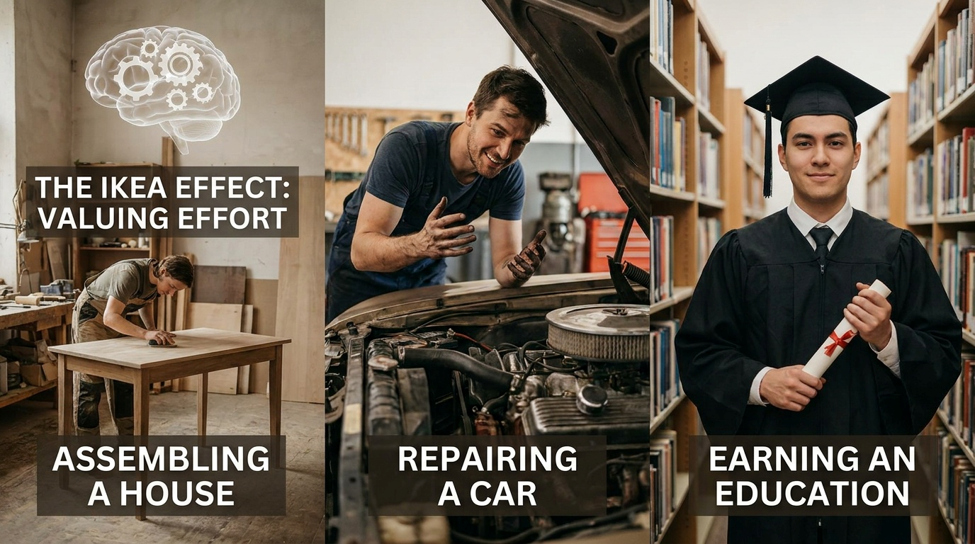
In other words, the investment itself often increases our appreciation.
This helps explain why many things that are freely given are sometimes underappreciated. When little or no personal investment exists, there may be less emotional attachment, less gratitude, and less commitment to maintaining what has been received.
Of course, there are important exceptions.
Many of life’s greatest blessings are not earned in the traditional sense. Loving parents, supportive friends, devoted spouses, gifted teachers, scholarships, unexpected opportunities, and even life-saving medical care may come through the generosity of others rather than through our own efforts. These gifts should never be viewed as having less value simply because they were freely given.
The difference lies in how we respond.
Even if something comes without financial cost, it still deserves appreciation, stewardship, and responsibility. Gratitude itself becomes a form of investment. We honor gifts not merely by receiving them, but by using them wisely and paying their benefits forward whenever possible.
Our modern culture often encourages the pursuit of shortcuts. We see advertisements promising rapid weight loss, instant wealth, overnight success, effortless investing, accelerated learning, and immediate happiness. Social media frequently amplifies this illusion by highlighting accomplishments while concealing the years of work, failures, sacrifices, and disappointments that preceded them.
People naturally seek the easiest path.
Psychologists describe this tendency as a preference for immediate gratification. Yet decades of research demonstrate that the ability to delay gratification is associated with numerous positive long-term outcomes, including academic achievement, financial stability, healthier lifestyles, and emotional regulation (Mischel et al., 1989; Duckworth et al., 2013).
Nature itself offers the same lesson. Trees require years to mature. Muscles strengthen only after repeated stress and recovery. Healthy relationships deepen through shared experiences. Wisdom develops through reflection upon both success and failure. There are no meaningful shortcuts around growth itself.
My own studies in martial arts, Tai Chi, Qigong, holistic wellness, and Eastern philosophy have reinforced this lesson repeatedly. Beginners often ask how long it takes to develop skill, balance, relaxation, internal awareness, or true self-mastery. While instruction can certainly accelerate learning, no teacher can breathe for another person, perform another person’s exercises, or cultivate another person’s character.
The student must ultimately make the exchange. Every practice session becomes an investment. Every hour of study becomes an investment. Every difficult decision becomes an investment. Every healthy meal, every mindful breath, every walk, every setback, and every act of discipline gradually shape the person we become.
This is where another Taoist principle has become increasingly meaningful to me. The concept of wu wei is often misunderstood as “doing nothing.” More accurately, it suggests acting in harmony with natural principles rather than struggling against them. The oak tree does not force itself to mature overnight. Rivers do not compete with mountains. They simply continue flowing, eventually carving valleys through persistent movement.

Likewise, meaningful self-development rarely occurs through frantic effort alone. It emerges through consistent, intelligent, sustainable practice repeated over months and years. The greatest transformations are often nearly invisible while they are occurring.
Ironically, because everything is temporary, perhaps the process becomes even more valuable than the outcome itself.
A beautiful home eventually ages. Financial wealth changes hands. Professional titles disappear after retirement. Physical strength gradually declines. Even our memories eventually fade.
Yet the habits, discipline, wisdom, compassion, resilience, humility, and discernment developed while pursuing these goals become woven into our character. They influence our families, our students, our communities, and often generations beyond our own lifetime. Perhaps that is the true return on investment.
Another lesson I continue learning is the distinction between appreciation and attachment. Appreciation allows us to fully enjoy the people, experiences, and possessions presently in our lives. Attachment often convinces us that our happiness depends upon permanently possessing them. The first encourages gratitude. The second often produces anxiety.
Holistic wellness extends beyond nutrition and exercise. It also includes cultivating a healthier relationship with success, failure, gain, loss, praise, criticism, youth, aging, and eventually even mortality. These are not problems to solve but realities to understand.
As I continue growing older, I find myself placing less importance on acquiring possessions and more importance on becoming a better steward of whatever time remains. My purpose has never centered upon accumulating things. Rather, it has been to help others improve their lives through education, encouragement, practical self-care, and hopefully a little greater wisdom than they possessed before we met.

Even that effort requires an exchange. Teaching requires preparation. Writing requires research. Listening requires patience. Serving requires compassion. Learning requires humility. Living well requires continual discernment. The rewards are rarely immediate, and they are seldom measured financially. Yet they often produce benefits extending far beyond anything we may personally witness.
Modern psychology, Stoic philosophy, Taoism, Buddhism, and many other wisdom traditions ultimately converge upon a remarkably similar insight. Although they use different language, they each recognize that meaning is found less in possessing and more in becoming.
Life’s greatest treasures are seldom free. They require investment, sacrifice, patience and most importantly, they require our most precious commodity, our limited time.
In the end, everything we own will eventually be left behind. Our possessions will belong to someone else. Our titles will be forgotten. Even our physical bodies will one day return to the earth. What remains is not what we accumulated. What remains is the life we lived, the character we developed, the people we influenced, and the legacy of compassion, wisdom, and integrity we leave behind.
Perhaps that is the most valuable investment any of us can ever make.
References
Aronson, E., & Mills, J. (1959). The effect of severity of initiation on liking for a group. The Journal of Abnormal and Social Psychology, 59(2), 177–181. https://doi.org/10.1037/h0047195
Duckworth, A. L., Tsukayama, E., & Kirby, T. A. (2013). Is it really Self-Control? Examining the predictive power of the delay of gratification task. Personality and Social Psychology Bulletin, 39(7), 843–855. https://doi.org/10.1177/0146167213482589
Epictetus. (1998). The enchiridion (S. Walton, Trans.). Dover Publications. (Original work published ca. AD 108) https://archive.org/details/epictetus-the-enchiridion
Festinger, L. (1957). A theory of cognitive dissonance. Stanford University Press. https://archive.org/details/theoryofcognitiv0000fest/page/n5/mode/2u
Viktor E. Frankl. (2006). Man’s search for meaning. Beacon Press. (Original work published 1946)
Laozi. (1993). Tao Te Ching (D. C. Lau, Trans.). Everyman. (Original work written ca. 4th century BCE)
Marcus Aurelius. (2002). Meditations (G. Hays, Trans.). Modern Library. (Original work written ca. AD 180) https://dn790009.ca.archive.org/0/items/meditation-GeorgeHays/meditations-GeorgeHays.pdf
Mischel, W., Shoda, Y., & Rodriguez, M. L. (1989). Delay of gratification in children. Science, 244(4907), 933–938. https://doi.org/10.1126/science.2658056
Norton, M. I., Mochon, D., & Ariely, D. (2011). The IKEA effect: When labor leads to love. Journal of Consumer Psychology, 22(3), 453–460. https://doi.org/10.1016/j.jcps.2011.08.002

 United Martial Arts Association