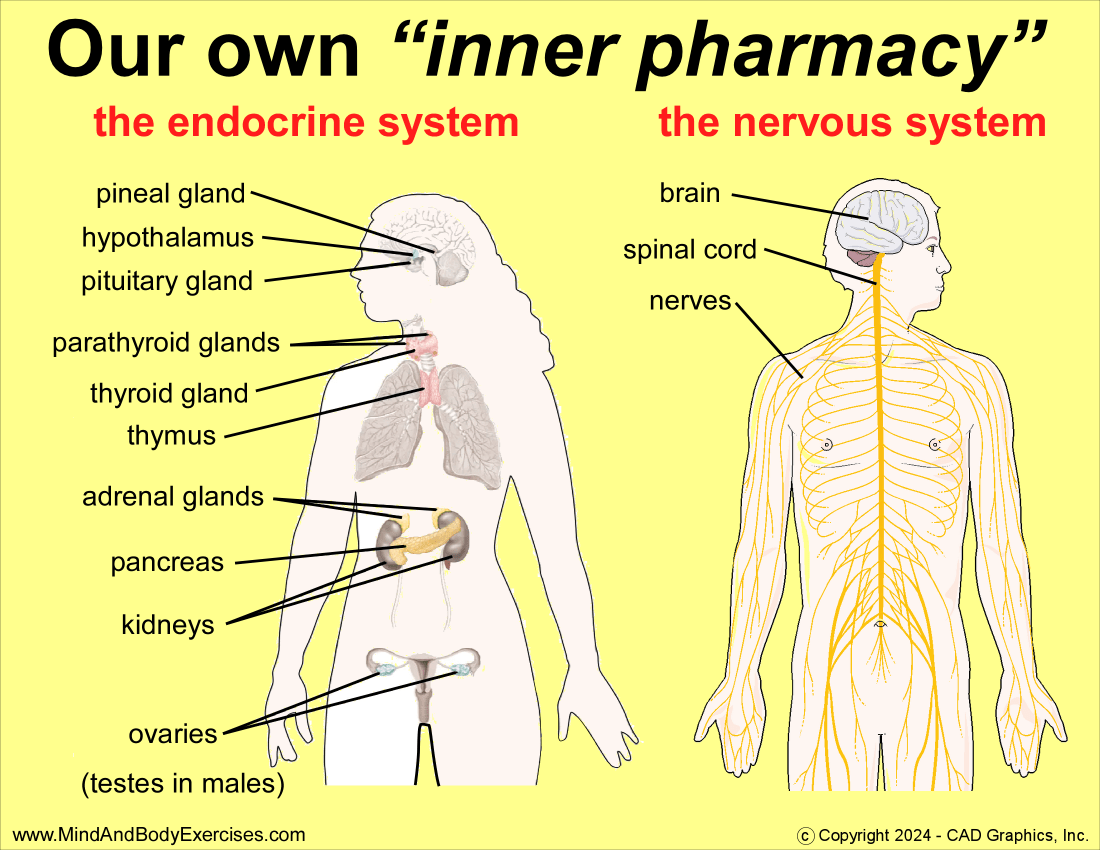
Our Own Inner Pharmacy

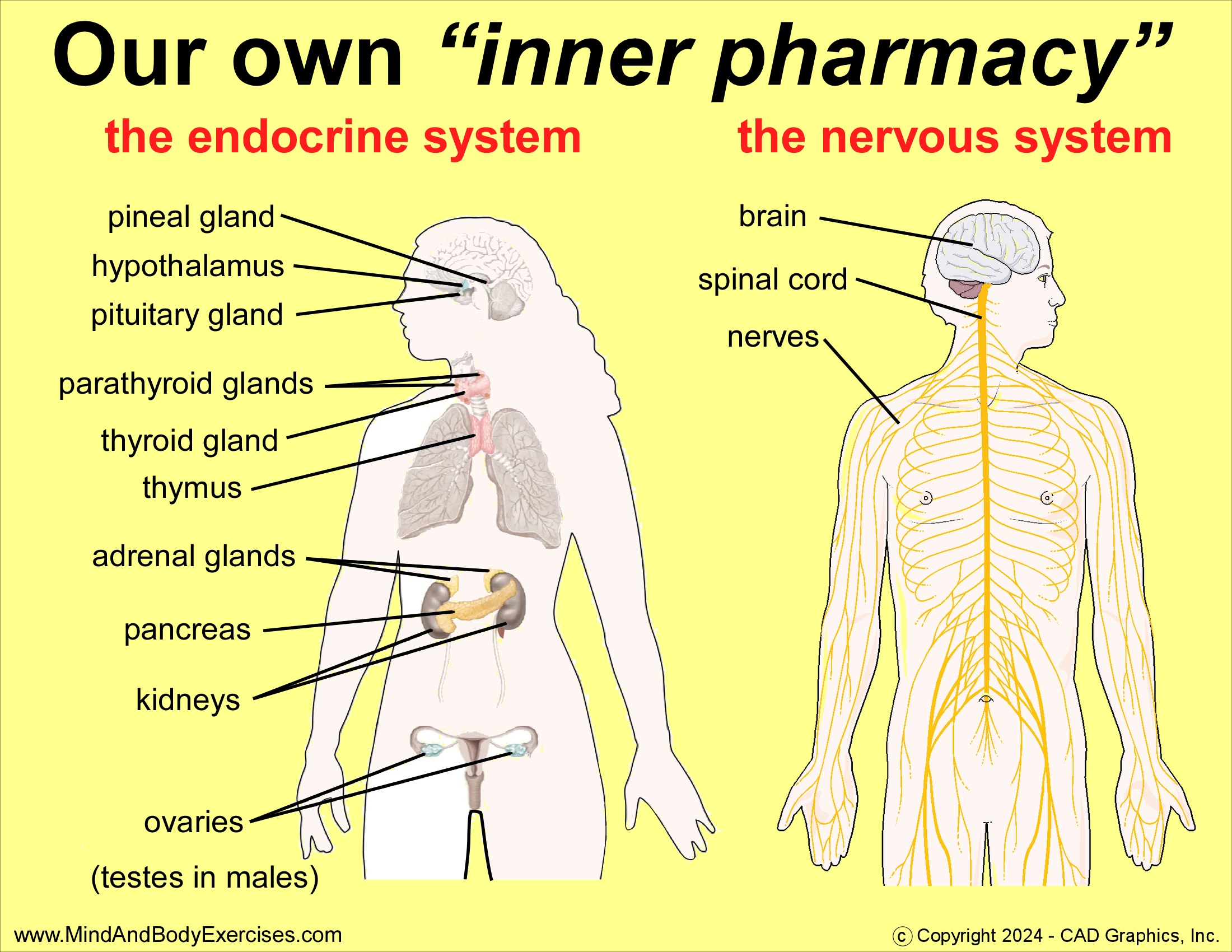
Human beings are not merely passive recipients of external chemicals. We carry within us an extraordinary “inner pharmacy” — a dynamic biochemical laboratory governed largely by the endocrine and nervous systems. At every moment, our bodies produce hormones, neurotransmitters, and signaling molecules that influence mood, energy, immunity, inflammation, motivation, and even perception.

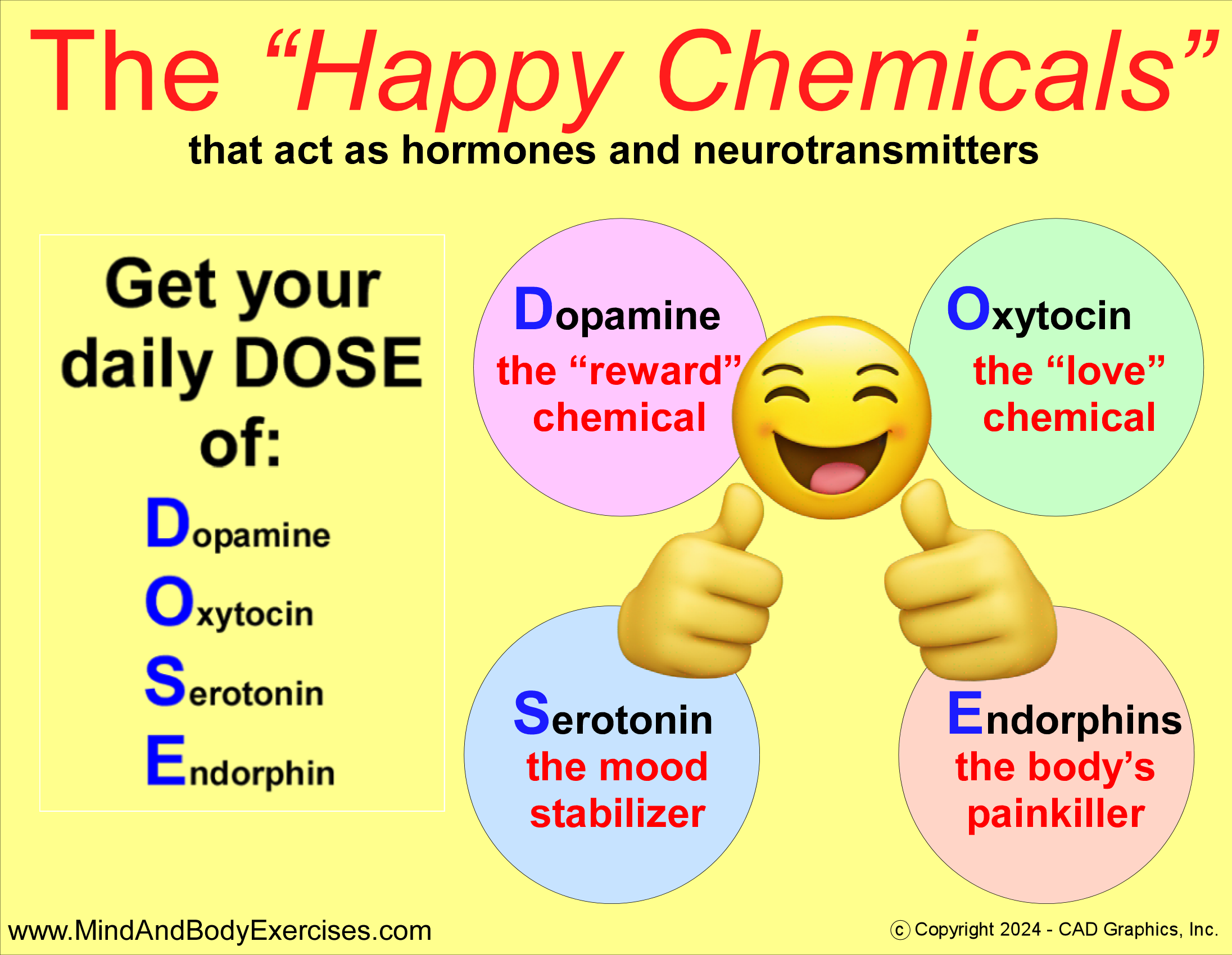
Stress hormones like cortisol and adrenaline can mobilize us for action. Endorphins can reduce pain. Oxytocin can deepen connection. Dopamine can enhance motivation and focus. Serotonin can stabilize mood. These substances are not foreign prescriptions; they are internally generated responses to how we live.

The remarkable reality is that we are not powerless in this process. Diet influences blood sugar stability, micronutrient availability, and hormone balance. Breath regulation can directly shift autonomic tone, moving us from sympathetic “fight-or-flight” dominance toward parasympathetic restoration. Thoughts and emotional patterns affect neurochemical cascades. Chronic rumination reinforces stress chemistry, while deliberate cognitive reframing can reduce it. Physical movement alters endocrine output. Sleep restores hormonal rhythms. Even posture and facial expression feed back into neurophysiology.

This does not mean we can will away disease or replace appropriate medical care. Rather, it means we possess meaningful influence over our internal chemistry. By consciously regulating diet, breathing, attention, emotional responses, and behavior, we participate in directing our own biochemistry.

The “inner pharmacy” is always open. The question is not whether chemicals are being dispensed, but which ones — and under what conditions.

Why We Sleep Better in Cooler Rooms – And Why a Hot Shower Can Help

In the world of holistic health, quality sleep is foundational to healing, regeneration, and mental clarity. Yet many people struggle with falling or staying asleep, unaware that their sleeping environment, particularly the temperature, may be working against them. Interestingly, both science and traditional wisdom agree: a cooler room helps the body sleep more deeply. But perhaps more surprising is the fact that a hot shower before bed can actually help you fall asleep faster. How can both be true?

Let’s explore the physiology of thermoregulation, circadian rhythms, and the role of temperature in sleep and what this means for your wellness routine.

Cooler Temperatures Support the Body’s Natural Sleep Rhythms

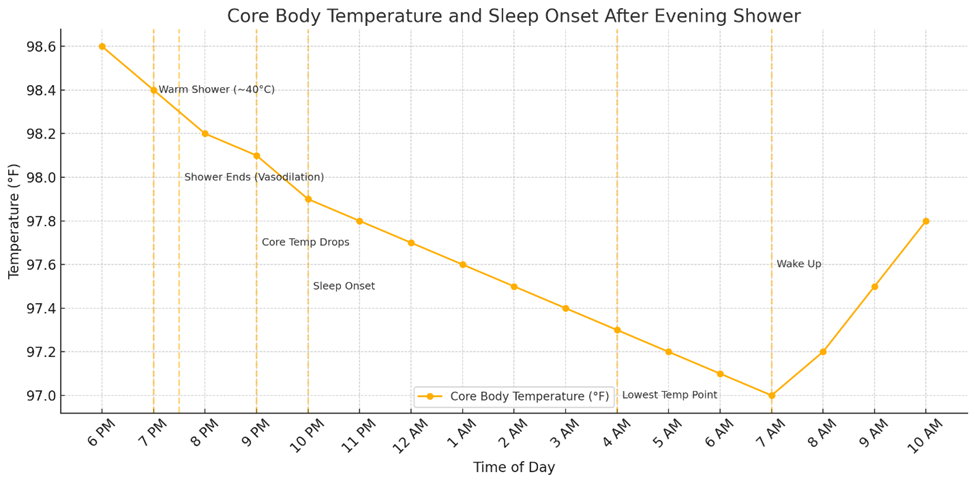
Human sleep is governed by the circadian rhythm, a 24-hour biological clock that regulates many body functions, including core body temperature. In a healthy cycle:

  • Core temperature begins to drop in the late evening, signaling the brain to prepare for sleep.
  • This drop continues through the night, reaching its lowest point around 4 a.m., then rising toward morning wakefulness.
  • A cooler ambient temperature supports this process, helping initiate and sustain deeper stages of sleep.

In essence, cooling the body acts as a natural signal for the nervous system to wind down. When the room is too warm, the body struggles to release heat, leading to more wakefulness, disrupted REM cycles, and less restorative sleep.

According to research, temperatures between 60–67°F (15–19°C) are optimal for most adults to achieve better sleep efficiency and fewer nighttime awakenings (Kräuchi et al., 2000).

Why a Hot Shower Before Bed Helps – Through Cooling

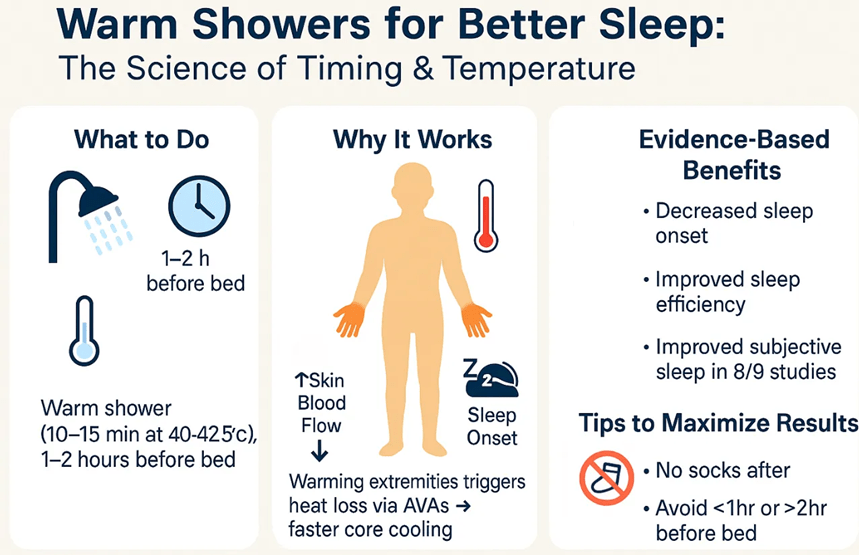
Here’s where it gets interesting. While cooler environments promote better sleep, a hot shower (or bath) about 1–2 hours before bed has also been shown to help people fall asleep faster. This isn’t a contradiction, it’s physiology in action.

Here’s how it works:

  1. A hot shower raises skin temperature, prompting the blood vessels near the surface (especially in hands, feet, and face) to dilate.
  2. This vasodilation enables the body to shed heat more effectively once you step out of the shower.
  3. As a result, your core body temperature rapidly decreases, mimicking the natural nighttime drop and signaling your brain to initiate sleep.

This process supports the body’s thermoregulation and helps shorten sleep onset latency, the time it takes to fall asleep.

A 2019 meta-analysis found that warm showers or baths taken 1–2 hours before bedtime reduced sleep onset time by up to 10 minutes, especially when combined with a cool sleeping environment (Haghayegh et al., 2019).

Holistic Implications: Sleep as a Ritual of Restoration

From a holistic health perspective, sleep is not merely a pause in activity. It is the body’s most profound period of healing and integration. Optimizing temperature regulation supports:

  • Melatonin production, which rises as the core temperature drops
  • Activation of the parasympathetic nervous system, the body’s natural “rest-and-digest” state
  • Emotional regulation, immune repair, and neurocognitive processing during REM and deep sleep

In this context, a hot shower can become more than hygiene. It can become a pre-sleep ritual, one that invites the body into a state of balance. The transition from warmth (shower) to coolness (bedroom) becomes a symbolic and physiological descent into stillness.

This aligns beautifully with Eastern practices such as Taoist bath meditations and Ayurvedic evening routines (dinacharya), which emphasize gentle warming, grounding, and purification before rest.

Practical Tips for Holistic Sleep Support

If you’re struggling with sleep or just want to deepen your nightly restoration try this:

  1. Take a warm shower (104–109°F / 40–43°C) about 90 minutes before bed.
  2. Use the time to also slow your breathing, quiet your thoughts, and mentally disconnect from the day.
  3. After drying off, transition to a cool, dark room (60–67°F).
  4. Choose natural fiber bedding and avoid artificial light sources or screens.
  5. Consider mindful breathing, gentle stretching, or herbal teas to further activate the parasympathetic nervous system.

Honor the Body’s Rhythms

The human body has an elegant wisdom built into its rhythms. By working with rather than against these cycles, we allow sleep to unfold more naturally. In holistic wellness, small shifts, like adjusting your room temperature or adding a warm shower to your evening routine can have a profound impact on your physical, emotional, and spiritual vitality.

Instead of forcing sleep through stimulants or sedatives, let the body return to its own balance. Honor the descent into stillness and let cool darkness and gentle ritual guide you into healing rest.

References:

Cagnacci, A., Elliott, J. A., & Yen, S. S. (1992). Melatonin: a major regulator of the circadian rhythm of core temperature in humans. The Journal of clinical endocrinology and metabolism75(2), 447–452. https://doi.org/10.1210/jcem.75.2.1639946

Haghayegh, S., Khoshnevis, S., Smolensky, M. H., Diller, K. R., & Castriotta, R. J. (2019). Before-bedtime passive body heating by warm shower or bath to improve sleep: A systematic review and meta-analysis. Sleep Medicine Reviews, 46, 124–135. https://doi.org/10.1016/j.smrv.2019.04.008

Kräuchi, K., Cajochen, C., Werth, E., & Wirz-Justice, A. (2000). Functional link between distal vasodilation and sleep-onset latency? American Journal of Physiology-Regulatory, Integrative and Comparative Physiology, 278(3), R741–R748. https://doi.org/10.1152/ajpregu.2000.278.3.R741

Luu, B., MD. (2025, May 22). Unlock Better Sleep with a Warm Shower. Brandon Luu MD. https://brandonluumd.substack.com/p/unlock-better-sleep-with-a-warm-shower

Open Communication, Right Communication, and the Illusion of Both

Closed Social Systems, Psychological Safety, and the Cost of Questioning

Many organizations, communities, workplaces, and social groups proudly promote the concept of “open communication.” On the surface, this sounds healthy, progressive, and emotionally mature. Members often hear phrases such as “You can ask anything,” “We are family,” “Transparency matters,” or “We encourage honest dialogue.” However, in some environments, openness exists more as an idealized slogan than an actual practice.

Over the years, I have personally experienced this dynamic within a highly structured social construct in which I was a willing participant for many years. I do not view myself merely as a victim of manipulation or coercion. Like many people who become deeply involved in organizations, I joined voluntarily because I believed in the values, purpose, community, and opportunities for growth that the group appeared to offer. There were many positive experiences, meaningful friendships, and valuable life lessons that emerged from that involvement. Yet over time, deeper patterns became increasingly apparent.

The group outwardly encouraged “open communication,” but only within carefully defined boundaries. Certain questions were welcomed, while others were heavily discouraged. Asking seemingly reasonable questions regarding organizational history, specific events, leadership behavior, financial matters, inconsistencies, or the character and conduct of certain authority figures was often frowned upon if not outright forbidden.

The issue was not always explicit censorship. More often, the pressure was subtle, psychological, and social.

People quickly learned which questions created discomfort and which subjects were considered off-limits. Eventually, members often begin censoring themselves long before direct punishment becomes necessary. This phenomenon reflects what psychologists refer to as normative social influence, whereby individuals conform to group expectations in order to gain acceptance and avoid rejection (Cialdini & Goldstein, 2004).

Over time, communication in closed systems can become increasingly performative rather than authentic. Individuals learn to say what is expected rather than what they genuinely think or feel. Independent inquiry may gradually become interpreted as negativity, ego, disloyalty, or a lack of commitment. In these environments, preserving the image and stability of the system often becomes more important than the honest pursuit of truth.

Importantly, I eventually realized that this phenomenon was not isolated to one organization. I have witnessed remarkably similar communication dynamics in toxic workplaces, dysfunctional social groups, political movements, religious organizations, educational institutions, and even certain healthcare environments. While the severity may differ, the underlying psychological mechanisms are often surprisingly similar.

Many workplaces, for example, claim to encourage feedback and collaboration. Employees are told their opinions matter and that leadership welcomes honest discussion. Yet workers may quickly discover that questioning management decisions, exposing inefficiencies, or discussing ethical concerns can carry social or professional consequences. Promotions, inclusion, reputation, and job security may become tied to conformity rather than competence or integrity.

This creates what organizational psychologists call low psychological safety. Psychological safety refers to an environment where individuals feel safe enough to ask questions, express concerns, admit mistakes, and offer feedback without fear of humiliation or punishment (Edmondson & Lei, 2014). When psychological safety is absent, communication narrows, innovation declines, stress increases, and groupthink becomes more prevalent.

Groupthink itself is a well-documented phenomenon in which the desire for harmony and conformity overrides critical thinking and realistic evaluation of alternatives (Janis, 1972). Within closed social systems, maintaining cohesion often becomes more important than seeking objective truth. Members may gradually lose the ability to distinguish independent thinking from disloyalty.

From a physiological perspective, environments lacking authentic communication can place individuals into chronic states of sympathetic nervous system activation. People become hypervigilant regarding what they say, how they say it, and who may be listening. This ongoing stress burden can influence sleep quality, cognition, mood regulation, emotional resilience, and physical health. Human beings communicate most effectively when they feel safe enough to socially engage rather than constantly defend themselves (Porges, 2011).

Ironically, many closed systems initially attract sincere, idealistic, and highly motivated individuals. People naturally seek meaning, purpose, structure, mentorship, belonging, and personal growth. According to self-determination theory, individuals flourish when they experience autonomy, competence, and relatedness (Deci & Ryan, 2000). Closed systems frequently offer the appearance of these needs being fulfilled while simultaneously restricting true autonomy and authentic self-expression.

However, another realization eventually emerged. Open communication and right communication are not necessarily the same thing. Many people hear the phrase “open communication” and interpret it as the freedom to say whatever they want, whenever they want, however they want. Yet unrestricted expression alone does not automatically create healthy communication.

A room filled with gossip, hostility, emotional outbursts, endless complaints, and personal attacks may technically be open, but it is hardly constructive.

Open communication primarily concerns access. It asks:

  • Can questions be asked?
  • Can concerns be raised?
  • Can disagreement be expressed?
  • Can information flow freely?
  • Can inquiry occur without fear?

These are important questions because without openness, truth becomes difficult to discover.

Yet openness alone is insufficient.

What might be called “right communication” addresses not only whether people can speak, but how, why, and when communication occurs.

The concept appears throughout many philosophical and spiritual traditions. In Buddhism, Right Speech asks whether communication is truthful, beneficial, timely, and compassionate. Stoicism emphasizes wisdom, restraint, and self-mastery. Confucian philosophy highlights responsibility, virtue, and social harmony. Though these traditions differ, they share a common insight: communication should serve growth, understanding, and truth rather than ego, impulse, or division.

In this sense, communication can be viewed through four possibilities:

  • Open and Right: Healthy dialogue and mutual growth.
  • Open but Wrong: Chaos, hostility, gossip, and noise.
  • Closed but Well-Intentioned: Respectful yet overly constrained.
  • Closed and Wrong: Manipulation, censorship, fear, and control.

The goal is not merely openness.

The goal is openness guided by wisdom.

This distinction aligns closely with my framework of the Warrior, Scholar, and Sage.

The Warrior asks:

“Do I have the courage to speak the truth?”

Without courage, important issues remain hidden.

The Scholar asks:

“Is what I am saying accurate?”

Without inquiry and evidence, communication devolves into opinion masquerading as fact.

The Sage asks:

“Is this the right time, place, and manner?”

Without wisdom, even truth can become a weapon rather than a tool for growth.

When all three dimensions are present, communication becomes honest, thoughtful, respectful, and transformational.

From an Eastern philosophical perspective, communication itself reflects yin and yang dynamics. Open communication possesses a more yang quality. It expresses, questions, reveals, and engages. Right communication incorporates both yin and yang. Speaking is the yang aspect. Listening, reflecting, exercising restraint, and choosing the proper timing represent the yin aspect.

Many people learn how to talk. Far fewer learn how to listen.

Likewise, many organizations learn how to advertise openness while quietly discouraging inquiry. Others encourage unrestricted expression without responsibility or discernment. Both extremes miss the mark.

One suppresses truth.

The other drowns truth in noise.

Healthy communication occupies the middle path.

It is open enough to allow truth to emerge, yet disciplined enough to ensure that truth is expressed with integrity, respect, and purpose.

One of the most important lessons I have learned is that truth does not fear honest examination. Healthy individuals, healthy organizations, and healthy communities should be capable of tolerating respectful inquiry without perceiving every difficult question as a threat. In the end, the quality of communication within a group often reveals the true nature of the group itself.

Open communication asks whether people are allowed to speak. Right communication asks whether what is spoken serves truth, understanding, and growth.

Healthy systems require both. Without openness, truth is suppressed. Without wisdom, truth becomes noise. The goal is not merely freedom of speech, but freedom guided by courage, discernment, and responsibility.

References

Cialdini, R. B., & Goldstein, N. J. (2004). Social influence: Compliance and conformity. Annual Review of Psychology, 55, 591–621. https://doi.org/10.1146/annurev.psych.55.090902.142015

Deci, E. L., & Ryan, R. M. (2000). The “what” and “why” of goal pursuits: Human needs and the self-determination of behavior. Psychological Inquiry, 11(4), 227–268. https://doi.org/10.1207/S15327965PLI1104_01

Edmondson, A. C., & Lei, Z. (2014). Psychological safety: The history, renaissance, and future of an interpersonal construct. Annual Review of Organizational Psychology and Organizational Behavior, 1, 23–43. https://doi.org/10.1146/annurev-orgpsych-031413-091305

Janis, I. L. (1972). Victims of groupthink: A psychological study of foreign-policy decisions and fiascoes. Houghton Mifflin. https://dn710801.ca.archive.org/0/items/victimsofgroupthinkirvingl.janis/Victims%20of%20GROUPTHINK%20-%20Irving%20Janis.pdf

Porges, S. W. (2011). The polyvagal theory: Neurophysiological foundations of emotions, attachment, communication, and self-regulation. W. W. Norton & Company. https://archive.org/details/polyvagaltheoryn0000porg

Beyond the Books

How Travel Expands Cognition, Perspective, and Present-Moment Awareness

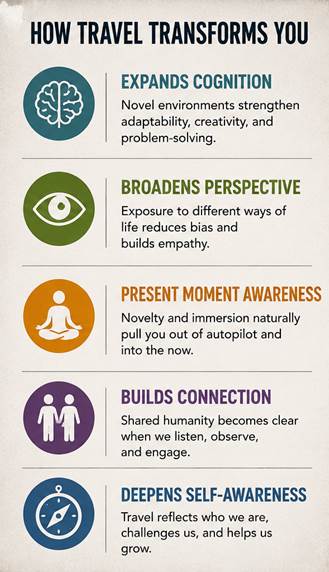
Many people read books, study history, watch documentaries, and intellectually explore the customs, politics, and philosophies of other nations. These pursuits are valuable and often essential. Through literature, education, and observation, one can gain important knowledge about geography, economics, religion, language, and cultural behavior. However, there remains a profound difference between learning about a culture and physically stepping into it. To travel is not merely to relocate the body across geographical boundaries; it is often to reposition the mind beyond habitual assumptions, challenge personal perspectives, and invite a deeper awareness of oneself and others.

Having traveled throughout much of the United States, while also visiting Canada, the Bahamas, and parts of Europe, I have repeatedly observed that travel offers something books alone cannot fully replicate: lived immersion. One can read about how societies differ, but standing within those environments by walking unfamiliar streets, hearing another language, adapting to different social norms, witnessing architecture shaped by centuries of history, and observing how people move through daily life, often provides a far deeper education. Travel becomes more than movement; it becomes embodied learning.

The Difference Between Knowing and Experiencing

Cognitive psychologists have long distinguished between declarative knowledge (facts and concepts) and experiential knowledge (learning through direct interaction and experience) (Kolb, 1984). Reading about another country may build intellectual understanding, but physically experiencing a place often integrates emotional, sensory, and contextual learning that deepens retention and insight.

A traveler who studies France may understand historical facts, social systems, or cuisine. Yet walking through neighborhoods in Paris, observing social etiquette, public transportation rhythms, street culture, and local behavioral norms creates a multidimensional learning experience. The brain does not simply process information through abstraction; it interprets experience through sensory and emotional encoding.

This aligns with experiential learning theory, which suggests that concrete experience followed by reflection produces stronger adaptation and understanding than passive acquisition alone (Kolb, 1984). In many ways, the traveler becomes both student and participant.

Travel and Cognitive Flexibility

One of the greatest psychological benefits of travel is enhanced cognitive flexibility, where one develops the ability to adapt thinking, shift perspectives, and respond effectively to unfamiliar situations. Routine environments often reinforce fixed patterns of thought. Travel disrupts these patterns.

Unfamiliar currencies, transportation systems, languages, social customs, food practices, and interpersonal expectations require the brain to continuously reassess, compare, and adapt. This process challenges rigid thinking and may strengthen executive functioning associated with attention, working memory, and adaptive reasoning (Diamond, 2013).

Research suggests that multicultural exposure and international experiences can improve creativity and cognitive complexity because individuals are forced to reconcile multiple viewpoints and behavioral frameworks (Maddux & Galinsky, 2009). Exposure to difference can expand problem-solving capacity by reducing overly simplistic “one-way” thinking.

From the perspective of the Scholar, travel becomes cognitive training.

Travel as a Means to Put Oneself “In the Moment”

Modern life often places people on cognitive autopilot. Familiar roads, repetitive schedules, predictable environments, and habitual routines can reduce conscious attention. Many individuals move through daily life physically present, yet mentally elsewhere, thinking about deadlines, obligations, worries, or digital distractions.

Travel often interrupts this pattern.

When one enters an unfamiliar city, boards a train in another country, navigates a foreign airport, or walks through a cultural district unlike anything at home, attention naturally heightens. The brain becomes alert because novelty demands engagement.

This is one of travel’s overlooked benefits: it places people in the moment.

Psychological research suggests that novelty increases attentional engagement and memory encoding because unfamiliar stimuli require more active cognitive processing (Kandel et al., 2013). A person walking through a market in another country notices sounds, accents, smells, architecture, body language, and social rhythms more consciously than they may notice their own neighborhood.

This resembles mindfulness—not necessarily formal meditation, but situational presence.

Instead of operating through habitual mental drift, the traveler becomes more aware of:

  • surroundings
  • movement
  • sensory detail
  • interpersonal behavior
  • timing
  • uncertainty
  • emotional responses

In Eastern traditions, awareness is often cultivated through presence, observation, and reduction of unnecessary mental distraction. Taoist and contemplative systems emphasize alignment with reality as it unfolds rather than attachment to internal agitation or distraction (Lao Tzu, trans. 1988). Travel can unintentionally foster this state by requiring full engagement with the immediate environment.

From the lens of the Warrior, travel sharpens awareness.

Embodied Learning and Sensory Cognition

Travel is not merely intellectual. It is somatic.

The body learns through movement, orientation, climate adaptation, fatigue, rhythm, and sensory immersion. Walking unfamiliar streets, standing in long transit lines, climbing hills, adjusting to jet lag, hearing non-native speech patterns, tasting unfamiliar foods, and experiencing different physical spaces all contribute to embodied cognition.

Embodied cognition theory suggests that cognition is deeply influenced by physical interaction with the environment rather than existing solely as abstract mental processing (Wilson, 2002). This means learning through travel is partly neurological and partly physiological.

When people physically experience different climates, infrastructure, public norms, and spatial organization, they often understand societal differences in a much deeper way.

From the Scholar and Sage, travel teaches through both observation and embodiment.

Humility, Perspective, and Reduced Ethnocentrism

Travel also challenges egocentric and ethnocentric assumptions.

Many individuals unconsciously view their own societal norms as “normal” or superior simply because they are familiar. Exposure to different systems of governance, transportation, food culture, social etiquette, family dynamics, healthcare, work-life patterns, and public behavior can challenge narrow assumptions.

This does not require idealizing other nations. Every society carries strengths, weaknesses, contradictions, and complexities. Yet observing other systems often reminds us that our worldview is only one lens among many.

Intercultural exposure has been associated with increased openness, empathy, and reduced social rigidity (Nguyen & Benet-Martínez, 2013). Perspective broadening may help individuals better tolerate ambiguity and diversity.

From the Sage, travel cultivates humility.

Travel, Time Perception, and Richer Memory

One fascinating cognitive phenomenon is that travel often makes time feel fuller.

Routine compresses memory. Repetitive days blend together because the brain encodes fewer distinct markers. Novel experiences, however, often create stronger episodic memory formation.

This helps explain why one week abroad may feel psychologically richer than several ordinary weeks at home.

Novel environments create stronger hippocampal encoding, which contributes to vivid recall and perceived experiential depth (Kandel et al., 2013). Travel may therefore enhance not only memory, but the felt richness of life.

Being “in the moment” contributes to this effect.

Travel as a Mirror of Self-Awareness

Perhaps one of travel’s most powerful lessons is not what we discover about other cultures, but what we discover about ourselves.

Unfamiliar environments often reveal:

  • patience or impatience
  • fear or courage
  • gratitude or entitlement
  • adaptability or rigidity
  • curiosity or resistance
  • emotional resilience under uncertainty

Without familiar comforts, many internal patterns become visible. Travel can therefore serve as a mirror.

The Warrior learns resilience.
The Scholar gains perspective.
The Sage develops humility.

A Holistic View of Travel and Human Development

From a holistic wellness perspective, meaningful travel can support cognitive growth, emotional intelligence, sensory awareness, adaptability, humility, and present-moment engagement.

Books educate the intellect.
Travel educates the whole person.

To read is valuable.
To study is essential.
To immerse oneself is transformative.

When approached mindfully, travel becomes more than recreation. It becomes a practice of awareness, a disruption of autopilot living, and an opportunity to refine perspective. In a world increasingly shaped by digital observation rather than lived participation, stepping physically into unfamiliar places may be one of the most practical ways to strengthen cognition, deepen empathy, and reconnect with the present moment.

Sometimes the greatest education begins when we leave the familiar behind.

References

Diamond, A. (2013). Executive functions. Annual Review of Psychology, 64, 135–168. https://doi.org/10.1146/annurev-psych-113011-143750

Kandel, E. R., Schwartz, J. H., Jessell, T. M., Siegelbaum, S. A., & Hudspeth, A. J. (2013). Principles of neural science (5th ed.). McGraw-Hill.

Kolb, D. A. (1984). Experiential learning: Experience as the source of learning and development. Prentice Hall.

Lao Tzu. (1988). Tao Te Ching (S. Mitchell, Trans.). Harper Perennial.

Maddux, W. W., & Galinsky, A. D. (2009). Cultural borders and mental barriers: The relationship between living abroad and creativity. Journal of Personality and Social Psychology, 96(5), 1047–1061. https://doi.org/10.1037/a0014861

Nguyen, A. M. D., & Benet-Martínez, V. (2013). Biculturalism and adjustment: A meta-analysis. Journal of Cross-Cultural Psychology, 44(1), 122–159. https://doi.org/10.1177/0022022111435097

Wilson, M. (2002). Six views of embodied cognition. Psychonomic Bulletin & Review, 9(4), 625–636. https://doi.org/10.3758/BF03196322

The Yin and Yang of Human Connection

Why Meaningful Encounters Leave Both Warmth and Ache

As I have grown older, I have come to deeply appreciate meaningful time spent with old friends, new acquaintances, and those brief but sincere encounters that remind us of our shared humanity. Whether it is reconnecting with someone from years past, sharing thoughtful conversation with a newer friend, or simply experiencing genuine fellowship, these moments often leave me feeling renewed, uplifted, and more grounded. They nourish something deeper than casual entertainment. They touch the mind, the heart, and perhaps even the soul.

Human beings are inherently social creatures. While some of us may value solitude, introspection, and self-cultivation, there remains a fundamental biological and psychological need for connection. Positive social interaction has been associated with activation of several beneficial neurochemical pathways, including dopamine, oxytocin, endorphins, and serotonin-related mood regulation, all of which can contribute to feelings of reward, trust, emotional warmth, and general well-being (Cacioppo & Cacioppo, 2014; Holt-Lunstad et al., 2010).

When we spend quality time with people who enrich our lives, there is often a subtle but noticeable sense of vitality. Conversation flows. Laughter feels restorative. Shared memories strengthen identity. New perspectives sharpen awareness. In many ways, meaningful relationships can become a form of emotional nourishment.

Yet, as many of us know, there is another side to this experience.

Eventually, the visit ends. The phone call concludes. The gathering disperses. The trip home begins. What was once full of warmth, movement, and engagement slowly gives way to quietness. Sometimes this transition carries a subtle emotional ache. Not necessarily depression, nor even sadness in its conventional sense, but perhaps a kind of reflective emptiness. A longing. A desire for just a little more time.

From a neuropsychological standpoint, this may reflect the shift from social stimulation and engagement back into relative stillness. While it may feel like a “chemical drop,” it is perhaps more accurate to say the nervous system transitions from heightened relational reward and stimulation into comparative emotional quiet (Lieberman, 2013). The contrast itself is what becomes so noticeable.

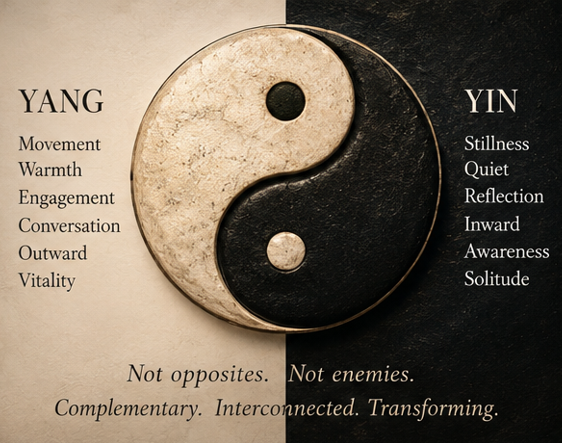
This dynamic reminds me greatly of the ancient Daoist principle of yin and yang, where opposite yet complementary forces continuously interact, balance, and transform.

Yang may represent:

  • movement
  • warmth
  • social engagement
  • conversation
  • outward expression
  • vitality

Yin may represent:

  • stillness
  • quiet reflection
  • absence
  • inward awareness
  • emotional softness
  • contemplative solitude

When we gather with people we care about, we often experience a distinctly yang state: active, warm, relational, and expansive. When those encounters conclude, yin emerges: quiet, introspective, and inward.

Yet Eastern philosophy reminds us that yin and yang are not enemies. They are not “good” versus “bad.” Rather, they are mutually arising, mutually dependent, and forever transforming into one another.

Without separation, reunion loses some of its sweetness.
Without silence, conversation has less depth.
Without temporary absence, presence can become less appreciated.
Without longing, gratitude may not fully mature.

This bittersweet interplay is deeply human.

Modern psychology often refers to this as bittersweetness or poignant emotion, where gratitude and sorrow can coexist within the same experience. These emotional states often deepen memory, perspective, appreciation, and even existential meaning (Larsen et al., 2001).

Perhaps what we call longing after meaningful encounters is not simply loneliness. Perhaps it is evidence that we still recognize value in genuine connection, purpose, and shared humanity.

As I reflect through my own lens of the Warrior, Scholar, and Sage, this becomes even clearer.

The Warrior shows up fully in relationship, valuing loyalty, courage, and presence.
The Scholar understands impermanence, recognizing that all meetings, seasons, and relationships naturally shift.
The Sage learns to appreciate connection deeply while not clinging to permanence.

In many ways, healthy human connection mirrors all of life: arrival and departure, fullness and emptiness, warmth and stillness, sweetness and ache.

So perhaps the deeper lesson is this:

Better to have experienced meaningful connection, even if it leaves behind a bittersweet longing, than to have never known such connection at all.

That ache may simply be proof that something valuable occurred.

And that, perhaps, is the enduring yin and yang of human connection.

References

Cacioppo, J. T., & Cacioppo, S. (2014). Social relationships and health: The toxic effects of perceived social isolation. Social and Personality Psychology Compass, 8(2), 58–72. https://doi.org/10.1111/spc3.12087

Holt-Lunstad, J., Smith, T. B., & Layton, J. B. (2010). Social relationships and mortality risk: A meta-analytic review. PLoS Medicine, 7(7), e1000316. https://doi.org/10.1371/journal.pmed.1000316

Larsen, J. T., McGraw, A. P., & Cacioppo, J. T. (2001). Can people feel happy and sad at the same time? Journal of Personality and Social Psychology, 81(4), 684–696. https://doi.org/10.1037/0022-3514.81.4.684

Lieberman, M. D. (2013). Social: Why our brains are wired to connect. Crown Publishers. https://archive.org/details/socialwhyourbrai0000lieb