
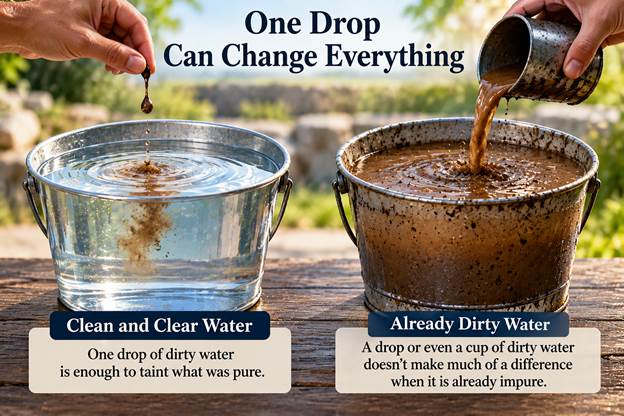
Many decades ago, I was introduced to a simple analogy that has stayed with me. Imagine two buckets of water. One contains water that is clean, clear and pure. The other contains water that is already cloudy and contaminated. Now place a drop of dirty water into each bucket.
In the bucket of clean water, that single drop represents contamination. Perhaps it is barely visible. Perhaps no one looking at the bucket would even notice it. Nevertheless, something has changed. What was previously pure is no longer completely pure.
Put that same drop into the bucket of dirty water and almost nothing appears to happen. Add another drop, and there is still little noticeable difference. You might even pour an entire cup of dirty water into it without substantially changing its appearance. The water was already contaminated.
When I first learned this analogy, it was being used to describe people, character and behavior. I have thought about it many times since then because I believe there is considerably more depth to the lesson than may initially appear.
A person who has spent years trying to live honestly may be deeply troubled by a single act that violates his or her values. A lie that seems insignificant to someone else may weigh heavily upon that individual. A questionable decision, betrayal of trust or deliberate act of dishonesty may produce considerable discomfort. From the outside, another person might wonder why such a seemingly small event matters so much.
But the issue is not necessarily the size of the drop. It is the condition of the water into which it fell. When we have established standards for ourselves, violations of those standards become noticeable. There is contrast. Something feels different because we have crossed a boundary that previously meant something to us.
This does not mean that a fundamentally honest person becomes dishonest because of one mistake. Human beings are imperfect, and all of us occasionally make poor decisions, lose our patience, act selfishly or fail to live up to our own expectations. I do not believe purity should be confused with perfection. In fact, demanding moral perfection can itself become unhealthy.
The more important question is what happens next. Do we recognize what we did? Do we experience enough discomfort to examine it? Do we apologize when appropriate, make restitution when possible and learn from the experience? Or do we begin explaining to ourselves why the behavior really wasn’t that bad?
That distinction matters. The first drop may not fundamentally change our character, but it can change what we are willing to tolerate. Once we have crossed a boundary, crossing it again can become easier. We have already created the explanation. We have already survived the discomfort. We have already demonstrated to ourselves that the rule can be bent. The second drop may therefore be easier than the first.
This is where the analogy becomes particularly meaningful to me. Much of what eventually becomes destructive behavior probably does not begin with a conscious decision to become dishonest, unethical or harmful. It begins with small compromises that are individually easy to justify.
“It’s only this once.”
“No one will know.”
“Everybody does it.”
“It really doesn’t hurt anyone.”
“I deserve this.”
“I didn’t have a choice.”
Any one of these explanations may even contain some truth. But repeated often enough, rationalization can gradually change our standards. The question slowly moves from “Is this right?” to “Can I get away with this?” or “Is this really bad enough to matter?” Those are very different questions.
There is also a psychological element involved. Human beings have a remarkable ability to adapt to their surroundings and experiences. This capacity is essential to survival, but adaptation is not always beneficial. We can become accustomed to things that once disturbed us.
The first exposure to dishonest behavior may create considerable discomfort. Repeated exposure can make it seem less unusual. Eventually it may become ordinary. What once generated an internal warning no longer produces much reaction. In that sense, the cloudy water represents more than wrongdoing. It can represent normalization.
This may help explain why two people can encounter the same questionable situation and respond very differently. One person may immediately feel that something is wrong and want no part of it. Another may barely notice. Their reactions may reflect different experiences, environments, values and boundaries.
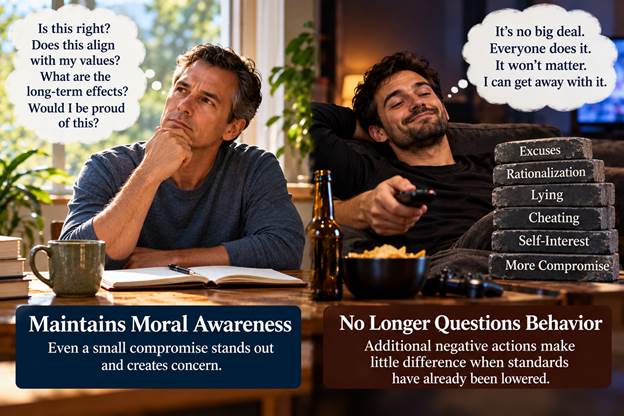
If someone has lived or worked for years in an environment where deception, manipulation, hostility or unethical behavior is routine, another example may simply blend into the background. The additional drop does not create much contrast.
For someone who has not normalized those behaviors, however, the same event may stand out sharply. This is why I think we should be cautious about judging another person’s sensitivity too quickly. Someone who refuses to participate in what appears to be a minor ethical compromise may not be naive, rigid or overly sensitive. That individual may simply recognize the significance of the first drop.
At the same time, this analogy should never be used to permanently label people as clean or dirty. Human beings are not buckets of water, and character is not a substance that becomes permanently contaminated. People learn, change, mature, make amends and rebuild themselves. Someone who has lived destructively for years is not condemned to remain that way.
The metaphor works best when we apply it to patterns and standards rather than permanent identities.
There is another side to the analogy that I find equally important. If dirty water can represent accumulated compromise, then perhaps clarity can represent conscious cultivation. We cannot necessarily remove every mistake we have made, but we can become increasingly aware of what we allow into our lives. We can examine our habits, relationships, environments and decisions. We can recognize when something is gradually pulling us away from the person we intend to be. This requires self-reflection.
It is much easier to recognize contamination in someone else’s bucket than in our own. We readily notice another person’s dishonesty, hypocrisy, selfishness or poor judgment while finding sophisticated explanations for our own behavior. Genuine self-development requires periodically looking into our own water.
What have I begun accepting that once bothered me?
What have I started rationalizing?
Have I lowered a standard simply because maintaining it became inconvenient?
Have repeated exposure and familiarity caused me to mistake something common for something acceptable?
These are uncomfortable questions, but discomfort can serve a purpose. Just as pain can alert the body that something requires attention, moral or emotional discomfort can tell us that our actions are moving away from our values.
I have increasingly come to believe that character is built through these seemingly small decisions. We tend to imagine integrity being tested during great moments of crisis, but most of the time it is probably shaped through ordinary choices that no one else sees. One drop at a time.
That is also why protecting one’s standards should not be confused with believing oneself morally superior to others. The lesson is not that I possess clean water while everyone else is contaminated. The lesson is that I am responsible for paying attention to what I allow into my own bucket.
We cannot control every circumstance that touches our lives. We will make mistakes. We will sometimes disappoint ourselves and others. We will occasionally discover that something we believed or practiced was misguided. None of this requires us to abandon our standards. Instead, awareness gives us the opportunity to correct our direction.
The old bucket analogy has stayed with me because of its simplicity. It reminds me that substantial changes in character do not always arrive as dramatic events. Sometimes they begin almost invisibly. A small compromise becomes easier to repeat. Repetition becomes familiarity. Familiarity becomes acceptance, and acceptance can eventually become part of our character.
The important question, then, may not simply be whether one drop of dirty water can ruin an entire bucket. Perhaps the more useful question is whether we still notice when the drop falls.
As long as we notice, reflect and care enough to respond, we have retained something extremely valuable: the ability to recognize the difference between the person we are becoming and the person we intend to be.


