Teukgi  –  Finding Your Specialty in the Martial Arts

Over many years of martial arts training, we encounter words and concepts that sometimes remain with us long after we have forgotten exactly where we first heard them. Some are philosophical ideas, while others are practical terms used by instructors to describe what they were seeing in our training. One such term that I remember hearing sounded something like “tiki.” It was used to describe a practitioner’s specialty, forte, or the particular skill that person had become especially good at.

After looking more closely at the Korean language, I believe the term was most likely teukgi, written in Korean as 특기 and with the Chinese characters 特技. The Korean Basic Dictionary translates teukgi as “specialty” or “one’s skill,” referring to a special skill or talent that distinguishes someone from others (National Institute of Korean Language, n.d.). The word combines teuk (特), meaning special or distinctive, with gi (技), referring to skill, technique, or ability. Although teukgi is not exclusively a martial arts term, I find the concept particularly useful when considering how martial artists develop over many years of practice.
Most martial artists begin their training by accumulating information. We learn stances, punches, kicks, blocks, throws, joint locks, forms, breathing methods, conditioning exercises, and various methods of self-defense. Depending upon the system, we might also learn weapons, meditation, internal exercises, or other traditional practices. This accumulation is necessary because we first need exposure to different methods before discovering which ones suit us particularly well. The mistake is assuming that continued accumulation always represents continued advancement.

There can be a tendency in martial arts to measure progress by how many techniques, forms, weapons, or systems someone knows. Yet there is an important difference between being familiar with a technique and developing the ability to perform it effectively. I can show someone the mechanics of a particular kick in a relatively short period of time. They may understand where to place the supporting foot, how to rotate the hip, how to maintain balance, and where the intended target might be. They now understand the technique, but that does not necessarily mean they have developed the skill.

After hundreds or thousands of repetitions, something begins to change. The movement becomes smoother, unnecessary tension diminishes, balance improves, and timing becomes more natural. The practitioner no longer has to consciously think about every component of the movement. What began as something they were trying to remember gradually becomes something their body has learned through experience. This is where teukgi begins to make sense in a martial arts setting. A specialty is not necessarily the technique we know the most about or the one that looks the most impressive. It may simply be something we have practiced so consistently and understood so thoroughly that it has become particularly reliable.

We Are Not All Built the Same

One of the lessons that becomes increasingly apparent after decades of training is that people are different. We have different body structures, flexibility, strength, speed, personalities, injuries, experiences, and ways of processing information. It would therefore be unrealistic to expect every practitioner to develop exactly the same abilities to exactly the same degree.

A tall practitioner with long legs may naturally gravitate toward certain kicking techniques, while a shorter or heavier practitioner may become particularly effective at close-range techniques, throwing, or controlling another person’s center of gravity. Someone with exceptional coordination may become skilled with weapons, while another person may develop an unusual sensitivity for timing, distance, or redirecting force. Even students who begin in the same school, practice the same curriculum, and learn from the same instructor will eventually develop somewhat differently.

In the early stages of training, imitation is necessary. We watch the teacher’s posture, movement, timing, and technique and attempt to reproduce what we see. Those fundamentals provide a common foundation, but advanced practitioners should not necessarily become identical copies of their instructors. Eventually, martial arts becomes personal. A good instructor recognizes this and helps students develop their natural strengths while continuing to address their weaknesses. One student may demonstrate exceptional footwork, another may generate considerable power at close range, and someone else may have an intuitive understanding of throwing, locking, or controlling techniques.

This is also why I do not believe a teukgi should be chosen too quickly. A beginning student may say that kicking is their specialty simply because they enjoy kicking. Enjoyment certainly matters, but a genuine specialty usually reveals itself through experience. Sometimes our instructors may recognize it before we do. With enough time and repetition, certain methods simply begin to fit the practitioner better than others.

Breadth Versus Depth

There is nothing wrong with learning new material. Curiosity is one of the things that can keep martial arts interesting throughout a lifetime, and exposure to different instructors and systems can broaden our understanding. The problem arises when searching for something new begins replacing the deeper practice of what we already know.

Modern martial artists have access to an extraordinary amount of information. Seminars, instructional videos, online courses, books, social media, and teachers from around the world are available in ways that would have been unimaginable when many of us began training. This can be tremendously valuable, but it can also create the impression that the next piece of information is always the one we are missing. There is always another form to learn, another seminar to attend, another weapon to study, another instructor to follow, or another supposedly advanced technique waiting around the corner.

Some practitioners can spend years moving from one source of information to another without spending enough time with what they have already learned to become truly proficient. At some point, it becomes useful to ask whether we are simply learning more or actually becoming better. Perhaps instead of continually asking, “What else can I learn?” we occasionally need to ask, “What have I already learned that deserves another thousand repetitions?”

This does not mean closing ourselves off from new knowledge. Breadth and depth can coexist. The experienced practitioner can remain curious while recognizing that genuine skill usually requires staying with something long enough to move beyond the initial excitement of learning it. Repetition eventually begins revealing details that were invisible when the technique was new.

When a Specialty Becomes a Personal Method

As a practitioner becomes more experienced, teukgi may evolve beyond one particular technique. Someone may initially think of their specialty as a certain kick, throw, strike, or weapon. Over time, however, the deeper specialty may turn out to be something more fundamental. A practitioner who has developed exceptional footwork may begin using that ability throughout almost everything they do. Someone whose strength is sensitivity may become particularly skilled at feeling and redirecting force. Another practitioner may develop an unusual ability to control distance, while someone else becomes especially good at generating power through relatively small movements.

At that point, the specialty is no longer simply “my best kick” or “my favorite throw.” It begins influencing the person’s entire approach to martial arts. This may help explain why highly experienced martial artists often appear to do less rather than more. Their movements can become simpler because they have discovered what works particularly well for them. They no longer need to demonstrate everything they know or search through a mental catalog of techniques. A smaller number of principles and methods have been practiced deeply enough to become dependable.

There is a certain economy in that kind of skill. A less experienced practitioner may know numerous possible responses to a situation and hesitate while deciding which one to use. The experienced practitioner may rely upon only a few preferred responses, but those responses have been practiced so thoroughly that they emerge naturally. Rather than representing a limitation, this kind of simplicity can represent refinement.

Teukgi Over a Lifetime

Another aspect of teukgi that interests me is that our specialty does not necessarily remain the same throughout our lives. What works exceptionally well for us at twenty-five may not be what we rely upon at sixty-five. Age, injuries, experience, and changes in our priorities inevitably influence how we train. A younger practitioner may develop a reputation for explosive kicking or athletic movement, while years later that same individual may become particularly skilled at timing, positioning, or controlling distance. Someone who once relied heavily upon muscular strength may eventually discover that structure, relaxation, leverage, and sensitivity can accomplish many of the same tasks with considerably less effort.

This should not automatically be viewed as losing ability. In many cases, it represents a deeper understanding of what is actually necessary. Perhaps this is one of the advantages of viewing martial arts as a lifelong practice rather than something limited to our physical prime. Our bodies change, but our experience continues accumulating. We may lose some attributes while developing others. Speed may diminish somewhat while timing improves. Explosive strength may decrease while efficiency increases. Our teukgi can mature along with us.

The Korean word teukgi may simply mean a special skill, specialty, or particular talent in ordinary conversation, but within martial arts I believe it provides a useful way of thinking about long-term development. We begin by learning broadly because we need a foundation. Over time, experience begins showing us which methods fit our bodies, personalities, and circumstances particularly well. Through repetition, some of those methods become increasingly natural and reliable.

We should certainly continue learning. Curiosity keeps the mind open and prevents training from becoming stagnant. But there is also a time to stop collecting long enough to cultivate what we already possess. Martial arts development is not measured solely by the amount of information we accumulate. At some point, depth matters as much as breadth, and perhaps even more.

After many years of practice, the question may no longer be, “How many techniques do I know?” Instead, we might ask, “What can I actually do well, and what have I practiced deeply enough that it has truly become part of me?” Somewhere within the answer to those questions, we may discover our own teukgi.

References

National Institute of Korean Language. (n.d.). 특기 (特技). Korean Basic Dictionary. https://krdict.korean.go.kr/eng/dicSearch/SearchView?ParaWordNo=82981&nation=eng

Moments of Enlightenment – When the Light Comes On

The word enlightenment carries a great deal of weight. For some people, it brings to mind Buddhist monks meditating for decades in monasteries, spiritual masters living apart from society, or philosophers and sages who have somehow reached a level of understanding beyond that of the average person. In our modern culture, however, the word is also used much more casually. Someone may describe becoming enlightened after discovering a new philosophy, surviving a difficult period of life, traveling to another culture, studying under a particular teacher, or suddenly seeing something from an entirely different perspective.

The problem is that enlightenment is not something that can easily be measured or verified. There is no blood test for enlightenment. There is no brain scan that can definitively determine that someone has crossed a particular threshold. There is no universally recognized certificate stating that a person has successfully completed the requirements and is now officially enlightened. Perhaps that is part of the problem with the way we sometimes think about it.

Over many years, I have been around individuals who appeared to possess considerably more wisdom, awareness, patience, or insight than others. Some were teachers. Some were martial artists. Some were involved in Eastern philosophy or contemplative practices. Others were simply people who had accumulated a great deal of life experience and, more importantly, had apparently learned something from those experiences. Interestingly, some of the wisest people I have encountered were also among the least likely to describe themselves as enlightened.

What several of these people shared with me over the years was a somewhat different way of looking at enlightenment. Rather than viewing it as a permanent destination that someone eventually reaches, they viewed enlightenment as something that can occur temporarily and repeatedly throughout one’s lifetime. I have come to appreciate this perspective more and more as I have grown older.

We often speak about enlightenment as though it were a place. Someone searches for enlightenment, reaches enlightenment, or becomes enlightened. The language itself suggests a destination. Once the traveler arrives, presumably the journey is complete. But human beings do not seem to function that way.

We can be remarkably insightful about one aspect of our lives and surprisingly unaware about another. We can understand something clearly today and become confused about it tomorrow. We can give excellent advice to someone else while failing to recognize the exact same problem occurring within ourselves. We can spend decades studying a subject and then suddenly realize that something we had believed for years was incomplete or perhaps even incorrect.

Perhaps enlightenment, then, is better understood not entirely as something we are, but as something we occasionally experience.

Psychologists have studied what are sometimes called insight experiences, those sudden moments when a previously confusing problem or situation becomes understandable. The familiar “Aha!” experience can involve a rapid restructuring of how we perceive something, producing the feeling that an answer has suddenly become obvious even though it had been hidden only moments before (Kounios & Beeman, 2014).

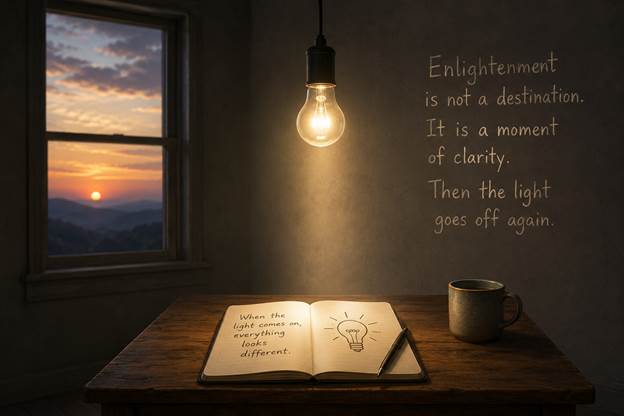
Most of us have experienced something similar, and I prefer the simple analogy of walking into a dark room and turning on a light. Before turning on the light, everything in the room was already there. The doors, windows, tables, chairs, and other objects existed whether we could see them or not. Turning on the light did not create anything. It simply allowed us to perceive what had previously been hidden by darkness.

Sometimes understanding works much the same way. Suddenly we see something that we did not see before. We might wonder how we could have missed something that now seems so obvious. The information may have been available to us for years, but for whatever reason we were not yet capable of seeing it from that particular perspective. We often call these “lightbulb moments.” Perhaps, at least temporarily, we might also call them moments of enlightenment.

There is another part of this analogy that I find equally important. The light does not necessarily stay on. Someone can have a profound realization during meditation, while practicing tai chi or qigong, walking through nature, recovering from an illness, traveling, losing someone they love, becoming a parent or grandparent, reading a book, talking with a friend, or simply sitting quietly and thinking. For a moment, something becomes remarkably clear. Then everyday life returns.

The bills still need to be paid. Someone cuts us off in traffic. Our body hurts. We become impatient with another person. We worry about tomorrow. Someone challenges one of our beliefs and we immediately become defensive. The supposedly enlightened human being suddenly looks remarkably human again. This does not necessarily invalidate the earlier experience. It may simply demonstrate that insight and wisdom are not always permanent states.

Even contemplative traditions that place great importance on awakening frequently emphasize continued practice rather than treating insight as permission to stop learning. Buddhist traditions themselves contain numerous interpretations of awakening and enlightenment, and they do not all describe the process in precisely the same way (Gethin, 1998). This alone should make us somewhat cautious about declaring exactly what enlightenment must look like.

Perhaps there is another possibility worth considering. As people become more curious, observant, reflective, and willing to question their own assumptions, these moments may begin occurring more frequently. Experience itself does not automatically produce wisdom. Someone can repeat the same mistake for forty years and simply become very experienced at making the same mistake. Reflection matters.

Psychological research distinguishes between merely accumulating experiences and developing wisdom through the way those experiences are interpreted. Wisdom has been associated with qualities such as reflection, compassion, emotional regulation, tolerance for uncertainty, and the ability to recognize multiple perspectives (Ardelt, 2003; Grossmann et al., 2020). Knowledge tells us things. Experience exposes us to things. Reflection helps us understand what those things might mean. Wisdom may gradually emerge from the interaction of all three.

This may explain why certain experiences that seemed insignificant when we were younger suddenly make sense decades later. The information did not necessarily change. We changed. Sometimes I think wisdom involves repeatedly walking through the same room and discovering another light switch.

There is also an interesting paradox that comes with all of this. The moment someone announces that they have become enlightened, I tend to become somewhat cautious. Claims of extraordinary wisdom or spiritual attainment can create authority. If other people accept that an individual possesses knowledge, awareness, or consciousness beyond their own, questioning that person can become increasingly difficult. This can be particularly relevant within spiritual communities, martial arts organizations, wellness movements, philosophical schools, and other groups built around respected or charismatic teachers.

A teacher may indeed possess extraordinary knowledge in certain areas. That does not mean that person possesses extraordinary knowledge in every area. Expertise is not omniscience. Wisdom is not infallibility. And enlightenment, however we choose to define it, should probably not provide immunity from reasonable questions.

There is even a psychological problem that can occur when we begin believing that we have finally figured everything out. Human beings remain vulnerable to confirmation bias, overconfidence, motivated reasoning, and numerous other cognitive tendencies that influence how we interpret information (Kahneman, 2011). Years of study do not necessarily make these tendencies disappear.

Ironically, believing ourselves to be permanently enlightened could become another obstacle preventing us from seeing what remains hidden. Perhaps one characteristic of wisdom is recognizing just how much remains unknown. This brings me back to another question that has always interested me. Who gets to decide what qualifies as enlightenment?

One person’s profound spiritual revelation may seem perfectly ordinary to someone else. A person may experience an overwhelming realization that everything in nature is interconnected. A biologist or ecologist might respond that ecosystems have demonstrated interdependence all along. Someone may suddenly realize that possessions do not create lasting happiness, while a philosopher may have reached that conclusion decades earlier. Someone else may discover through meditation that thoughts arise and disappear without necessarily requiring action, while a psychologist familiar with mindfulness may consider this a well-established observation. Does the fact that someone else already understands something make another person’s realization less meaningful? I do not think so.

Understanding is personal. Knowing something intellectually and realizing it through experience are not necessarily the same thing. We can tell someone for years that life is temporary. They understand the words. They may even agree with them. Then someone close to them dies, they survive a serious accident, their children grow up and leave home, they retire from a lifelong career, or they suddenly recognize their own aging in the mirror. The words have not changed. Their understanding has. The light came on.

This is perhaps why one person’s nirvana may be another person’s typical Tuesday afternoon. What is profound to one person may seem obvious to another because we are all arriving at these realizations from different starting points. We carry different experiences, different beliefs, different educations, different cultures, different hardships, and different levels of awareness. Perhaps we also make enlightenment unnecessarily exotic.

Maybe enlightenment does not always require mountaintops, monasteries, gurus, secret teachings, or decades of esoteric study. Perhaps some of our most meaningful moments of enlightenment occur while washing dishes, teaching a class, walking through the woods, talking with our children, practicing a familiar exercise, sitting beside someone who is dying, traveling through an unfamiliar country, or simply recognizing that something we believed for many years was incorrect. That last example may be particularly important. There is a certain freedom in being able to say, “I was wrong.”

That simple statement may represent a greater degree of awareness than defending an old belief simply because we have invested years of our lives in it. Real learning frequently requires revising our existing understanding rather than merely adding more information to what we already believe. Sometimes growth occurs because we discover something new. At other times, growth occurs because we finally become willing to let go of something old. Both can turn on another light.

After decades of studying martial arts, Eastern philosophy, mind-body practices, holistic health, psychology, and simply observing people, I have become increasingly comfortable with the possibility that enlightenment may not be an all-or-nothing condition. Perhaps we do not become enlightened once and remain that way forever. Perhaps we become enlightened for a few seconds. Maybe for several minutes. Occasionally perhaps for an afternoon, or during some particularly meaningful period of our lives. Then we return to being ordinary human beings again, carrying our habits, emotions, assumptions, strengths, weaknesses, and unfinished business along with us. Over time, however, perhaps the lights begin coming on more frequently.

Through practice, reflection, curiosity, humility, experience, and a willingness to reconsider what we think we already know, we may begin noticing things that were previously hidden from us. The room becomes brighter. Then we discover another room. And perhaps another after that. Eventually we may realize that there was never going to be a final room where all of the answers were waiting for us.

I find something encouraging about this way of looking at enlightenment. It makes enlightenment less of a trophy reserved for a select few and more of an ongoing human possibility. We do not need to prove that we have reached some ultimate state of consciousness. We do not need to convince others that we possess secret knowledge. We simply need to remain receptive enough to recognize those moments when something becomes clearer than it was before. Maybe that is enough.

The universe, nature, society, relationships, our bodies, and our own minds seem to provide endless opportunities for observation, learning, questioning, and reconsideration. Some of those opportunities are dramatic. Most are probably quite ordinary. Many may pass directly in front of us without our ever recognizing them.

The challenge may simply be remaining open enough to notice when another light comes on. And perhaps there is a final paradox in all of this. The more lights we turn on, the more clearly we may see just how much remains in the dark.

References

Ardelt, M. (2003). Empirical assessment of a three-dimensional wisdom scale. Research on Aging, 25(3), 275–324. https://doi.org/10.1177/0164027503025003004

Gethin, R. (1998). The foundations of Buddhism. Oxford University Press.

Grossmann, I., Weststrate, N. M., Ardelt, M., Brienza, J. P., Dong, M., Ferrari, M., Fournier, M. A., Hu, C. S., Nusbaum, H. C., & Vervaeke, J. (2020). The science of wisdom in a polarized world: Knowns and unknowns. Psychological Inquiry, 31(2), 103–133. https://doi.org/10.1080/1047840X.2020.1750917

Kahneman, D. (2011). Thinking, fast and slow. Farrar, Straus and Giroux.

Kounios, J., & Beeman, M. (2014). The cognitive neuroscience of insight. Annual Review of Psychology, 65, 71–93. https://doi.org/10.1146/annurev-psych-010213-115154

The Healer as a Teacher: Helping Others Learn to Heal Themselves

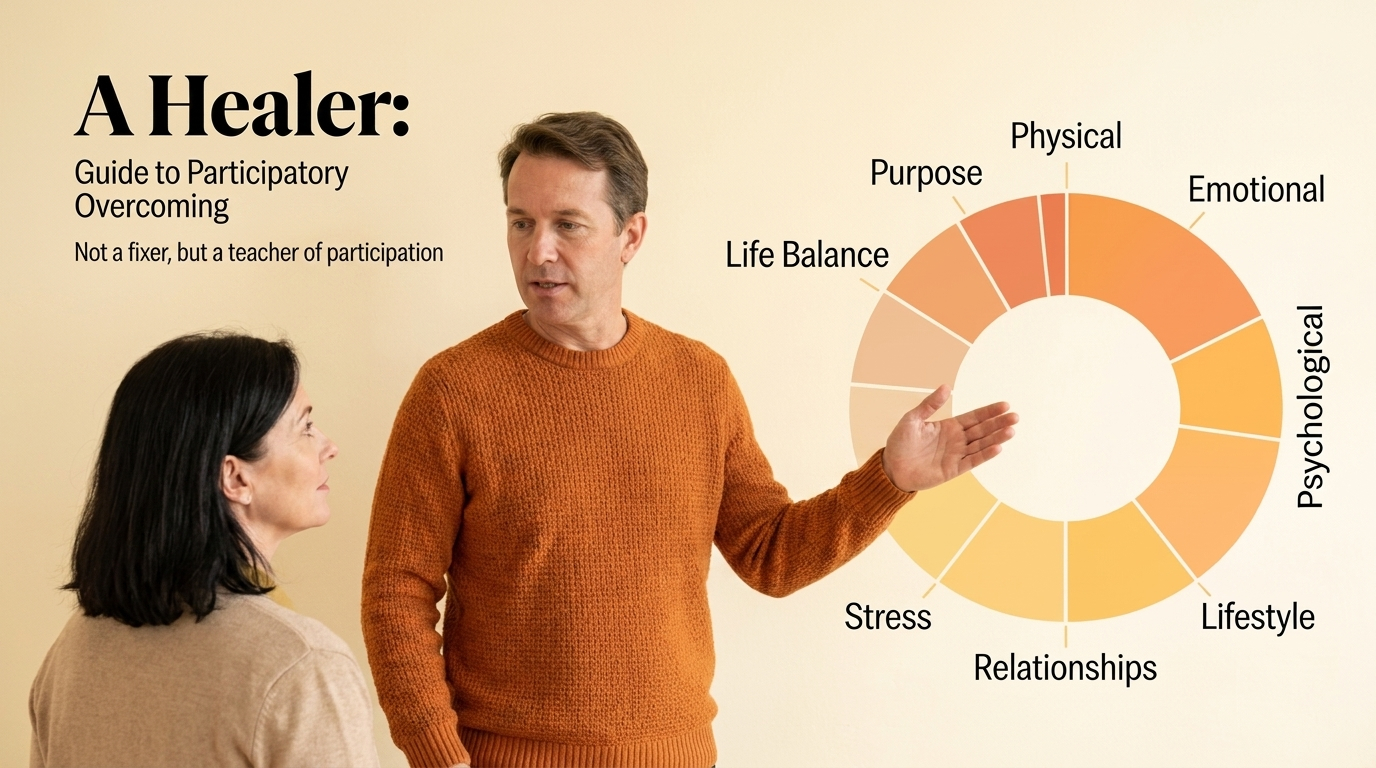
Over the years, my understanding of what it means to be a healer has changed considerably. When many people hear the word healer, they may picture someone who possesses a special ability to cure another person, remove their pain, correct their illness, or somehow make them whole again. In this model, the healer does the healing while the person in need receives it. One person is active, while the other is largely passive. That has never completely fit with how I have come to understand healing.

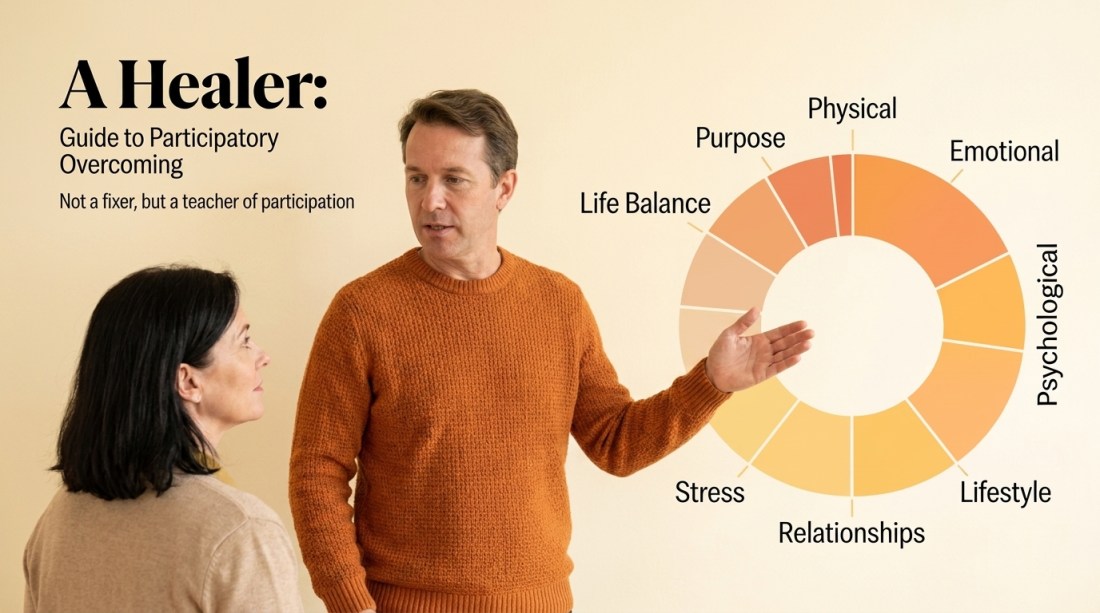
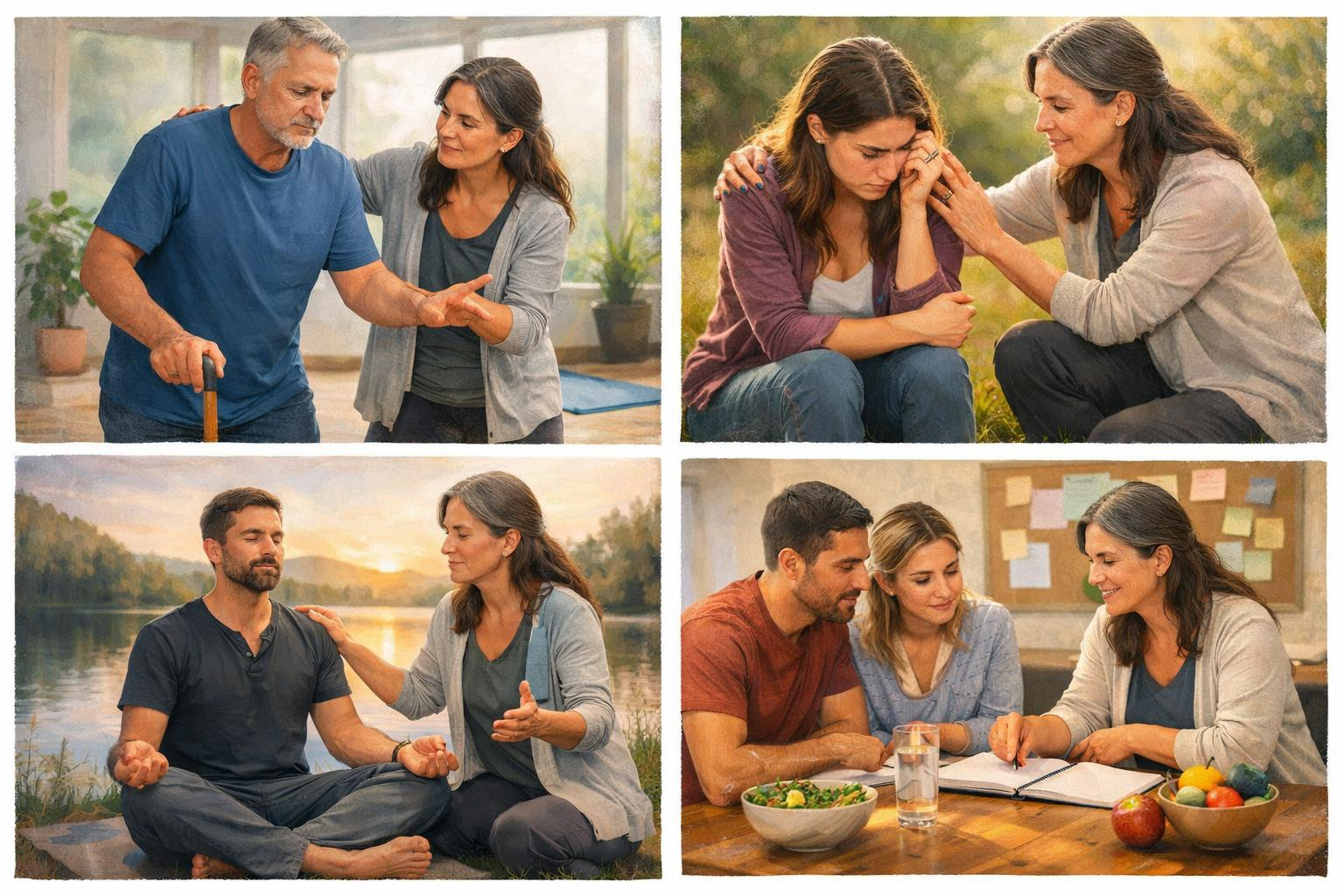
My definition of a healer is not necessarily someone who cures or fixes another person. Rather, I see a healer as someone who shows, helps, guides, or teaches another person how to participate more fully in overcoming whatever may be troubling them. Sometimes that trouble is physical. Sometimes it is emotional or psychological. Sometimes it involves lifestyle, relationships, stress, purpose, or simply the realization that the way we have been living is no longer working very well. This distinction may seem subtle, but I believe it is important.

A healer can provide knowledge, encouragement, perspective, techniques, and perhaps even treatment. But ultimately, much of the work of healing still takes place within the individual.

I often think of something as simple as preparing a meal. I can teach someone how to make a healthy meal. I can explain the ingredients, demonstrate how to prepare them, discuss why certain foods may be beneficial, and perhaps even stand beside that person while they cook. But at some point, they have to make the meal themselves. More importantly, I cannot eat the meal for them and somehow transfer the nutritional benefits into their body. Their body has to chew it, digest it, absorb it, and make use of what has been provided. Healing often works in much the same way.

A physician can explain why someone needs to exercise, but the physician cannot perform the exercise for the patient. A physical therapist can teach movements that may restore strength and mobility, but the therapist cannot make the muscles stronger without the patient’s participation. A counselor can help someone recognize unhealthy patterns of thought or behavior, but eventually that person must practice responding differently when those patterns appear in everyday life.

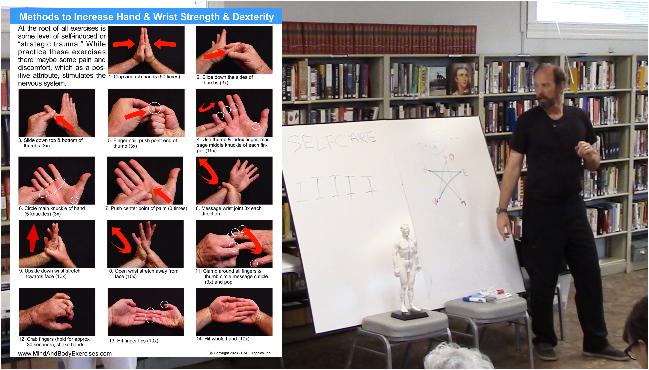
The same is true within many of the practices I have studied and taught over the years. I can teach someone tai chi, qigong, breathing exercises, meditation, stretching, strengthening, posture, relaxation, or other methods of self-care. I can explain the principles behind them and help correct mistakes. I can encourage someone when progress seems slow. But I cannot practice for them.

That is where I believe an important part of healing is sometimes overlooked.

We have become accustomed to thinking of health care as something that is primarily done to us. We go somewhere, receive something, and hopefully leave feeling better. Certainly, there are situations where this is exactly what is needed. If I break a bone, suffer a serious infection, require surgery, or experience a medical emergency, I am very grateful that trained professionals can intervene. There are times when another person’s expertise and intervention may literally save our lives.

But that is only one part of the much larger picture of health and healing.

There is also the enormous territory between being perfectly healthy and experiencing a medical emergency. This is where we live most of our lives. It includes how we sleep, breathe, move, eat, manage stress, maintain relationships, respond to setbacks, use our bodies, and care for ourselves day after day. No practitioner can completely control those things for another person.

This is why I tend to think of the healer as being closer to a teacher, guide, or facilitator than a repair technician. A good teacher does not simply give students answers. A good teacher helps students develop the ability to find answers themselves. In the same way, a good healer should ideally help people develop greater awareness and greater participation in their own well-being.

This does not mean blaming people for becoming sick or suggesting that every illness can be overcome through positive thinking, exercise, diet, or self-discipline. Biology is far more complicated than that. Genetics, injury, aging, infection, environment, socioeconomic circumstances, and simple chance can all affect our health. There are conditions that cannot simply be exercised, meditated, or breathed away. But recognizing those realities does not mean that personal agency disappears.

There is usually a difference between asking, Who is going to fix me? and asking, What can I do to participate in getting better?

That second question can change the relationship between the practitioner and the person seeking help.

Instead of saying, “Heal me,” we begin asking, “Teach me.”

Teach me what I can do.

Teach me what I may be doing that is making the situation worse.

Teach me what signs I should pay attention to.

Teach me how to move differently.

Teach me how to breathe differently.

Teach me how to strengthen what has become weak.

Teach me how to recognize when I need professional help and when I can safely help myself.

This type of relationship does not diminish the importance of physicians, therapists, counselors, teachers, coaches, or other practitioners. I believe it actually makes their knowledge more valuable because their expertise becomes something that can continue working through the individual long after an appointment, treatment, or class has ended.

This has always been one of the things that appeals to me about teaching mind-body practices. If I teach someone a simple breathing exercise that helps them calm themselves during stressful situations, they now possess a tool that can potentially be used for the rest of their life. If I teach an older adult how to improve balance and leg strength, that knowledge does not belong to me anymore. It belongs to them. If someone learns how to recognize unnecessary tension in their shoulders, change their posture, move more efficiently, or calm their breathing, they have gained something far more valuable than simply receiving temporary relief.

They have gained another degree of independence.

Perhaps this is one of the differences between treatment and healing. Treatment may sometimes be something we receive. Healing, however, often requires participation.

Even the word practice tells us something important. We practice tai chi. We practice qigong. We practice meditation, better eating habits, communicating with others, managing stress and becoming more aware of what our bodies and minds are telling us.

There is rarely a point where someone announces, “That’s it. I have mastered my health and never have to think about it again.” Life keeps changing, and so do we.

What worked for us at twenty may not work the same way at forty. What worked at forty may require modification at sixty, seventy, or eighty. Injuries happen. Responsibilities change. Stress comes and goes. Our bodies age. Our priorities shift. The person who understands how to participate in their own well-being is better equipped to adapt to these changes than someone who has always expected another person to provide the solution.

This is also why I am cautious about placing healers on pedestals. The idea that another person possesses some special knowledge or power that we cannot possibly understand can easily create dependency. Certainly, expertise matters. Someone who has spent decades studying medicine, physical therapy, psychology, nutrition, martial arts, traditional practices, or any other discipline should know considerably more about that subject than the average person.

But expertise should ideally empower others rather than make them permanently dependent upon the expert.

The best teachers I have encountered throughout my life did not seem interested in keeping knowledge locked away. They wanted students to understand it, test it, practice it, question it, and eventually make it their own. Their success was not measured by how helpless their students remained without them. It was measured, at least in part, by how capable their students became. I believe healing can follow a similar philosophy.

Perhaps one of the greatest things a healer can eventually hear is, “I know what to do now.” That does not mean the person will never need help again. None of us becomes completely independent. We all need teachers, physicians, friends, family members, mentors, and communities at different times throughout our lives. Independence and interdependence can exist together.

But there is an enormous difference between receiving help and surrendering responsibility. I can point toward the path. I can walk beside someone for part of the journey. I can share what I have learned from my own experience and from the teachers who came before me. I can offer tools, encouragement, and perspective. But eventually, each person has to take their own steps.

Just as I cannot eat your meal and digest it for you, I cannot exercise your muscles for you, breathe your breaths for you, change your habits for you, or live your life for you.

Perhaps what a true healer does is not say, “I will heal you.”

But someone who says, “Let me show you what you may be able to do for yourself.”

To me, that is not a lesser form of healing. It may be one of its most meaningful forms, because instead of simply helping someone feel better today, we may be helping them become more capable of caring for themselves tomorrow.

Yin and Yang: Understanding the Degrees Between the Opposites

When people are first introduced to the concept of yin and yang, it is easy to see it simply as a philosophy of opposites. Yin is often represented as dark, while yang is light. Yin is stillness, while yang is movement. Yin is inward, while yang is outward. Yin is soft, while yang is hard. These comparisons are useful when we are first learning the concept, but yin and yang become much more interesting when we stop thinking about them as simply black and white. Between the two extremes are countless degrees of difference.

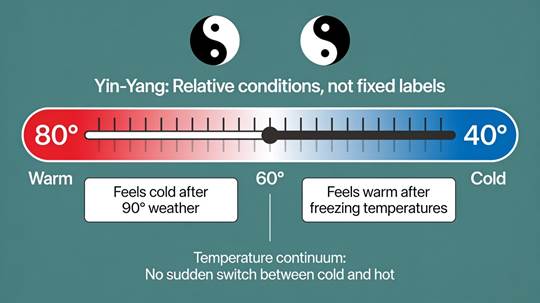
One of the easiest ways I have found to explain this is to think about a thermometer. We might say that 80 degrees is warm and 40 degrees is cold, but what about everything in between? There is no magical point where cold suddenly becomes hot. Temperature moves through degrees along a continuum. Even our perception of temperature depends upon what we are comparing it to. Sixty degrees may feel cold after several days of 90-degree weather, while the same 60 degrees may feel wonderfully warm after several weeks of freezing temperatures. Yin and yang can be understood in much the same way. They describe relative conditions rather than permanent labels.

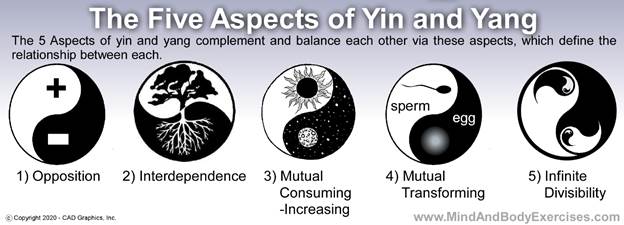
This becomes clearer when we consider what I refer to in my teaching as the five manifestations or relationships of yin and yang: opposition, interdependence, mutual consuming and increasing, mutual transformation, and infinite divisibility. These concepts help move our understanding beyond the familiar black-and-white yin-yang symbol and into something we can actually observe throughout nature and our own lives.

Opposition is probably the easiest manifestation to recognize. Day and night, activity and rest, heat and cold, expansion and contraction all demonstrate contrasting qualities. Yet opposition does not necessarily mean conflict. The two sides actually help us recognize and define one another. We understand darkness partly because we have experienced light, and we recognize stillness because we understand movement.

This leads naturally into interdependence. Yin and yang do not exist independently of one another. We cannot meaningfully describe something as hot without having some concept of cold. Movement is understood in relation to stillness, just as day has meaning partly because there is night. Each side provides a reference point for the other. This is one reason yin and yang should not be viewed as competing forces where one side must eventually defeat the other. Their relationship is complementary.

The manifestation I find especially useful when discussing the stages of our lives is mutual consuming and increasing. This describes how, as one aspect increases, the other relatively decreases. We can observe this simply by watching a day unfold. As morning progresses toward midday, the yang qualities of light, warmth and activity generally increase. As afternoon moves toward evening, these qualities begin to decline while the yin qualities of darkness, coolness and rest gradually increase.

There is no precise moment when day suddenly becomes night. Sunrise itself is a transition. Darkness gradually gives way to light. The sun rises higher, the air warms and activity increases. Later, the process reverses. The sun descends, shadows become longer, temperatures begin dropping and eventually darkness returns. Yang has gradually decreased while yin has increased. Then, during the night, the process eventually begins moving in the opposite direction again.

This is very similar to the thermometer. The temperature does not have to drop from 80 degrees to 60 degrees. It passes through 79, 78, 77 and all of the smaller measurements in between. Nature tends to move through transitions rather than constantly jumping between absolutes. Yin and yang provide a philosophical way of describing these changing relationships.

This also helps us understand why balance does not necessarily mean maintaining a perfect 50/50 relationship between yin and yang. Nature rarely seems interested in remaining perfectly balanced in that sense. Summer does not contain exactly the same amount of warmth and daylight as winter. Noon does not contain the same amount of light as midnight. The relationship is constantly adjusting. Balance, therefore, can be dynamic rather than static.

We can see this same process across the course of a human lifetime. The earlier stages of life tend to contain many yang characteristics. Children run, climb, jump, explore and seemingly move simply for the sake of moving. Young adults often continue this outward expansion as we build careers, raise families, compete, travel, accumulate experiences and test ourselves against the world. There is often considerable emphasis upon doing, achieving and moving outward into life.

As we grow older, the proportions may gradually change. This does not happen on a particular birthday, nor do we suddenly become “yin” because we have reached a certain age. Instead, the degrees begin shifting. We may become more selective about where we spend our physical and emotional energy. Physical training may gradually shift from concerns about how much weight we can lift, how fast we can run or how hard we can strike toward maintaining mobility, balance, coordination, breathing, posture and overall health.

Our priorities may change as well. Experiences can become more important than possessions. Understanding may become more valuable than proving ourselves correct. Listening can become as important as speaking, and reflection may begin accompanying action. This can be viewed as another example of mutual consuming and increasing. Some of the yang characteristics that dominated earlier stages of life may gradually decrease while certain yin characteristics increase.

Of course, this does not mean that older people are yin and younger people are yang. That would simply return us to the black-and-white thinking we are trying to move beyond. A 70-year-old lifting weights or hiking a mountain is expressing relatively yang qualities. That same person sitting quietly afterward, practicing breathing exercises or reflecting upon the day’s experiences is expressing relatively more yin qualities. Likewise, a young martial artist practicing a slow tai chi form may be expressing more yin qualities than an older practitioner performing vigorous strength training. Yin and yang always depend upon what we are comparing.

This is also where infinite divisibility becomes important. Even something we categorize as yang contains different degrees of yin and yang within itself. Exercise may generally be considered yang compared with sitting quietly, but walking is relatively yin compared with sprinting. Jogging might be more yang than walking but more yin than running at full speed. We can continue making these distinctions almost indefinitely. The same principle applies to yin. Sitting quietly may be yin compared with walking, while deep sleep may be even more yin compared with sitting awake. Every time we divide something into yin and yang, those divisions can themselves be divided again.

The principle of mutual transformation takes this relationship another step further. Under the appropriate circumstances, yin can transform into yang and yang into yin. Night eventually becomes day, just as day eventually becomes night. Vigorous activity eventually creates the need for rest, while sufficient rest restores our capacity for activity. Winter eventually gives way to spring, and the quiet dormant period of nature becomes the foundation for renewed growth.

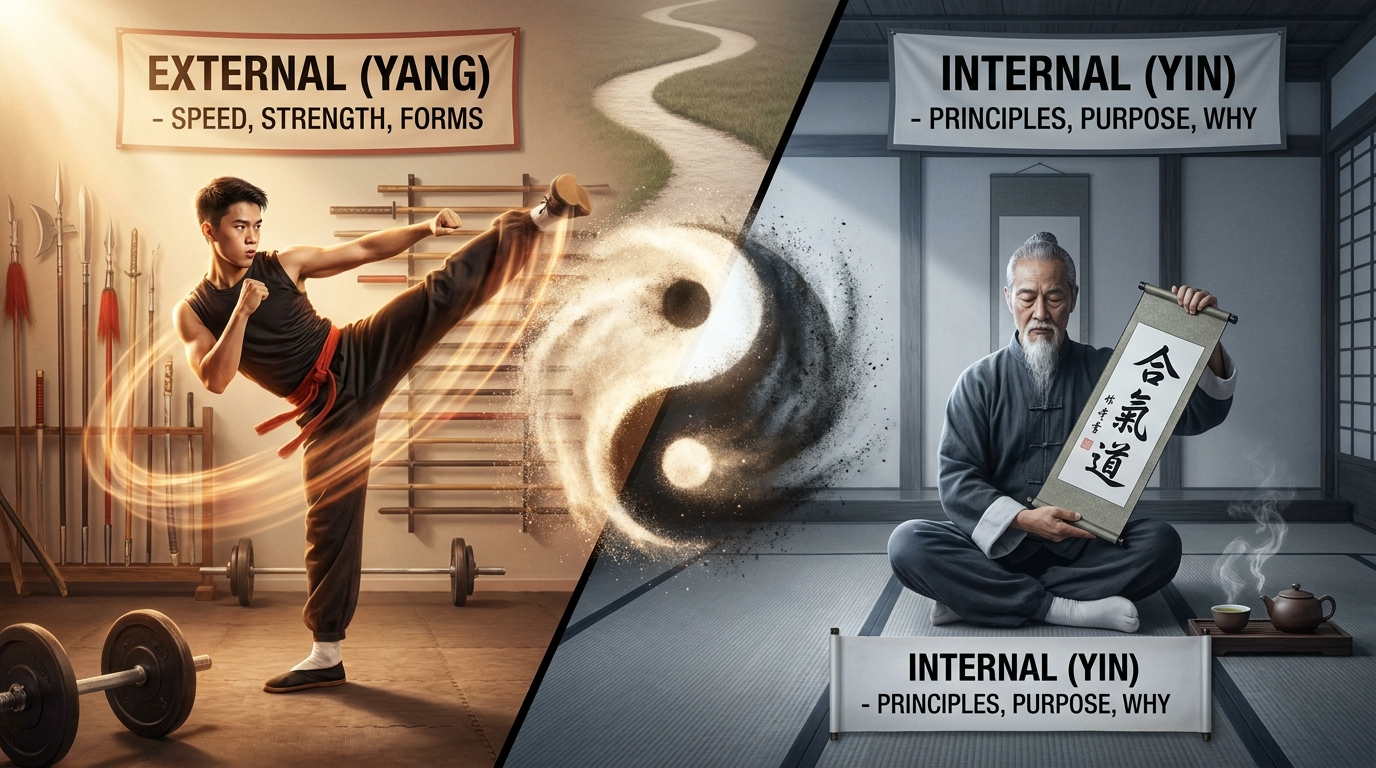
I have noticed a similar transformation within martial arts and mind-body practices. When we are younger, we may be fascinated primarily by speed, strength, flexibility, techniques, forms, fighting applications and physical accomplishments. We want to learn more and do more. Over time, however, some practitioners begin asking different questions. Instead of simply asking how to perform a movement, we begin asking why we are performing it. Instead of constantly collecting another form, another technique or another exercise, we may spend considerably more time examining the principles contained within movements we already know.

The external practice gradually creates an opportunity for internal observation. Tai chi, qigong, yoga, meditation and many traditional martial arts contain this possibility. At first we may be concerned primarily with what our body looks like from the outside. Where does the foot go? Where should the hand be? How low should the stance be? Eventually our attention may begin turning inward toward what the movement actually feels like, where we are holding unnecessary tension, how our breathing changes and whether we can sense our balance shifting before we lose it. The exercise may look almost identical from the outside, yet the experience occurring within the practitioner may be considerably different.

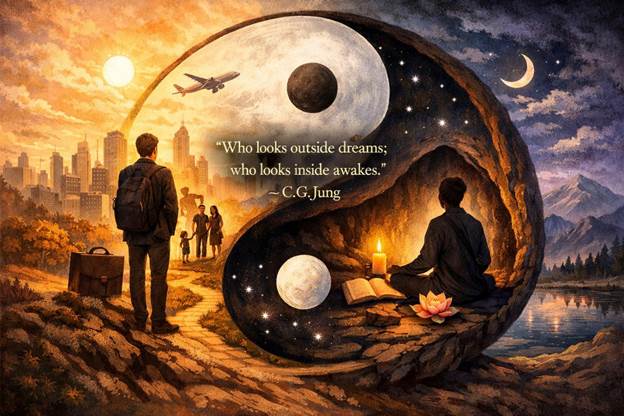
This brings us to an observation from the Swiss psychiatrist Carl Jung. In a 1916 letter, Jung wrote, “Who looks outside dreams; who looks inside awakes.” The statement appeared within a longer discussion about the importance of turning attention inward and examining oneself (Jung, 1973). I think this provides an interesting bridge between Western psychology and some of the ideas we encounter within yin-yang philosophy.

Much of our younger life is understandably directed outward. We wonder what we can accomplish, what we can obtain, where we can go and what we can become. We are concerned with establishing ourselves within families, careers and communities. These are not foolish or superficial concerns. They are important parts of interacting with the world and developing ourselves within it.

Over time, however, another set of questions may become increasingly important. Why do I believe what I believe? Why do certain situations bother me? Why have I repeatedly made some of the same choices? What have my experiences actually taught me? What should I continue carrying with me, and what should I finally let go? These are quieter and more inward-looking questions. In that sense, looking outward might be considered relatively more yang, while looking inward and reflecting upon ourselves might be considered relatively more yin.

Neither direction is necessarily superior. Too much outward activity without reflection can leave us constantly busy without understanding why we are doing what we are doing. Too much inward reflection without action can leave us contemplating life without actually living it. There are times to act and times to wait, times to speak and times to listen, times to push ourselves and times to recover. There are times to experience the world around us and times to consider what those experiences have taught us.

Even within a single day, we continually move through these degrees. We awaken from the relatively yin state of sleep and become increasingly yang as we get out of bed and begin moving. We work, exercise, interact with people and engage the outside world. Eventually activity begins to decline. Evening arrives, the lights dim, conversations quiet down and the body prepares for sleep. Yang gradually decreases as yin increases. Then morning comes and the cycle begins again.

Perhaps this is one of the most practical lessons contained within yin-yang philosophy. Life is rarely absolute. We like categories because they make the world easier to understand: hot or cold, strong or weak, active or passive, young or old, healthy or unhealthy. But much of human experience exists somewhere between these extremes.

The five manifestations of yin and yang help us understand why. Opposites define one another. They depend upon one another. As one increases, the other relatively decreases. Under the appropriate circumstances, one can transform into the other. And within every distinction we make, further degrees of yin and yang can still be discovered.

As we move through life, our own relationship between these qualities changes as well. What served us at 25 may not serve us in exactly the same way at 65. That does not necessarily mean that something has been lost. It may simply mean that our position along the continuum has changed. The outward journey can gradually become accompanied by a deeper inward journey. Movement becomes increasingly balanced by stillness, speaking by listening, doing by reflecting and accumulating experiences by trying to understand what those experiences actually mean.

Perhaps wisdom itself involves becoming increasingly comfortable with these changing degrees. Yin and yang remind us that we do not always have to choose one side and reject the other. Instead, we can learn to recognize where we are at a particular moment, what the circumstances require and when the balance may naturally begin moving in another direction.

Just as daylight gradually becomes darkness, summer eventually gives way to winter, activity leads toward rest and rest eventually prepares us for activity again, our lives continue to move through different degrees of yin and yang.

The degrees are always changing, and so are we.

Reference

Jung, C. G. (1973). Letters of C. G. Jung: Volume 1, 1906–1950 (G. Adler & A. Jaffé, Eds.; R. F. C. Hull, Trans.). Princeton University Press. (Original letter written October 22, 1916)

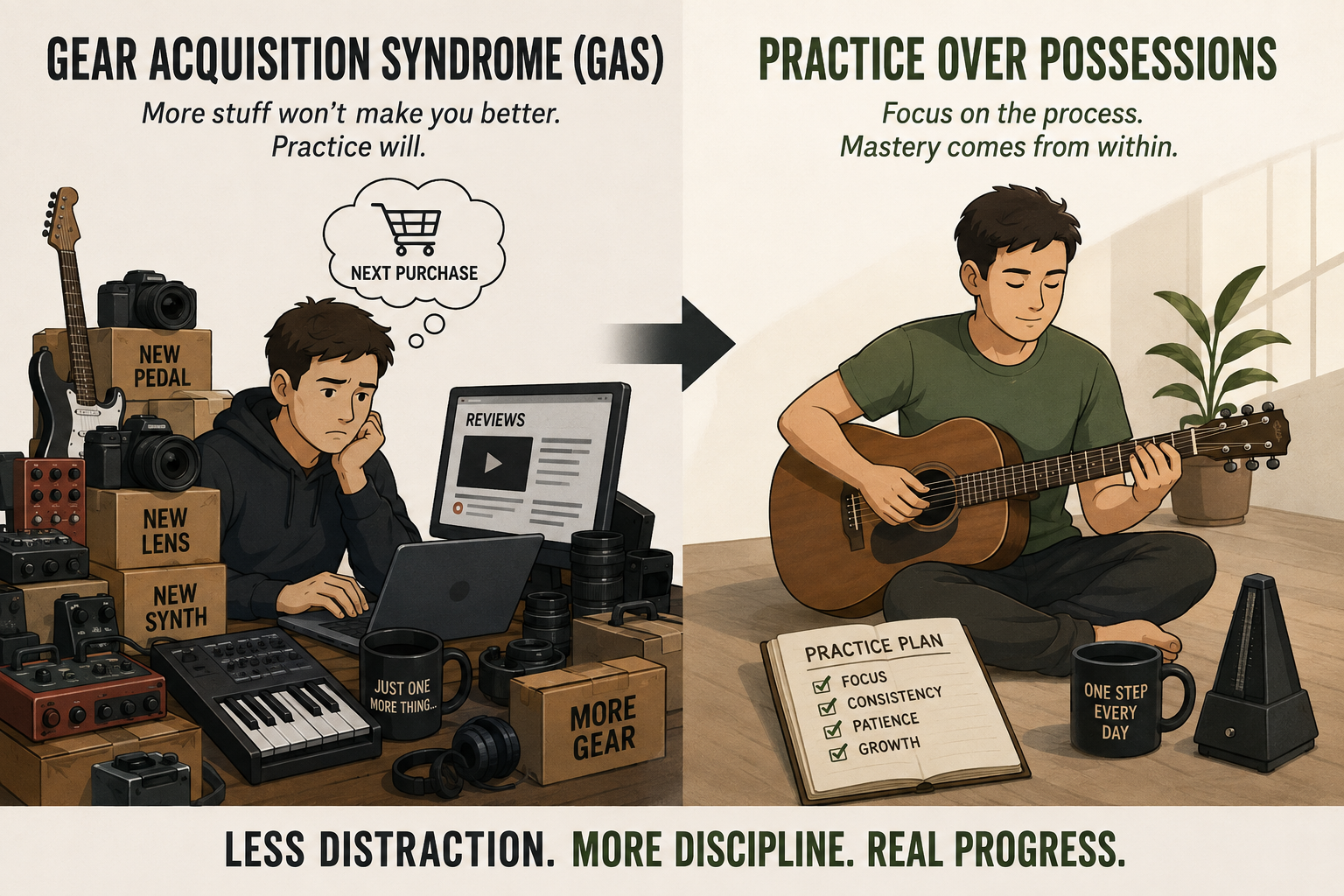
Gear Acquisition Syndrome: When Acquiring More Replaces Becoming More

There is nothing inherently wrong with having good equipment. A musician needs an instrument, a photographer needs a camera, a martial artist may benefit from training equipment, and someone exercising at home may reasonably purchase weights or other useful tools. Likewise, there is nothing wrong with continuing our education, attending seminars, studying with different teachers, or expanding our knowledge.

The problem begins when acquiring more becomes a substitute for developing what we already have.

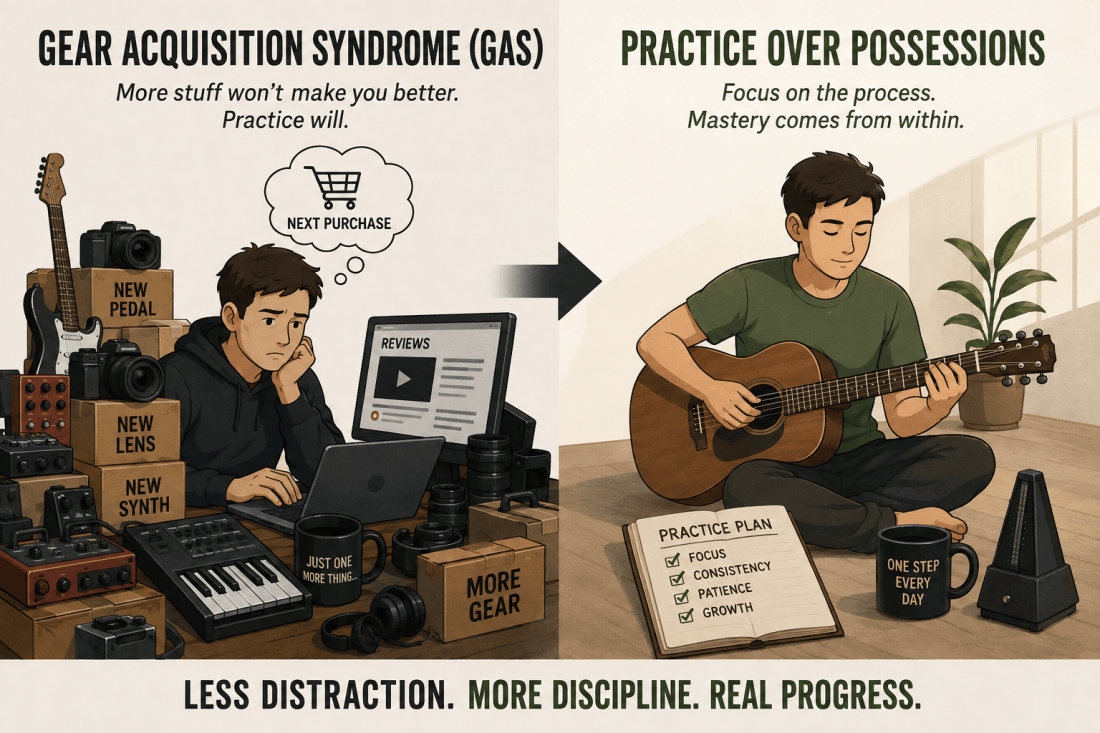
There is a somewhat humorous term for one version of this tendency: Gear Acquisition Syndrome, commonly abbreviated GAS. The expression originated among musicians and was initially associated with “Guitar Acquisition Syndrome.” It eventually broadened into “Gear Acquisition Syndrome” as people recognized that the behavior extended well beyond guitars. Researcher Jan-Peter Herbst examined the phenomenon among electric guitar players and described GAS as the persistent desire to acquire equipment, often connected with expectations concerning sound, creativity, identity, or satisfaction (Herbst, 2017).

Gear Acquisition Syndrome is not a recognized psychiatric diagnosis. The word “syndrome” is being used somewhat tongue-in-cheek. Nevertheless, the behavior describes something very real about human nature, and I believe the principle extends well beyond simply buying things.

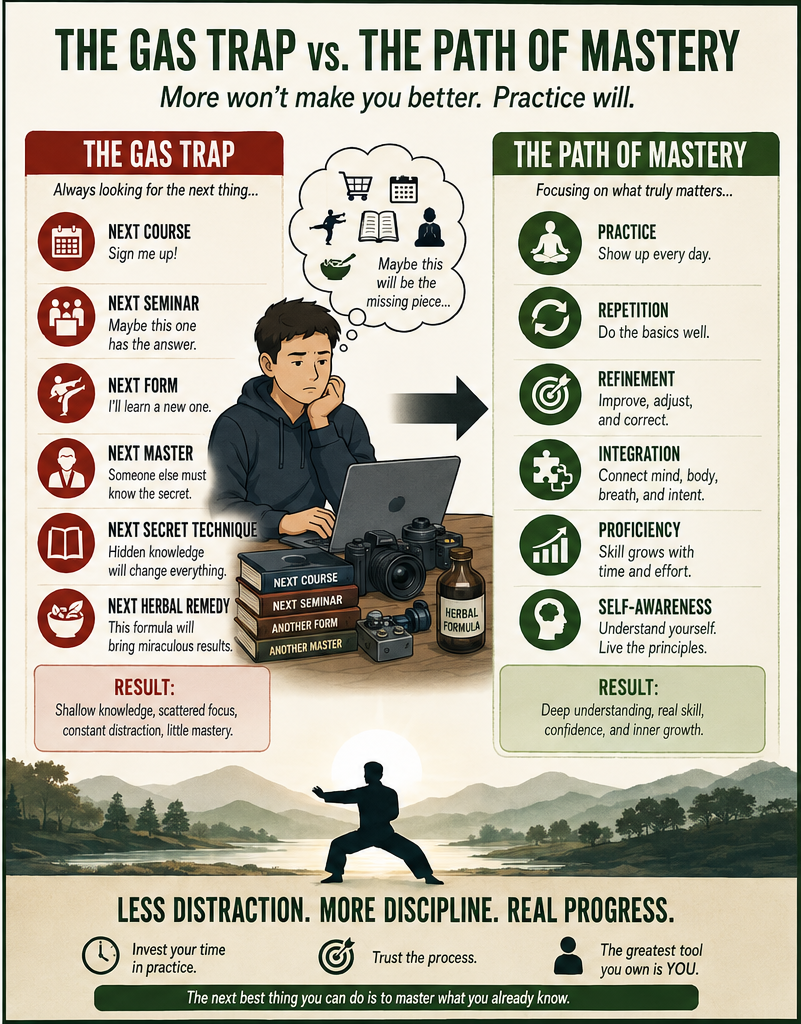
Sometimes the “gear” we acquire is not physical equipment at all. It may be another technique, another form, another seminar, another certification, another teacher, another herbal formula, or another supposedly secret body of knowledge. In each case, the important question may be whether we are acquiring something because it genuinely contributes to our development, or because acquiring something new feels like development.

Those are not necessarily the same thing.

The Attraction of the Next Thing

Most of us have experienced the excitement of getting something new. We research it, compare alternatives, read reviews, watch videos, and imagine what we will be able to accomplish once we finally have it.

Part of this attraction involves anticipation itself. Dopamine is often casually described as a “pleasure chemical,” but its role is considerably more complicated. Dopamine is involved in motivation, reward learning, anticipation, and behaviors directed toward potentially rewarding outcomes (Berridge & Robinson, 2016). In other words, the hunt itself can become rewarding.

This may explain why researching and anticipating a purchase can sometimes be more exciting than owning it. The item arrives, the novelty eventually fades, and before long our attention turns toward something else.

There is nothing particularly unusual about enjoying something new. Problems arise when we repeatedly confuse novelty with progress.

This can also become a subtle form of procrastination because acquisition often feels productive. Someone may spend hours researching exercise equipment while doing very little exercise. A musician can study amplifiers instead of practicing. A martial artist can spend an evening researching training equipment while neglecting the exercises already available to them.

Because the activity is related to the goal, it can masquerade as progress.

Researching the method is not practicing the method. Buying the tool is not developing the skill. Preparing to begin is not necessarily beginning.

Eventually information has to become application.

When Knowledge Becomes Another Possession

I have seen another version of this throughout the martial arts world. In this case, the person may not be collecting equipment at all. They may be collecting knowledge.

Some martial arts enthusiasts seem to be continually pursuing the next course, the next seminar, the next form, the next system, or the next master. They barely finish learning one form before wanting another. They return from one seminar and immediately begin looking for the next. They accumulate techniques, certificates, memberships, books, videos, and associations with respected teachers.

There is certainly nothing wrong with continuing to learn. Much of my own life has involved studying different martial arts, health practices, philosophies, and mind-body disciplines. Exposure to different teachers and perspectives can broaden our understanding and can sometimes help us recognize misconceptions that we previously accepted.

But there is a difference between breadth of exposure and depth of understanding.

Someone may know the choreography of twenty forms without being particularly proficient in any of them. Another person may have attended dozens of seminars while rarely practicing the material once the seminar is over. Someone else may possess numerous certificates while still struggling with basic posture, balance, timing, breathing, coordination, or movement.

This creates an interesting paradox. A person can continually become more knowledgeable without necessarily becoming more capable.

Knowledge acquisition and skill acquisition overlap, but they are not identical.

Sometimes the constant pursuit of something new can actually prevent us from discovering what is contained within something old. A relatively simple exercise practiced for years may reveal subtleties that were completely invisible when we first learned it. The exercise has not changed. We have.

This is one reason returning to foundational material after many years of practice can be surprisingly enlightening. We are no longer the same student encountering the same information.

The Search for the Secret

Martial arts and traditional wellness practices introduce another variation of this tendency: the perpetual search for hidden knowledge.

There always seems to be another secret breathing method, qigong exercise, internal-energy practice, pressure point, lineage teaching, herbal formula, or method supposedly known only to a small group of advanced practitioners.

Sometimes traditional practices genuinely contain information unfamiliar to the general public. Historical martial arts and healing traditions often preserved and transmitted knowledge very differently from modern educational systems. We should therefore be careful about automatically dismissing something simply because it is unfamiliar.

At the same time, unfamiliarity is not evidence of effectiveness, and secrecy is not evidence of depth of wisdom.

The allure of secret knowledge can become its own version of Gear Acquisition Syndrome. Instead of purchasing another piece of equipment, we acquire another concept or another promise. Somewhere in the background is the hope that perhaps this will finally be the missing piece.

The same tendency can appear in the wellness world. Someone may continually move from one supplement, herb, tea, mushroom, tincture, traditional formula, detoxification program, or healing method to another, hoping to discover something that will provide extraordinary benefits.

Traditional herbal medicine has a long history, and many plant compounds possess genuine biological and pharmacological activity. At the same time, herbal products can cause adverse effects and interact with medications, while claims about their effectiveness vary considerably in the quality of supporting evidence (Ekor, 2014).

The issue is therefore not whether herbs or traditional practices are good or bad. The more useful distinction is between seeking realistic benefits and miraculous ones.

When every new teacher, exercise, seminar, remedy, philosophy, or secret method is expected to contain the missing piece, perhaps it is worth considering whether the missing ingredient is something far less exciting: time, practice, patience, critical thinking, and consistency.

The Less Exciting Road to Proficiency

One of the difficulties with genuine skill development is that much of it is repetitive.

Knowing about a movement is different from being able to perform it. Performing it under comfortable conditions is different from performing it dynamically. Performing it dynamically is different from applying it against resistance. Eventually, something that initially required considerable conscious effort may become increasingly integrated through repetition and experience.

Research on expertise has long emphasized the importance of sustained and purposeful practice. Ericsson, Krampe, and Tesch-Römer (1993) famously examined the role of deliberate practice in developing expert performance. Later research challenged overly simplistic interpretations suggesting that practice alone explains expertise, but practice nevertheless remains an important contributor to performance and skill development (Macnamara et al., 2014).

Martial artists understood this principle long before psychologists studied expertise. Skill takes time. That simple reality is sometimes difficult to accept in a culture where almost everything else seems to be getting faster. Information that once required years to locate can now be found within seconds. Videos demonstrating thousands of exercises and martial arts forms are immediately available. Equipment can arrive at our homes the next day. Courses can be purchased instantly.

But our nervous system has not suddenly become an overnight delivery service. Muscles still require time to adapt. Coordination still requires repetition. Balance has to be challenged. Experience has to accumulate. Understanding often has to mature.

There are no certificates we can purchase that substitute for these processes, and there are no weekend seminars that eliminate them.

When the Tools Become the Identity

There is another side to this discussion that deserves consideration. Sometimes equipment and accumulated knowledge become part of how we see ourselves.

The clothing, books, weapons, certificates, gadgets, supplements, and other possessions associated with an activity can reinforce the feeling that we belong to that world. Psychological research has even examined how clothing may influence thoughts and behavior, a concept called enclothed cognition (Adam & Galinsky, 2012), although subsequent research suggests that these effects are more complicated and context-dependent than early findings implied (Burns et al., 2019).

There is nothing inherently wrong with enjoying the culture surrounding an activity. A martial artist may enjoy collecting weapons. A musician may simply love guitars. Someone may collect books knowing full well that they will never read all of them. Hobbies do not always have to justify themselves through productivity.

The important element is awareness.

There is a considerable difference between saying, “I enjoy collecting these things,” and convincing ourselves that owning them is making us more skilled.

Likewise, there is a difference between continuing our education because we genuinely want to broaden our understanding and constantly seeking another teacher because we believe the next person will finally reveal the secret that eliminates the need for patient practice.

Perhaps the Real Upgrade Is Ourselves

Before buying another piece of equipment, registering for another seminar, learning another form, or pursuing another secret method, perhaps the most useful question is simply: What limitation am I actually trying to solve?

Sometimes the answer really is equipment. Sometimes we genuinely need additional knowledge. Sometimes another teacher can provide a perspective that changes our understanding. Sometimes a seminar opens an entirely new direction for study. But sometimes the limitation is much closer to home.

Perhaps we have not practiced enough. Perhaps our fundamentals remain weak. Perhaps we have become bored with repetition. Perhaps we have accumulated far more information than we have integrated. Or perhaps searching for something new is simply more exciting than confronting our present level of ability. No purchase can permanently solve those problems.

This is why Gear Acquisition Syndrome can serve as a useful metaphor for something much larger than shopping. Human beings have a remarkable tendency to search outside ourselves for solutions to problems that require internal development. It can be easier to buy another book than apply the previous one, easier to attend another seminar than spend months practicing what we learned at the last one, and certainly more exciting to discover a secret technique than to practice a basic movement for the ten-thousandth time.

Yet the basics have an annoying tendency to remain important.

None of this means we should stop buying things, stop learning, stop attending seminars, or stop seeking knowledgeable teachers. Curiosity and lifelong education are valuable qualities. New tools and new information can expand what we are capable of doing.

The issue is one of discernment. We need to recognize when acquisition is supporting our development and when acquisition has quietly become a substitute for it.

Eventually, the finest equipment cannot create skill. A collection of forms cannot create proficiency. Certificates cannot create understanding. A succession of masters cannot give us what we are unwilling to cultivate ourselves. And no secret herbal concoction or ancient formula should be expected to provide miraculous benefits simply because it is exotic, traditional, expensive, or difficult to obtain.

Tools can support us. Teachers can guide us. Knowledge can inform us. New experiences can broaden our perspective. But eventually we have to stop searching long enough to work with what we have already found.

Perhaps the next level is not always found by adding something new. Sometimes it is found by going deeper into what we already have.

References

Adam, H., & Galinsky, A. D. (2012). Enclothed cognition. Journal of Experimental Social Psychology, 48(4), 918–925. https://doi.org/10.1016/j.jesp.2012.02.008

Berridge, K. C., & Robinson, T. E. (2016). Liking, wanting, and the incentive-sensitization theory of addiction. American Psychologist, 71(8), 670–679. https://doi.org/10.1037/amp0000059

Burns, D. M., Fox, E. L., Greenstein, M., Olbright, G., & Montgomery, D. (2019). An old task in new clothes: A preregistered direct replication attempt of enclothed cognition effects on Stroop performance. Journal of Experimental Social Psychology, 83, 150–156. https://doi.org/10.1016/j.jesp.2018.10.001

Ekor, M. (2014). The growing use of herbal medicines: Issues relating to adverse reactions and challenges in monitoring safety. Frontiers in Pharmacology, 4, Article 177. https://doi.org/10.3389/fphar.2013.00177

Ericsson, K. A., Krampe, R. T., & Tesch-Römer, C. (1993). The role of deliberate practice in the acquisition of expert performance. Psychological Review, 100(3), 363–406. https://doi.org/10.1037/0033-295X.100.3.363

Herbst, J.-P. (2017). “Gear Acquisition Syndrome”: A survey of electric guitar players. In J. Merrill (Ed.), Popular music studies today (pp. 139–148). Springer VS. https://doi.org/10.1007/978-3-658-17740-9_15

Macnamara, B. N., Hambrick, D. Z., & Oswald, F. L. (2014). Deliberate practice and performance in music, games, sports, education, and professions: A meta-analysis. Psychological Science, 25(8), 1608–1618. https://doi.org/10.1177/0956797614535810