
I have often viewed mind-body practices as methods of personal development rather than simply forms of exercise. We may practice Tai Chi, Qigong, martial arts, yoga, Pilates, strength training, walking, hiking, swimming, or other physical disciplines because we want to become healthier, stronger, more flexible, or more capable. These are worthwhile goals, but I have increasingly considered another possibility: perhaps taking care of the physical body also gives us a greater opportunity to continue the much larger process of learning how to live.
None of us knows how long we will live, and exercise certainly provides no guarantee of longevity. We can do many things correctly and still encounter illness, injury, genetics, circumstances, or chance. Nevertheless, substantial evidence supports the value of regular physical activity for reducing the risk of premature mortality and many chronic diseases while helping preserve physical and cognitive function as we age (Bull et al., 2020; Izquierdo et al., 2021).
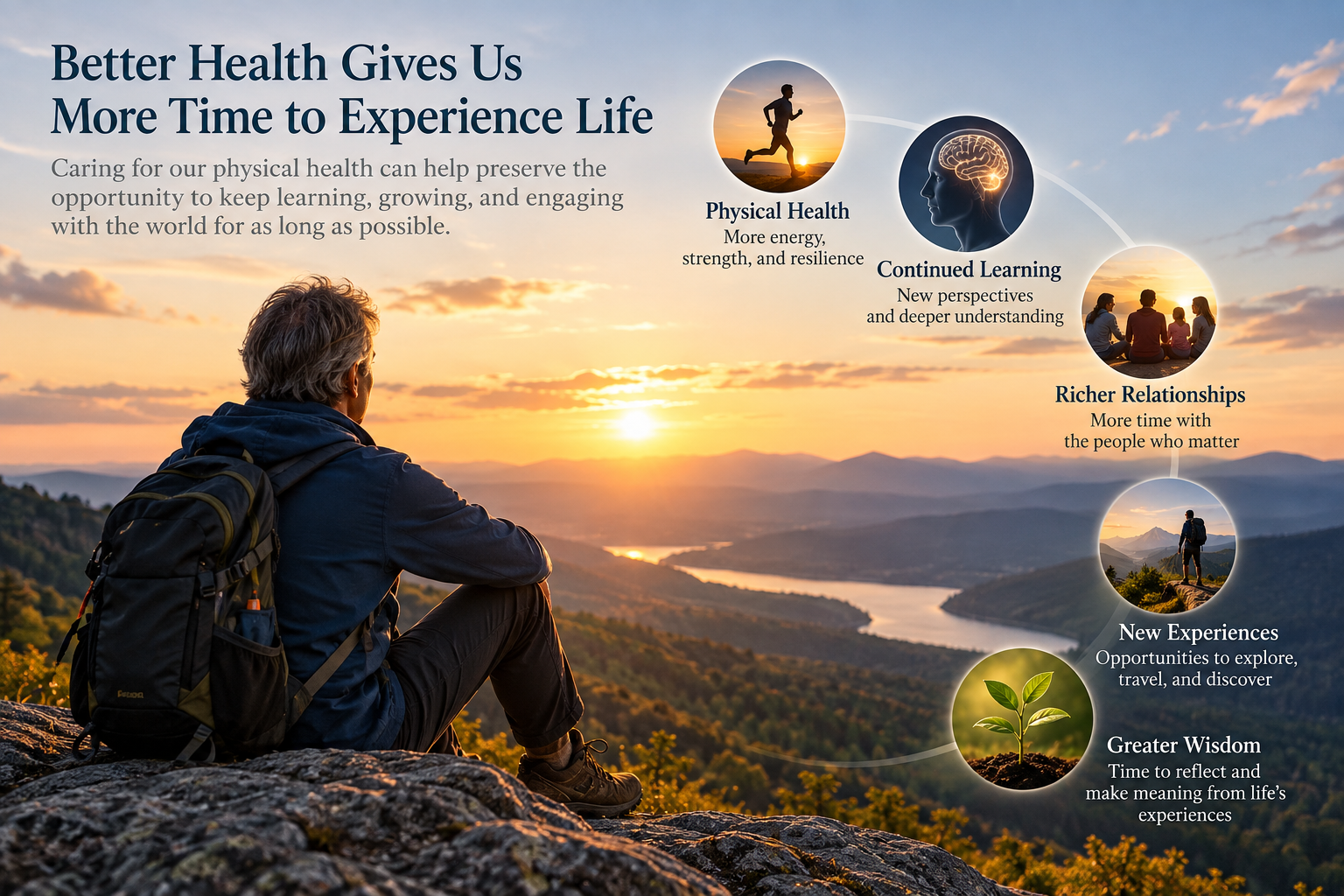
This introduces an important distinction between lifespan and healthspan. Simply adding years to life is not necessarily the same as adding functional years to life. Ideally, I want to remain capable of moving, thinking, learning, interacting with others, traveling, teaching, practicing, and experiencing the world for as long as reasonably possible. Physical fitness then becomes about much more than muscles, appearance, or athletic ability. It becomes one means of preserving our ability to participate in life.
At twenty years old, I could learn from experiences that I could not have understood at ten. At forty, I could look back upon my twenties with a different perspective. At sixty, experiences from earlier decades can take on entirely different meanings. The events themselves have not changed, but I have. Time provides context, and reflection can transform the meaning of what we have experienced.
Perhaps this is one of the differences between knowledge and wisdom. Knowledge can be accumulated relatively quickly. We can read books, attend classes, study research, listen to teachers, and acquire tremendous amounts of information. Wisdom seems to require something more. Information must encounter experience, and experience must be examined. Sometimes we must live with an idea for years before we understand what it actually means.
This is where caring for the body takes on a larger significance for me.
When I exercise to maintain cardiovascular health, strength, balance, mobility, and coordination, I am certainly training my body. But I may also be preserving the physical vehicle that allows me to continue encountering the world. Another healthy year may bring a relationship, challenge, loss, discovery, mistake, or insight that changes how I understand something I thought I already knew.
The body therefore does not have to be viewed separately from intellectual, emotional, or spiritual development. If physical health helps us remain actively engaged with life, caring for the body can support everything else we hope to continue developing.
This becomes particularly meaningful as we grow older. The goals of physical practice naturally change. When we are young, we may exercise primarily to become faster, stronger, more competitive, or more physically attractive. Later, maintaining muscle mass, balance, bone strength, cardiovascular fitness, mobility, and the ability to perform ordinary activities independently may become far more important. Resistance training and other forms of exercise can help older adults preserve physical capacity and reduce age-related functional decline (Izquierdo et al., 2021).
The objective is not to pretend that aging can be defeated. Aging is part of life. Rather, I want to remain an active participant in the process for as long as circumstances permit.
Living longer, however, does not automatically make someone wiser. A person can repeat the same mistakes for eighty years just as easily as another can repeat them for forty. Experience alone is not wisdom. What matters is what we do with experience.
Mind-body practices can contribute to this process because many cultivate qualities beyond physical fitness. They require attention, expose limitations, demand consistency, and continually require adaptation. They remind us that yesterday’s ability is not guaranteed tomorrow. The body I practice with at sixty is not the body I possessed at twenty, and learning to recognize and adapt to those changes can itself become part of the practice.
Perhaps this is why I increasingly resist separating mind, body, and spirit into completely independent categories. They may be useful distinctions for discussion, but our actual lives do not occur so neatly. Physical health influences our mental state. Our thoughts and attitudes influence our behavior. Relationships affect both. Meaning and purpose influence how we respond to difficulty. Each affects the others.
From this perspective, maintaining the body is not simply about trying to stay alive longer. It is about trying to remain available to life longer.
There may still be things I need to learn, ideas I need to reconsider, people I have not yet met, and experiences that will challenge what I currently believe. Some lessons may only become understandable after enough years have passed for me to see them differently.
Eventually, the purpose of physical practice can therefore become much larger than physical fitness.
We strengthen the body so it can continue carrying us into experience. We cultivate the mind so we can better understand those experiences. And perhaps, through enough experience combined with reflection, humility, and awareness, some portion of accumulated knowledge eventually matures into wisdom.
Longevity by itself is not the goal.
The greater opportunity may be having more healthy years in which to continue becoming.
References
Bull, F. C., Al-Ansari, S. S., Biddle, S., Borodulin, K., Buman, M. P., Cardon, G., Carty, C., Chaput, J. P., Chastin, S., Chou, R., Dempsey, P. C., DiPietro, L., Ekelund, U., Firth, J., Friedenreich, C. M., Garcia, L., Gichu, M., Jago, R., Katzmarzyk, P. T., … Willumsen, J. F. (2020). World Health Organization 2020 guidelines on physical activity and sedentary behaviour. British Journal of Sports Medicine, 54(24), 1451–1462. https://doi.org/10.1136/bjsports-2020-102955
Izquierdo, M., Merchant, R. A., Morley, J. E., Anker, S. D., Aprahamian, I., Arai, H., Aubertin-Leheudre, M., Bernabei, R., Cadore, E. L., Cesari, M., Chen, L. K., de Souto Barreto, P., Duque, G., Ferrucci, L., Fielding, R. A., García-Hermoso, A., Gutiérrez-Robledo, L. M., Harridge, S. D. R., Kirk, B., … Singh, M. F. (2021). International exercise recommendations in older adults (ICFSR): Expert consensus guidelines. The Journal of Nutrition, Health & Aging, 25, 824–853. https://doi.org/10.1007/s12603-021-1665-8


