
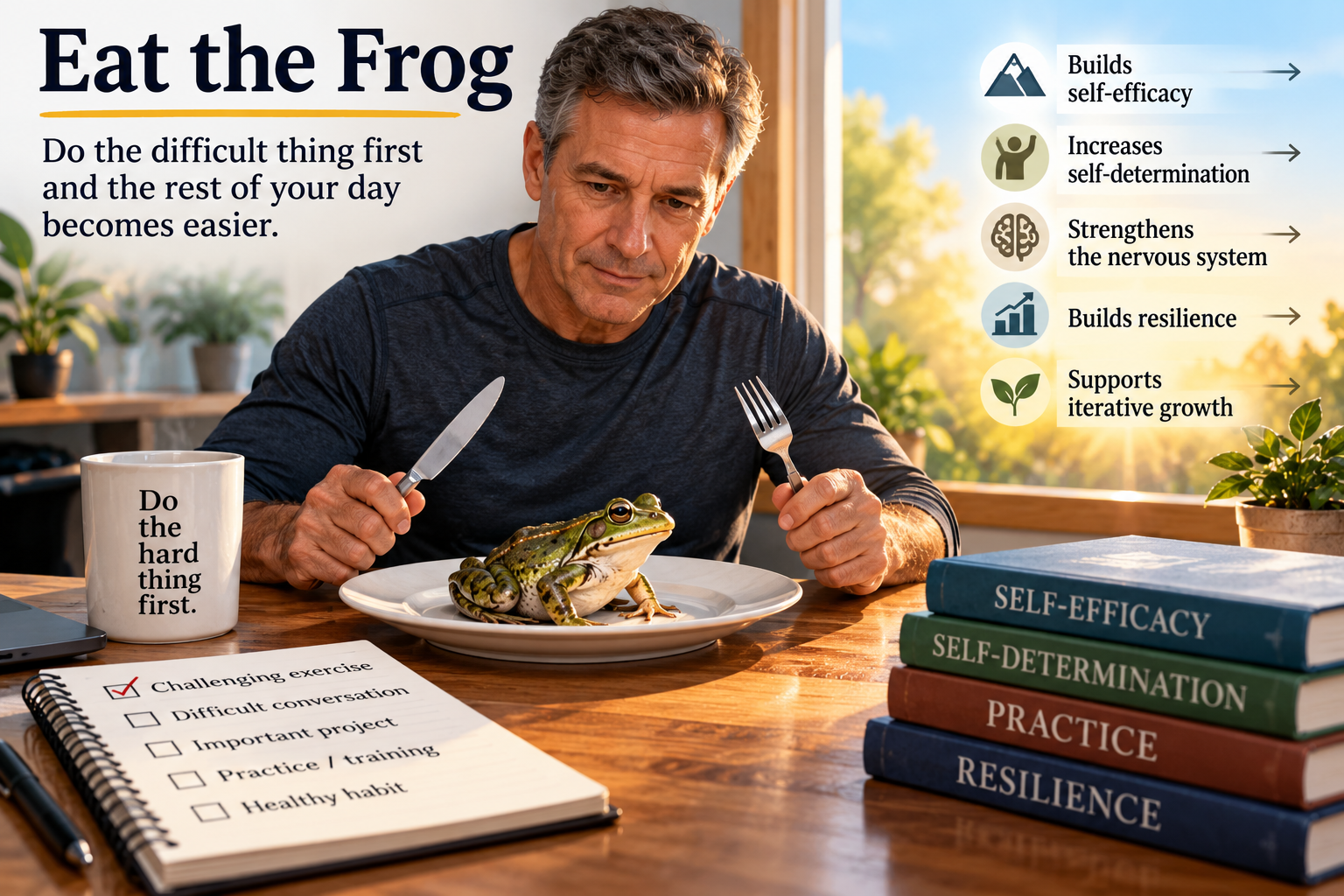
A popular quotation often attributed to Mark Twain says that if it’s your job to eat a frog, it’s best to do it first thing in the morning. Another version suggests that if you eat a live frog for breakfast, the worst thing you’ll face all day has already happened. Whether Twain said it is questionable, but the message holds more wisdom than a joke about procrastination.
To me, “eating the frog” means voluntarily confronting something difficult rather than continually avoiding it. The frog might be demanding exercise, an uncomfortable conversation, a challenging assignment, a complicated skill, or an unhealthy habit we know we should break.
There is an important distinction, however. Difficulty is not automatically beneficial. It becomes useful when approached at an appropriate level, with some choice, purpose, preparation and recovery. This is one difference between cultivation and trauma: cultivation challenges our existing capacity while giving us a chance to adapt, whereas trauma can overwhelm that capacity.
Having spent much of my life in physical and mental disciplines, I see this clearly. Holding a difficult stance, repeating a technique, staying calm while uncomfortable, or practicing when progress seems slow are all forms of voluntary stress. Over time the exercise may not become easy. Instead, we become more capable of doing something difficult.

Difficulty as Training
Most people understand physical conditioning: challenge muscles beyond what they’re accustomed to, allow recovery, repeat, and the body adapts. One mile becomes three. A thirty-second stance becomes several minutes. A similar process occurs psychologically. When we repeatedly work through manageable challenges, we accumulate evidence: I have been uncomfortable before, I have solved problems before, I can probably handle this one too.
Albert Bandura described this through self-efficacy, our belief in our ability to organize and carry out the actions needed to deal with particular situations, and identified mastery experiences as one of its strongest sources (Bandura, 1997). Successfully doing difficult things helps convince us we are capable of difficult things. The confidence comes from evidence, not positive thinking alone.
Self-Determination Rather Than Self-Punishment
Self-determination theory emphasizes autonomy and competence as components of healthy motivation (Ryan & Deci, 2017). Difficulty imposed on us differs psychologically from difficulty we choose. Getting up early to exercise because someone forces us feels very different from doing so because we’ve decided our health matters. Holding an uncomfortable posture as punishment differs from holding it to deliberately train legs, posture, breathing and concentration. The discomfort may be similar, but the interpretation is not. Choice transforms the experience.
This may matter especially in a culture designed to reduce friction: food arrives without leaving the house, entertainment is instant, information takes little effort, and elevators replace stairs. Convenience isn’t wrong, but when every inconvenience is treated as something to eliminate, we can gradually lose our tolerance for friction.
Training the Nervous System
Appropriately challenging mind-body practices may help us function comfortably while physiologically aroused. During demanding exercise, stance training, martial arts, breath regulation or sustained concentration, the body produces signals of effort: elevated heart rate, muscular tension, heat, fatigue and the urge to stop. The goal is not always to eliminate these signals but to learn we can experience them without immediately reacting.
In Tai Chi, Qigong and standing practices, we place ourselves within a controlled degree of difficulty while practicing relaxed breathing, awareness and emotional regulation. In a practical sense, we give the nervous system repeated opportunities to meet challenge without interpreting it as danger.
This does not mean we can “toughen” ourselves indefinitely. Too much stress without recovery can reduce resilience. The principle is progressive cultivation, not relentless punishment. A useful challenge stretches capacity without continually overwhelming it.
Iterative Cultivation
Human development rarely happens through one enormous transformation. More often we change through repeated cycles of challenge, adaptation, reflection and refinement. We attempt something, struggle, adjust, and try again until what once required great conscious effort becomes part of our normal capacity. Beginners in martial arts or music struggle to coordinate basic movements. With repetition, those movements need less attention, freeing it for subtler aspects.
The same applies psychologically. We practice patience in situations requiring patience, discipline by acting when motivation is absent, courage by moving toward manageable uncertainty, and concentration by staying with a task when the mind wanders. These qualities are not merely ideas we possess. They are capacities we exercise.
The Frog Changes
The frog itself changes over time. The first difficult workout feels enormous; the hundredth does not. Speaking before ten people may once have caused considerable anxiety, yet years of teaching make it just another part of the day. The circumstances haven’t necessarily become easier. Our capacity has expanded. Then another frog appears. That is not failure; it is development.
If I can comfortably do everything I attempt, I am probably operating within abilities I’ve already developed. Growth usually requires approaching the boundary between what I can comfortably do and what I might do next. Some discomfort is information: it tells us we are nearing an edge. Wisdom involves distinguishing an edge worth exploring from a warning that should be respected.
Eat the Frog
The wisdom of “eating the frog” extends beyond getting an unpleasant task done early. It can become a philosophy of voluntary cultivation. Occasionally do something difficult because you choose to. Act with discipline before motivation arrives. Place yourself in manageable situations requiring patience, effort, concentration or courage. Give your body and nervous system appropriate stress followed by successful recovery. Then remember what happened, because the next time difficulty appears, you carry evidence that you have faced it before.
Perhaps this is why challenging practices have long been built into martial arts, contemplative traditions and athletics. The exercise becomes a laboratory in which we discover how we respond to challenge. The stance ends, the conversation ends, the task gets completed, but something remains. Self-efficacy develops through evidence of competence, self-determination through deliberate choice, and the nervous system gains another experience of stress without being overwhelmed.
The objective is not a life filled with frogs; life provides enough difficulty without our help. It is to avoid becoming so accustomed to comfort that every frog begins to look like a dragon. Choose an appropriate challenge, face it while it is manageable, and discover you are a little more capable than you thought. Then move on with your day.
References
Bandura, A. (1997). Self-efficacy: The exercise of control. W. H. Freeman.
Ryan, R. M., & Deci, E. L. (2017). Self-determination theory: Basic psychological needs in motivation, development, and wellness. Guilford Press.


