I have spent much of my life studying and teaching practices that involve both the mind and body. Martial arts, Tai Chi, Qigong, meditation, exercise, breathing practices, and other forms of movement are obvious examples. Yet over time, I have come to believe that the category of mind-body practice can be much larger than we sometimes assume.
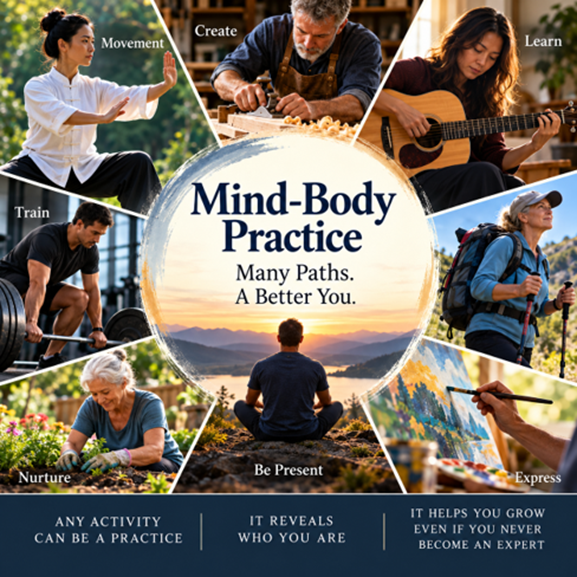
Learning to play a musical instrument is a mind-body practice. So is singing, painting, woodworking, metalworking, gardening, dancing, sculpting, cooking, or learning almost any difficult physical skill. Sports, martial arts, yoga, Pilates, weight training, and similar activities provide another avenue toward the same general process. Although these pursuits may appear very different on the surface, they have something important in common: they require us to bring thought, attention, physical action, repetition, frustration, correction, and persistence together.
In doing so, they have a remarkable ability to reveal us to ourselves.
A person may begin learning the piano because they want to play music. Someone else may take up woodworking because they want to build furniture. Another person may begin Tai Chi because they want better balance or less stress. Initially, the goal usually concerns the activity itself. We want to become better at doing something.
But something else often happens along the way.
The activity begins exposing characteristics that were already within us. Perhaps we discover that we are impatient. We become frustrated when progress does not happen quickly enough. We compare ourselves with people who have practiced for decades. We become overly concerned with looking competent. We discover that we do not like correction, or that we tend to quit when something becomes difficult.
Conversely, we may discover strengths that we did not know we possessed. We learn that we can remain focused longer than expected. We become more comfortable making mistakes. We discover patience, persistence, creativity, discipline, adaptability, or the ability to laugh at ourselves when things do not go according to plan.
The practice becomes a mirror.
This is one reason I believe these activities can be valuable even when we never become particularly accomplished at them. We tend to measure success through external achievement. How much weight can I lift? How well can I play the guitar? What belt have I earned? How complicated a piece of furniture can I build? How gracefully can I perform a Tai Chi form?
Those measurements have their place, but they are only part of the story.
Suppose I spend several years learning an instrument and remain an average musician, but in the process I develop greater patience and concentration. Was the effort unsuccessful? Suppose I practice martial arts without ever becoming an exceptional fighter, yet become calmer under pressure and less controlled by my ego. Was my training wasted? Suppose my woodworking never produces museum-quality furniture, but teaches me to slow down, measure carefully, correct mistakes, and accept that good work requires time. I would consider each of these a meaningful success.
The finished product may not always be the most important product. Sometimes we are the product being worked on.
This changes how I think about mastery. Mastery does not necessarily mean becoming better than everyone else. It can mean becoming better than the person I was when I began.
There is also an interesting paradox in this. We can become very good at doing something rather badly.
I might be a mediocre golfer, an average painter, a struggling musician, or a Tai Chi student who never develops beautiful technique. Yet if I become better at accepting correction, managing frustration, remaining attentive, persevering through difficulty, and appreciating incremental progress, then something worthwhile has occurred.
The skill may still be imperfect, while the person practicing it has improved.
Of course, this does not mean that competence is irrelevant. If I choose to practice something, I should make a sincere effort to learn proper fundamentals and improve my ability. There is value in craftsmanship and proficiency. But proficiency should not become the only measurement by which an activity is judged.
This perspective can also make learning more sustainable. If my only goal is achievement, every mistake becomes evidence that I am failing. If part of my goal is development, the mistake becomes information. Frustration tells me something about myself. Difficulty reveals where additional work is needed. Repetition develops patience. Correction challenges ego. Small improvements teach me that meaningful change often occurs gradually rather than dramatically.
This is where many seemingly unrelated activities begin to overlap. A musician repeating a difficult passage, a martial artist practicing the same movement hundreds of times, a carpenter learning to make a precise joint, and a weightlifter patiently refining technique are engaged in different activities, but each is participating in a similar developmental process. Attention is directed toward action, action produces feedback, and feedback creates an opportunity for refinement.
Eventually, the question can change from “How good am I at this?” to “What is doing this teaching me about myself?”
That may be one of the greatest benefits of mind-body practice.
We certainly can strive for excellence. There is nothing wrong with wanting to become an excellent musician, athlete, martial artist, craftsperson, painter, or practitioner. But perhaps excellence has more than one definition. There is excellence in performance, and there is excellence in what the pursuit of performance gradually develops within the individual.
I may never become great at everything I attempt. In fact, I certainly will not. But if the process makes me more patient, disciplined, attentive, adaptable, humble, resilient, or self-aware, then the practice has accomplished something considerably larger than improving a particular skill.
Sometimes we practice the activity.
And sometimes, without initially realizing it, the activity is practicing us.