A System Focused More on Disease Management Than Health Creation
The United States is often praised for having one of the most technologically advanced healthcare systems in the world. In many respects, this praise is justified. Acute trauma care, emergency medicine, surgical intervention, and crisis stabilization are among the best available anywhere on the planet. If someone is involved in a severe automobile accident, experiences a major cardiac event, or requires emergency surgery, American hospitals and specialists can often provide rapid and lifesaving treatment with remarkable efficiency.
However, this success in acute care frequently creates the illusion that the overall healthcare system itself is healthy. The reality is far more complicated. While the United States excels in emergency and high-tech intervention, it performs poorly in many areas involving chronic disease prevention, long-term wellness, and quality of life. In many ways, the system appears designed more for managing disease than creating health (Marmot, 2015).
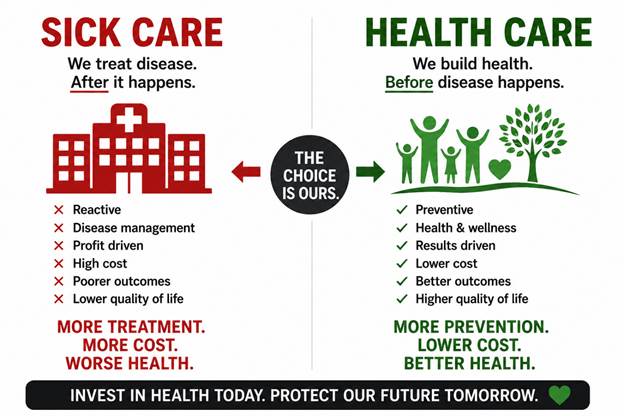
Chronic illnesses such as obesity, diabetes, cardiovascular disease, hypertension, autoimmune disorders, anxiety, depression, and osteoporosis continue to rise at alarming rates throughout the American population. What is perhaps most concerning is that many of these conditions are now appearing in children and adolescents at rates previously associated primarily with older adults (Centers for Disease Control and Prevention [CDC], 2024). Childhood obesity, insulin resistance, type 2 diabetes, fatty liver disease, and mental health disorders have all increased significantly over the past several decades (Hales et al., 2020).
This raises an uncomfortable but necessary question: If the healthcare system is truly succeeding, why are so many people becoming chronically ill in the first place?
According to the Centers for Disease Control and Prevention, approximately 6 in 10 American adults live with at least one chronic disease, while 4 in 10 live with two or more chronic conditions (CDC, 2024). In addition, a substantial portion of the population takes at least one prescription medication daily, with many individuals taking multiple pharmaceuticals simultaneously. While medications can certainly save lives and improve symptoms, they often address the manifestations of disease rather than the underlying causes.
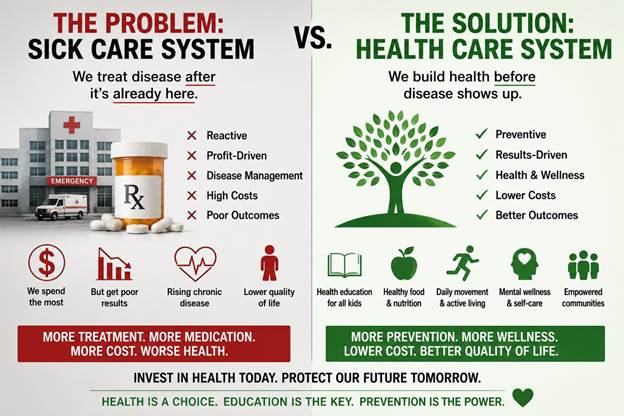
A society that normalizes widespread chronic illness while relying heavily on pharmaceutical intervention cannot honestly be described as truly healthy.
One of the greatest weaknesses within the American healthcare model is that genuine self-care education is often introduced far too late. Many individuals are never truly taught how to care for their bodies, regulate stress, nourish themselves properly, sleep effectively, or develop long-term health discipline during their formative years. Instead, wellness education is often fragmented, inconsistent, or overshadowed by commercialized food systems, sedentary lifestyles, digital overstimulation, and increasingly stressful environments.
Children today grow up immersed in environments that encourage excessive sitting, screen dependency, processed food consumption, sleep disruption, and chronic mental overstimulation. Physical education programs have been reduced in many schools, outdoor activity has declined, and many young people receive more education about passing standardized tests than about maintaining their own physical and mental well-being.

This is particularly troubling because habits formed in childhood often become the behavioral foundations carried into adulthood. Research consistently demonstrates that lifestyle patterns involving diet, exercise, stress regulation, sleep, and emotional coping are strongly predictive of long-term health outcomes (Fogelholm, 2010). In many ways, adult disease frequently begins as childhood behavior patterns reinforced over time.
If young people were educated thoroughly in health, wellness, self-regulation, nutrition, physical movement, emotional resilience, and self-responsibility through at least mid-adolescence, society might eventually see dramatic reductions in preventable chronic disease. True healthcare should begin long before the first diagnosis appears.
Unfortunately, much of modern healthcare remains reactive rather than proactive. A reactive system waits until symptoms become problematic enough to require intervention. A proactive system seeks to cultivate resilience, vitality, and prevention before disease develops. These are fundamentally different philosophies.
The financial structure of the American healthcare industry also creates difficult ethical questions. The United States spends more on healthcare than any other developed nation, yet its overall outcomes in life expectancy, chronic disease burden, obesity rates, and general wellness often rank poorly compared to many other industrialized countries (Tikkanen & Abrams, 2020). This contradiction suggests that simply spending more money on healthcare does not necessarily create a healthier population.
When healthcare becomes deeply intertwined with corporate profit structures, pharmaceutical dependency, insurance complexity, and symptom management, the incentives may gradually shift away from long-term prevention and toward ongoing treatment. A profit-driven system naturally benefits when more individuals require continuous care, medications, procedures, and long-term management.
This does not imply that healthcare professionals themselves are malicious or uncaring. In fact, many doctors, nurses, therapists, and healthcare workers enter their professions with sincere intentions to help others. However, even compassionate professionals are often working within a larger system shaped by economics, bureaucracy, insurance limitations, pharmaceutical influence, and institutional pressures.
The result is a culture where true health creation is frequently overshadowed by disease maintenance.
From a holistic perspective, genuine health involves far more than simply suppressing symptoms or surviving illness. Health includes physical vitality, emotional balance, mental clarity, meaningful social connection, purpose, movement, proper nutrition, restorative sleep, stress management, and personal responsibility. These are foundational principles recognized not only in modern lifestyle medicine but also throughout many traditional systems of wellness, including Traditional Chinese Medicine, Daoist philosophy, and numerous indigenous healing traditions (Sagner et al., 2014).
Ironically, many ancient wellness systems emphasized prevention thousands of years ago, while modern industrial healthcare systems are only recently beginning to rediscover the importance of lifestyle intervention, exercise, mindfulness, breath regulation, nutrition, and stress reduction. In some respects, the healthcare system appears to be decades behind where preventive education should already be.
The solution is not to abandon modern medicine. Emergency medicine, surgery, diagnostics, antibiotics, and acute intervention remain extraordinary achievements that save countless lives. The true challenge is integration. Society must move beyond a model that merely treats disease after it develops and toward one that actively cultivates healthier human beings from childhood onward.
A healthier future will require a cultural shift toward education, prevention, self-responsibility, and empowerment. People must be taught not only how to survive illness, but how to build resilience before illness arises. Health should not simply mean the absence of disease. It should mean the presence of vitality, adaptability, balance, and quality of life.
Until healthcare becomes more results-driven than profit-driven, and until wellness education becomes as important as academic achievement, the cycle of chronic disease will likely continue.
The health of a nation ultimately reflects the habits, values, education, and priorities of its people and institutions alike.
References
Centers for Disease Control and Prevention. (2024). About chronic diseases. CDC Chronic Disease Information
Fogelholm, M. (2010). Physical activity, fitness and fatness: Relations to mortality, morbidity and disease risk factors. Obesity Reviews, 11(3), 202–221. https://doi.org/10.1111/j.1467-789X.2009.00653.x
Hales, C. M., Carroll, M. D., Fryar, C. D., & Ogden, C. L. (2020). Prevalence of obesity and severe obesity among adults and youth: United States, 2017–2018. National Center for Health Statistics. https://www.cdc.gov/nchs/products/databriefs/db360.htm
Marmot, M. (2015). The health gap: The challenge of an unequal world. Bloomsbury Publishing. https://archive.org/details/healthgapchallen0000marm
Sagner, M., Katz, D., Egger, G., Lianov, L., Schulz, K., Braman, M., . . . Ornish, D. (2014). Lifestyle medicine potential for reversing a world of chronic disease epidemics: from cell to community. International Journal of Clinical Practice, 68(11), 1289–1292. https://doi.org/10.1111/ijcp.12509
Tikkanen, R., & Abrams, M. K. (2020). U.S. Health Care from a Global Perspective, 2019: Higher Spending, Worse Outcomes? The Commonwealth Fund Website. https://doi.org/10.26099/7avy-fc29