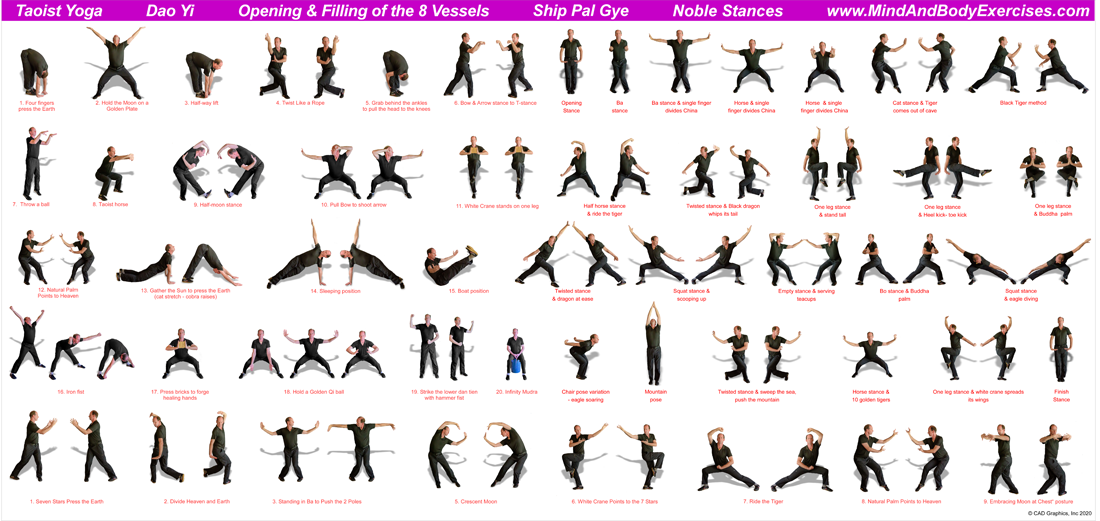
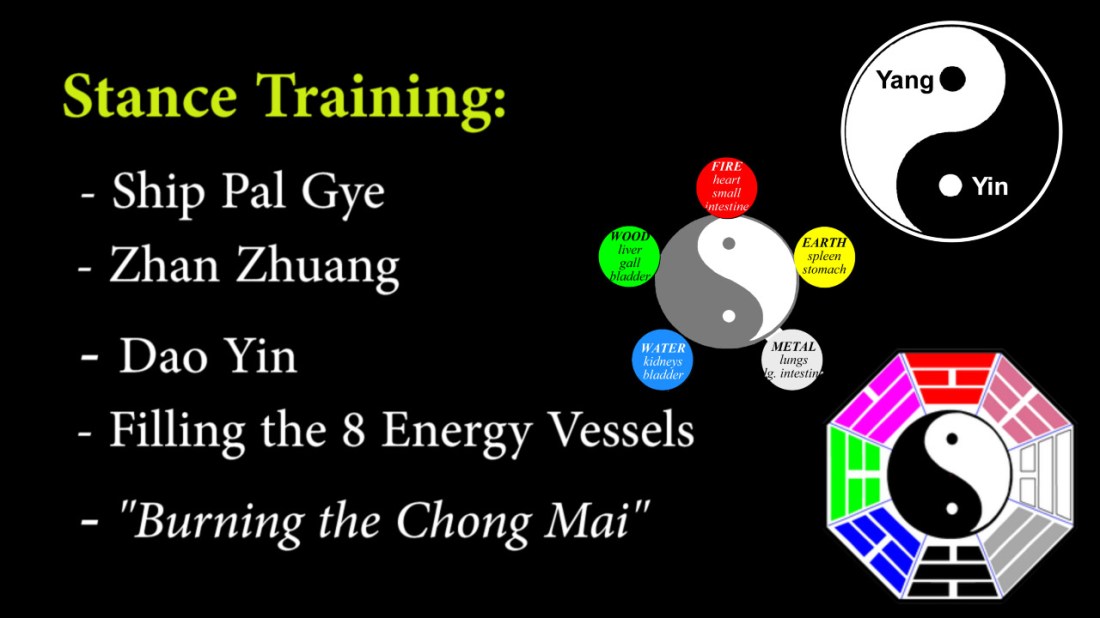
𝑷𝒂𝒍 𝑮𝒚𝒆 6 (18 𝑸𝒊 𝑬𝒙𝒆𝒓𝒄𝒊𝒔𝒆𝒔), 𝒁𝒉𝒂𝒏 𝒁𝒉𝒖𝒂𝒏𝒈 (𝑺𝒕𝒂𝒏𝒅𝒊𝒏𝒈 𝑸𝒊𝒈𝒐𝒏𝒈), & 𝑫𝒂𝒐 𝒀𝒊𝒏 (𝑮𝒖𝒊𝒅𝒊𝒏𝒈 𝑸𝒊 𝒘𝒉𝒊𝒍𝒆 𝒔𝒕𝒓𝒆𝒕𝒄𝒉𝒊𝒏𝒈)

Stance training is a foundational practice in traditional martial arts and mind-body cultivation, developing physical strength, structural alignment, balance, endurance, concentration, and nervous system resilience. Drawing upon Ship Pal Gye (18 Qi Exercises), Zhan Zhuang (standing Pole Qigong), and Dao Yin (Guiding Qi while stretching) , these exercises integrate intentional posture, controlled breathing, and focused awareness. By progressively increasing the duration and intensity of standing postures, we introduce manageable physical and psychological challenges that encourage adaptation. Rather than reacting to muscular fatigue and discomfort with unnecessary tension, we learn to regulate our breathing, maintain composure, and remain mentally focused. Over time, this deliberate conditioning can improve postural stability, muscular endurance, body awareness, and our ability to manage stress without becoming overwhelmed.

This video also explores traditional Chinese energetic cultivation through the Eight Extraordinary Vessels, including a practice is referred to as “Burning the Chong Mai,” or expansion of the Thrusting Vessel. Within traditional Chinese medicine, these practices are associated with cultivating and regulating Qi throughout the body. From a physiological perspective, progressive stance training challenges the neuromuscular system while providing opportunities to practice autonomic regulation, attentional control, and relaxation under physical demand. The objective is not simply to stand still or tolerate discomfort, but to gradually strengthen our capacity to remain physically stable, mentally focused, and emotionally composed. Through consistent practice, we cultivate greater self-regulation, resilience, and confidence in our ability to respond effectively to life’s challenges

Cruel to Be Kind: The Difference Between Niceness, Compassion, and True Care Feeling (Genuine Care)

Several sayings have endured across generations because they contain a measure of truth about human nature and personal growth. “Cruel to be kind,” “tough love,” and “kind words are seldom true; true words are seldom kind” all point toward a reality that many people eventually discover through experience. Genuine care is not always pleasant. Sometimes the most compassionate thing we can do is tell someone what they need to hear rather than what they want to hear.

Yet this topic is more nuanced than it first appears. Not every harsh word is wisdom. Not every strict teacher is effective. Not every difficult lesson is beneficial. Understanding the difference requires discernment.

Many people mistake agreement for support, comfort for compassion, and niceness for caring. Yet some of the individuals who have contributed most to our growth were not always the ones who made us feel comfortable. They were often the people who cared enough to challenge our assumptions, correct our mistakes, and encourage us to become more than we believed possible.

Niceness Versus Compassion

Niceness and compassion are not always the same thing.

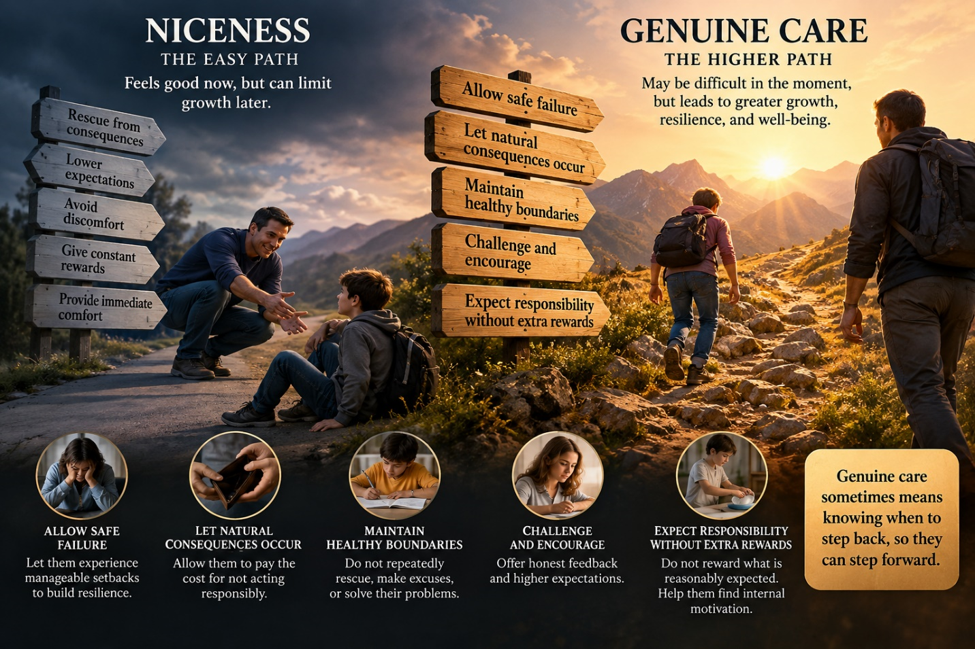
Niceness is often concerned with immediate emotional comfort. Compassion is concerned with long-term well-being. One seeks to avoid discomfort, while the other recognizes that discomfort is sometimes necessary for growth.

Consider a parent who allows a child to eat whatever they want, avoid responsibilities, and escape consequences. Such behavior may appear kind in the short term, but it may ultimately undermine the child’s development. Conversely, a parent who establishes boundaries, expectations, and accountability may be viewed as strict or demanding, yet their actions are often rooted in genuine concern for the child’s future.

The same principle applies to teachers, coaches, healthcare providers, and mentors. A teacher who lowers standards so that everyone succeeds may be well-liked, but a teacher who challenges students to think critically and work diligently may contribute more substantially to their growth. Likewise, a coach who demands discipline and effort may not always be popular, but those expectations often cultivate resilience, competence, and confidence over time (Bandura, 1997).

Compassion is not measured solely by how good someone feels in the moment. It is also measured by whether an action contributes to long-term health, growth, and flourishing.

The Meaning of True Care Feeling

Some traditions describe this deeper form of compassion as “true care feeling.” Albeit this phrase is a bit grammatically incorrect. This deeper form of compassion might better be described as genuine care. Genuine care looks beyond immediate comfort and focuses instead upon the best possible outcome for another person.

A healthcare provider who encourages a patient to lose weight, stop smoking, improve nutrition, or become more physically active may create temporary discomfort. Yet avoiding such conversations out of fear of offending someone may ultimately contribute to poorer health outcomes.

Similarly, a trusted friend who points out a destructive habit, an unhealthy relationship, or a pattern of self-sabotage may temporarily create tension. However, their willingness to speak honestly may provide the catalyst for meaningful change.

Research on self-efficacy suggests that confidence develops not by avoiding challenges but by successfully overcoming them (Bandura, 1997). Likewise, self-determination theory proposes that long-term psychological well-being is fostered through the development of competence, autonomy, and meaningful relationships rather than dependence upon external validation (Deci & Ryan, 2000).

Genuine care recognizes these realities. It understands that genuine growth often requires temporary discomfort in pursuit of a greater good.

Tough Love and the Value of Challenge

The concept of tough love is frequently misunderstood. Tough love is not cruelty, punishment, or indifference. Rather, it involves maintaining healthy boundaries while allowing individuals to experience the consequences of their actions.

Many of life’s most important lessons emerge through adversity, challenge, and personal responsibility. If every obstacle is removed, every mistake excused, and every consequence avoided, opportunities for growth may also be diminished.

Psychologists have long recognized that resilience is not developed through complete protection from difficulty but through learning how to navigate and overcome manageable challenges (Peterson & Seligman, 2004).

This does not mean seeking hardship for its own sake. Rather, it means recognizing that some forms of discomfort are essential for growth. Physical exercise requires stress to produce adaptation. Learning requires mistakes and correction. Emotional maturity often develops through confronting reality rather than avoiding it. In this sense, compassion sometimes requires firmness rather than softness.

When Tough Love Is Not Compassion

An important caution must be acknowledged. Not every harsh word is wisdom. Not every strict teacher is effective and not every demanding coach, parent, mentor, or leader is acting from genuine compassion.

Throughout history, harmful behaviors have often been justified under the banner of discipline, loyalty, tradition, character building, or “doing what is best for you.” Some individuals are sincere but misguided. Others may be motivated by ego, control, status, financial gain, or a desire for obedience rather than genuine concern for another person’s welfare.

Good intentions alone are not enough. A teacher may genuinely believe they are helping students while relying upon outdated methods or excessive criticism. A parent may sincerely love a child while unknowingly projecting personal fears and insecurities. A leader may believe they are building character while actually creating dependency, fear, and resentment. Likewise, some individuals intentionally hide manipulative or abusive behavior behind the language of accountability and personal growth.

This is why outcomes matter. Genuine care promotes greater confidence, competence, autonomy, and well-being over time (Deci & Ryan, 2000). Manipulation and abuse tend to produce confusion, diminished self-worth, dependency, and fear. One approach asks, “How can I help this person become stronger and more capable?” The other asks, consciously or unconsciously, “How can I maintain influence and control?” The distinction is profound.

Kind Words and True Words

The saying, “Kind words are seldom true; true words are seldom kind,” contains an important insight, although it should not be interpreted literally.

The goal is not to choose between kindness and truth. The goal is to integrate both. Truth without compassion can become cruelty. Compassion without truth can become deception. A difficult truth does not become valuable simply because it is difficult. Likewise, criticism is not automatically constructive simply because it is honest.

The quality of the messenger matters. A skilled mentor understands that correction should be proportional, purposeful, and delivered with respect. The objective is education rather than humiliation, growth rather than domination. An unhealthy mentor, by contrast, may confuse harshness with effectiveness and criticism with wisdom.

Viktor Frankl (2006) observed that meaning emerges not merely through comfort and pleasure but through responsibility, purpose, and confronting reality as it truly exists. Honest feedback delivered with genuine concern can therefore be an act of compassion, even when it is uncomfortable.

The Importance of Discernment

Perhaps the most important element in this entire discussion is discernment. Discernment asks not only, “What should I do?” but also, “What should I not do?” There are times when encouragement is needed, and when correction is needed. Other scenarios require speaking or silence, depending upon which is more appropriate. There are times when helping is compassionate, but other times when stepping back and allowing another person to learn through experience is the greater act of compassion. Likewise, there are times when criticism should be accepted and reflected upon. There are also occasions when criticism should be questioned, challenged, or rejected.

Not every hard lesson is a good lesson. Not every demanding teacher is a good teacher and not every form of discomfort leads to growth. The challenge lies in distinguishing necessary challenges from unnecessary suffering, guidance from control, accountability from manipulation, and compassion from mere appearances. This is the essence of discernment: knowing when to do and when not to do.

Being nice and being compassionate are not always the same thing. Genuine care often extends beyond immediate comfort and focuses instead upon long-term well-being.

This type of concern, seeks growth rather than approval and development rather than convenience. At times, compassion may appear gentle and supportive. In other situations, it may appear firm and challenging. Both approaches have their place. The key is understanding that neither softness nor firmness is inherently virtuous. Their value depends upon intent, wisdom, context, and outcome.

True compassion requires honesty, empathy, courage, and discernment. It asks us to seek the best possible outcome for another person, even when doing so may be uncomfortable, misunderstood, or temporarily unpopular.

In the end, the challenge is not simply being kind or being truthful. The challenge is learning how to embody both in the right measure, at the right time, and for the right reasons.

Genuine care sometimes means resisting the impulse to rescue another person from every disappointment or consequence. A parent may allow a child to experience a manageable failure rather than immediately stepping in to fix it. A teacher may allow a student to receive the grade they earned rather than lowering expectations. A friend or family member may decline to repeatedly solve financial or personal problems created by another adult’s irresponsible choices. Even praise and rewards require discernment; continually rewarding someone simply for doing what is reasonably expected can unintentionally teach them to depend upon external recognition rather than developing responsibility and internal motivation.

In each of these situations, the objective is not punishment or indifference. It is allowing people to experience the relationship between choices and consequences while the stakes are still manageable. Sometimes helping means stepping forward, but genuine care can also mean knowing when to step back.

References

Bandura, A. (1997). Self-efficacy: The exercise of control. W. H. Freeman.

Deci, E. L., & Ryan, R. M. (2000). The “what” and “why” of goal pursuits: Human needs and the self-determination of behavior. Psychological Inquiry, 11(4), 227–268. https://doi.org/10.1207/S15327965PLI1104_01

Frankl, V. E. (2006). Man’s search for meaning (Rev. ed.). Beacon Press. (Original work published 1946)

Peterson, C., & Seligman, M. E. P. (2004). Character strengths and virtues: A handbook and classification. Oxford University Press.

Ryan, R. M., & Deci, E. L. (2020). Intrinsic and extrinsic motivation from a self-determination theory perspective: Definitions, theory, practices, and future directions. Contemporary Educational Psychology, 61, 101860. https://doi.org/10.1016/j.cedpsych.2020.101860

The Ripples We Never See

There are times when I think about everything I have taught, written, studied, practiced, and shared over the years and wonder where any of it ultimately goes. A class ends and everyone goes home. A book is purchased and disappears onto someone’s shelf. An article is posted and eventually moves farther down the page. A video may be watched by someone whose name I will never know. A conversation ends, and two people go their separate ways.

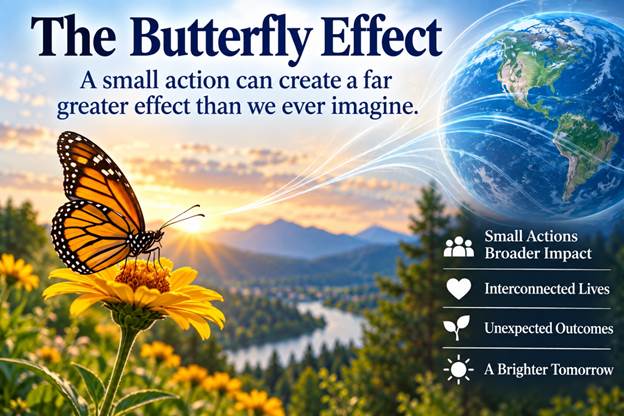
I have gradually come to think of these experiences as something like standing beside a river with a stone in my hand. I throw the stone into the water and watch it strike the surface. There is a splash, followed by ripples spreading outward. Then the stone sinks and disappears. I cannot see where it finally settles, nor can I follow the ripples very far. I simply know that something has been set in motion.

Perhaps sharing knowledge works much the same way.

Becoming a Conduit

After decades of studying martial arts, holistic health, philosophy, psychology, spirituality, human behavior, and the many ways people search for meaning, I have become increasingly aware of how little any one person can actually know. The more we learn, the more we encounter questions for which we do not have complete answers.

For that reason, I increasingly think of myself as a conduit rather than an authority. Knowledge passes through us. Some of it comes from formal education, while much of it comes from teachers, mentors, books, traditions, science, personal experience, mistakes, relationships, hardships, and simple observation.

We rarely create knowledge entirely by ourselves. We encounter ideas, examine them, compare them with our experiences, and decide whether they still have value. Some remain with us for decades. Others are eventually discarded. Occasionally, something we once accepted as true proves incomplete or incorrect, and intellectual honesty requires us to change our position.

This is one of the reasons I believe knowledge should be shared rather than guarded. Human beings have always learned from one another. Long before universities, websites, podcasts, and videos existed, someone discovered something useful and showed someone else. That person remembered it, adapted it, and perhaps passed it along again. In that sense, we are temporary caretakers of what we have learned.

Influence We May Never Witness

One of the difficulties with teaching or writing is that we naturally notice the visible results. We know how many people attended a class, purchased a book, watched a video, or responded to an article. Those measurements can tell us something, but they cannot tell us everything. What happens afterward is much harder to see.

A person might learn a breathing technique in a class and later show it to a spouse who is struggling with stress. Someone might read a paragraph about self-responsibility and begin reconsidering the way they approach their health. A student may remember something a teacher said many years earlier and suddenly understand it differently because life has finally provided the experience necessary to make sense of it.

Research into social networks has shown that ideas and behaviors can move through relationships in complicated ways. Researchers continue to debate how far particular effects spread and how much can truly be attributed to social influence, but there is little question that human beings continually affect one another through relationships, behavior, communication, and example (Christakis & Fowler, 2013).

I have experienced this from the receiving side myself. There are things teachers told me decades ago that did not seem especially important at the time. Years later, a particular phrase or lesson suddenly carried much greater meaning. The teacher could not have known when, or even whether, that understanding would arrive. The same is probably true of things I have shared with others.

Teaching Without Owning the Outcome

Recognizing this also requires humility. If I share something with another person, I cannot control what that person does with it. I can explain an exercise, but I cannot make someone practice it. I can discuss movement, breathing, nutrition, stress management, philosophy, or self-awareness, but another person must decide whether any of that belongs in their life.

This is closely related to the distinction I have often made between healing and fixing. A good teacher, coach, practitioner, or healer can provide knowledge, tools, encouragement, and perspective, but meaningful change eventually requires participation from the person receiving them.

Psychologist Albert Bandura described human agency as our capacity to influence our own actions and circumstances rather than simply being passive recipients of outside forces (Bandura, 2001). That idea resonates strongly with my own approach to teaching. The goal should not be to make another person permanently dependent upon the teacher. Ideally, what has been taught eventually becomes something the student can understand, question, adapt, and use independently. At some point, the information no longer belongs to the person who offered it.

Purpose Beyond Recognition

Modern culture makes it easy to confuse visibility with impact. We count followers, views, subscribers, sales, downloads, attendance, and engagement. These measurements have practical value, particularly when we are trying to determine whether people are being reached, but numbers cannot fully measure what happens inside another human being.

A video watched by thousands may quickly be forgotten, while a quiet conversation with one person may influence a decision that changes the direction of a life. The person who initiated that conversation may never know what happened afterward. This is where purpose begins to separate from recognition.

Viktor Frankl wrote extensively about the human search for meaning and suggested that meaning can be found through what we contribute, what we experience, and how we respond to circumstances that cannot be changed (Frankl, 2006). Purpose does not necessarily require an audience to confirm that something mattered.

For me, teaching and writing have increasingly become expressions of that understanding. There are only so many classes I can teach and people I can meet personally. Writing, books, recorded lessons, and videos allow ideas to continue traveling beyond those limitations. Someone I will never meet may encounter something years from now that happens to be useful at precisely the right moment. That possibility is enough reason to continue.

Carrying Knowledge Forward

There is also another side to this process. Before we ever began sharing what we knew, other people were sharing with us.

Teachers, parents, friends, authors, philosophers, scientists, martial artists, health practitioners, and ordinary people describing their experiences have all contributed to the way we understand the world. Some lived centuries before us, yet their ideas still reached our lives.

Much of what I have learned through martial arts, tai chi, qigong, philosophy, and holistic approaches to health existed long before I encountered it. My responsibility is not necessarily to preserve everything exactly as I received it. Experience has taught me that traditions should be examined rather than blindly repeated. Some ideas withstand scrutiny, while others require clarification, modernization, or correction.

Being a conduit does not mean being a passive pipe. We can question what passes through us, compare old ideas with new evidence, admit when our understanding changes, and separate useful principles from unnecessary mythology. We can then communicate what remains valuable in language that another person might understand.

Someone else may eventually take one of those ideas and carry it farther than we ever could.

The Ripples We Never See

Perhaps this is one of the quieter meanings of legacy.

Legacy does not have to mean that our names are remembered generations from now. It may simply mean that something we contributed became part of someone else’s life. An idea influenced the way another person thought. A practice became part of someone’s routine. A kindness affected how that person later treated someone else. A question caused someone to reconsider an assumption. Eventually, the original source may even be forgotten. I find something reassuring in that.

At this stage of my life, I am increasingly comfortable knowing that I will never be able to measure the reach of everything I have taught or written. I intend to continue studying, questioning, teaching, writing, and sharing what seems worthwhile, not because every effort will produce a visible result, but because someone somewhere may be looking for an idea, a practice, a different perspective, or simply a little direction. Perhaps something I share will reach that person. Perhaps it will not. There is no way to know. But there can be no ripple if the stone is never cast.

References

Bandura, A. (2001). Social cognitive theory: An agentic perspective. Annual Review of Psychology, 52, 1–26. https://doi.org/10.1146/annurev.psych.52.1.1

Christakis, N. A., & Fowler, J. H. (2013). Social contagion theory: Examining dynamic social networks and human behavior. Statistics in Medicine, 32(4), 556–577. https://doi.org/10.1002/sim.5408

Frankl, V. E. (2006). Man’s search for meaning. Beacon Press. (Original work published 1946)

What If This Is Not the Real World?

Reality, Consciousness, and the Possibility That This Life Is Only One Part of a Much Larger Existence

Most of us wake up every morning without giving much thought to what is real. We open our eyes, recognize the room around us, get out of bed, and continue with our lives. There are people we love, responsibilities waiting for us, bills to pay, meals to prepare, places to go, and bodies that need our attention. This is the world we know, and naturally, we call it reality.

But what if it is only our present reality?

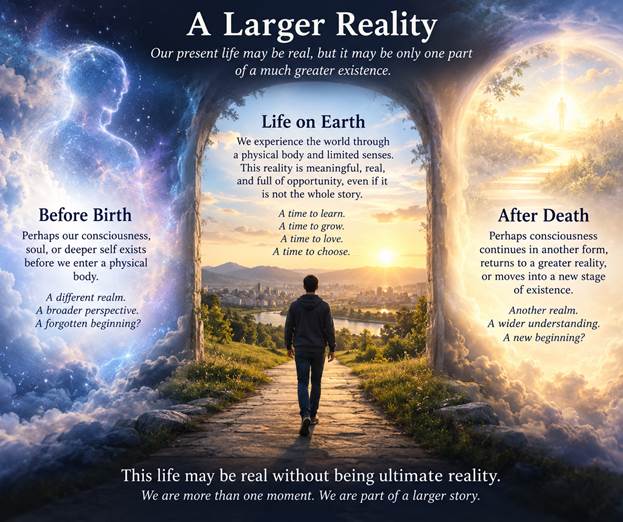
That question does not require us to reject science, deny the physical world, or believe in anything supernatural. It simply asks us to consider a possibility that human beings have wondered about for thousands of years: What if the reality we experience through our bodies and senses is only one part of something much larger?

Perhaps birth and death are not necessarily the beginning and ending of existence. Maybe they are simply the beginning and ending of this particular experience. We do not know. But perhaps not knowing is exactly what makes the question worth considering.

We Experience Only Part of the World

One reason to remain open-minded about reality is that we already know our senses are limited. Our eyes see only a small portion of the light that exists around us. Our ears detect only certain frequencies of sound. Other animals can smell, hear, see, or sense things that we cannot. A dog’s experience of the world is heavily influenced by smell. A bird may navigate through abilities that humans barely notice. Other creatures perceive forms of light or vibration that are completely invisible to us. None of this means that our world is false. It simply means that we experience the world through the equipment we have been given.

The philosopher Immanuel Kant explored a similar idea. In simple terms, he suggested that there may be a difference between reality itself and reality as human beings are capable of experiencing it. We cannot step outside our human senses and human minds to see existence from a completely independent point of view (Guyer & Horstmann, 2026).

That leaves us with an interesting possibility. What we experience may be completely real while still being incomplete. Think of a fish living its entire life underwater. Water is not simply something surrounding the fish; it is part of the conditions through which the fish experiences existence. A bird experiences space differently because flight is part of its world. A dog experiences a landscape of smells that we can barely imagine.

Perhaps human beings are no different. We experience reality through a human body and a human brain. Naturally, we tend to assume that what we can see, hear, touch, measure, and remember represents everything that exists. But what if it doesn’t?

Plato’s Cave

More than two thousand years ago, Plato explored a similar question through his famous Allegory of the Cave. He imagined people who had spent their entire lives inside a cave, able to see only shadows appearing on a wall. Because the shadows were all they had ever known, they naturally believed the shadows were reality. They were not foolish. They were simply working with the information available to them. That may be the most important part of the story. Their mistake was not believing that the shadows existed. Their mistake was believing that the shadows were all that existed.

Plato believed there was a deeper reality beyond ordinary appearances and also explored the possibility that the soul existed beyond the physical body (Silverman, 2014). We do not have to accept all of Plato’s conclusions to appreciate the question he left us. Could we also be looking at only part of the picture?

We experience matter, space, time, birth, aging, and death. From where we stand, these things seem absolute. But if some greater level of existence were beyond the abilities of our senses, how would we know? Perhaps we wouldn’t.

The Wave and the Ocean

Indian philosophy offers another useful way of thinking about this.

The Sanskrit word māyā is often translated as “illusion,” but that can create the wrong impression. It can sound as though Hindu philosophy is saying that nothing around us is real. A better way to understand the idea is that things may not be exactly what they appear to be. In Advaita Vedānta, for example, the deepest self, called ātman, is understood as being connected with, and ultimately not separate from, the deeper reality called Brahman (Dalal, 2021).

The ocean provides a simple way of imagining this. Watch a wave rise from the water. For a few moments, it appears to be a separate thing. We can point at it. We can photograph it. We can watch it travel toward shore. Then it disappears back into the ocean. Was the wave real? Of course. But was it ever truly separate from the ocean?

Perhaps human life can be considered in a similar way. We emerge into the world as individuals. We develop names, personalities, careers, relationships, beliefs, possessions, memories, fears, and hopes. Eventually the body returns to the same physical world from which it came.

The question raised by some Indian traditions is whether we have become so focused on being the wave that we have forgotten the possibility of the ocean.

Buddhism Offers Another Possibility

Buddhism complicates the picture because it generally does not teach that there is a permanent individual soul that remains unchanged forever. The Buddhist idea of anattā, or “not-self,” asks us to question how permanent the person we call “me” actually is (Siderits, 2011).

Consider how much you have already changed during your lifetime. Your body, thoughts and your beliefs may have changed. Your relationships, priorities, fears, interests, and understanding of yourself may all be different from what they were decades ago. Yet somehow there is a sense of continuity.

Buddhism developed teachings about karma, rebirth, and liberation without necessarily requiring an eternal, unchanging personality to travel from one life to another. What continues might be more like a process than a permanent individual object.

That opens another possibility. Maybe the choices are not limited to “I remain exactly myself forever” or “nothing continues after death.” There may be possibilities we simply do not understand.

What If Life Is Something Like a Dream?

Daoist philosophy gives us one of the simplest and most memorable examples. The ancient Chinese philosopher Zhuangzi told a story about dreaming that he was a butterfly. In the dream, being a butterfly seemed completely natural. After waking, however, he wondered whether he was Zhuangzi who had dreamed of being a butterfly, or somehow a butterfly dreaming that he was Zhuangzi. The story was not meant simply as a joke or puzzle. It raises a fascinating question about how we decide which experience is ultimately real (Hansen, 2024).

Most of us have experienced very convincing dreams. While dreaming, we usually do not stop and say, “None of this is real.” We accept it. We may talk with people who died years ago. We may find ourselves in places that could not possibly exist. We may feel fear, sadness, happiness, love, or grief. During the dream, those emotions can seem completely genuine. Then we wake up. Only afterward do we recognize that what seemed completely real existed within a different state of consciousness. That leads to an unusual but fascinating question: What would it mean to awaken from this life?

Perhaps death is simply the end of consciousness. That possibility must remain on the table. But if consciousness somehow exists beyond the physical body, death might look completely different from the other side. What we call dying might be experienced as something more like waking up. Again, we do not know. But our inability to see beyond our present condition does not necessarily mean there is nothing beyond it.

What Were We Before We Were Born?

People frequently ask, “What happens after we die?” We ask much less often, “What were we before we were born?”

Plato believed the soul existed before physical birth and suggested that some forms of learning might actually involve remembering truths the soul already knew (Silverman, 2014). Centuries later, Plotinus developed related ideas about the soul becoming absorbed in physical existence and forgetting its deeper origin (Moore, n.d.).

Whether we accept those ideas or not, they raise an interesting problem. We usually assume that because we cannot remember anything before birth, there must have been nothing before birth. But memory is not the same thing as existence.

Most adults remember almost nothing from their first year of life. That does not mean they did not exist during that year. We spend roughly a third of our lives sleeping and often remember little or nothing about much of that time. Lack of memory does not prove that something did or did not happen. It simply means we do not remember it.

Other Religious Traditions

Christianity, Judaism, and Islam approach these questions differently from Hinduism and Buddhism. They generally preserve the idea of an individual person who continues in some way beyond physical death and emphasize a continued relationship with God.

Christianity, in particular, has traditionally placed considerable importance on resurrection rather than simply describing death as a soul permanently escaping the body. Exactly what personal survival means has been debated by theologians and philosophers for centuries (Meister, 2023).

The traditions disagree considerably about the details. Some speak of heaven. Others describe reincarnation or rebirth. Some describe liberation from the cycle of physical existence. Others speak of returning to a divine source. Yet beneath many of these differences is a remarkably persistent idea: This physical life may not be the whole story.

Maybe “Illusion” Is the Wrong Word

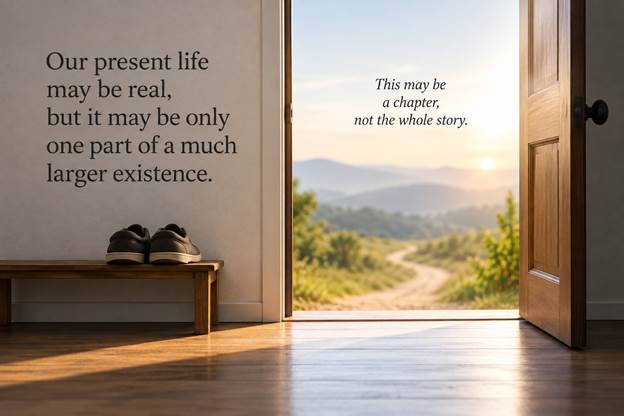
This may be one of the most important distinctions in the entire discussion. Even if there is a greater reality beyond this physical life, that does not necessarily mean this life is fake or meaningless. Perhaps “illusion” is simply the wrong word. Childhood is not an illusion because adulthood comes afterward. A classroom is not unreal because the student eventually graduates. A chapter of a book is not false simply because there are chapters before and after it.

Perhaps our physical lives are something similar. This experience may be real without being all of reality. Our bodies still matter. Pain, love and relationships matter. Our choices affect other people. What we learn and what we teach are all important to us. And if this life is temporary, perhaps that gives these things even greater value.

Living as Though This Matters

There can be a problem with believing that the physical world is somehow less than ultimate reality. Taken too far, that idea might encourage someone to think, “If none of this is permanent, why should anything matter?” I would suggest almost the opposite. If this life is one stage within a much larger existence, then perhaps what happens here matters enormously.

Maybe there are things that can only be experienced through physical life. We experience limitations because we have bodies. We experience uncertainty because we cannot see the future. We experience relationships because we appear to be separate individuals. We experience aging, loss, desire, responsibility, pleasure, pain, and choice. Most importantly, we are required to make decisions without knowing everything. Perhaps that is part of the experience.

A sunset does not become meaningless because it lasts only a few minutes. In many ways, its temporary nature makes us appreciate it more. Time with an aging parent becomes precious because we know there will not be an unlimited number of conversations. Our bodies deserve care partly because they will not remain young and strong forever. Relationships deserve attention because circumstances change. Temporary does not mean meaningless. Sometimes temporary is exactly what creates meaning.

The Value of Not Knowing

Science has not established that an individual soul existed before birth or survives bodily death. Religious traditions and philosophical systems offer possibilities, teachings, arguments, and personal experiences, but these are not the same thing as scientific proof. Perhaps it is important to admit that.

We use words such as consciousness, life, death, mind, spirit, and reality so frequently that we can begin to think we understand exactly what they mean. But do we?

We know that we are here and conscious. We know that, for some period of time, we experience existence through a human body. We know that the body eventually dies. Beyond that point, our certainty begins to fade.

Perhaps this life is the only reality we will ever experience. Maybe consciousness is entirely produced by the brain and ends when the brain stops functioning. But perhaps not. Or maybe what we call birth was not our absolute beginning, and what we call death will not be our absolute end. Maybe they are simply boundaries between different kinds of experience. While we are alive, however, we cannot step outside this existence and look back at it from somewhere else. We are inside the experience.

Like Plato’s prisoners looking at shadows, Zhuangzi dreaming of the butterfly, or a wave temporarily rising from the ocean, we can only see reality from where we presently stand. Perhaps someday there will be nothing more to discover.

Or perhaps someday we will awaken and recognize that what we confidently called “the real world” was real after all, but it was only one remarkable part of something much greater.

References

Dalal, N. (2021). Śaṅkara. In E. N. Zalta (Ed.), The Stanford encyclopedia of philosophy. Stanford University.

Guyer, P., & Horstmann, R.-P. (2026). Idealism. In E. N. Zalta & U. Nodelman (Eds.), The Stanford encyclopedia of philosophy. Stanford University.

Hansen, C. (2024). Zhuangzi. In E. N. Zalta & U. Nodelman (Eds.), The Stanford encyclopedia of philosophy. Stanford University.

Meister, C. (2023). Afterlife. In E. N. Zalta & U. Nodelman (Eds.), The Stanford encyclopedia of philosophy. Stanford University.

Moore, E. (n.d.). Plotinus. Internet Encyclopedia of Philosophy.

Siderits, M. (2011). Mind in Indian Buddhist philosophy. In E. N. Zalta (Ed.), The Stanford encyclopedia of philosophy. Stanford University.

Silverman, A. (2014). Plato’s middle period metaphysics and epistemology. In E. N. Zalta (Ed.), The Stanford encyclopedia of philosophy. Stanford University.

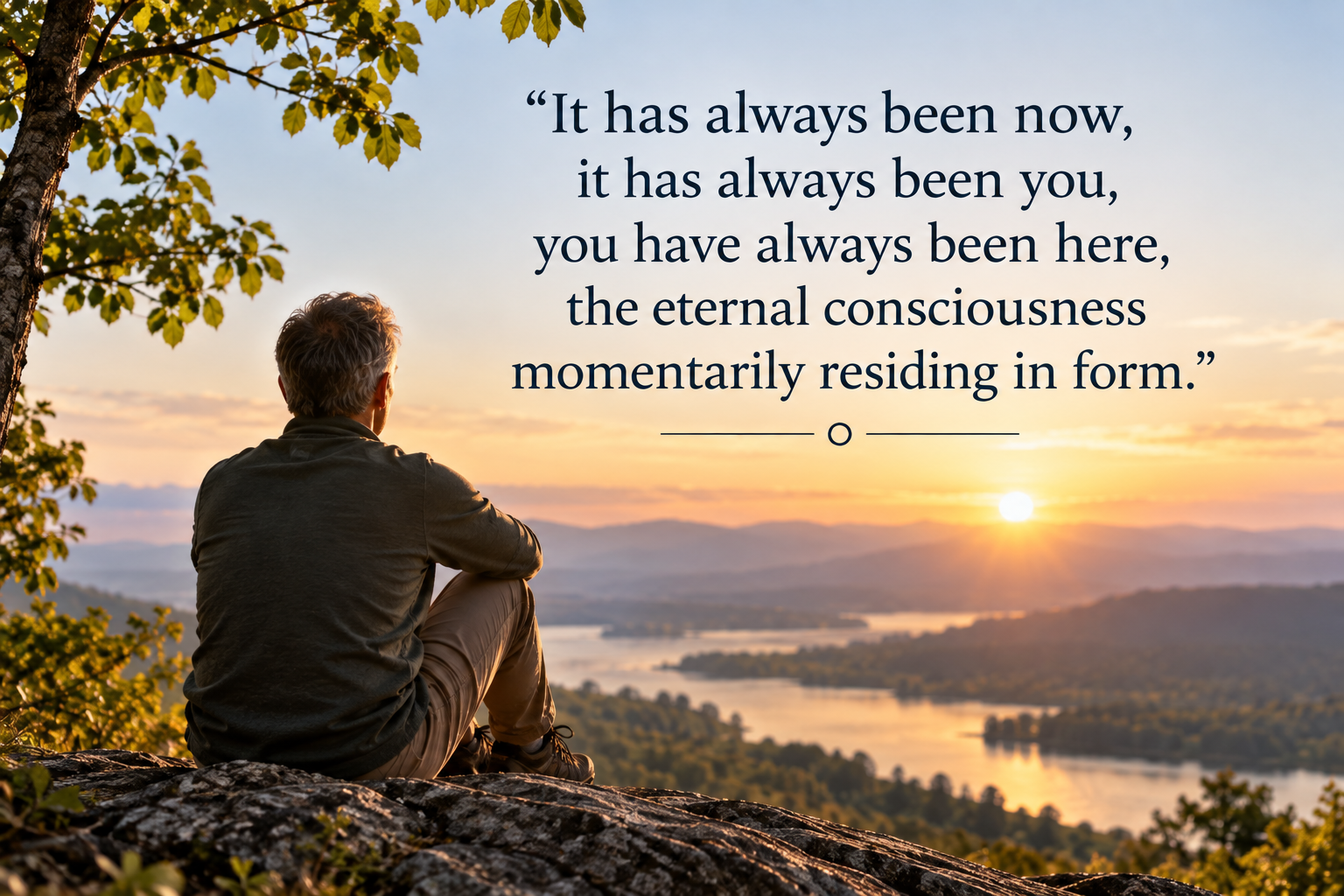
Consciousness and the Experience of Now

The Strange Reality of the Present Moment

At first, this statement may sound mysterious or overly spiritual. But there is a fairly simple idea behind it. No matter where we have been in life, how old we were, or what was happening around us, we have always experienced life in the present moment.

Think about your childhood. At the time, it was not the past. It was now. Think about something you were worried about ten years ago. At the time, the future had not yet happened. You were experiencing another now. Even when tomorrow arrives, we will not experience it as “the future.” We will experience it as the present.

In that sense, it really has always been now.

Our lives obviously unfold through time. We are born, grow older, accumulate experiences, and eventually die. Calendars and clocks are useful and necessary ways of organizing this movement. Yet our actual experience of being alive happens only in the present. The past survives largely through memory, while the future exists through anticipation, imagination, planning, and expectation. The only place where we actually experience anything is here.

This simple observation has been explored in many different ways by philosophers, spiritual traditions, scientists, and contemplative teachers. Eckhart Tolle (1999), for example, made the experience of the present moment central to The Power of Now. Buddhist and Taoist traditions have approached similar questions for centuries, although through very different philosophical frameworks.

Perhaps we do not need to understand all of those traditions to appreciate the basic point. Life is always happening now.

The Past and Future Still Matter

Recognizing the importance of the present does not mean pretending that the past and future are meaningless. Our memories help shape who we are. We learn from experience, carry relationships with us, and sometimes live with the consequences of decisions made decades earlier. Likewise, thinking about the future allows us to make plans, protect ourselves, set goals, and prepare for what may come.

The problem begins when our attention becomes so dominated by yesterday or tomorrow that we barely experience today.

Most people know what this feels like. We replay a conversation from last week, worry about something that might happen next month, regret a decision from years ago, or imagine a future problem that may never occur. Meanwhile, the body is sitting in a chair, walking through a park, eating dinner, exercising, or talking with someone we care about. The mind can travel backward and forward. The body cannot.

This is one reason practices such as meditation, Tai Chi, qigong, breathing exercises, and simple mindful movement can be useful. They bring attention back to what is actually happening. The breath, balance and body movements are happening now. The feeling of the ground beneath our feet is happening now.

For a few moments, we stop living almost entirely inside the story of our lives and return to the experience of actually living them.

What Do We Mean by “You”?

The second part of the statement, “it has always been you,” raises another interesting question: What exactly do we mean by you?

At first the answer seems obvious. I am the person with my name, body, history, personality, relationships, and my memories. All of that is certainly part of who I am.

But consider how much of that has changed.

The body you had at five years old is not the body you have today. Your beliefs have probably changed. Your knowledge has changed. Your relationships, interests, fears, abilities, and priorities may have changed dramatically. You may look at photographs from decades ago and barely recognize the person staring back at you.

And yet there is still a sense that it was you.

Something seems to connect the child, the teenager, the young adult, the middle-aged person, and the older person. We can call it identity, awareness, consciousness, or simply the continuing experience of being ourselves.

Eastern philosophical traditions have spent considerable time exploring this distinction between the changing person and the awareness experiencing those changes. Advaita Vedānta, for example, distinguishes between our temporary personal identity and a deeper level of awareness (Deutsch, 1980). Zen approaches the question differently, but it too asks us to look beyond the stories and labels we normally use to define ourselves (Suzuki, 1956).

We do not have to accept any particular spiritual explanation to find the question worthwhile. If almost everything about us changes during a lifetime, what is it that allows us to continue saying, “That was me”?

Consciousness Residing in Form

This brings us to perhaps the most challenging part of the original statement: “eternal consciousness momentarily residing in form.”

Here we move beyond what can be easily demonstrated and into philosophy, spirituality, and personal belief.

We know that human consciousness, as we ordinarily experience it, is deeply connected to the living brain and body. What science has not established is that an individual consciousness existed before the body or continues independently after death. Religious and philosophical traditions have offered many different answers to that question.

But suppose, simply as a philosophical possibility, that the body is not the whole story. Many traditions have suggested that what we call the self may be a temporary expression of something larger. Hindu traditions have explored the relationship between Atman and Brahman. Taoism describes individual forms emerging from and returning to the Tao. Christian mystical traditions have spoken about a deeper spiritual reality within ordinary human existence. These traditions differ greatly, and we should not pretend they are all saying exactly the same thing. Yet they share an interest in a similar question: Is the person we see in the mirror the entirety of what we are?

There may be no way to answer that question with certainty during our lifetime. But contemplating it can change the way we look at life.

We Are Temporary, Whatever Else May Be True

There is one part of this discussion that does not require a spiritual belief: our present physical form is temporary.

Every human body has a beginning and an end. The material that makes up our bodies existed before we did and will continue to exist after we are gone. The elements within us came from processes reaching far back into the history of the universe. As physicist Brian Greene (2004) discusses in his exploration of matter, space, and time, we are physically part of a universe that existed billions of years before our individual lives began. That alone is remarkable.

For a relatively brief period, these materials come together as us. We breathe, move and think. We love people. We become frightened. We learn and teach things. We create memories and influence other people. Also, we make mistakes. Eventually the particular arrangement we call our body changes and returns to the larger physical world. Whether consciousness continues beyond that point is a different question.

Religion may answer yes. Materialism generally answers no. Various philosophical traditions offer possibilities somewhere between those positions. Perhaps intellectual humility requires admitting that we simply do not know with certainty. But uncertainty does not make the question meaningless.

What If This Life Is One Expression of Something Larger?

If consciousness is somehow larger than our individual physical existence, then life might be understood as a temporary opportunity for consciousness to experience the world through a particular person. For these years, it sees through these eyes. It experiences the world through this body. It encounters these people, these challenges, these joys, these losses, and these opportunities. Then the form changes.

This possibility helps explain the phrase “momentarily residing in form.” Momentarily does not necessarily mean briefly in human terms. Someone may live ninety or one hundred years. But compared with the age of the universe, even a long human life is extraordinarily short.

We arrive, experience our portion of existence, and leave. What existed before and what follows afterward remain among humanity’s oldest questions.

Returning to the Present

This is where an abstract philosophical idea can become surprisingly practical. If the present moment is the only place where life is actually experienced, then learning to inhabit it more fully becomes important regardless of what we believe about consciousness, reincarnation, heaven, the soul, or death.

Meditation can bring us back to the breath. Tai Chi can bring us back to posture, balance, and movement. Qigong can bring attention to sensation and breathing. Walking can reconnect us with our surroundings. A conversation can become an opportunity to actually listen rather than prepare our next response.

None of this requires withdrawing from ordinary life. In fact, it may allow us to participate in ordinary life more completely. Presence does not mean abandoning goals or refusing to think about tomorrow. It means recognizing when tomorrow has taken over today. Likewise, it does not mean forgetting the past. It means remembering that we cannot return there. We can learn from yesterday and prepare for tomorrow while still living today.

The Eternal Now

Perhaps that is the most accessible way to understand the original statement. It has always been now.

Every moment you have ever experienced was experienced as the present. It has always been you.

Although your body, beliefs, circumstances, and personality have changed, there has remained a continuing experience of being the person living through those changes. You have always been here. Wherever your life has taken you, experience itself has always occurred from the immediate position of here and now.

And finally: Eternal consciousness momentarily residing in form.

That final idea remains a possibility rather than something we can prove. Perhaps consciousness is produced entirely by the body and ends when the body dies. Perhaps consciousness is somehow more fundamental, and the individual body provides it with a temporary form. Humanity has wrestled with these possibilities for thousands of years, and the question remains open. Maybe we do not need to solve it in order to gain something from considering it.

We are here and conscious now. We have this particular body, this particular life, these particular relationships, and whatever amount of time remains to us. If something greater exists beyond this physical life, we will eventually discover it. If it does not, then the time we have becomes even more precious. Either way, perhaps the wisest response is remarkably similar: be here for the life that is happening now.

References

Deutsch, E. (1980). Advaita Vedānta: A philosophical reconstruction. University of Hawaii Press.

Garfield, J. L. (1995). The fundamental wisdom of the Middle Way: Nāgārjuna’s Mūlamadhyamakakārikā. Oxford University Press. https://doi.org/10.1093/oso/9780195103175.001.0001

Greene, B. (2004). The fabric of the cosmos: Space, time, and the texture of reality. Alfred A. Knopf.

Suzuki, D. T. (1956). Zen Buddhism: Selected writings. Doubleday.

Tolle, E. (1999). The power of now: A guide to spiritual enlightenment. New World Library.