
One of the more interesting figures from Greek mythology is Chiron, the centaur who eventually became associated with what we now often call the wounded healer. His story has survived for thousands of years, perhaps because it touches upon something that remains very human today. Sometimes the people who are best able to help others are not those who have avoided pain, injury, disappointment, or hardship. They are the people who have experienced these things, struggled with them, learned from them, and eventually found a way to turn their experiences into something useful. This idea has always resonated with my own understanding of holistic health.
I have never been particularly comfortable with the idea that a healer is someone who simply “heals” another person. Certainly, physicians, therapists, teachers, herbalists, bodyworkers, coaches, and other practitioners can provide valuable assistance. But ultimately, much of the healing process still takes place within the individual. Someone can show us the path, provide information, offer treatment, teach exercises, recommend changes, or help us understand what may be happening. But at some point, we still have to participate in our own healing.
The story of Chiron provides an ancient metaphor for this idea.
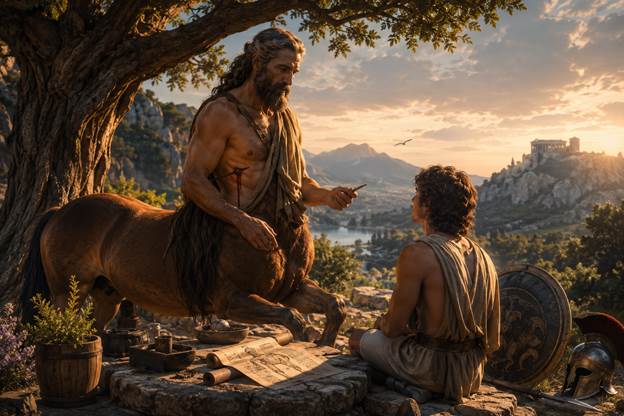
Chiron Was Different
In Greek mythology, centaurs were generally portrayed as wild and unruly creatures, part human and part horse, often representing the tension between our more rational nature and our instinctive or animal nature. Chiron was different. He was known for wisdom, medicine, music, hunting, ethics, and teaching. More importantly, Chiron became the teacher of heroes.
Among those associated with his instruction were Achilles, Asclepius, Jason, and other important figures of Greek mythology. Chiron was therefore not simply a warrior or healer. He was a mentor. His value was found largely in what he was able to awaken, develop, and cultivate in others. That distinction is important.
The greatest teacher does not necessarily create followers who remain dependent upon the teacher. A good teacher gradually makes the student more capable of standing on his or her own. In martial arts, holistic health, tai chi, qigong, fitness, meditation, or virtually any other discipline, the purpose of instruction should eventually be to increase the student’s own awareness and ability.
I can teach someone how to breathe differently, move more efficiently, improve balance, strengthen the body, manage stress, or become more aware of unhealthy habits. But I cannot breathe for that person. I cannot exercise, sleep, or make better food choices for them. And I certainly cannot practice tai chi or qigong on their behalf. At some point, knowledge has to become personal responsibility.
The Wound That Could Not Be Healed
Chiron’s story becomes particularly meaningful because the great healer himself eventually suffered from a wound that he could not heal. According to the myth, Chiron was accidentally wounded by one of Heracles’ arrows, which had been poisoned with the venom of the Hydra. Because Chiron was immortal, the wound created a terrible paradox. He possessed tremendous knowledge of healing, yet he could not completely heal himself. He could neither fully recover nor simply die from the injury. This is where Chiron becomes much more interesting as a symbol.
We often think of health in very absolute terms. Something is either healthy or unhealthy. Something is either healed or injured. A treatment either works or does not work. Yet real life is rarely that simple. Most people who live long enough accumulate a few wounds.
Some are physical. Others are emotional. Some involve relationships, careers, financial setbacks, betrayals, disappointments, failures, or simply the consequences of our own poor decisions. Aging itself gradually teaches us that the human body is not an indestructible machine.
The question then becomes not whether we can avoid every wound, but what we do with the wounds we acquire.
Healing Does Not Always Mean Erasing the Wound
This may be one of the most useful lessons we can draw from Chiron. Modern culture sometimes presents healing as though the goal is to completely erase whatever happened. We want the pain gone, the injury repaired, the stress eliminated, and the unpleasant experience forgotten. Sometimes that is possible. Sometimes it is not.
There are injuries that leave limitations. Experiences that permanently change our perspective. Losses that cannot be reversed. Bodies that change with age. Relationships that cannot be restored. Decisions whose consequences cannot simply be undone. But something can remain imperfect without becoming useless.
A person can carry a wound and still become stronger, wiser, more compassionate, and more capable. In fact, sometimes the wound becomes part of the education. This does not mean that suffering is automatically beneficial. Pain by itself does not necessarily produce wisdom. A person can experience hardship and learn very little from it. The important factor is what we eventually do with the experience.
Do we become bitter, helpless, and permanently defined by what happened? Or do we study it? Do we learn or do we adapt? And perhaps eventually, do we use what we have learned to help someone else? That is where the wounded healer becomes meaningful.
From Patient to Participant
One of the problems I see in our modern approach to health is the temptation to become passive participants in our own well-being. We develop a problem and naturally want someone else to fix it. Sometimes professional intervention is absolutely necessary. There are times when we need physicians, surgeons, medications, physical therapists, counselors, or other trained professionals. Self-responsibility should never be confused with refusing appropriate care. But professional care and personal responsibility are not opposites. They should work together.
If someone has high blood pressure, chronic stress, poor mobility, weak muscles, inadequate sleep, or unhealthy eating habits, there may be medical treatments that help. But there are also questions that belong to the individual.
What am I eating? How much am I moving? Am I sleeping well? How am I breathing? Do I respond well to stress? What habits have I developed? What am I willing to change?
Those questions bring us back to holistic health because holistic health is not simply about collecting alternative therapies. It is about recognizing that many different aspects of our lives influence one another.
The body affects the mind. The mind affects the body. Our environment affects both. Relationships, physical movement, nutrition and sleep habits all matter. Purpose and Community have effects upon us. Stress affects us too. And our daily decisions accumulate over time. None of this guarantees perfect health. Chiron himself reminds us of that.
We can do many things correctly and still become injured, sick, or eventually grow old. Self-responsibility is not the promise of immortality. It is simply the recognition that we should participate as fully as possible in the life and body we have been given.

The Healer as a Teacher
Perhaps this is why I prefer to think of the healer primarily as a teacher. A teacher does not claim ownership over another person’s healing. A teacher provides tools.
This is very similar to martial arts instruction. A teacher can demonstrate a technique hundreds of times, but eventually the student must practice it. The teacher can explain posture, alignment, timing, relaxation, breathing, and awareness. But understanding does not enter the student’s body simply because the instructor understands it.
Practice creates understanding. The same principle applies to health. Someone may explain meditation, but we still have to sit quietly. Another may explain nutrition, but we still have to choose what goes onto the plate. And still, someone else may explain exercise, but we still have to move. A teacher may teach us methods for managing stress, but eventually we have to recognize our own patterns and apply those methods when life becomes difficult. The teacher provides the map. The student still has to walk.
Chiron’s importance was therefore not simply that he possessed knowledge. It was that he passed knowledge forward.
Turning Experience Into Wisdom
As we get older, we accumulate something that younger people simply cannot acquire quickly: experience. But experience and wisdom are not necessarily the same thing.
Experience is what happens to us. Wisdom develops when we reflect upon what happened, extract something useful from it, and apply that understanding more intelligently in the future. That process can occur throughout an entire lifetime.
The injuries we recover from may teach us something about movement. Periods of stress may teach us about our nervous system. Mistakes may teach us humility. Poor decisions may improve our judgment. Difficult relationships may teach us boundaries. Aging may teach us that strength is valuable, but adaptability may be even more important.
Even our limitations can become teachers. In that sense, each of us carries a little bit of Chiron. We are all wounded in some way eventually. Hopefully, we all discover things that we cannot completely control. And we all encounter limitations. And ultimately, none of us gets out of this life alive. But that does not make our efforts meaningless. Quite the opposite. It makes what we do with the time, health, knowledge, and experience available to us even more important.
Becoming Our Own Wounded Healer
Perhaps the lasting value of Chiron is not that we should search for some extraordinary healer who possesses secret knowledge. It may suggest almost the opposite. We can seek knowledgeable teachers and accept help when it is needed while still recognizing our own responsibility within the process. Through study, practice, mistakes, adjustments, and greater attention to what our bodies and minds are telling us, experience gradually becomes understanding. A good teacher can help guide that process, but ultimately, we are the ones who must put the lessons into practice and determine how they fit into our own lives. And eventually, if we are fortunate, some of what we learn becomes useful to others.
The wound does not have to become our identity. Neither does it have to disappear before we can move forward. Sometimes it simply becomes part of the story.
Chiron could teach healing while carrying a wound of his own. There is something profoundly human in that image. We do not have to achieve perfect health before encouraging someone else to take better care of themselves. We do not have to have lived a perfect life before sharing something we have learned. And we do not have to possess all the answers before becoming useful to another person.
Perhaps the responsibility is simply to continue learning from our experiences and to use what we learn wisely. That, to me, is one of the most practical meanings behind the ancient story of the wounded healer.
We may not be able to heal every wound. But we can decide what the wound teaches us. And sometimes, what we learn while healing ourselves becomes exactly what allows us to help someone else.


