
It is often said that exercise raises blood pressure, while slow, controlled breathing calms the system and promotes relaxation. At first glance, these ideas may seem to conflict. If one elevates pressure and the other reduces it, how do they coexist within a healthy body?
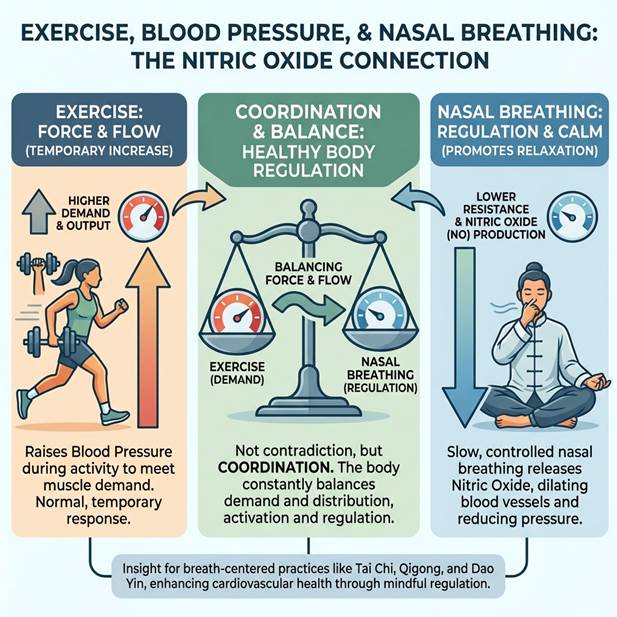
The answer lies not in contradiction, but in coordination. The human body is not simply increasing or decreasing pressure. It is constantly balancing force and flow, demand and distribution, activation and regulation.
Understanding this relationship provides deeper insight into not only cardiovascular health, but also the value of breath-centered practices such as Tai Chi, qigong, and dao yin.
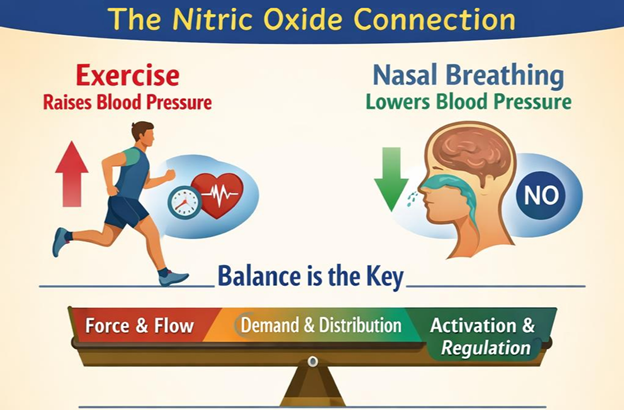
Exercise and the Temporary Rise in Blood Pressure
During physical activity, the body must meet the increased metabolic demands of working muscles. To accomplish this, the cardiovascular system responds immediately. Heart rate increases, stroke volume rises, and cardiac output expands. As a result, systolic blood pressure elevates.
In moderate aerobic exercise, systolic pressure may rise into the range of 160 to 220 mmHg, while diastolic pressure often remains stable or may even decrease slightly due to the dilation of blood vessels in active tissues (Kenney et al., 2022).
This increase is not harmful in healthy individuals. It is functional and necessary. It allows the body to deliver oxygen and nutrients more efficiently where they are needed most. Once exercise ceases, blood pressure typically returns to baseline or even drops below resting levels for a period of time, a phenomenon known as post-exercise hypotension.
Nitric Oxide: A Key Regulator of Vascular Tone
At the center of this process is nitric oxide, a simple yet powerful signaling molecule that plays a critical role in vascular health.
Nitric oxide is produced within the body through the action of nitric oxide synthase enzymes, which convert the amino acid L-arginine into nitric oxide. One of the most important forms, endothelial nitric oxide synthase, operates within the lining of blood vessels and responds to increased blood flow and shear stress during exercise.
In addition to this internal production, nitric oxide is also generated in the paranasal sinuses. Each time you breathe through your nose, small amounts of nitric oxide are drawn into the lungs along with inhaled air (Lundberg et al., 1996). This creates an interesting and often overlooked connection between breathing patterns and vascular function.
How Nitric Oxide Supports Vasodilation
Once released into the bloodstream, nitric oxide acts directly on the smooth muscle of blood vessel walls. In simple terms, it signals these muscles to relax. This relaxation causes the vessels to widen, a process known as vasodilation.
From a more technical standpoint, nitric oxide initiates a cascade that increases cyclic guanosine monophosphate (cGMP) within the smooth muscle cells, ultimately reducing their contractile tension (Moncada & Higgs, 1993). The result is decreased vascular resistance and improved blood flow.
This is not a trivial effect. It is the same fundamental mechanism used in emergency cardiac medicine through nitric oxide–donating drugs such as nitroglycerin.
Nasal Breathing Versus Mouth Breathing
This brings us to an important distinction that is often overlooked in both fitness and general health discussions.
Nasal breathing allows for the intake of nitric oxide produced in the sinuses, whereas mouth breathing largely bypasses this process. Studies suggest that nitric oxide concentrations in the nasal passages are significantly higher than in the lower airways, making the nose a meaningful contributor to nitric oxide availability (Lundberg et al., 1996).
Beyond nitric oxide, nasal breathing also:
- Filters, humidifies, and warms incoming air
- Naturally slows the rate of breathing
- Improves carbon dioxide tolerance
- Encourages parasympathetic nervous system activity
In contrast, habitual mouth breathing, particularly when rapid and shallow, is more commonly associated with sympathetic activation and less efficient respiratory mechanics (Zaccaro et al., 2018).
The Exercise Context: Pressure and Flow Working Together
When exercise and nasal breathing are considered together, a more complete picture emerges.
During exercise, the heart increases pressure to drive blood through the system. At the same time, blood vessels in active tissues dilate to reduce resistance. Nitric oxide, produced both internally and supported through nasal breathing, plays a central role in this process.
This creates a coordinated dynamic:
- Pressure increases to enhance delivery
- Vasodilation improves distribution
- Breathing helps regulate and support both
Rather than opposing forces, these mechanisms function as complementary aspects of a unified system.
A Bridge Between Physiology and Practice
For those engaged in Tai Chi, qigong, or dao yin, this relationship may feel familiar. These practices emphasize coordinated movement, controlled breathing, and internal awareness. While often described in traditional language, their effects can be understood through modern physiology.
Slow, nasal breathing combined with rhythmic movement supports vascular efficiency, enhances parasympathetic activity, and promotes long-term cardiovascular health. Over time, this may contribute to lower resting blood pressure, improved endothelial function, and greater overall resilience (Green et al., 2004).
The Takeaway
The body does not simply raise or lower blood pressure. It balances pressure and flow in response to changing demands. Exercise provides the force. Vasodilation provides the pathway. Breath provides the regulation. When these elements are aligned, the system operates efficiently and effectively.
In the end, the goal is not to eliminate stress from the body, but to learn how to work with it. Through movement, breath, and awareness, we begin to understand that health is not found in extremes, but in balance.
References
Green, D. J., Maiorana, A., O’Driscoll, G., & Taylor, R. (2004). Effect of exercise training on endothelium-derived nitric oxide function in humans. Journal of Physiology, 561(1), 1–25. https://doi.org/10.1113/jphysiol.2004.068197
Kenney, W. L., Wilmore, J. H., & Costill, D. L. (2022). Physiology of sport and exercise (8th ed.). Human Kinetics.
Lundberg, J. O., Weitzberg, E., Lundberg, J. M., & Alving, K. (1996). Nitric oxide in exhaled air. European Respiratory Journal, 9(12), 2671–2680. https://doi.org/10.1183/09031936.96.09122671
Moncada, S., & Higgs, A. (1993). The L-arginine–nitric oxide pathway. New England Journal of Medicine, 329(27), 2002–2012. https://doi.org/10.1056/NEJM199312303292706
Zaccaro, A., Piarulli, A., Laurino, M., Garbella, E., Menicucci, D., Neri, B., & Gemignani, A. (2018). How breath-control can change your life: A systematic review on psycho-physiological correlates of slow breathing. Frontiers in Human Neuroscience, 12, 353. https://doi.org/10.3389/fnhum.2018.00353


… reposted this!
LikeLike
… reposted this!
LikeLike
… reposted this!
LikeLike
… reposted this!
LikeLike
… reposted this!
LikeLike
… reposted this!
LikeLike
… reposted this!
LikeLike
… reposted this!
LikeLike
… reposted this!
LikeLike
… reposted this!
LikeLike
… reposted this!
LikeLike
… reposted this!
LikeLike
… reposted this!
LikeLike
… reposted this!
LikeLike
… reposted this!
LikeLike