
A Holistic Reflection on Credibility, Burnout, and the Modern Medical System
It is not uncommon for individuals committed to a disciplined lifestyle, regular movement, mindful nutrition, and stress management to encounter a perplexing contradiction within the modern healthcare system. Many patients report a growing sense of frustration when the very professionals advising them on weight management, exercise, and lifestyle modification appear to be struggling with those same issues themselves.
This observation raises an important question:
How should one reconcile medical advice when the messenger does not appear to embody the message?
This is not merely a personal frustration; it reflects a deeper paradox within contemporary healthcare.
The Knowledge–Behavior Gap
Healthcare professionals are extensively trained in anatomy, physiology, pathology, and disease management. They understand, often better than most, the importance of:
- Regular physical activity
- Nutrient-dense diets
- Sleep hygiene
- Stress regulation
Yet research consistently shows that knowledge alone does not guarantee behavior change. This phenomenon is often referred to as the knowledge–behavior gap and is well documented in behavioral science (Kwasnicka et al., 2016).
Even highly educated individuals are subject to:
- Decision fatigue
- Self-regulation depletion
- Emotional exhaustion
In other words, knowing what to do and having the capacity to consistently do it are two very different things.
An Unhealthy System Producing Unhealthy Outcomes
A critical factor often overlooked is the structure of the healthcare system itself.
Healthcare professionals frequently work under conditions that are inherently misaligned with health:
- Long shifts (often exceeding 10–12 hours)
- Irregular schedules and sleep disruption
- High patient volumes
- Administrative overload
- Continuous exposure to illness, trauma, and mortality
These conditions create a physiological environment characterized by chronic stress activation. Elevated cortisol levels, disrupted circadian rhythms, and prolonged sedentary behavior all contribute to metabolic dysfunction, weight gain, and declining overall health (Melamed et al., 2006; Shanafelt et al., 2015).
Thus, the issue is not simply individual failure, it is systemic.
Burnout: The Silent Epidemic Among Healthcare Workers
Burnout has become one of the most significant occupational hazards in healthcare. It is defined by:
- Emotional exhaustion
- Depersonalization
- Reduced sense of personal accomplishment
Studies suggest that a substantial proportion of physicians and healthcare workers experience burnout at some point in their careers (Shanafelt et al., 2015).
From a physiological and behavioral perspective, burnout leads to:
- Reduced motivation for self-care
- Increased reliance on convenience foods
- Decreased physical activity
- Impaired emotional regulation
What may appear externally as neglect or hypocrisy is often the visible manifestation of internal depletion.
Why Do Some Providers Appear Healthier Than Others?
Interestingly, many individuals observe that certain specialists, particularly surgeons, often appear to maintain better physical condition.
Several factors may contribute:
- Selection bias: Surgical fields tend to attract highly disciplined, performance-oriented individuals
- Cultural expectations: Physical stamina and endurance are often emphasized
- Financial resources: Greater access to high-quality food, fitness facilities, and time-saving services
- Career autonomy: Increased control over scheduling later in practice
However, it is important to note that even within these groups, burnout and stress-related disorders remain prevalent.
The Credibility Dilemma
From a holistic perspective, credibility is not derived solely from knowledge, it is also rooted in embodiment.
When a healthcare provider advises:
- “Lose weight”
- “Exercise more”
- “Reduce stress”
…yet appears to struggle with those same challenges, it can create a disconnect that undermines trust.
This tension highlights an important distinction:
Clinical Expertise vs. Personal Practice
A provider may possess:
- High-level diagnostic and medical knowledge
…while simultaneously lacking:
- Consistent personal health practices
These are not mutually inclusive domains.
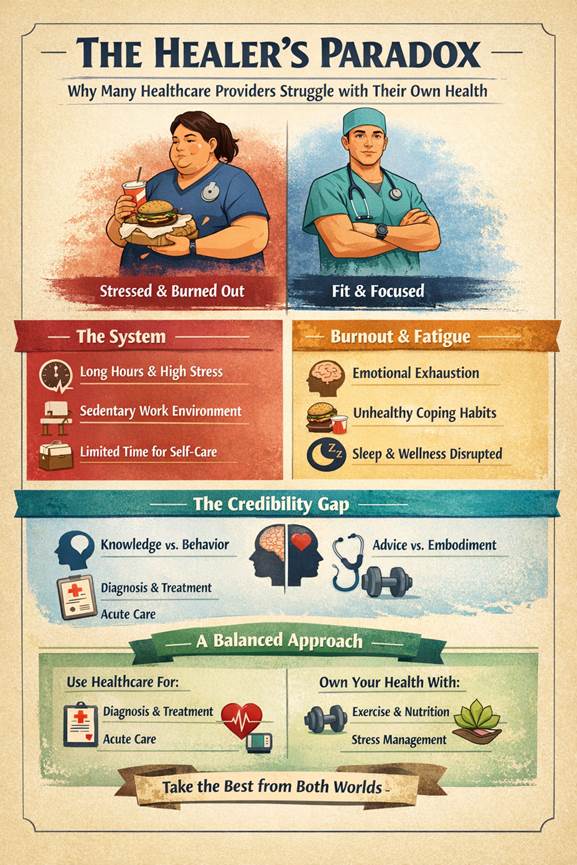
A Clash of Health Paradigms
At a deeper level, this issue reflects a broader divide between two models of health:
Conventional Medical Model
- Disease management
- Symptom control
- Pharmaceutical intervention
- Reactive care
Holistic Model
- Prevention and self-regulation
- Mind–body integration
- Lifestyle as medicine
- Personal responsibility
For individuals grounded in holistic disciplines such as yoga, tai chi, qigong, and mindful living, this divergence can feel particularly stark.
A Practical and Balanced Approach
Rather than rejecting conventional medicine outright, or accepting it without question, a more refined approach is warranted.
Utilize the Healthcare System For:
- Diagnostic testing and screening
- Acute and emergency care
- Risk assessment and monitoring
Cultivate Personal Responsibility For:
- Daily movement and exercise
- Nutritional choices
- Stress management practices
- Sleep and recovery
Seek Alignment When Possible
There is a growing field of practitioners who bridge both worlds:
- Lifestyle medicine physicians
- Integrative and functional medicine providers
- Practitioners who embody the principles they teach
Final Reflection
The apparent contradiction within healthcare providers is not simply hypocrisy. It is a reflection of:
- Human limitations
- Chronic systemic stress
- A disconnect between knowledge and lived experience
For the discerning individual, the path forward is not one of rejection, but of discernment.
Take what is useful. Question what is not. And remain rooted in practices that cultivate true health from within.
In doing so, one becomes not merely a patient within a system—but an active participant in their own well-being.
References
Kwasnicka, D., Dombrowski, S. U., White, M., & Sniehotta, F. (2016). Theoretical explanations for maintenance of behaviour change: A systematic review of behaviour theories. Health Psychology Review, 10(3), 277–296. https://doi.org/10.1080/17437199.2016.1151372
Melamed, S., Shirom, A., Toker, S., Berliner, S., & Shapira, I. (2006). Burnout and risk of cardiovascular disease: Evidence, possible causal paths, and promising research directions. Psychological Bulletin, 132(3), 327–353. https://doi.org/10.1037/0033-2909.132.3.327
Shanafelt, T. D., Hasan, O., Dyrbye, L. N., Sinsky, C., Satele, D., Sloan, J., & West, C. P. (2015). Changes in burnout and satisfaction with work-life balance in physicians and the general US working population between 2011 and 2014. Mayo Clinic Proceedings, 90(12), 1600–1613. https://doi.org/10.1016/j.mayocp.2015.08.023

 United Martial Arts Association