
More than two thousand years ago, the Greek philosopher Plato offered an allegory that remains surprisingly relevant to modern life. It was not really a story about caves, prisoners, or shadows. It was a story about perception, education, awareness, and the difficulty of questioning what we have always believed to be true. In many ways, Plato’s Allegory of the Cave is also a story about the human journey from simply accepting what we have been shown toward developing the ability to investigate, question, experience, and think for ourselves.
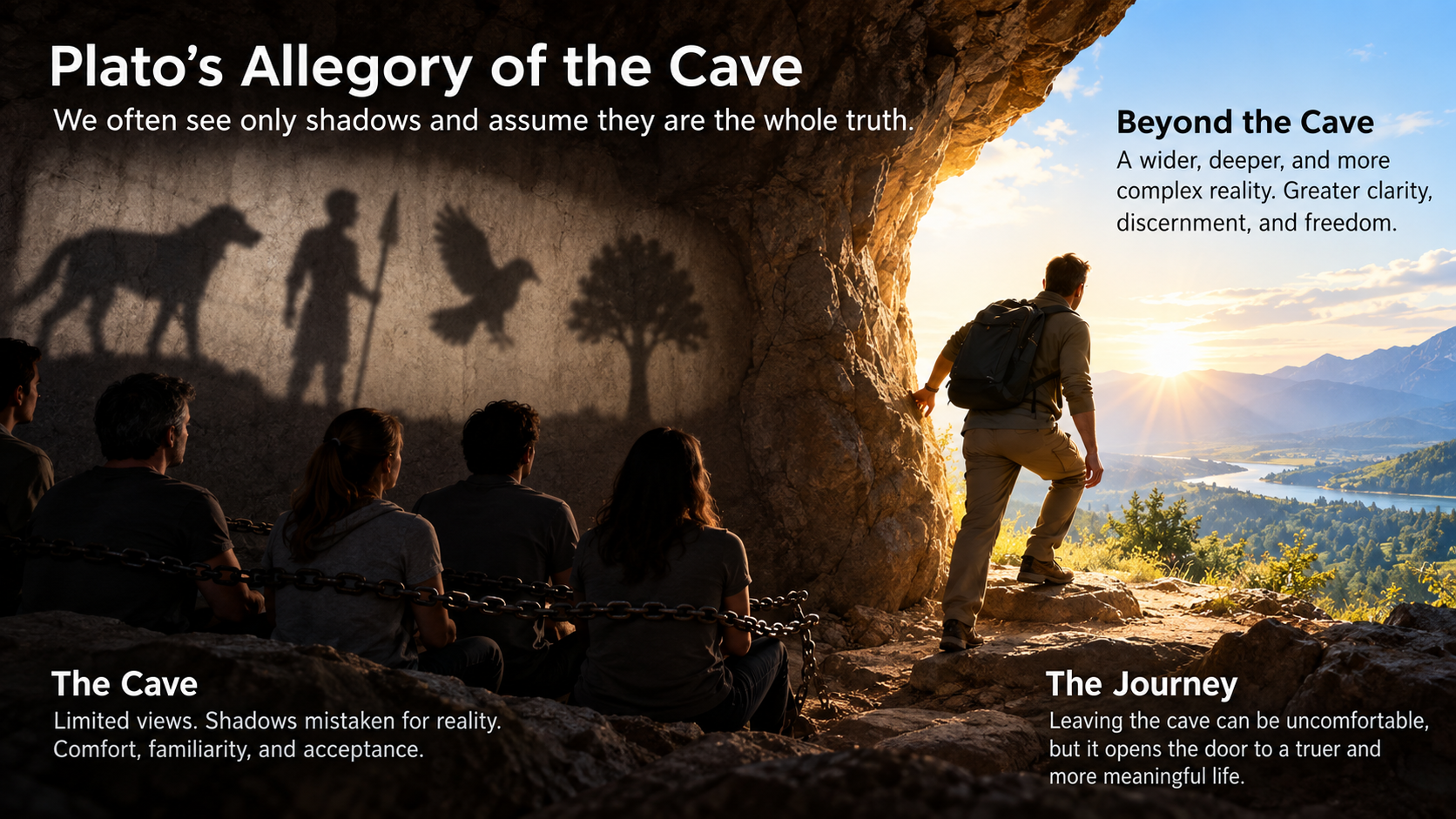
The allegory appears in Book VII of Plato’s Republic, written around 375 BCE. Plato asks us to imagine people who have lived their entire lives imprisoned inside an underground cave. They are chained in such a way that they can look only toward a wall in front of them. Behind them burns a fire, and between the prisoners and the fire other people carry various objects. The fire projects shadows of those objects onto the wall. Because the prisoners have never known anything else, they naturally assume that the shadows are reality.
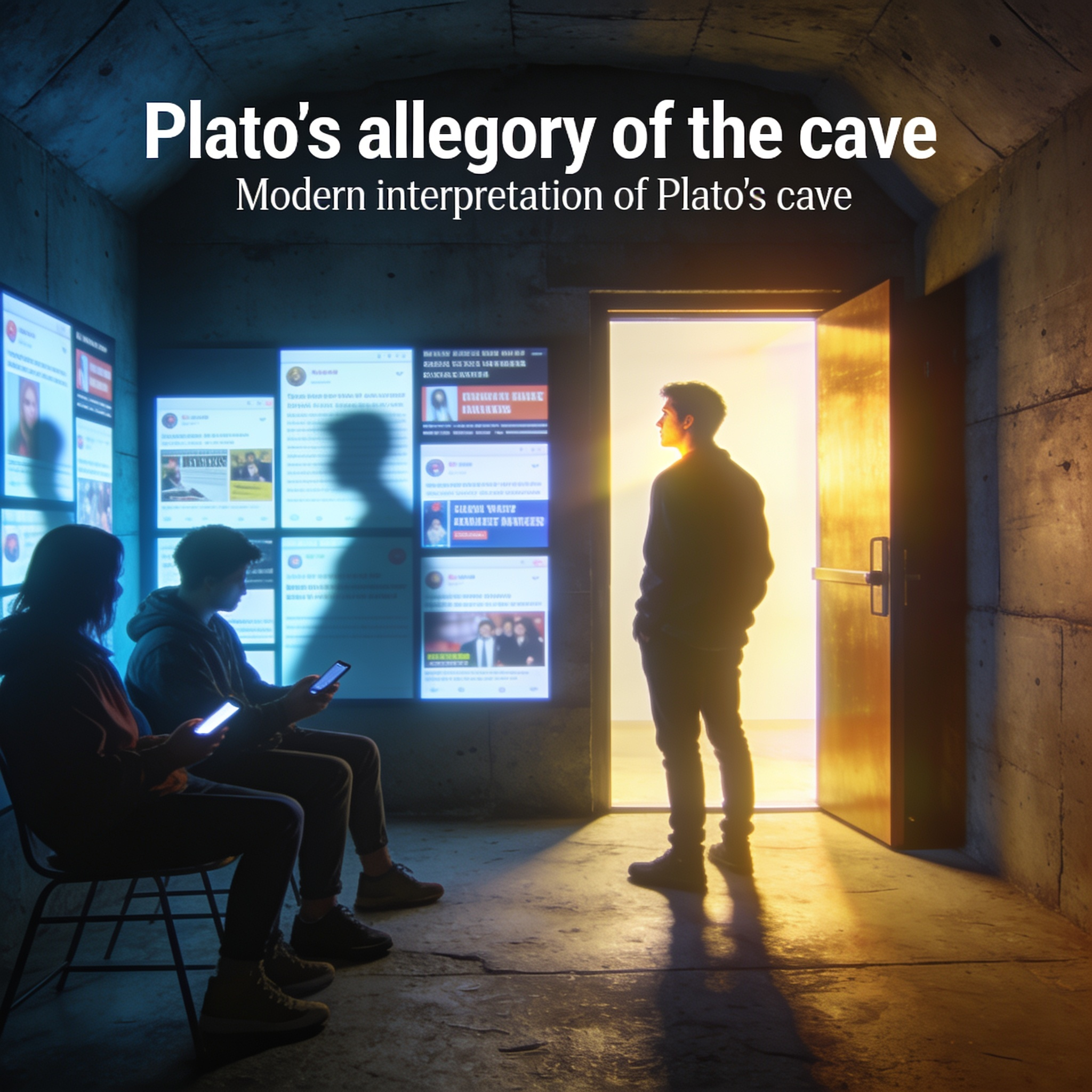
This is the part of the allegory that has always fascinated me. The prisoners are not necessarily stupid, gullible, or intentionally ignorant. From their perspective, they have evidence for what they believe. Everyone around them sees the same shadows, and the shadows have always been there. Why would they question something that appears so obvious?
Plato then asks us to imagine that one prisoner is released. At first, freedom is not particularly pleasant. When the prisoner turns toward the fire, the light hurts his eyes. Objects that created the familiar shadows appear strange and confusing. If he is eventually brought outside the cave into daylight, the experience becomes even more uncomfortable. Gradually, however, his eyes adjust. He begins to recognize reflections, physical objects, the surrounding world, and eventually the sun itself.
For Plato, this movement represented the journey from ignorance toward knowledge and philosophical understanding. Education was therefore much more than placing information into someone’s mind. Plato described it as a kind of turning of the soul, redirecting attention from appearances toward deeper understanding (Plato, trans. 1992). Modern philosophical interpretations similarly describe the cave as an illustration of the movement from imagination and belief toward reason and understanding (Internet Encyclopedia of Philosophy, n.d.).
Yet there is another part of the story that may be even more important. The freed prisoner eventually returns to the cave and attempts to explain what he has discovered. Instead of immediately welcoming his new knowledge, the other prisoners resist him. His eyes, now accustomed to daylight, initially have difficulty seeing in the darkness. To those who remained behind, this may appear to prove that leaving the cave harmed him rather than enlightened him. Plato even suggests that they might violently resist someone attempting to free them. That observation about human behavior remains remarkably recognizable.
The Caves We Build Around Ourselves
Most of us would probably like to imagine that we would be the person who walks out of Plato’s cave. Yet it may be worth considering how often we are prisoners as well. I suspect that throughout a lifetime we occupy both positions.
Our caves may be constructed from culture, family, education, religion, politics, professional training, social groups, advertising, social media, and personal experience. None of these influences are automatically harmful. Many provide valuable knowledge, structure, identity, and community. The problem begins when we stop recognizing how strongly they influence what we see.
Modern psychology provides an interesting parallel. Human perception is not simply a camera recording objective reality. Previous beliefs, expectations, attention, and experience can influence what we notice and how we interpret it (Weir, 2026). Research concerning misinformation likewise suggests that people can be less critical of information that fits comfortably within an existing worldview, while repetition and social reinforcement can make questionable information seem increasingly believable (American Psychological Association [APA], 2024).
Plato obviously knew nothing about cognitive psychology, television, smartphones, or social media, but his shadows provide a remarkably useful metaphor for them. Information now reaches us through an enormous variety of sources, including teachers, organizations, charismatic personalities, political movements, advertisements, wellness trends, and online algorithms. The lesson should not be that all these sources are deceptive. The more useful lesson is that information deserves examination rather than automatic acceptance. This applies equally to traditional wisdom and modern knowledge.
I have spent much of my life studying martial arts, holistic health, Eastern philosophy, traditional practices, and modern approaches to wellness. One lesson that becomes increasingly apparent with experience is that age does not automatically make something true, just as novelty does not automatically make something better. An ancient practice deserves investigation rather than blind reverence, while a modern scientific claim deserves understanding rather than blind acceptance. A respected teacher may possess tremendous knowledge while still being mistaken about some things. The goal is not cynicism. It is discernment.
Leaving One Cave Does Not Mean We Have Arrived
Plato’s allegory also relates closely to the idea of enlightenment, although perhaps not in the way the word is commonly used today. Enlightenment is sometimes presented as though a person reaches a particular level of consciousness and thereafter possesses some permanent superior understanding. I have never found that interpretation especially convincing.
There are moments when something suddenly becomes clear that we previously could not understand. It can feel almost as if someone turned on a light in a dark room. We recognize a pattern in our behavior, understand something a teacher tried to explain years earlier, see a relationship differently, or reconsider an old belief. These might be considered small moments of leaving the cave.
But walking out of one cave does not guarantee that we are no longer standing in another.
The person who recognizes that one teacher was wrong can become equally devoted to another. Someone who escapes one rigid ideology can adopt another. A person disappointed by conventional medicine might become overly trusting of alternative or traditional medicine, just as someone who recognizes unsupported alternative claims might become unnecessarily dismissive of useful allopathic practices.
This is one reason awareness is better understood as an ongoing practice rather than a final destination. It also fits surprisingly well with the Taoist principle of wu wei. Wu wei is often translated too simplistically as “doing nothing.” A more practical interpretation involves sensitivity to circumstances and responding appropriately without unnecessary force. To do that well requires the ability to perceive circumstances without allowing assumptions, fear, habit, or ego to completely dictate our response.
Teachers Should Help Us Turn Around
The allegory also raises an important question about the role of teachers.
Plato rejected the idea that education amounts to inserting knowledge into someone who does not possess it. Instead, education helps turn the learner toward something he or she may not previously have been able to see (Plato, trans. 1992).
That comes very close to my own understanding of teaching and even healing.
A good teacher can provide information, demonstrate techniques, offer perspectives, ask questions, correct mistakes, and point toward possibilities. But the student still has to look. The student must practice, experience, investigate, compare, and eventually make the knowledge his or her own.
The same applies to health. A physician, therapist, coach, instructor, or healer can provide valuable assistance, but ultimately we continue to live inside our own bodies. Someone can explain nutrition, but cannot eat well for us. Someone can teach movement but cannot exercise for us. Someone can demonstrate breathing practices but cannot breathe for us.
This also places a responsibility on teachers. Once people begin listening to us, it becomes easy to mistake influence for truth. A teacher who genuinely wants students to grow should encourage greater independence rather than greater dependence. If students are never permitted to question the teacher, explore other perspectives, or eventually disagree, education can quietly become another set of chains.
The Discomfort of Changing Our Minds
One of the most realistic elements of Plato’s story is that leaving the cave hurts.
We often imagine learning as an accumulation of knowledge. Sometimes it is. But some of the most important learning requires letting go of something we previously believed. Changing a long-held belief may require admitting that we misunderstood something, trusted the wrong person, followed an ineffective practice, participated in something we now view differently, or taught information that we later came to question. The greater our personal investment in a belief, the more difficult reconsideration can become. Modern psychological research supports the idea that identity and existing worldviews can strongly influence how people evaluate information and misinformation (APA, 2024).
There is no shame in having once believed something based upon the information and experience available to us at the time. The more important question is what we do when better information becomes available.
This is where personal sovereignty becomes important. Sovereignty does not mean refusing teachers, rejecting authority, or assuming that our personal opinion is always correct. That would merely replace external authority with unchecked ego. It means accepting responsibility for examining what we believe and remaining willing to modify those beliefs as experience and evidence accumulate.
We can therefore respect tradition without becoming imprisoned by it, value scientific knowledge while recognizing that scientific understanding evolves, and participate in communities without allowing belonging to replace independent thought.
Returning to the Cave
There is one final part of Plato’s allegory that deserves consideration, particularly for anyone who teaches, writes, mentors, or shares knowledge. The journey does not end when the prisoner reaches the sunlight. He returns.
For Plato, this had political implications. The philosopher who develops greater understanding has a responsibility to return to society rather than simply remaining apart from it (Internet Encyclopedia of Philosophy, n.d.). I believe there is a broader lesson here as well. Knowledge becomes more meaningful when it can be used to help others see possibilities they might not have considered.
As we accumulate experience, education, mistakes, injuries, successes, disappointments, and occasional moments of clarity, we have opportunities to share what we have learned. That does not require demanding that others accept our conclusions. Plato’s story itself warns us that people may resist perspectives that challenge the world they know. Sometimes our responsibility is simply to offer another direction in which to look.
This is one reason I continue to teach, write, study, and share what I have learned. After decades of martial arts, wellness practices, philosophy, teaching, and life experience, I certainly do not believe that I have finally escaped every cave. If anything, experience has made me more aware of how many caves there may be.
Perhaps that is one of the most valuable lessons contained in Plato’s allegory. Wisdom does not necessarily mean reaching a place where we finally possess all the answers. It may have more to do with developing the curiosity to investigate what we believe, the courage to change when necessary, and the humility to recognize that what appears obvious from where we are standing may still be only a shadow.
References
American Psychological Association. (2024, March 1). What psychological factors make people susceptible to believe and act on misinformation? https://www.apa.org/topics/journalism-facts/misinformation-belief-action
Internet Encyclopedia of Philosophy. (n.d.). Plato: The Republic. https://iep.utm.edu/republic/
Plato. (1992). Republic (G. M. A. Grube, Trans.; C. D. C. Reeve, Rev.). Hackett Publishing Company. (Original work published ca. 375 BCE)
Weir, K. (2026, July 1). Is seeing believing? How we make sense of the world around us. Monitor on Psychology, 57(5). American Psychological Association. https://www.apa.org/monitor/2026/07-08/sensory-processing-systems


