
We often hear people speak about trying to “find the right person.” Usually this refers to romantic relationships, but the same thinking can appear in friendships, business partnerships, teachers, students, coworkers, and many of the other relationships we develop throughout life. We create an image of the qualities another person should possess and then begin evaluating people according to that standard. They should be more patient, understanding, affectionate, responsible, healthy, ambitious, or perhaps simply more interested in the things that interest us.
There is nothing inherently wrong with having standards. Some people are simply not compatible, and some relationships are unhealthy or destructive. But there is another question that may be considerably more uncomfortable: Instead of spending so much time trying to find the right person, what if we spent more time trying to become the right person ourselves?
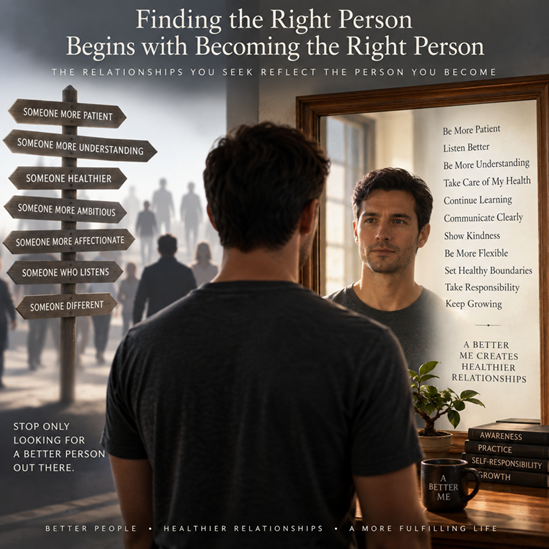
That changes the direction of our attention. Rather than continually examining what another person lacks, we begin examining what we bring into the relationship. If we want patience, how patient are we? If we want someone who listens, how well do we listen? Before demanding understanding, honesty, flexibility, affection, or respect, perhaps we should consider how consistently we demonstrate those qualities ourselves.
This is not about accepting blame for everything that happens in a relationship. It is about accepting responsibility for the portion that actually belongs to us.
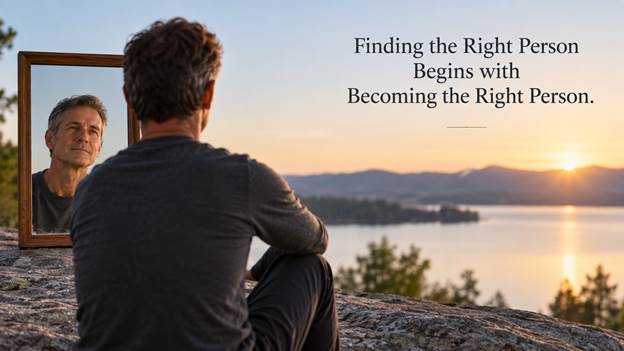
The Person in the Mirror
This idea is closely related to something I have encountered repeatedly through decades of martial arts, holistic health, Eastern philosophy, and self-awareness practices. Much of genuine training eventually turns our attention inward.
In martial arts, beginners naturally focus on the opponent. Is the other person stronger, faster, younger, or more experienced? With sufficient training, however, we begin to recognize that many of our greatest limitations are found within ourselves. Fear, unnecessary tension, impatience, ego, poor habits, and unrealistic expectations can interfere with our effectiveness as much as anything an opponent does.
Health presents a similar lesson. It is tempting to search outside ourselves for someone or something that will solve our problems. Doctors, medications, supplements, diets, exercise programs, therapists, and teachers can all provide valuable assistance, but eventually we still have to participate in our own well-being. Someone can teach us how to exercise but cannot exercise for us. Someone can explain better nutrition but cannot make our daily food choices.
Relationships also require participation. We may spend years searching for someone who satisfies our requirements while giving surprisingly little attention to whether we have developed ourselves into the kind of person such an individual would want to be around.
This requires self-awareness rather than self-criticism. Research by Breines and Chen (2012) suggests that responding to personal shortcomings with self-compassion does not necessarily encourage complacency. In their experiments, self-compassion was associated with greater motivation for self-improvement. Looking inward, therefore, does not have to mean attacking ourselves for our shortcomings. It can simply mean seeing ourselves clearly enough to recognize where growth is possible.
From Changing Others to Cultivating Ourselves
There is something distinctly Taoist about this approach. Taoist philosophy has long warned against excessive forcing and attempting to make circumstances conform to our personal desires. The principle of wu wei is often translated literally as “non-doing” or “non-action,” but its practical meaning is much richer. It suggests an ability to respond appropriately without unnecessary force or struggle.
Relationships require effort, but effort and forcing are not the same thing. We can communicate our needs, establish boundaries, encourage another person, and decide whether a relationship remains healthy. What we cannot reliably do is redesign another human being according to our specifications.
Modern psychology offers an interesting parallel through the concept of psychological flexibility, the capacity to remain engaged with present circumstances while continuing to act according to meaningful values. Rather than requiring uncomfortable thoughts, emotions, or circumstances to disappear before moving forward, psychological flexibility involves responding to them more adaptively (Macri & Rogge, 2024). In a meta-analysis examining romantic and family relationships, Daks and Rogge (2020) found psychological flexibility associated with healthier relationship dynamics, while inflexibility was associated with greater conflict and less supportive interactions.
Perhaps this is one reason relationships based on rigid expectations can become so difficult. If our happiness continually depends upon another person behaving exactly as we believe they should, we place much of our own well-being into circumstances we cannot completely control.
The Martial Arts Principle of Adjustment
One of the practical lessons of martial arts is that reality rarely behaves exactly as expected. An opponent does not necessarily move the way we practice in class. Distance, timing and balance changes. Something that worked perfectly during training may fail when circumstances change. Experience teaches us to adjust rather than stubbornly force the original technique.
Life requires much the same ability. Careers change, bodies age, families evolve, children grow up, health changes, and relationships move through different stages. The person we married twenty or thirty years ago is not exactly the same person today, but neither are we.
This does not mean abandoning our standards. It means occasionally examining where those standards came from. Some reflect deeply held values and legitimate needs. Others may have developed from insecurity, previous relationships, cultural expectations, ego, fear, or an idealized picture of what life is supposed to look like.
Self-awareness allows us to tell the difference.
Becoming What We Hope to Find
Perhaps the qualities we seek in other people can also become a curriculum for our own development. If we want someone who cares for their physical and mental health, we can work on our own. If we value curiosity, we can continue learning. If patience matters, we can practice patience. If we hope for meaningful conversation, we can become better listeners and communicators. Loyalty, kindness, independence, humor, compassion, and purpose do not have to exist merely as qualifications on a checklist for someone else.
This does not suggest that two people should become alike. Healthy relationships often benefit from differences in personality, interests, experience, and strengths. Nor does it mean that we must perfect ourselves before deserving a good relationship. No one would ever qualify.
Rather, it recognizes a simple truth: we bring ourselves into every relationship we enter.
Changing partners, friends, jobs, teachers, or communities may sometimes be appropriate, but a new environment does not automatically correct our own patterns. If the same problems repeatedly follow us into different relationships, eventually it may be worthwhile to consider whether at least part of what needs attention is traveling with us.
That can be a difficult realization, but also an empowering one. What belongs to another person remains largely outside our control. What belongs to us gives us somewhere to begin.
Acceptance Is Not Surrender
Personal responsibility should never be confused with tolerating harmful behavior. Two decent people can still be incompatible, and another person may be unwilling to communicate, compromise, or accept responsibility. More seriously, relationships can involve manipulation, coercion, addiction, violence, or abuse. No philosophy of self-improvement should be used to convince someone that if they simply become more patient, understanding, or enlightened, another person’s destructive behavior will somehow disappear.
Acceptance means seeing reality clearly. It does not mean approving everything we see. Sometimes awareness encourages patience, communication, forgiveness, and compromise. At other times, the healthiest response is a firm boundary or the decision to leave. Wu wei should not be mistaken for passivity. Appropriate action can include decisive action.
Rethinking the “Right Person”
Perhaps the phrase “finding the right person” itself deserves reconsideration. It can create the impression that somewhere there is a finished human being waiting for us, and once that individual is found, everything will finally fall into place.
Human beings do not work that way. We change throughout life, as do the people around us. A successful long-term relationship therefore involves more than finding someone who satisfies our present expectations. It involves two imperfect and evolving people learning whether they can continue to communicate, adapt, respect one another, and grow.
The search for the “right person” may therefore begin somewhere unexpected. Before looking outward and asking who meets our standards, we can occasionally turn the question around and ask what we are bringing to the people already in our lives.
Am I asking for qualities I am also willing to develop? Am I expecting another person to provide something I have neglected within myself? Are my expectations based upon genuine values, or upon an imagined version of how another person should behave?
These are not questions we answer once. They are part of the continuing process of self-awareness.
We cannot control when the right friend, partner, teacher, student, or opportunity will appear, nor can we control another person’s development. But we do have considerable influence over the person who meets them when they arrive.
Perhaps, then, instead of continually asking, “When will I find the right person?” we might occasionally ask a different question:
“Am I becoming the kind of person I would hope to find?”
The objective is not perfection. It is growth, awareness, and greater responsibility for the one human being we have the greatest opportunity to influence: ourselves.
References
Breines, J. G., & Chen, S. (2012). Self-compassion increases self-improvement motivation. Personality and Social Psychology Bulletin, 38(9), 1133–1143. https://doi.org/10.1177/0146167212445599
Daks, J. S., & Rogge, R. D. (2020). Examining the correlates of psychological flexibility in romantic relationship and family dynamics: A meta-analysis. Journal of Contextual Behavioral Science, 18, 214–238. https://doi.org/10.1016/j.jcbs.2020.09.010
Macri, J. A., & Rogge, R. D. (2024). Examining domains of psychological flexibility and inflexibility as treatment mechanisms in acceptance and commitment therapy: A comprehensive systematic and meta-analytic review. Clinical Psychology Review, 110, 102432. https://doi.org/10.1016/j.cpr.2024.102432


