
Stress is not necessarily our enemy. The human stress response is one of the mechanisms that has allowed us to survive. When we encounter danger, uncertainty, or challenge, the body prepares us to respond. Heart rate and breathing may change, muscles prepare for action, and hormones such as adrenaline and cortisol help mobilize energy. The problem occurs when we rarely turn this system off.
Modern life can keep us in a state of low-level alert for long periods. Work, finances, relationships, health concerns, technology, and the feeling that something constantly requires our attention can prevent the mind and body from fully settling. We may not be running from a predator, but our nervous system can still respond as though immediate action is required.
Cortisol is sometimes dramatically described as a “death hormone,” but this is misleading. Cortisol is essential to life. The concern is what can happen when our stress response remains activated too frequently or has difficulty returning to normal. Chronic stress has been associated with problems involving sleep, cardiovascular health, immune function, mood, metabolism, and inflammation.
The Stressor Does Not Always Have to Be Present
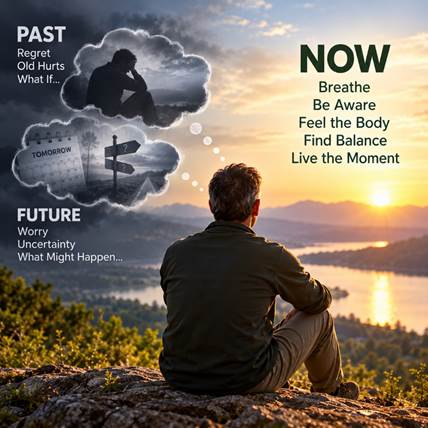
The human mind can mentally travel through time. We can remember something that happened decades ago and imagine something that might happen years from now.
I can sit safely in a chair while mentally replaying an argument from ten years ago. Nothing threatening is happening around me, yet my muscles may tighten, my breathing changes, and the emotions return. Likewise, I can imagine something going wrong tomorrow and begin experiencing some of tomorrow’s anxiety today.
The event does not need to be happening now for the body to participate in it.
At times we respond not to what is happening, but to memories, expectations, and imagined possibilities. Because the mind does not simply obey the command to “stop thinking about it,” calming the mind may begin by working through the body.
Moving, Standing and Sitting
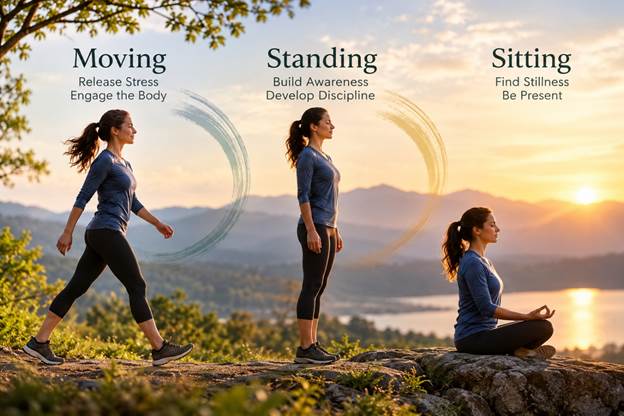
A useful approach to mind-body regulation can be found through three increasingly quieter practices: moving, standing, and sitting.
Movement is often the easiest place to begin. Walking, Tai Chi, Qigong, martial arts, stretching, swimming, and other activities can redirect attention away from repetitive thinking while helping regulate stress. When I coordinate posture, breathing, balance, and movement, awareness gradually shifts toward what my body is doing right now.
Movement also supports cardiovascular health, mobility, mood, and sleep while helping regulate physical patterns associated with prolonged stress.
Once movement becomes comfortable, standing practice introduces a different challenge. Standing still sounds easy until we attempt it with intention. In Qigong, Tai Chi, and martial arts, standing postures have long been used to develop alignment, breathing, relaxation, concentration, and body awareness.
Standing can also be understood as a form of nervous system training. Remaining upright, relaxed, aligned, and attentive requires the nervous system to continuously coordinate balance, posture, breathing, muscle tone, and sensory information. Although the body appears still, many small adjustments are continually taking place.
As we become more comfortable remaining still without unnecessary tension or immediately reacting to every sensation, we practice greater nervous system regulation. In this sense, standing can help “strengthen” the nervous system, not by making the nerves physically stronger, but by improving our ability to remain stable, adaptable, and composed under increasing demands.
An itch suddenly seems important. A muscle becomes uncomfortable. We want to move. The purpose is not to ignore genuine warning signals, but to distinguish them from ordinary restlessness. We learn that an impulse does not always require an immediate reaction. Standing therefore becomes a bridge between movement and meditation: the body remains engaged while the mind learns to become still.
Sitting introduces another level. Meditation, contemplative breathing, prayer, or simply sitting quietly allows attention to settle further. Yet when people close their eyes and expect their thoughts to disappear, the mind may seem even louder. If the body and nervous system have been stimulated all day, demanding immediate mental silence may be asking too much. Progressing from moving to standing to sitting gradually reduces activity rather than jumping directly from chaos into tranquility.
Trauma or Cultivation: Two Paths Into the Present
Sometimes life forces us into the present moment.
An accident, serious illness, sudden loss, or frightening event can instantly eliminate our usual mental wandering. We are no longer thinking about next month or replaying something insignificant from last year. Awareness becomes intensely focused on what is happening right now.
Trauma can therefore force us into the present through shock, fear, pain, or survival. This may create extraordinary clarity for a moment, but at a potentially tremendous physical and emotional cost, with effects that can continue after the danger has passed. Cultivation offers another path.
Instead of waiting for crisis to force us into the present, we can deliberately train ourselves to enter it through practice. Moving develops awareness through activity. Standing develops stability, concentration, and nervous system regulation. Sitting reduces activity further and asks us to remain with our breathing, sensations, and awareness.
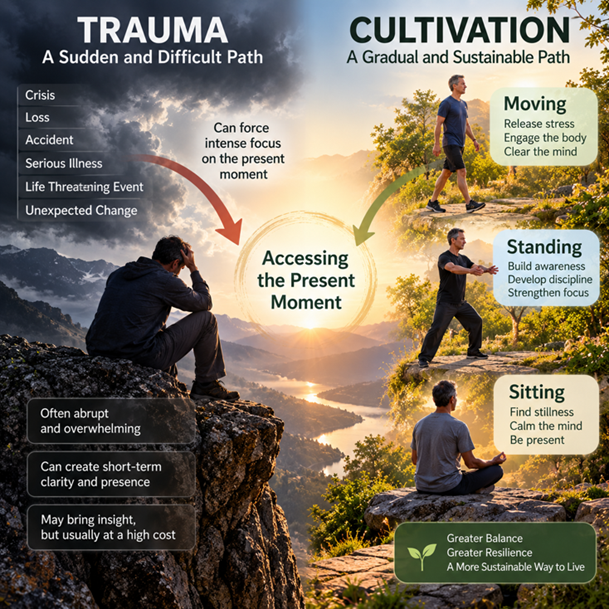
Trauma says, in effect, “You must be here now.” Cultivation teaches us, “I can choose to be here now.”
One path arrives suddenly through disruption; the other develops gradually through practice. Cultivation allows us to experience the present under relatively safe conditions. Rather than requiring a crisis to interrupt our mental habits, we practice interrupting them ourselves. It does not protect us from life’s difficulties, but it can help us develop greater stability before those challenges arrive.
Learning to Return to Now
The common thread is awareness of the present moment.
The past has already occurred. The future has not yet arrived. We can learn from one and prepare for the other, but neither is where our physical life is actually taking place. Life is occurring now.
When I become aware of my breathing, posture, footsteps, or surroundings, I give my mind something immediate to experience rather than remaining absorbed in what happened or what might happen.
This does not make the past irrelevant or future planning unnecessary. It means recognizing when our thoughts have pulled us away from the reality in front of us and learning to return.
The Mind Should Be a Tool
Our minds are powerful tools, allowing us to reason, remember, imagine, solve problems, and create. But a useful tool must sometimes be put down. If every quiet moment is filled with worry, planning, scrolling, remembering, or anticipating, we may become so accustomed to mental activity that we no longer recognize it as stimulation. Mind-body practices use breathing, posture, movement, and physical awareness to bring attention back into the body.
There is no single method that works equally well for everyone. One person may benefit from sitting meditation, while another may first need walking, Tai Chi, Qigong, or another activity. The goal is to discover what helps each individual move toward greater balance.
Creating Conditions for Recovery
Our bodies possess remarkable systems of maintenance, adaptation, and repair. Sleep, physical activity, nutrition, relaxation, social connection, and appropriate medical care support these processes. Stress management belongs within this larger picture. It cannot guarantee longevity or reverse disease, but reducing prolonged stress can support healthier functioning.
We cannot control everything around us, erase every difficult experience, or guarantee what tomorrow will bring. We can influence how we prepare ourselves to meet those circumstances.
Movement teaches us to inhabit the body. Standing teaches stability, awareness, and non-reaction. Sitting teaches us to become comfortable with stillness. Cultivation brings these together so that presence becomes something we practice rather than something a crisis must force upon us.
The objective is not to eliminate stress. Challenge is part of growth, adaptation, and life. The greater goal is to respond when action is necessary and return toward balance when it is not.
Mind-body harmony does not mean permanent calm. It means recognizing when we have moved away from balance and knowing how to find our way back.
Perhaps the simplest place to begin is where we already are: moving, breathing, standing, sitting, and learning to become more present right now.


